Tesla ownership in Dubai has grown steadily over the past few years. The Model 3, Model Y, Model S, and Model X are all present on UAE roads in meaningful numbers — and as the fleet ages and mileage accumulates, the need for proper bodywork and collision repair has become a practical reality for more owners.
Finding a proper Tesla body shop in Dubai is more complicated than finding a bodyshop for a conventional vehicle. Tesla’s construction uses aluminium-intensive structures, specific adhesive bonding methods, and panel materials that require different handling from steel-bodied vehicles. A bodyshop that repairs these correctly needs specific knowledge and equipment — not a generic approach applied to a premium-badged car.
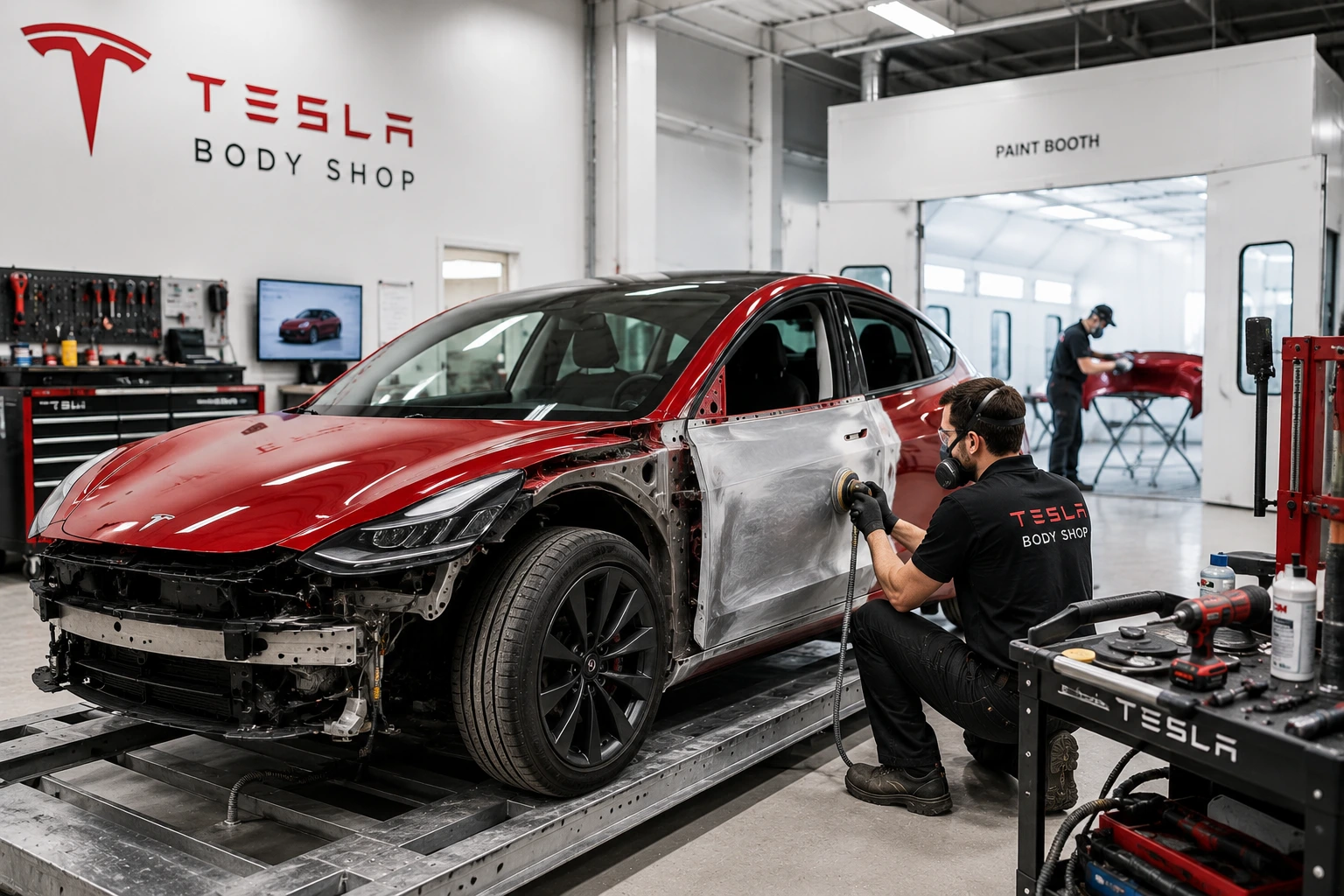
A proper Tesla body shop in Al Quoz handles collision repairs, dent removal, and paint matching with the material knowledge and preparation standards Tesla’s construction demands.
Tesla Body Shop Dubai — Why Tesla Construction Requires Specific Knowledge
Tesla vehicles use a combination of high-strength aluminium alloys, ultra-high-strength steel, and structural adhesives alongside conventional welding. The Model S and Model X use extensive aluminium spaceframe construction. The Model 3 and Model Y use a mixed-material approach with aluminium at the front and rear and steel in the central structure.
This material mix creates specific collision repair requirements that a standard steel-focused bodyshop doesn’t always handle correctly.
Aluminium doesn’t behave like steel under impact — it deforms differently and doesn’t tolerate being straightened repeatedly the way steel can be massaged back into shape. Aluminium that has been significantly deformed in a collision is often better replaced than straightened, because the material’s crystalline structure changes under the forces involved in pulling.
A Tesla body shop technician who understands aluminium repair correctly assesses whether a deformed aluminium component can be straightened to within specification or requires replacement — rather than applying steel panel straightening technique to a material it doesn’t suit.
Tesla Body Shop — Understanding Tesla’s Construction by Model
Each Tesla model has a different structural approach that affects how a Tesla body shop approaches collision and bodywork repair.
Model 3 and Model Y
The Model 3 and Model Y are the most common Teslas in Dubai’s market and the models that generate the most bodywork enquiries.
These vehicles use a mixed-material body structure — aluminium front and rear substructures combined with a high-strength steel passenger cell. The front crash structure uses aluminium extrusions designed to deform in a controlled way in a frontal impact, absorbing energy before it reaches the passenger compartment.
Front End Collision Repair
A front end impact on a Model 3 or Model Y — even one that appears minor from the outside — can involve deformed aluminium crash structure members that need replacement rather than repair. The bumper cover, the front fascia, and the underlying crash structure are separate components that require independent assessment.
A Tesla body shop that replaces only what’s visibly damaged without inspecting the underlying crash structure is completing an incomplete repair. The crash structure is the component that protects occupants in a subsequent impact — restoring it correctly is a safety requirement, not a cosmetic one.
Rear Collision Repair
The rear subframe on the Model 3 and Model Y integrates the rear motor mounting points on AWD and Performance variants. A rear impact significant enough to deform the rear crash structure can affect motor mounting geometry — a Tesla body shop repair on these models should include verification that rear drivetrain alignment hasn’t been compromised by structural deformation.
Model S and Model X
The Model S and Model X use more extensive aluminium construction than the Model 3 and Model Y — and require correspondingly more specific handling in any Tesla body shop repair.
Aluminium Spaceframe Considerations
The Model S aluminium spaceframe uses specific alloy grades with specific repair procedures. Tesla’s approved repair methods for spaceframe sections specify which components are repairable, which require replacement, and which procedures are acceptable for each section.
A bodyshop that repairs an aluminium spaceframe section using technique appropriate for steel risks work-hardening the aluminium, introducing microcracks, or reducing the structural integrity of the repair below specification.
Panel Bonding and Riveting
Certain body panels on the Model S and Model X are attached using structural adhesive bonding alongside mechanical fasteners — a combination that requires specific surface preparation and cure procedures. A Tesla body shop replacing a bonded panel correctly prepares the bonding surfaces, uses the correct adhesive specification, and allows proper cure before the vehicle is returned to service.
Improper bonding preparation produces a repair that holds initially and fails progressively — often becoming visible as a panel gap that opens gradually after the repair.
Model X Falcon Wing Doors
The Model X’s falcon wing doors are a specific consideration in any Tesla body shop repair involving the rear section of this vehicle. The doors use a complex hinge mechanism with proximity sensors that control the door’s opening arc to avoid obstacles.
A rear impact on a Model X that affects door alignment requires specific attention to the hinge mechanism, the sensor calibration, and the door’s relationship to the roof structure. A bodyshop without specific Model X experience may restore the cosmetic appearance of the rear section while leaving the falcon wing door operation compromised.
Paint Repair on Tesla Vehicles
Tesla’s paint system presents specific challenges for any Tesla body shop attempting colour-matched repairs.
Tesla Paint Quality Characteristics
Tesla’s factory paint — particularly on earlier production vehicles — has been noted for thinner clear coat application than comparable premium European brands. This has two practical implications for bodywork repair in Dubai.
First, Tesla paint is less forgiving of polishing and compounding during prep work — aggressive machine polishing removes a proportionally greater percentage of the total clear coat thickness, leaving less protective clear coat over the colour layer.
Second, the thinner clear coat means paint depth measurements on Teslas read differently from European premium vehicles when assessing original versus repaired panels — a Tesla body shop technician familiar with these characteristics interprets paint depth readings correctly rather than applying European premium brand benchmarks.
Colour Matching Tesla Finishes
Tesla offers a relatively compact colour palette — Pearl White Multi-Coat, Midnight Silver Metallic, Deep Blue Metallic, Solid Black, Red Multi-Coat, and others depending on production year. Despite the limited palette, these colours present specific matching challenges.
Pearl White Multi-Coat
Pearl White Multi-Coat is Tesla’s most popular colour and one of the more challenging to match correctly. It uses a multi-layer system with a pearl mid-coat between the base and clear coat layers. Matching the depth and luminosity of the pearl layer requires the correct mid-coat formulation and the correct application technique.
A Tesla body shop that matches Pearl White by colour code alone without accounting for the multi-coat application technique produces a repair that looks slightly different from the surrounding original panels — visible as a brightness or depth variation that’s particularly pronounced in direct sunlight.
Red Multi-Coat
Red Multi-Coat uses a similar multi-layer approach to Pearl White. The red base, the mid-coat, and the clear coat each contribute to the final appearance. Repairs to Red Multi-Coat panels require the correct base formulation, the correct mid-coat application, and the correct blend zone technique to disguise the slight colour variation between new and UV-aged original panels.
Midnight Silver Metallic
Silver metallic finishes are among the most technique-sensitive colours in any Tesla body shop repair. The metallic flake orientation during spraying — controlled by spray distance, air pressure, and gun speed — determines how the colour reads at different viewing angles. Incorrect technique produces a repair that matches at one angle and shows a colour or texture variation at another.
High Voltage Safety in Tesla Body Repair
Tesla vehicles carry high-voltage battery systems that require specific safety procedures during any bodywork repair.
De-Energising Before Structural Work
Any structural repair involving cutting, welding, or significant panel manipulation requires the high-voltage system to be de-energised before work begins. Tesla’s service manual specifies the correct procedure for placing the vehicle in a state that safely isolates the high-voltage circuit.
A Tesla body shop that proceeds with structural bodywork without correctly de-energising the high-voltage system creates a genuine safety risk for the technician and the potential for high-voltage component damage that turns a bodywork repair into a battery system replacement.
Welding Near Battery Structures
The battery pack on Model 3 and Model Y sits within the floor structure of the vehicle. Welding operations near the floor pan require specific heat management to prevent thermal damage to battery cells and battery management system components.
A proper Tesla body shop understands the proximity of battery structures to repair areas and manages heat input accordingly — using heat shields, limiting welding time per area, and monitoring panel temperature to stay within safe limits for the battery components beneath.
ADAS Calibration After Tesla Body Repair
Tesla’s Autopilot and Full Self-Driving capability systems use cameras, radar, and ultrasonic sensors distributed across the vehicle — many of which are mounted in areas commonly affected by collision damage.
Camera and Sensor Recalibration
Any repair that disturbs a camera or sensor mounting position — or that replaces a component in the vicinity of a sensor — requires recalibration of the affected system. Cameras that are misaligned after a repair produce incorrect lane keeping, following distance, and obstacle detection behaviour.
A Tesla body shop that completes a front collision repair without recalibrating the forward camera and front radar returns a vehicle that looks repaired but has Autopilot systems operating on incorrect reference data.
Bumper Cover Repairs and Sensor Accuracy
Parking sensors and ultrasonic sensors mounted in bumper covers require correct positioning relative to the bumper surface after any bumper repair or replacement. A bumper cover that’s slightly inset or proud of its original position after repair affects sensor reading accuracy — parking sensors that report incorrect distances or false alerts are often a consequence of bodywork that didn’t restore sensor positioning correctly.
Combining Tesla Body Repair with Other Services
Body repair at a quality workshop is more efficient when combined with other maintenance needs.
A complete car service covering tyre rotation, brake inspection, and cabin filter replacement can be scheduled alongside body repair — both completing while the car is at the workshop. A qualified car mechanic familiar with Tesla’s electric drivetrain handles any mechanical concerns identified during the repair assessment.
For owners who need an initial assessment of collision damage before deciding how to proceed, a mobile car mechanic can attend the vehicle’s location and advise whether it’s safe to drive to the workshop or requires recovery. Proper roadside assistance ensures a collision-damaged Tesla is transported correctly — flatbed transport only, with the vehicle in Transport Mode to prevent drivetrain engagement during loading.
For ongoing paint protection after repair, professional car painting with correct Tesla colour codes and clear coat chemistry produces repairs that hold up in Dubai’s UV environment. For owners in Al Quoz and surrounding areas looking for a garage near me with specific Tesla body repair knowledge — the material competence and safety awareness required for these vehicles makes workshop selection more important than for conventional vehicles.
FAQ
Can any body shop repair a Tesla in Dubai?
Not correctly — Tesla's aluminium construction, multi-coat paint system, high-voltage safety requirements, and ADAS calibration needs require specific knowledge that a standard steel-focused bodyshop doesn't always have.
Does Tesla body repair require high-voltage system de-energising?
Yes — any structural repair involving cutting, welding, or significant panel manipulation requires the high-voltage system to be correctly de-energised before work begins.
Why is Tesla's Pearl White Multi-Coat difficult to match?
It uses a multi-layer system with a pearl mid-coat between base and clear coat — matching the depth and luminosity correctly requires the right formulation and application technique, not just the colour code.
Does ADAS need recalibration after Tesla body repair?
Yes — any repair that disturbs camera or sensor mounting positions requires recalibration of affected Autopilot and parking systems before the vehicle is returned to service.
How long does Tesla body repair take in Dubai?
Minor dent and paint repairs typically take two to three days. Structural collision repairs requiring aluminium component replacement and ADAS recalibration can take five to ten days depending on parts availability.
Conclusion
A proper Tesla body shop in Dubai combines aluminium repair knowledge, multi-coat paint matching capability, high-voltage safety procedures, and ADAS recalibration after any repair affecting sensor positions. The owners who find that workshop avoid the visible paint mismatches, the safety compromises, and the Autopilot calibration issues that result from bodywork done without Tesla-specific knowledge.
Rapid Rev Garage in Al Quoz handles Tesla body repair — collision damage, dent removal, paint matching, and post-repair calibration — with the material knowledge and safety awareness these vehicles require. Book your appointment on WhatsApp or find the workshop on Google Maps.