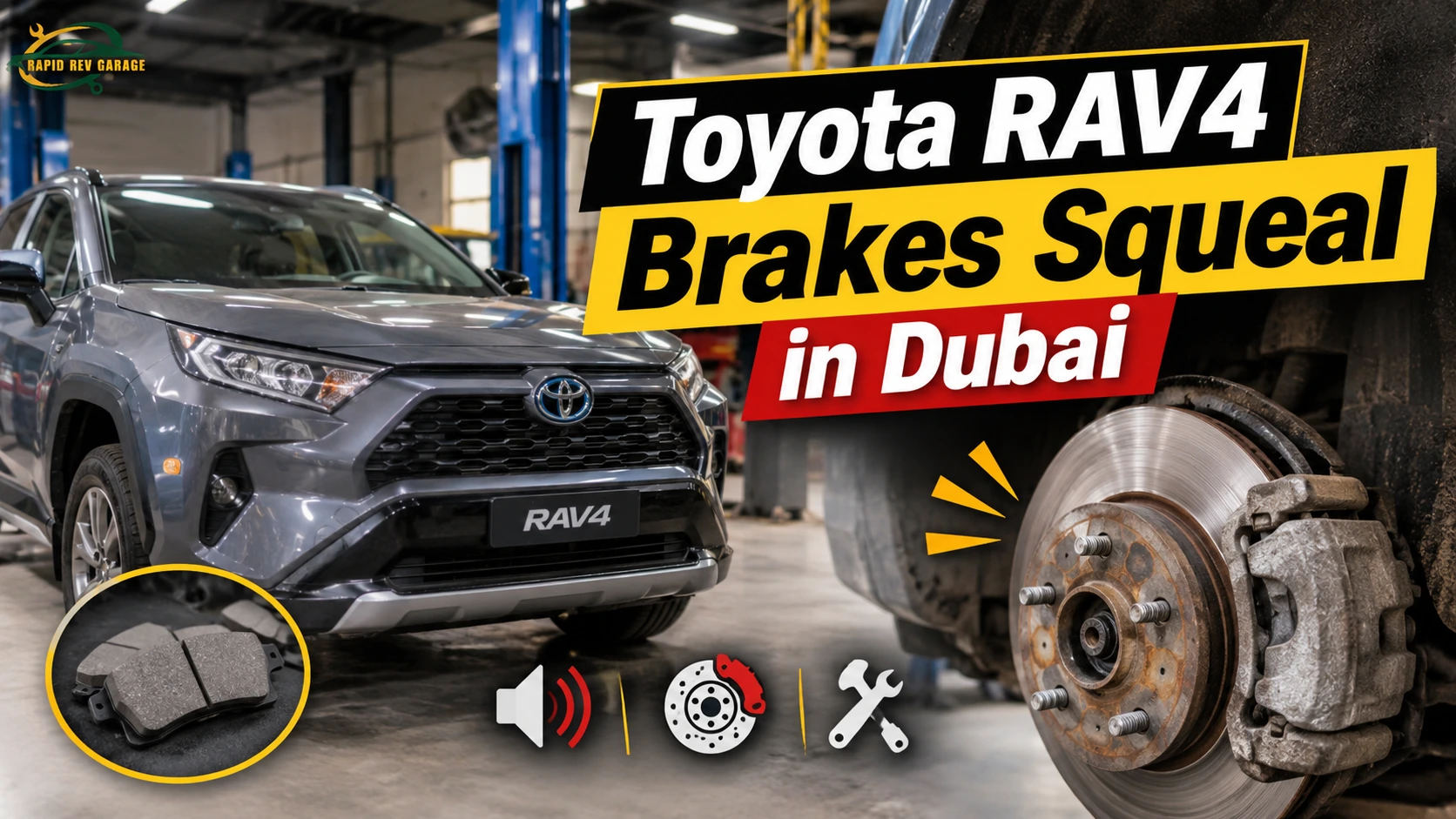
Toyota RAV4 brake squeal is one of the most common brake complaints Dubai workshops hear. Most of the time, the cause is simple, like worn pads, sand in the caliper, or a dry shim. Sometimes it is the first warning before the pads wear down to bare metal. This guide explains what each noise means, why Dubai roads make it worse, what repairs cost, and when you should stop driving.
Toyota RAV4 Brake Squeal: Quick Answer
A Toyota RAV4 brake squeal is usually caused by vibration between the brake pads and the rotors. The most common triggers are worn pads with the metal wear tab touching the rotor, pads glazed by heat, dry or missing anti-squeal shims, sand trapped in the caliper, and seized slide pins. Some 2019 to 2023 RAV4 and RAV4 Hybrid models also have a known front brake squeak covered by Toyota bulletin T-SB-0001-22. A short squeak on the first few stops of the morning is often surface rust and clears on its own. A squeal that stays, or turns into grinding, needs a wheel-off brake inspection within a few days.
Table of Contents
- What Each RAV4 Brake Noise Is Telling You
- Why Dubai Roads Make RAV4 Brakes Squeal Sooner
- The Known Front Brake Squeak on 2019 to 2023 RAV4 Models
- Why the RAV4 Hybrid Squeals Differently
- 8 Common Causes of Toyota RAV4 Brake Squeal
- How a Workshop Diagnoses the Squeal Step by Step
- Simple Checks You Can Do Before Booking
- Toyota RAV4 Brake Repair Costs in Dubai
- How Long RAV4 Brake Pads Last in Dubai Traffic
- How to Stop the Squeal Coming Back
- When Brake Noise Becomes a Safety Problem
- Why Choose Rapid Rev Garage for Toyota RAV4 Brake Squeal
- Frequently Asked Questions
What Each RAV4 Brake Noise Is Telling You
The timing of the noise is the fastest clue to what is wrong. Use this table to match what you hear to the likely cause.
| Noise | When you hear it | Most likely cause | How soon to act |
| High-pitched squeal | Light braking at low speed | Pad wear tab, dry shims, known 2019 to 2023 issue | Within a week |
| Short squeak | First 2 or 3 stops after parking overnight | Surface rust on the rotors | Normal if it clears quickly |
| Squeal in reverse | Backing out of a parking space | Pads moving in their brackets, rust ridge on rotor edge | At your next service |
| Constant squeal | Even with your foot off the pedal | Wear tab on the rotor or a sticking caliper | Within 2 to 3 days |
| Grinding or scraping | Any time you brake | Pads worn down to the steel backing plate | Stop driving and book now |
Try to work out which corner the noise comes from. Find a quiet car park, open the windows, and brake gently at walking pace. Front squeal is far more common on the RAV4 because the front brakes do most of the stopping.
Why Dubai Roads Make RAV4 Brakes Squeal Sooner
Driving in Dubai puts more heat, dust, and stop-and-go load on brakes than an average driving cycle. Four local conditions are behind most Toyota RAV4 brake squeal complaints in the city.
Sand and Brake Dust on Industrial and Desert Roads
Fine sand gets between the pad and rotor and works its way into the caliper slides. Owners who drive through Al Quoz industrial roads, construction zones, or out to the desert at weekends see this most. The sand cuts rings into the rotor face and dries out the slide pin grease, and both cause squeal.
Summer Heat and Glazed Pads
In a 45°C summer, the brakes are already warm before you press the pedal. Repeated hard stops on top of that can overheat the pad surface. The resin in the pad then hardens into a shiny glaze that slides and squeals instead of gripping.
Stop-Start Traffic on Sheik Zayed Road
A daily run from Jebel Ali to Deira can mean hundreds of brake applications. Speed bumps in areas like JVC and Al Barsha add even more. Every stop takes a little pad material off, so a Dubai RAV4 often reaches its wear tab sooner than the owner expects.
Humid Nights and Underground Parking
Coastal humidity in places like Dubai Marina leaves moisture on the rotors overnight—a thin layer of orange rust forms by morning. The first few stops scrape it off with a squeak, which is harmless as long as the noise goes away quickly.
The Known Front Brake Squeak on 2019 to 2023 RAV4 Models
Toyota has a technical service bulletin for this exact problem on the fifth-generation RAV4. Bulletin T-SB-0001-22 covers some 2019 to 2023 RAV4 and RAV4 Hybrid vehicles that squeal or squeak from the front brakes under light to moderate braking. A service bulletin is not a recall. It gives dealers a set repair procedure for a known complaint.
What to Do If Your RAV4 Falls in These Years
If your Toyota RAV4 brake squeal started on a 2019 to 2023 model, ask the Toyota dealer to check your VIN against the bulletin. Cars still under warranty normally get the bulletin repair at no cost. Out of warranty, an independent workshop can usually stop the noise by fitting quality pads with new shims, cleaning and greasing the pad contact points, and checking the rotors.
Why the RAV4 Hybrid Squeals Differently
The RAV4 Hybrid uses its electric motor to slow the car during most gentle stops. This is called regenerative braking, meaning the friction pads only take over at very low speeds or during harder stops.
Because the pads work less, rust and deposits stay on the rotors longer. The pads also do much of their work in the last few km/h before the car stops, which is exactly where squeal is loudest. That is why many hybrid owners hear the noise right as the car comes to a halt.
Is a Hybrid Squeal Worth Checking
Yes, if it lasts beyond the first few stops of the day. Hybrid pads last much longer than petrol-model pads, so slide pins can sit unused and seize without the owner noticing. A seized pin keeps one pad dragging, and that drag is a common source of Toyota RAV4 brake squeal on hybrids.
8 Common Causes of Toyota RAV4 Brake Squeal
These are the faults a mechanic finds most often when a RAV4 comes in with noisy brakes. Many cars have two or three of them at once.
1. Worn Pads Touching the Wear Indicator
Most RAV4 pads have a small steel tab built into them. When the friction material wears down to about 2 to 3 mm, the tab touches the rotor and makes a sharp squeal on purpose. It is a built-in warning that means new pads are due soon.
2. Glazed Pads and Rotors
Heat from hard braking can turn the pad surface smooth and shiny. The rotor then picks up a matching glazed layer. Light glazing can sometimes be removed by sanding the pads and skimming the rotors, but heavy glazing means it’s time for new parts.
3. Worn, Dry or Missing Anti-Squeal Shims
Shims are thin metal plates on the back of each pad that soak up vibration. Cheap pad sets often come without them, and some fitters reuse old rusty ones. Without good shims, the pad vibrates against the caliper and squeals at a high pitch.
4. Seized or Dry Caliper Slide Pins
The caliper slides on two greased pins so both pads press evenly. Sand and heat dry out the grease, and the pins start to stick. One pad then drags on the rotor, wears faster, and squeals even when you are not braking.
5. Scored or Uneven Rotors
Deep grooves, rust lips on the outer edge, and uneven thickness all stop the pad from sitting flat. The result is squeal, a pulsing pedal, or a shaking steering wheel. Each rotor has a minimum thickness stamped on it, and a rotor below that number must be replaced, not skimmed.
6. Hard or Low-Grade Replacement Pads
Some low-cost and semi-metallic pads use a harder compound that is naturally noisier. They may stop the car well but squeal at every light. Ceramic pads made for the RAV4 are usually quieter and produce less dust.
7. Sand and Debris in the Brake Assembly
Between the rotor and the dust shield behind it, a small rock or a buildup of sand can get stuck. This can cause a scraping sound that doesn’t change no matter how hard you press the pedal. Removing the wheel and cleaning the assembly usually fixes it quickly.
8. Rear Brake and Electric Parking Brake Issues
The 2019 and newer RAV4 uses an electric parking brake built into the rear calipers. If the rear pads or the motor-driven caliper stick, the rear brakes drag and squeal. Rear noise is less common than front noise, but it is often missed because people only check the front.
How a Workshop Diagnoses the Squeal Step by Step
A proper diagnosis checks all four wheels and the entire brake system, not just the pads that are making noise. Any car mechanic near me you choose should follow a process like this before quoting.
Road Test and Noise Mapping
The technician first drives the car at low speed, in reverse, and at higher speed to hear when the noise starts. This shows whether the squeal is linked to braking, steering, speed, or the parking brake.
Wheel-Off Brake Inspection
With the wheels removed, each brake part is measured and checked against Toyota limits. These five tests form the core of the inspection.
Pad Thickness Measurement
Each inner and outer pad is measured with a gauge. Most workshops recommend replacing pads at 3 mm or less, and a large difference between the inner and outer pads can point to a sticking caliper.
Rotor Thickness and Runout Check
A micrometer checks the rotor thickness in several places, and a dial gauge checks how straight the rotor spins. The pulsing and shaking that often happen with squeal are caused by runout.
Caliper Slide Pin Check
The pins are pulled out, cleaned, and checked for rust, wear, and torn rubber boots. Dry pins are greased with high-temperature brake grease, and damaged ones are replaced.
Shim and Clip Check
The technician looks at the shims, abutment clips, and anti-rattle springs. Bent, rusty, or missing hardware is one of the most common causes of Toyota RAV4 brake squeal after a cheap pad change.
Brake Fluid Moisture Test
A tester measures how much water the brake fluid has absorbed. The RAV4 uses DOT 3 fluid, and fluid above 3% moisture should be replaced because it boils sooner in summer heat.
Final Road Test After Repair
After the work, the car is road tested again to confirm the noise has gone and the pedal feels firm. New pads are also bedded in during this drive.
Simple Checks You Can Do Before Booking
A few quick checks at home help you describe the problem and judge how urgent it is.
- Look through the wheel spokes at the outer pad. If the friction material looks thinner than 3 mm, book an inspection soon.
- Note whether the noise clears after the first few stops of the day. If it does, surface rust is the likely cause.
- After a short drive, hold your hand near each wheel without touching it. A wheel that feels much hotter than the others may have a dragging brake.
- Watch the dashboard for the red brake warning light or the electric parking brake light.
- Notice any burning smell after driving, which can mean a pad is dragging.
Toyota RAV4 Brake Repair Costs in Dubai
The final price depends on your model year, pad and rotor quality, and what the inspection finds. These are typical ranges at independent workshops in Dubai, including parts and labor per axle. Dealer prices are usually higher.
| Service | Typical cost range (AED) |
| Brake clean and lubrication service | 100 to 200 |
| Front brake pads (aftermarket to OEM) | 250 to 550 |
| Rear brake pads (aftermarket to OEM) | 220 to 500 |
| Rotor skimming, pair | 150 to 250 |
| Rotor replacement, pair | 400 to 900 |
| Caliper slide pin service, per axle | 100 to 200 |
| Caliper rebuild or replacement, each | 350 to 1,000 |
Fixing a Toyota RAV4 brake squeal early is usually the cheaper option. Pads alone cost far less than pads, rotors, and a caliper together, which is often the bill when grinding is ignored. For a full breakdown of brake services, see the car brakes repair in Dubai page.
How Long RAV4 Brake Pads Last in Dubai Traffic
Front pads on a petrol RAV4 driven in Dubai traffic usually last around 30,000 to 50,000 km. Rear pads often reach 50,000 to 70,000 km. Hybrids can go much further because regenerative braking does a lot of the work.
Heavy commuting, school runs and desert trips all push those numbers down. Having the brakes checked at every regular car service is the simplest way to catch wear before the squeal starts.
How to Stop the Squeal Coming Back
Most repeat Toyota RAV4 brake squeal problems come from cutting corners on the first repair. These habits keep a RAV4 quiet for longer.
Choose Quality Ceramic Pads
Ceramic pads made for the RAV4 run quieter and make less dust than low-cost semi-metallic sets. Ask the workshop which brand and compound they are fitting before the job starts.
Replace Shims and Hardware With Every Pad Change
New clips and shims cost little compared to the pads themselves. Reusing old, rusty hardware is the main reason a car squeals a few weeks after new pads.
Bed In New Pads Properly
Bedding in lays an even layer of pad material on the rotor. On an empty road, make 8 to 10 moderate stops from about 60 km/h down to 10 km/h without coming to a full stop. Then drive for five minutes with light braking so the parts can cool.
Clean the Brakes After Desert Trips
Sand from dune driving packs into the calipers and dust shields. A quick wheel-off clean after a desert weekend stops it from scoring the rotors. If your calipers are already rusty and need refurbishing, some owners also have them finished with heat-resistant paint by a car painting specialist at the same time.
Leave More Space in Traffic
A bigger gap to the car in front lets you brake earlier and more gently. That keeps pad temperatures down and stops glazing before it starts.
When Brake Noise Becomes a Safety Problem
Some noises mean the brakes are no longer safe to drive on. Stop driving and get help if you notice any of the following:
- A grinding or metal-on-metal sound when you brake
- A soft or sinking brake pedal
- The red brake warning light staying on.
- The car pulling hard to one side under braking.
- Smoke or a strong burning smell from one wheel
In these cases, call roadside assistance rather than driving to the workshop. For lighter issues, such as a squeal that has just started, a mobile car mechanic can often check pad thickness and confirm whether the car is safe to drive.
Why Choose Rapid Rev Garage for Toyota RAV4 Brake Squeal
RAV4 owners with brakes that make noise should go to Rapid Rev Garage in Al Quoz Industrial Area 2. Since the shop mostly works on passenger cars, brake squeal is seen as a problem that needs investigation, not just a quick pad swap.
Full Brake Inspection Before Parts Are Replaced
Everything is checked, including pad thickness, the condition of the rotor, the slide pins, and the hardware. Owners are told what parts need to be replaced and what can stay. This way, they only pay for the parts their cars actually need.
Fixing the Cause Behind the Noise
A Toyota RAV4 brake squeal often comes back when only the pads are changed. Replacing shims, servicing the slide pins, and checking the rotors at the same time is what stops the noise from returning.
Easy to Reach From Main Dubai Roads
The workshop sits in Al Khail Gate, close to Al Khail Road and Sheik Zayed Road. Drivers searching for a car garage near me from Al Barsha, Business Bay, or JVC can reach it quickly.
To book a brake check, visit Rapid Rev Garage, send a photo or voice note of the noise on WhatsApp, or call or get directions on Google Maps.
Frequently Asked Questions
Q1: Why does my RAV4 squeal when braking?
Sometimes it’s because worn pads are hitting the wear tab, shims are dry or missing, pads are glazed, or there is sand in the caliper. The front brakes on models from 2019 to 2023 are known to squeak, and a Toyota bulletin talks about it.
Q2: Is RAV4 brake squeal dangerous to ignore?
On day one, a Toyota RAV4 brake squeal isn’t usually dangerous, but it is a sign that something is wrong. Not addressing the problem—which could be worn pads—can cause grinding, rotor damage, and longer stopping distances.
Q3: Why do RAV4 brakes squeak in reverse?
Most of the time, reverse squeak is caused by the pads moving slightly in their brackets or rubbing against a rust ridge on the rotor edge. Usually, new clips, greased contact points, and a rotor skim will fix it.
Q4: How much do RAV4 brake pads cost?
In Dubai, front brake pads usually cost AED 250 to 550 fitted, depending on whether you choose aftermarket or OEM. Rear pads cost slightly less.
Q5: Does the RAV4 Hybrid have brake problems?
The hybrid has no major brake defect, but its pads wear out faster because of regenerative braking. This can leave rust on the rotors and allow slide pins to seize, which can cause Toyota RAV4 brake squeal at low speed.
Q6: Why do new brake pads squeal?
New pads can squeal if they weren’t bedded in, if old shims were reused, or if the rotors weren’t skimmed or replaced. A light squeal for the first 100 to 200 km can be normal while the pads settle.
Q7: Will cleaning the brakes stop the squeal?
Cleaning helps when sand or dust is the cause, and the result is often instant. If the pads are worn or glazed, cleaning only hides the noise for a few days.
Q8: What is Toyota bulletin T-SB-0001-22?
It is a Toyota technical service bulletin for some 2019 to 2023 RAV4 and RAV4 Hybrid models with front brake squeal during light to moderate braking. It gives dealers a set repair procedure for the noise.