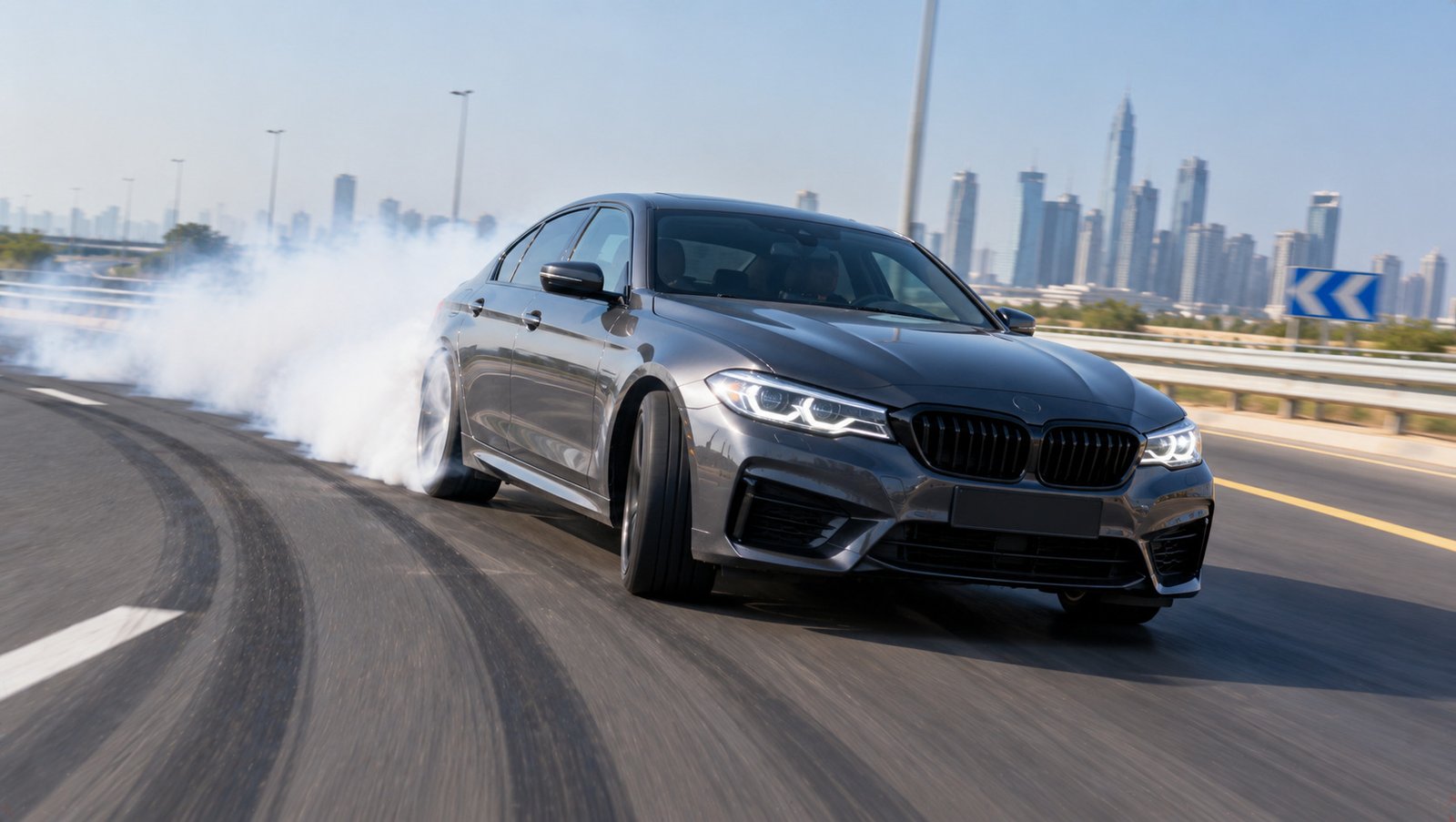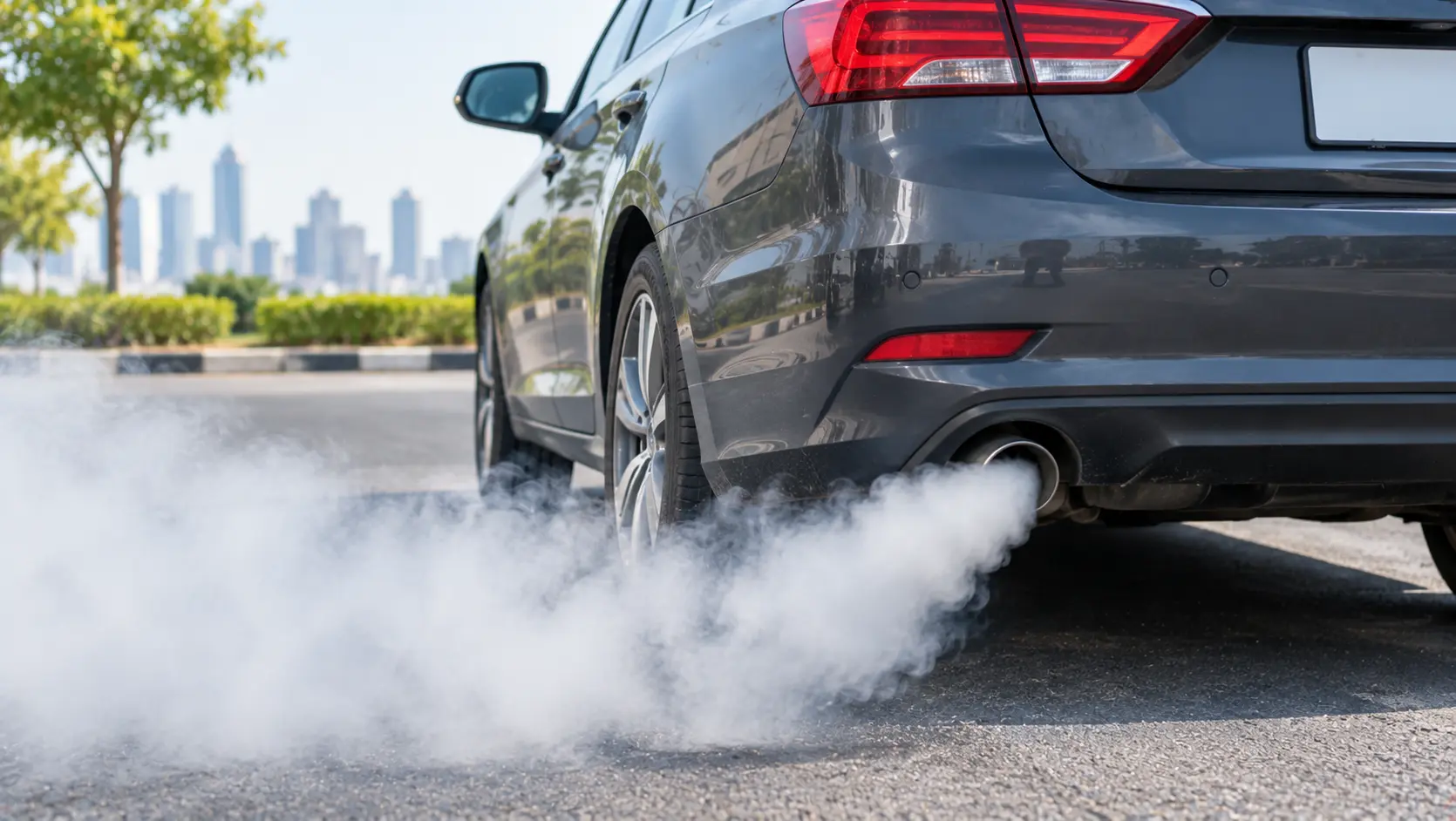
White smoke coming from exhaust signals that something other than fuel is burning in the combustion chamber. On a cold morning, a small puff of white vapour is completely normal — it is condensation in the exhaust system burning off. But sustained white smoke from a warm engine is a different matter entirely.
Sustained white smoke coming from exhaust confirms coolant is entering the combustion chamber — being burned with the fuel — and exiting as steam through the exhaust. This is a serious fault that demands immediate diagnosis. The source is almost always a failed head gasket, a cracked cylinder head, or in severe cases a cracked engine block.
In Dubai, white smoke coming from exhaust most commonly follows an overheating event — the overheating warped the cylinder head and broke the gasket seal. At Rapid Rev Garage in Al Quoz, we diagnose this with a cooling system pressure test and a combustion gas test before recommending any engine work.
White Smoke Coming From Exhaust — Quick Answer
White smoke coming from exhaust is almost always caused by coolant burning in the combustion chamber. The coolant enters through a failed head gasket — the sealing layer between the cylinder head and the engine block — that has been breached by overheating, age, or a manufacturing fault. A cracked cylinder head allows coolant to leak directly into the combustion chamber. Less commonly, a cracked engine block is the entry point. Each of these faults allows coolant to be sprayed into the cylinder during the intake stroke and burned during combustion — producing white steam from the exhaust. A sweet, glycol-like smell from the exhaust accompanies white smoke and confirms coolant combustion. Immediate diagnosis and repair is required — continued driving with coolant burning causes rapid engine damage.
Table of Contents
- Cold Morning Vapour vs Sustained White Smoke — The Difference
- How Coolant Gets Into the Combustion Chamber
- Head Gasket Failure — The Most Common Cause
- Cracked Cylinder Head
- Cracked Engine Block
- How Overheating in Dubai Causes Head Gasket Failure
- Warning Signs That Appear Before the White Smoke
- How We Confirm the Cause at Rapid Rev Garage
- The Services That Fix Each Confirmed Cause
- What Does the Repair Cost in Dubai?
- Is It Safe to Keep Driving?
- Why Rapid Rev Garage?
- FAQ
- Conclusion
Cold Morning Vapour vs Sustained White Smoke — The Difference
A small amount of white vapour from the exhaust during the first 60–90 seconds of a cold start is normal. Exhaust systems accumulate condensation overnight. This moisture burns off as the exhaust heats up — producing a brief white puff that disappears completely once the system is warm.
This is not white smoke coming from exhaust in the diagnostic sense. It disappears within a minute. It has no smell. The coolant level is unchanged. The temperature gauge reads normally.
Genuine white smoke is different. It appears after the engine is warm — when all condensation should have long since burned off. It is sustained — it continues for the duration of the drive rather than clearing after a minute. It may have a sweet smell — the glycol in the coolant has a distinctive odour when burned. The coolant level drops between drives.
If white smoke coming from exhaust appears on a warm engine and continues throughout the drive, the cause is coolant in the combustion chamber and the diagnosis needs to happen the same day.
How Coolant Gets Into the Combustion Chamber
The engine’s cooling system and combustion chambers are separated by several sealed interfaces — the head gasket, the cylinder head casting, and the engine block casting. These interfaces are under significant mechanical and thermal stress.
The head gasket is the most critical interface. It seals the junction between the cylinder head above and the block below — containing both the combustion pressure inside each cylinder and the coolant passages that run through both components.
When the head gasket fails at a coolant passage location, coolant from the cooling system can enter the combustion chamber through the breach. During the intake stroke, the piston draws coolant into the cylinder along with the air-fuel mixture. During combustion, the coolant is vaporised and exits through the exhaust as white steam.
This is the direct mechanism of white smoke coming from exhaust from a head gasket breach. Our car mechanic team performs a combustion gas test at the coolant reservoir before any engine disassembly — this test confirms whether combustion gases are present in the cooling system, which is the definitive indicator of a head gasket or head crack.
Head Gasket Failure — The Most Common Cause
The head gasket is a multi-layer steel and composite gasket that sits between the cylinder head and the engine block. It seals the combustion chambers, the oil passages, and the coolant passages simultaneously.
Head gasket failure occurs when:
The gasket material fatigues. High mileage, repeated heat cycles, and sustained high engine temperatures cause the gasket material to compress and lose its sealing force at specific points. A coolant passage seal that loses integrity allows coolant to migrate into an adjacent combustion chamber.
The cylinder head warps. Overheating causes the aluminium cylinder head to expand unevenly. This uneven expansion distorts the head surface — it is no longer flat. The gasket, trying to seal an unflat surface, fails at the points where the gap is largest.
The gasket is blown by detonation. Sustained engine knock — detonation — creates pressure spikes in the combustion chamber that exceed the gasket’s holding capacity. The gasket fails at its weakest point.
Head gasket replacement requires removing the cylinder head completely. The head surface is measured for flatness and machined if it has warped beyond the specification limit. A new head gasket is fitted with new head bolts — used head bolts are not reused, as their stretch changes their clamping force.
Cracked Cylinder Head
A cracked cylinder head is a more severe fault than a failed gasket. The crack allows coolant to enter the combustion chamber directly — without the gasket as the failure point.
Cylinder head cracks occur from thermal shock — a rapid temperature change that exceeds the metal’s ability to accommodate the expansion and contraction. In Dubai, the most common thermal shock scenario is a significantly overheated engine that is then cooled quickly — either by adding cold coolant to a hot engine, or by the cooling fan and flow resuming after sustained overheating.
A crack in the cylinder head is confirmed by pressure testing the head with the gasket removed. Compressed air applied to the coolant passages while the head is submerged in water reveals cracks as streams of bubbles.
A cracked cylinder head is replaced rather than welded in most cases. Aluminium head welding is possible but requires specialist equipment and produces a repair that is typically not as reliable as a replacement head. For any roadside emergency from an engine fault, our roadside assistance team covers Al Quoz and nearby Dubai areas.
Cracked Engine Block
A cracked engine block is the least common but most severe cause of white smoke coming from exhaust. The block is a casting — typically cast iron on older engines, aluminium on most modern engines — that forms the main structural component of the engine.
A block crack at a coolant passage allows coolant to enter the cylinder bore directly. The symptoms are identical to a head gasket failure — white smoke, coolant loss, sweet exhaust smell.
Block cracks are confirmed after head removal by pressure testing the block in the same way as the head. A cracked aluminium block is typically unrepairable at reasonable cost. Engine replacement is the correct outcome for a confirmed cracked block.
How Overheating in Dubai Causes Head Gasket Failure
Dubai’s conditions are uniquely demanding for cooling systems. Peak summer ambient temperatures of 45°C significantly reduce the cooling system’s heat rejection capacity — the temperature difference between the coolant and the ambient air is smaller, which reduces the radiator’s ability to transfer heat.
An engine that would manage peak output safely in 20°C ambient may reach critical temperature in stop-start traffic in 45°C ambient with the AC running at full load. A single overheating event — the temperature warning light, or worse the gauge hitting the red — is enough to cause the type of thermal distortion that fails the head gasket.
The white smoke coming from exhaust that appears days or weeks after a significant overheating event is the delayed consequence of the thermal damage to the gasket. The gasket was distorted during the overheating. It continued to seal marginally. Then it failed completely.
This is why a temperature warning that appeared and was ignored often results in a head gasket repair bill weeks later. For any exterior repairs needed alongside engine work, our car painting team handles colour-matched bodywork at the same visit.
Warning Signs That Appear Before the White Smoke
White smoke coming from exhaust is rarely the first sign. These symptoms typically precede it by days or weeks.
Coolant level dropping without visible leaks. The coolant is disappearing into the combustion chamber — where it is burned and exits as steam. No puddle under the car. Just a reservoir that needs topping up repeatedly.
Sweet smell from the exhaust. The glycol in the coolant has a distinctive sweet smell when burned. This smell from the exhaust appears before the white smoke becomes heavy.
White milky residue under the oil filler cap. Coolant mixing with engine oil produces a white or grey emulsion. Check the underside of the oil filler cap for this residue — it confirms coolant has entered the oil system through the breached gasket.
Engine temperature running higher than normal. A cooling system that is losing coolant into the combustion chamber has reduced coolant volume — less coolant capacity to absorb heat.
Bubbling in the coolant reservoir. Combustion gases entering the cooling system through the head gasket breach produce bubbles in the coolant reservoir when the engine runs.
How We Confirm the Cause at Rapid Rev Garage
Combustion gas test. A chemical test strip or block-check fluid is applied to the coolant filler neck with the engine running. The fluid changes colour if combustion gases are present in the cooling system — confirming a head or block breach. This is the definitive test. It confirms the fault before any disassembly.
Cooling system pressure test. The system is pressurised to its specified pressure and monitored. Pressure that drops confirms a leak — either external or internal into the combustion chamber.
Oil condition check. The oil is inspected for the milky emulsion that confirms coolant contamination through the breached gasket.
Cylinder compression test. A cylinder with significantly lower compression than the others — or one that shows pressure loss when the combustion gas test confirms coolant entry — identifies the specific cylinder where the breach is located.
Head removal and inspection. After confirmation, the head is removed and both the gasket and the head surface are inspected for the breach location and the extent of warping.
The Services That Fix Each Confirmed Cause
Head gasket replacement. Head removed, head surface measured for flatness and machined where necessary, new multi-layer steel gasket fitted with new head bolts, cooling system flushed. AED 2,500–7,000 depending on the engine and whether head machining is required.
Cylinder head replacement. Confirmed cracked head replaced with a remanufactured or new head. New gasket and head bolts fitted. AED 3,500–10,000 depending on the vehicle.
Engine replacement. Where a cracked block or severe internal damage makes a rebuild uneconomical. AED 6,000–25,000 depending on the vehicle and engine type. Our car service packages include a cooling system and combustion integrity check at every major service for vehicles over 80,000 km. Our mobile car mechanic covers Al Quoz and nearby Dubai areas for on-site initial assessment and combustion gas testing. Our garage near me in Al Quoz serves drivers from Business Bay, Jumeirah, Barsha, Satwa, Downtown, and the Sheikh Zayed Road corridor.
What Does the Repair Cost in Dubai?
| Service | Cost Range |
| Head gasket replacement | AED 2,500–7,000 |
| Cylinder head replacement | AED 3,500–10,000 |
| Engine replacement | AED 6,000–25,000 |
All costs confirmed after combustion gas test, compression test, and head inspection.
Is It Safe to Keep Driving?
No. A vehicle with white smoke coming from exhaust from coolant combustion should not be driven further than necessary to reach a workshop.
Coolant entering the combustion chamber is progressively damaging the engine. Coolant is not a lubricant — the cylinder walls and piston rings are being exposed to a fluid that causes corrosion rather than protection. Continued driving accelerates cylinder wall scoring and piston ring damage beyond what the head gasket repair alone would address.
A vehicle with white smoke should be assessed within 24 hours. If driving is necessary, stop immediately if the temperature gauge moves above normal — further overheating with a breached gasket causes catastrophic engine damage very quickly.
Why Rapid Rev Garage?
White smoke coming from exhaust is confirmed by the combustion gas test — not by the appearance of the smoke or the driver’s description alone. A positive combustion gas test before any disassembly tells us the fault is a breach between the cooling system and the combustion chamber. The head removal then identifies exactly where and how.
We do not recommend head gasket replacement based on symptoms alone. We confirm the breach first, then assess the head for warping before quoting any repair.
FAQ — White Smoke Coming From Exhaust
Here are the questions Dubai drivers ask us most about white exhaust smoke.
Is white exhaust smoke always serious?
Cold-start vapour that clears within a minute — not serious. White smoke on a warm engine that continues throughout the drive — always serious. The key distinction is whether the smoke persists after the engine reaches operating temperature.
Can I use a head gasket sealer instead of replacing the gasket?
Chemical sealers can temporarily close minor breaches in a head gasket. They are not a permanent repair. On a warped head — which is the most common cause of gasket failure after overheating — no sealer can restore the flat sealing surface. Sealer is a temporary measure to allow the vehicle to be driven to a workshop, not a repair.
How do I know if the coolant is mixing with the oil?
Check the underside of the oil filler cap. A white, creamy emulsion on the cap confirms coolant has mixed with the engine oil. Also check the dipstick — contaminated oil appears greyish or milky rather than the normal brown or black.
Why does white smoke smell sweet?
Ethylene glycol — the base component of coolant — produces a distinctive sweet smell when burned. This is different from burning oil, which smells acrid, and from normal exhaust, which smells of combustion gases. The sweet smell confirms it is coolant burning, not oil.
Can overheating cause white smoke even if the car seems fine now?
Yes. A single overheating event can warp the cylinder head slightly — enough to begin a slow gasket breach that takes weeks to develop into visible white smoke. If the car overheated at any point in the past few months and white smoke has now appeared, the overheating was the trigger for the gasket failure.
Conclusion
White smoke coming from exhaust on a warm engine confirms coolant is burning in the combustion chamber. The cause is a breach in the head gasket, a cracked cylinder head, or a cracked engine block. In Dubai, overheating from sustained stop-start traffic in 45°C summer conditions is the most frequent trigger.
Rapid Rev Garage in Al Quoz confirms every white smoke coming from exhaust complaint with a combustion gas test before any engine disassembly — then repairs or replaces only what the confirmed fault requires.
Rapid Rev Garage is in Al Quoz, serving Business Bay, Jumeirah, Downtown, Barsha, Satwa, and the Sheikh Zayed Road corridor. Book your appointment on WhatsApp or find us on Google Maps.
Rapid Rev Garage — White Smoke Coming From Exhaust | Al Quoz, Dubai