Your engine communicates before it fails. A knock here, a warning light there, a trail of oil on your parking space — these are not random events. They are specific signals that something has changed mechanically and that your car’s engine needs repair before the problem escalates into something far more expensive.
If you’re based in Dubai, that urgency is real. Sustained heat above 45°C, stop-start traffic, and short daily commutes create conditions that accelerate engine wear faster than any temperate-climate service schedule accounts for. Catching any of the 15 signs below early is what separates a manageable repair from a complete engine rebuild.
At Rapid Rev Garage, our specialist engine repair in Dubai team diagnoses these faults with multi-module scanning before recommending any repair — every time.
When Your Engine Needs Repair
Your engine needs repair if you notice any of the following: a persistent check engine light, unusual knocking or tapping sounds, excessive smoke from the exhaust, oil leaks under the car, loss of power during acceleration, rough or unsteady idle, overheating, hard starts, increased fuel consumption, or a burning smell from the engine bay. In Dubai’s heat, these symptoms develop faster and escalate more quickly than in cooler climates. Book a diagnostic inspection as soon as any symptom appears.
When your engine needs repair, the cause is almost always a system of interdependent components — pistons, valves, timing chains, bearings, seals, and sensors — all working together within tight tolerances. When one component begins to fail, it places additional load on the components around it. A worn piston ring that allows oil into the combustion chamber, for example, causes blue smoke from the exhaust, fouls the spark plugs, and gradually contaminates the catalytic converter. What started as a seal issue has now affected three other systems.
This is why early diagnosis matters more than the initial symptom suggests. The 15 signs below are your engine’s early warning system — and in Dubai’s climate, each one warrants a same-week inspection rather than a wait-and-see approach.
The 15 Signs Your Engine Needs Repair — Full Guide
Here are all 15 warning signs, grouped by category, with the specific cause each one usually points to.
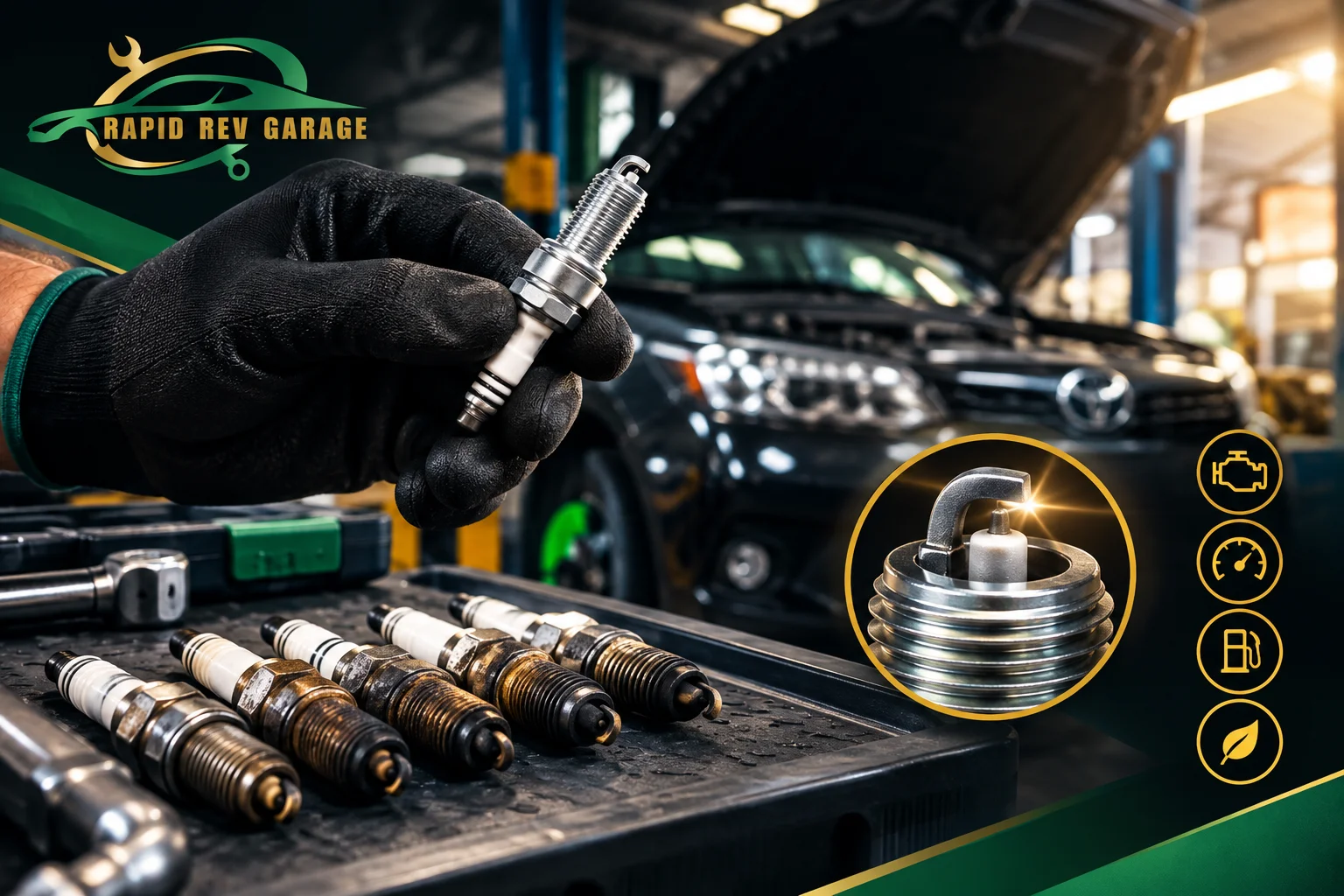
Engine Needs Repair — Warning Signs You Can See
The most obvious signals are often visual. Your engine communicates through its exhaust, its fluids, and the space beneath where you park.
Sign 1: Check Engine Light Is On
The check engine light covers a wide range of faults — from a loose fuel cap to a failing oxygen sensor to a serious engine management issue. A light that stays on steadily warrants a diagnostic scan within the week. A light that flashes while driving is more urgent and means pull over when it’s safe to do so, since flashing usually indicates an active misfire that can damage the catalytic converter.
Sign 2: White Smoke From the Exhaust
White smoke that persists beyond the first 30 seconds of a cold start almost always indicates coolant entering the combustion chamber — either through a blown head gasket or a cracked cylinder head. This is one of the most serious symptoms on this list. Continuing to drive means progressively losing coolant into the engine and risking a seized engine from overheating.
Sign 3: Blue Smoke From the Exhaust
Blue or blue-grey smoke is burning engine oil. On higher-mileage engines, worn piston rings allow oil to bypass the rings and enter the combustion chamber. Worn valve stem seals produce the same symptom but more noticeably on cold starts and during deceleration. Either way, the engine is consuming oil faster than it should and the root cause needs addressing before bearing damage follows.
Sign 4: Black Smoke From the Exhaust
Black smoke indicates a rich fuel mixture — too much fuel, not enough air. Common causes include a faulty MAF sensor, clogged air filter, stuck fuel injector, or a failing oxygen sensor giving incorrect feedback to the engine management system. Black smoke is usually less immediately catastrophic than white or blue, but it signals a fuelling fault that affects performance and fuel economy and gets worse over time.
Sign 5: Oil Puddle Under the Car After Parking
Finding oil on the ground where you park is confirmation of an active engine oil leak. Common sources include the valve cover gasket, oil filter housing gasket, cam seals, and rear main seal. The size of the puddle matters — a small spot is an early-stage leak worth addressing promptly. A large puddle or a trail means the leak rate is high enough to risk low oil pressure on the next drive.
Engine Needs Repair — Sounds That Mean Something Specific
Unusual sounds are among the most reliable early indicators that something has changed internally — and each type of sound points to a different component.
Sign 6: Knocking or Knocking Sound From the Engine
A deep, repetitive knocking from the engine — often described as a “rod knock” — is one of the most serious sounds on this list. It indicates bearing wear, typically on the connecting rod bearings that connect the pistons to the crankshaft. Low oil pressure, extended oil change intervals, or oil that has degraded beyond its service life all accelerate this wear. A rod knock that’s ignored leads to catastrophic engine failure.
Sign 7: Tapping or Ticking Sound at Idle
A light tapping or ticking that’s faster than the engine’s RPM and particularly noticeable at idle is usually a valve train issue — low oil pressure reaching the valve lifters, collapsed hydraulic lifters, or on timing chain-equipped engines, a worn timing chain tensioner losing hydraulic pressure overnight. The cold-start rattle that disappears within 10–15 seconds is this tensioner symptom specifically.
Sign 8: Rattling Sound During Acceleration
A rattling that appears specifically during acceleration and fades at steady speed often points to carbon buildup in the combustion chamber — detonation, sometimes called pinging — or in some cases a loose heat shield near the exhaust manifold. On direct-injection engines common in Dubai’s European car market, carbon buildup on intake valves causes exactly this kind of acceleration roughness.
Our car mechanic team identifies the specific source of any engine noise through live data review and physical inspection before any repair is recommended.
Engine Needs Repair — How the Car Feels to Drive
Beyond what you see and hear, changes in how the car responds under your hands and feet are equally important signals.
Sign 9: Loss of Power During Acceleration
An engine that used to accelerate smoothly and now feels sluggish, hesitates, or surges during acceleration has a fuelling, ignition, or compression issue. Clogged fuel injectors, a failing fuel pump, worn spark plugs, or a MAF sensor fault all produce this symptom. Low compression from worn rings or a failing valve is the more serious underlying cause, confirmed through a cylinder compression test.
Sign 10: Rough or Unsteady Idle
An engine that shakes, vibrates, or produces an irregular RPM while idling — rather than sitting at a smooth, consistent 700–800 RPM — almost always has a cylinder that isn’t contributing evenly to the engine’s output. A misfire, a vacuum leak, a failing idle control valve, or an injector that isn’t delivering properly all produce this. The diagnostic scan reads live misfire counters per cylinder to identify exactly which one.
Sign 11: Hard Starting or Extended Cranking
An engine that cranks for several seconds before firing, or that needs multiple attempts to start, has a fuelling, ignition, or compression issue preventing normal combustion. In Dubai’s heat, battery weakness is also a factor — a battery at reduced capacity can’t spin the starter at the speed needed for reliable ignition. Our car service packages include battery load testing at every visit specifically for this reason.
Sign 12: Sudden Increase in Fuel Consumption
A car that’s noticeably using more fuel than it used to — verified over several fill-ups rather than a single observation — is an engine that isn’t burning fuel efficiently. Faulty oxygen sensors, clogged fuel injectors, a dirty air filter, or misfiring cylinders all reduce combustion efficiency and force the engine management system to compensate by adding more fuel.
Engine Needs Repair — Temperature and Smell Warning Signs
Heat and smell are two of the most urgent warning channels — by the time either appears, the fault is often already advanced.
Sign 13: Engine Overheating
A temperature gauge that climbs into the red, an overheating warning on the dashboard, or steam from the engine bay means stop driving immediately. Continuing past an overheating warning risks warped cylinder heads, blown head gaskets, and potentially a seized engine — all significantly more expensive than whatever caused the overheating in the first place. Common causes in Dubai include a failing thermostat, a clogged radiator, a leaking water pump, or low coolant from a slow leak.
For immediate assistance with an overheating engine on the road, our roadside assistance covers Al Quoz and nearby Dubai areas.
Sign 14: Burning Smell From the Engine Bay
A burning smell while driving or immediately after stopping can mean several things depending on the specific odour. A sweet, slightly chemical smell is coolant — a leak onto a hot component. An acrid, oily smell is oil burning on hot metal — a leak onto the exhaust manifold or turbocharger. A sharp, electrical smell suggests a wiring or component overheat. Each type of smell points to a different system.
Sign 15: Excessive Oil Consumption Between Services
An engine that needs oil topping up between scheduled service visits — more than 0.5 litres per 1,000 km — is consuming oil either through internal burning (piston rings or valve seals) or through an active leak. In Dubai’s heat, this is more common than in cooler climates because heat cycling accelerates seal degradation. Tracking how often you top up is one of the simplest early-warning habits any owner can develop.
Common Causes Behind These Symptoms
Most of the 15 signs above trace back to one of three underlying factors that are specific to how cars are used and stored in Dubai.
Why Dubai Conditions Accelerate Engine Wear
Several of the 15 signs above appear earlier on Dubai-driven vehicles than the same fault would develop in a temperate market. The underlying reasons are consistent.
Oil Degradation From Repeated Short Trips
Short commutes — the school run, the Business Bay errand — never allow the engine to reach sustained operating temperature. Condensation and combustion blowby accumulate in the oil faster than a vehicle doing longer highway stretches, accelerating oil breakdown well before the service reminder triggers.
Thermal Stress From Extreme Heat
Components that expand and contract repeatedly under Dubai’s daily temperature swing — from air-conditioned underground parking to 50°C exterior surface heat — develop fatigue faster than in stable climates. Gaskets, seals, and plastic components are particularly affected.
Sand and Dust Contamination
Fine desert dust that bypasses a clogged air filter introduces abrasive particles into the engine that accelerate cylinder wall and ring wear far beyond what clean-air driving would cause.
Diagnostic Process at Rapid Rev Garage
Every engine complaint follows the same three-step diagnostic sequence at our Al Quoz workshop.
Step One: Full Multi-Module Diagnostic Scan
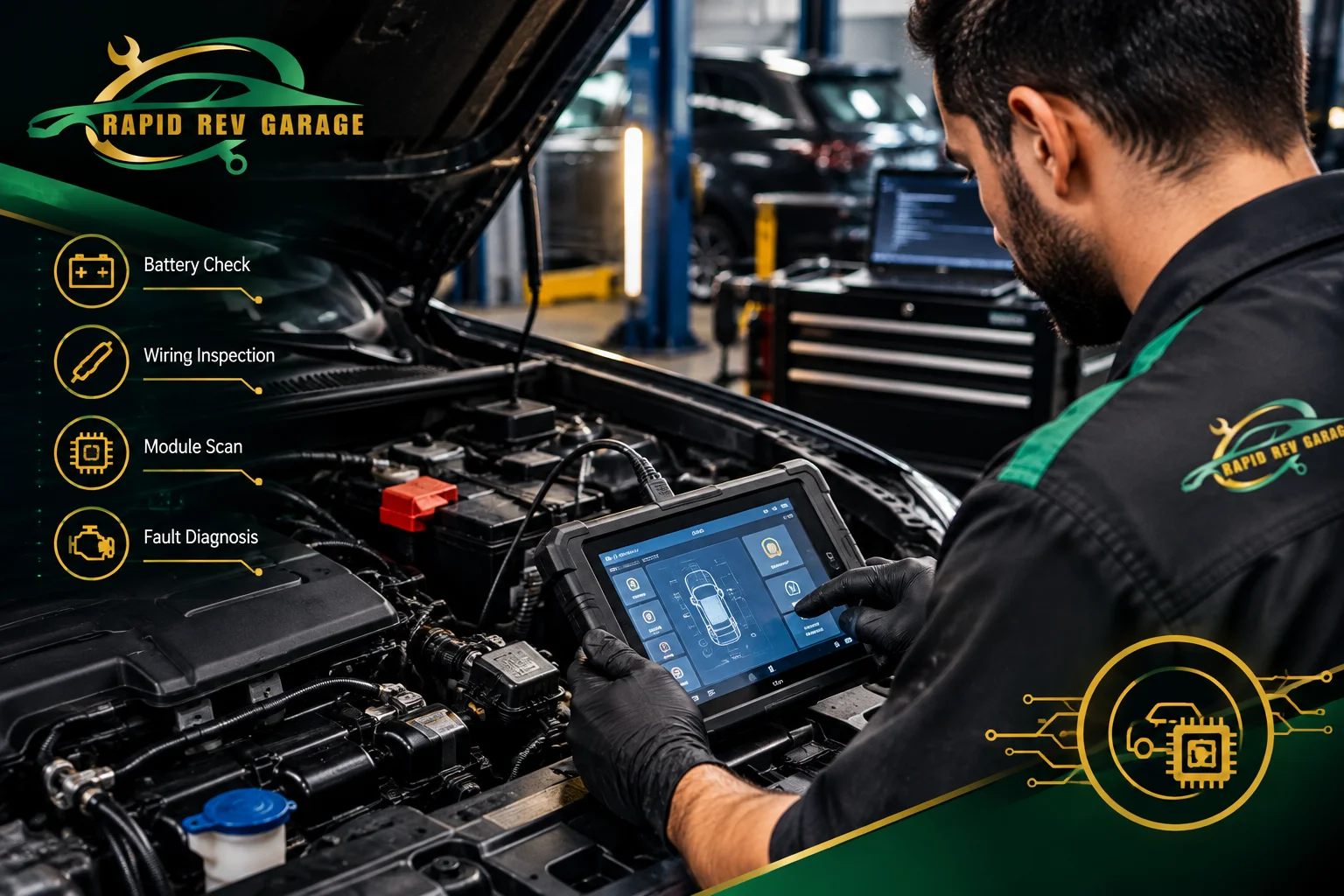
Every engine complaint starts with a full scan across all control modules — engine ECU, transmission, ABS, and body control — using brand-compatible diagnostic tools. This reads stored fault codes, live sensor data during a road test, and misfire counters per cylinder.
Step Two: Physical Inspection Under Load
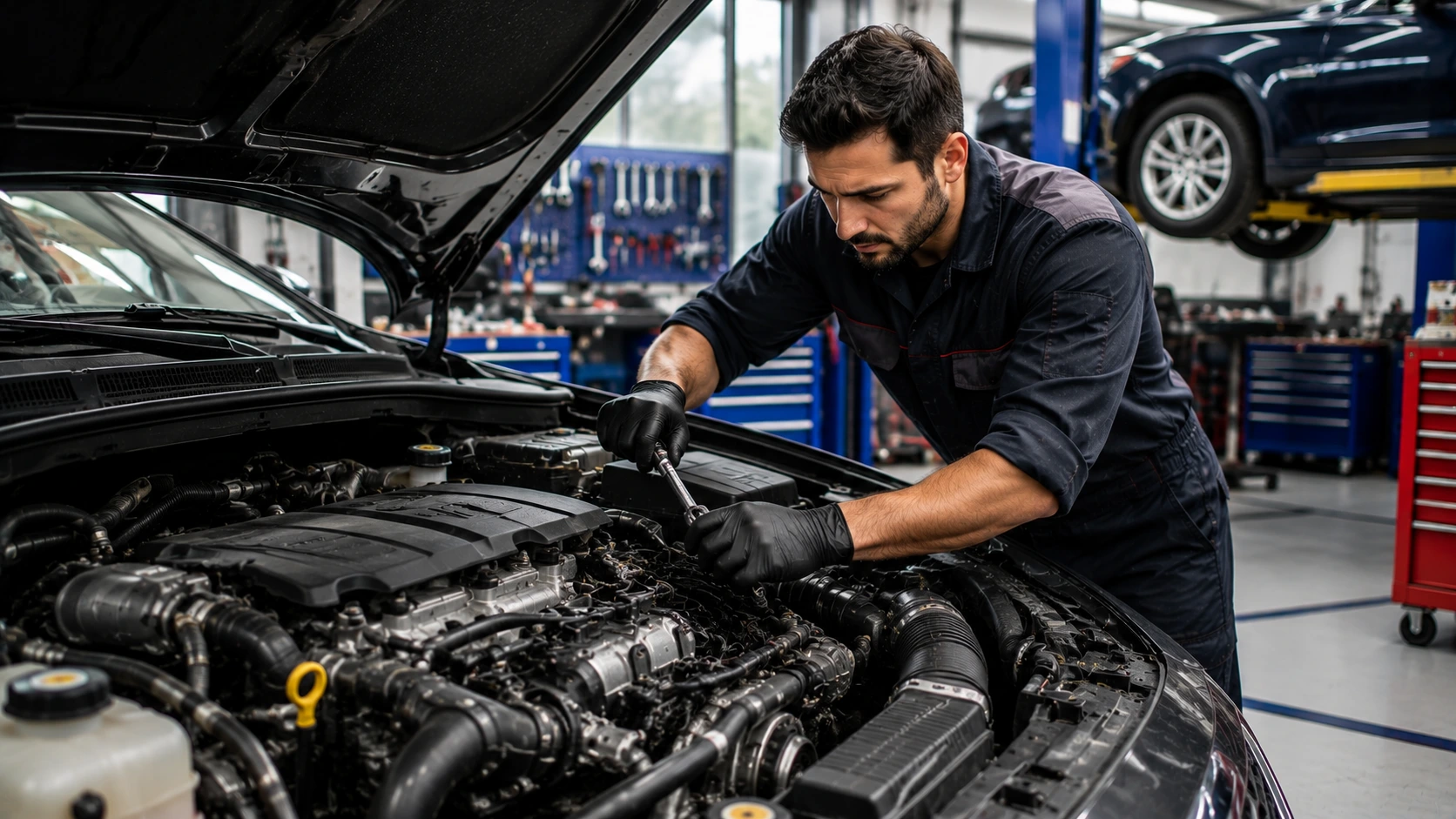
Diagnostic data identifies the likely fault. Physical inspection confirms it. Compression testing on each cylinder, oil pressure measurement under load, coolant pressure testing, and smoke testing for vacuum or boost leaks all form part of this process where relevant.
Step Three: Findings Presented Before Any Work Begins
Every finding is explained in plain terms before any repair is authorised. The actual measurements — compression figures, oil pressure values, misfire counts — are shared with the owner so the repair recommendation is understood, not just accepted.
Our mobile car mechanic can carry out an initial assessment at your location if the vehicle isn’t safe to drive in.
Repair Process
Once the fault is confirmed, the repair approach is matched specifically to what the data shows — not a precautionary broader scope.
How Engine Repair Progresses From Diagnosis to Completion
Once the fault is confirmed, the repair scope is matched specifically to what’s actually failing — not a precautionary broader teardown. A timing chain tensioner replacement doesn’t require removing the engine. A head gasket repair does. A valve cover gasket leak is an accessible external repair. A worn piston ring set requires engine disassembly.
Parts are sourced to OEM-equivalent or genuine specification for the vehicle make and model. All engine work is followed by a road test under the same conditions that originally produced the symptom, to confirm the repair is complete before the vehicle is returned.
Visit our engine repair in Dubai service page for the full scope of what we cover.
Risks of Ignoring Engine Warning Signs
Every sign on this list follows the same progression if left unaddressed: the original fault grows, affects surrounding components, and multiplies the eventual repair cost.
What Happens When These Signs Are Left Too Long
Ignoring engine warning signs follows a consistent pattern regardless of which symptom started it: the original fault grows, affects surrounding components, and transforms a single repair into multiple simultaneous repairs.
A slow coolant leak ignored for weeks becomes a blown head gasket. A timing chain rattle ignored for months becomes a jumped chain and bent valves. A slow oil leak that drops oil pressure becomes spun bearings. In every case, the cost multiplies several times over what the original repair would have been.
The Financial Argument for Acting Early
The diagnostic visit that catches a timing tensioner fault early costs a fraction of the engine rebuild that a jumped chain produces. This is the most direct argument for treating any of the 15 signs above as same-week information rather than something to monitor.
Can You Continue Driving?
Not all 15 signs carry the same urgency. The answer depends entirely on which symptom you’re dealing with.
Which Signs Mean Stop Immediately
Some of the 15 signs are genuine stop-now situations where continuing to drive risks catastrophic and irreversible damage.
Stop driving immediately if:
- The temperature gauge enters the red or an overheating warning appears
- White smoke is billowing from the exhaust while driving
- A sudden, loud knocking sound appears from the engine
- The oil pressure warning light illuminates
- Steam is visible from the engine bay
Which Signs Allow a Short-Term Drive to the Workshop
Other signs allow careful, short-distance driving to a workshop but shouldn’t be deferred for more than a few days.
Drive carefully to the workshop if:
- The check engine light is on but steady (not flashing) and the car drives normally
- A minor oil spot appears under the car with no warning lights
- Fuel consumption has increased but performance feels unchanged
- A slight roughness at idle has appeared recently
Repair Time
Repair duration varies significantly based on what the diagnosis finds and how accessible the fault is on your specific engine.
How Long Engine Repairs Take
Repair time varies significantly depending on what the diagnosis finds. Simple external repairs — oil leaks from gaskets and seals, sensor replacements, spark plug and ignition service — are typically completed same-day. Timing chain replacement is usually a one-to-two day job depending on engine accessibility. Head gasket repair requires two to four days including reassembly and cooling system pressure testing. A full engine rebuild or replacement is typically a week or more, depending on parts availability and the specific engine configuration.
Cost Factors
Engine repair cost is determined by four variables, and none of them can be accurately quoted before a confirmed diagnosis.
What Determines the Cost of an Engine Repair
Engine repair cost in Dubai is determined by four variables: which specific fault was found, which make and model the vehicle is, parts availability and specification, and the labour access required for the repair.
A valve cover gasket on a Golf costs differently from the same repair on an Audi Q7 or a BMW 5 Series, because accessibility varies significantly by platform. A head gasket on a four-cylinder is a different job from the same repair on a V6 or V8. These differences are why a quote based on symptoms rather than a confirmed diagnosis is rarely accurate — the actual cost can only be known once the fault is confirmed.
For cosmetic exterior repairs needed alongside mechanical work, our car painting team handles colour-matched work at the same visit.
Prevention Tips
The habits below are specifically calibrated for Dubai driving conditions — not generic advice lifted from a European service manual.
How to Keep Your Engine Out of This List
Prevention is consistently cheaper than any repair on this list. The habits below are specifically calibrated for Dubai driving.
Oil change at 5,000–8,000 km for city drivers. Short-trip Dubai commuting degrades oil faster than factory intervals assume — and is one of the top reasons an engine needs repair earlier here than elsewhere. The service reminder is a maximum, not a target.
Check the oil level monthly. A 60-second dipstick check once a month catches a developing oil consumption problem before it risks low pressure.
Never ignore a persistent warning light. A check engine light that’s been on for two months has either got worse or been masking a developing fault the whole time.
Inspect the car park spot after parking. Oil, coolant, or any fluid on the ground beneath the car is information worth acting on.
Keep coolant concentration correct. In Dubai’s heat, correct coolant mixture protects the aluminium components inside the engine from internal corrosion that doesn’t show any external symptom.
Dubai-Specific Advice
Dubai’s engine repair patterns differ from global averages in three specific ways that every owner should understand.
What Every Dubai Driver Should Know About Engine Health
Dubai’s engine repair patterns differ from global averages in three specific ways that every owner should understand.
Heat accelerates everything. A fault that’s slow-developing in a temperate climate becomes urgent here. A minor coolant leak that takes months to cause a problem in the UK can cause overheating in Dubai within days during summer.
Short trips cause disproportionate wear. The majority of Dubai drivers use their car for short, repeated daily trips rather than longer sustained drives. This specific pattern is harder on oil quality, harder on the battery, and harder on the timing chain tensioner than any other driving pattern.
Sand and dust are engine risks, not just cosmetic annoyances. A clogged air filter that allows fine dust past it introduces abrasives into the combustion chamber. Air filter inspection — not just at service, but after any sandstorm or extended off-road use — is genuinely worth adding to your awareness.
Why Rapid Rev Garage?
Three principles define how we handle every engine job that comes through Al Quoz.
What We Do Differently on Every Engine Job
We confirm before we quote. No engine repair is recommended at Rapid Rev Garage without a confirmed diagnostic finding — actual compression figures, actual misfire data, actual oil pressure measurements. Owners receive the specific numbers, not just a description of the problem.
We use brand-compatible diagnostic tools across all makes. BMW ISTA. Mercedes STAR Diagnosis. VCDS for Volkswagen Group. SDD for Land Rover. Generic OBD tools don’t access the full module network that modern engines communicate across — we work with the complete picture.
We spread repairs across what’s actually failing. A timing tensioner replacement doesn’t turn into a full engine-out job unless the data confirms that’s what’s needed. Scope creep adds cost without solving additional problems.
Visit our engine repair in Dubai page for the full list of engine repair services we provide.
FAQ — 15 Signs Your Engine Needs Repair
What is the first sign that your engine is going bad?
Usually one of two things appears first: either a warning light on the dashboard, or a change in how the engine sounds — a new knock, tick, or rattle that wasn't there previously.
Can I drive with a check engine light on?
A steady check engine light generally allows short, careful driving to a workshop. A flashing check engine light means pull over safely as soon as possible — it indicates an active misfire that can damage the catalytic converter within minutes.
How long can you drive with a knocking engine?
Not long, and it isn't advisable. A knocking engine is almost always bearing wear, and continued driving under load accelerates the wear until a bearing fails catastrophically — which is typically a non-recoverable engine event.
Does engine repair always mean an engine replacement?
No — many serious-sounding engine faults are repairable without replacement. Timing chain work, head gasket repair, piston ring replacement, and bearing replacement are all repair procedures, not replacement scenarios.
How much does engine repair cost in Dubai?
It depends entirely on which specific fault is found and which vehicle it's on. Minor external repairs start from a few hundred dirhams. Major internal work can range into five figures depending on the engine platform and parts required.
Book Your Engine Inspection at Rapid Rev Garage
If you’ve recognised any of the 15 signs above, do not defer the visit. The cost of a diagnostic inspection is a fraction of the cost of any repair that develops from an ignored symptom — and in Dubai’s heat, the window between early warning and serious damage is shorter than it is almost anywhere else.
Rapid Rev Garage is in Al Quoz, serving drivers across nearby Dubai areas — Business Bay, Jumeirah, Downtown, Barsha, Satwa, and the Sheikh Zayed Road corridor. Our engine repair in Dubai service covers the full range of engine faults across all makes and models.
Book your appointment on WhatsApp or find us on Google Maps. Walk-ins welcome — same-day diagnostic appointments available.
Rapid Rev Garage — Engine Needs Repair | Al Quoz, Dubai and Nearby Areas