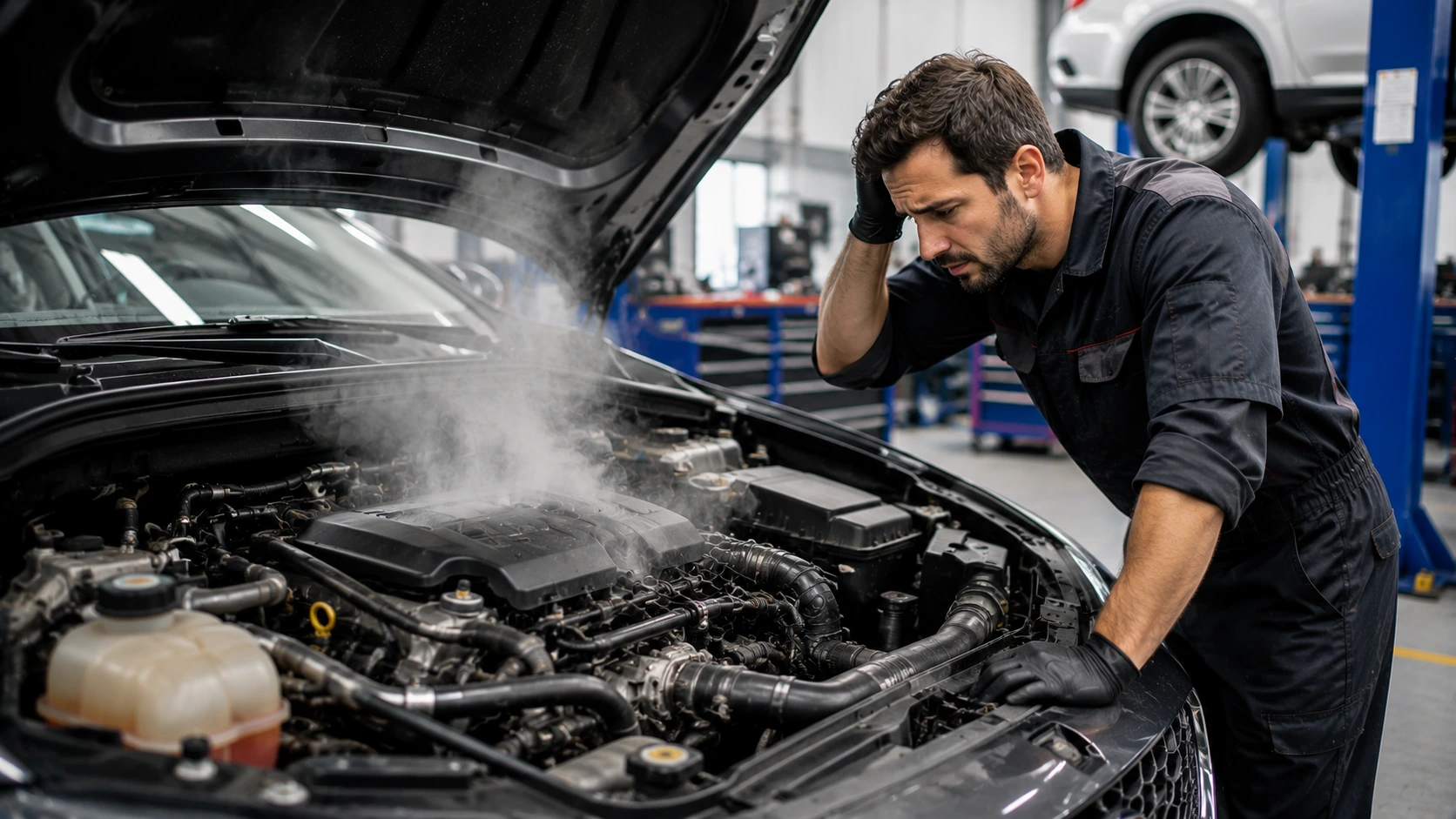
Dubai’s summers put a car’s cooling system through conditions it was never fully designed for. Ambient temperatures above 45°C, stop-start traffic that keeps the engine working without the airflow that highway driving provides, and AC running at maximum capacity from April to October — every one of these factors puts additional thermal load on a system that’s already operating near its ceiling. When any part of that system weakens even slightly, engine overheat in Dubai happens faster and causes more damage than the same fault would in a cooler climate.
The good news is that an overheating engine almost always warns you before catastrophic damage occurs. Knowing the specific causes and what each warning sign means is what allows you to act in time rather than after the damage is done. Our engine repair in Dubai team diagnoses and resolves every cooling system fault — from a slow leak to a failed water pump — before it becomes an engine rebuild.
Engine Overheat in Dubai
The most common reasons an engine overheats in Dubai are low coolant from a slow leak, a failing thermostat, a blocked radiator, a failed cooling fan, or a failing water pump. Dubai’s extreme heat means these faults escalate faster than they would in moderate climates. If your temperature gauge climbs toward red, turn off the AC, turn on the heater, pull over safely, and do not open the radiator cap. Call for recovery rather than continuing to drive. Damage from overheating is significantly cheaper to repair when the engine is stopped promptly.
The cooling system’s job is to hold the engine at a stable operating temperature — typically between 90°C and 105°C — regardless of what’s happening outside the vehicle. In normal conditions, the system manages this comfortably through a circuit of coolant, a water pump, a thermostat, a radiator, and one or more cooling fans working together.
In Dubai’s summer conditions, that same system is already working near its design limit before any fault develops. The ambient air temperature is extreme, the AC condenser adds heat load in front of the radiator, and stop-start traffic eliminates the natural airflow that helps the radiator reject heat at highway speed. This is why even a minor fault — a small coolant leak, a slightly sticky thermostat, a partially blocked radiator — that would be manageable elsewhere becomes a serious overheating event here.
Why Dubai’s Climate Makes Overheating More Likely
Understanding why Dubai specifically accelerates overheating is the starting point for understanding how to prevent it.
The Thermal Margin Is Much Smaller Here
This reduced margin is the core reason every cooling system fault is more urgent here than it would be elsewhere.
Normal vs Dubai Operating Conditions
In a temperate climate, the cooling system has considerable thermal margin — it’s capable of maintaining safe engine temperature well below its maximum capacity under normal driving conditions. In Dubai’s summer, that margin shrinks significantly. The system is working near its limit even when everything is functioning correctly.
AC Load Adds to the Problem Specifically
The AC compressor draws power from the engine, adding heat at the source. The AC condenser, which sits in front of the radiator and must reject its own heat, competes with the radiator for the same airflow. In stop-start traffic, both are under maximum load simultaneously — exactly the conditions where an already-stressed cooling system becomes unable to keep up.
Causes of Engine Overheat in Dubai
Six distinct faults account for the vast majority of overheating events we see at Rapid Rev Garage. Each one affects the cooling circuit differently and requires a different repair.
Engine Overheat in Dubai Cause 1 — Coolant Leaks and Low Coolant Level
This is the most common cause we see, and it’s often invisible until the temperature gauge moves.
How a Slow Leak Creates a Dangerous Situation
Coolant is what carries heat away from the engine block and cylinder heads to the radiator. A slow leak from a degraded hose, a cracked expansion tank, or a failing seal gradually reduces the coolant volume available to absorb that heat. With less coolant in the circuit, the remaining fluid reaches higher temperatures on each pass through the engine until the system can no longer maintain safe operating temperature.
Why Dubai Heat Accelerates Seal Degradation
Rubber hoses and sealing components that would last the expected service life in a moderate climate degrade faster under Dubai’s sustained heat and thermal cycling. The daily swing between air-conditioned parking and peak exterior temperatures causes repeated expansion and contraction that hardens and cracks rubber compounds over time.
Cause 2 — Thermostat Failure
A faulty thermostat is one of the most cost-effective repairs on this list when caught before it causes an overheating event.
What a Thermostat Does and How It Fails Here
The thermostat controls when coolant flows from the engine into the radiator. A thermostat stuck in the closed position prevents coolant from reaching the radiator entirely — the engine heats up with no way to reject that heat. A thermostat stuck partially open doesn’t regulate temperature correctly, causing erratic temperature gauge behaviour and inefficient cooling under high load.
Why This Is a Common Dubai Fault
Dubai’s sustained heat means the thermostat operates at or near its opening threshold far more often than in cooler climates, accelerating wear on the wax element that controls the valve. A thermostat that lasts eight or ten years in Europe may fail significantly earlier on a Dubai-driven vehicle.
Cause 3 — Radiator Blockage From Dust and Scale
Radiator blockage is the most preventable cause on this list, and the most consistently found on Dubai-driven vehicles that skip regular service.
Two Types of Blockage That Reduce Cooling Efficiency
External blockage — dust and fine sand accumulating between the radiator fins — restricts airflow through the radiator, reducing its ability to reject heat to the outside air. Internal scale and mineral deposit buildup from old or incorrect coolant reduces the effective flow area inside the radiator tubes, reducing coolant flow rate and heat transfer efficiency.
Why Both Types Develop Faster in Dubai
Al Quoz’s industrial environment generates a consistently higher concentration of fine dust than most locations, and this dust accumulates on the radiator’s external surface faster than any European maintenance schedule anticipates. Internal scale is accelerated by the higher operating temperatures Dubai vehicles experience, which promotes mineral precipitation from coolant that’s past its service life.
Cause 4 — Cooling Fan Failure
Fan failure is particularly dangerous in Dubai because its impact is felt most severely in exactly the traffic conditions most common here.
Why the Cooling Fan Matters Most in Stop-Start Traffic
At highway speed, the airflow generated by the vehicle’s motion provides significant cooling for the radiator. At idle and low speed — the most common Dubai urban driving condition — that natural airflow doesn’t exist, and the electric cooling fan carries the entire burden of moving air through the radiator. A failed fan motor, a failed relay, or a temperature sensor not triggering fan activation correctly means the radiator has no airflow at all during the traffic conditions where overheating risk is highest.
The AC Connection
Many vehicles share the same fan or fan assembly between the radiator and the AC condenser. A fan fault affects both cooling circuits simultaneously, which is why an AC system that stops cooling properly at idle can sometimes be the first symptom of a fan fault rather than a refrigerant issue.
Cause 5 — Water Pump Failure
The water pump is the heart of the cooling circuit, and its failure is almost always preceded by warning signs worth recognising.
How a Failing Water Pump Reduces Coolant Flow
The water pump circulates coolant around the entire cooling circuit — engine block, cylinder heads, heater core, radiator. A pump whose impeller is worn, corroded, or has separated from the shaft still turns but moves significantly less coolant than it should. The reduced flow rate means coolant spends more time in the hot engine before reaching the radiator, arriving there already much hotter and unable to transfer heat as effectively.
Warning Signs Before Complete Failure
A weeping water pump shaft seal produces coolant residue around the pump housing before the pump fails completely. A bearing wearing out produces a faint grinding sound from the front of the engine that changes with RPM. These early signs, caught at a service visit, allow pump replacement before the overheating event they would otherwise cause.
Cause 6 — Head Gasket Failure
Head gasket failure sits at the serious end of this list — it is both a cause and a consequence of overheating.
Why Head Gaskets Both Cause and Result From Overheating
A blown head gasket can either be the original cause of overheating — combustion gases entering the coolant circuit and displacing coolant volume — or the consequence of overheating that was allowed to continue too long and warped the cylinder head. In either direction, white smoke from the exhaust and coolant that goes milky or frothy are the primary indicators.
Symptoms and Warning Signs
Several warning signs appear in sequence before serious damage occurs. Recognising each one means you can act at the earliest possible stage.
What Your Car Tells You Before Serious Damage Occurs
Several warning signs appear before an engine overheats to the point of damage. Recognising them in sequence is what allows you to act before a manageable repair becomes a major one.
Temperature Gauge Rising Above Normal
The most direct warning. A gauge that runs higher than its normal position — the midpoint of the scale — during stop-start traffic is the cooling system telling you it’s working harder than it should. The escalation from “slightly high” to “red zone” can happen quickly in Dubai’s summer traffic.
Low Coolant Warning Light
This appears before the temperature climbs, and it means coolant level has dropped below the sensor threshold — an active leak is in progress. It shouldn’t be dismissed as a reminder to top up without finding why the level dropped.
Steam From the Engine Bay
Visible steam from under the bonnet, or a strong sweet smell while driving, means coolant is making contact with hot components. At this stage, stop safely and immediately.
Unusual Smell or Heater Blowing Cold
A sweet, chemical smell inside or outside the cabin while the engine is running indicates coolant is burning off somewhere. A heater that suddenly blows cold air instead of warm is sometimes an early sign of critically low coolant — there’s not enough volume in the circuit to warm the heater core properly.
Diagnostic Process
Accurate diagnosis is what separates a repair that solves engine overheat in Dubai from one that addresses only the most obvious visible symptom.
How We Find the Actual Cause Before Recommending Any Repair
Overheating diagnosis isn’t simply checking coolant level and topping it up. At Rapid Rev Garage, the diagnostic sequence identifies the specific failing component before any repair is quoted.
Pressure Test of the Cooling Circuit
A cooling system pressure test holds the circuit at operating pressure for a timed interval. If pressure drops, there’s an active leak. The test identifies whether the leak is external — visible at a hose or fitting — or internal, through a head gasket into the combustion chamber.
Combustion Gas Check in the Coolant
A simple chemical test confirms whether combustion gases are present in the coolant reservoir, which is the direct indicator of a blown head gasket. This test takes minutes and prevents an expensive misdiagnosis.
Live Temperature Data and Fan Activation Check
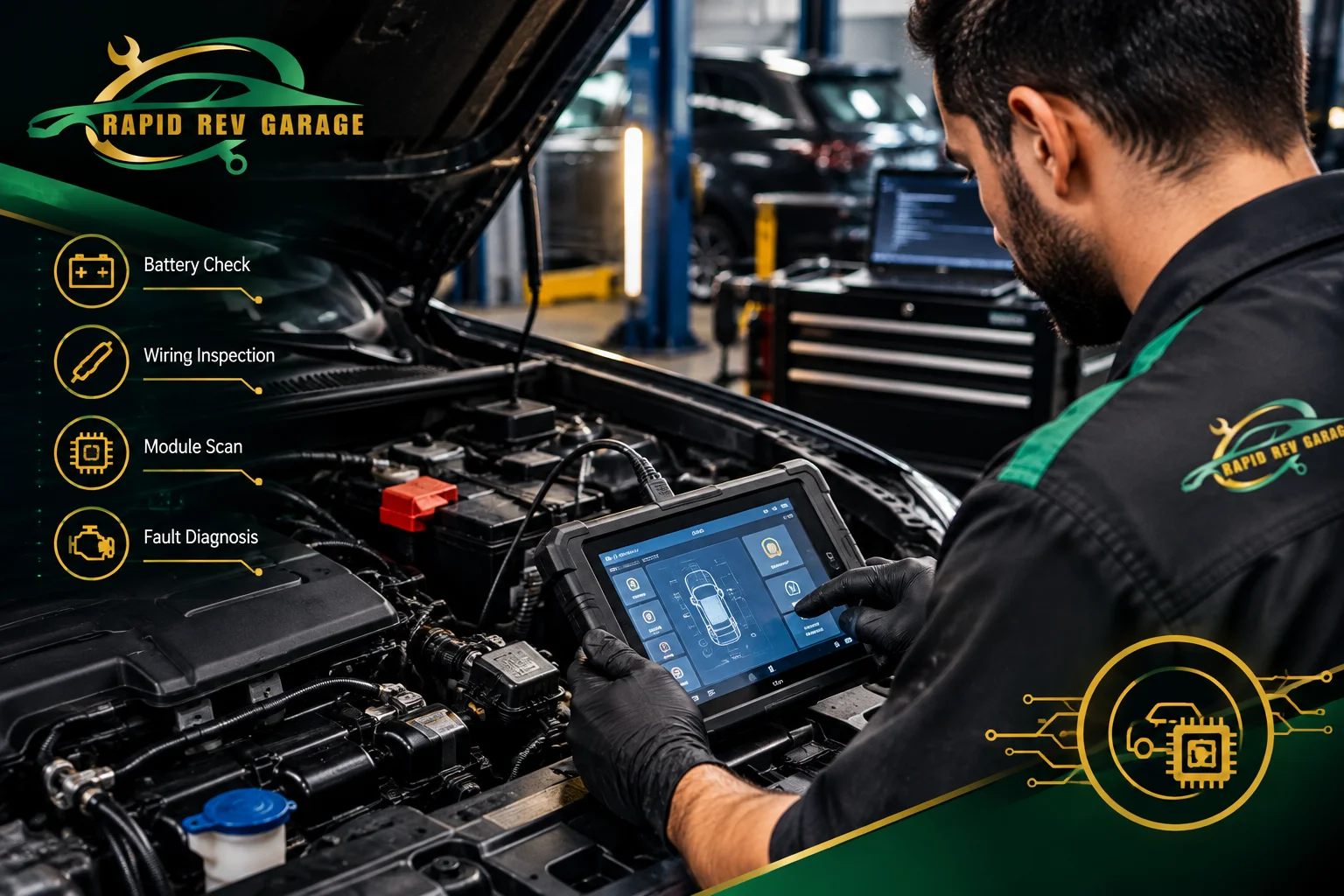
Our car mechanic team reads live temperature sensor data across different cooling system points, and confirms cooling fan activation timing and output against the manufacturer’s specification — revealing a thermostat fault or fan control issue that a basic visual check won’t identify.
Repair Process
Every overheating repair is sized to what the diagnosis confirms — no more, and no less.
Matching the Repair to What the Diagnosis Confirms
A coolant leak from a degraded hose is a straightforward external repair. A failing thermostat is a one-to-two hour replacement job. A water pump replacement varies significantly by engine — some are accessible from the front of the engine, others are driven off the timing belt and require the timing system to be partially disassembled. A blown head gasket requires full cylinder head removal, resurfacing or replacement, and careful reassembly with pressure testing to confirm the repair is complete.
The repair scope is determined by the diagnostic findings, not by the symptom alone. An overheating engine could require any of these repairs — the pressure test and combustion gas check are what tell us which one before any disassembly begins.
Risks of Ignoring Overheating
Overheating damage follows a predictable escalation — and each stage is significantly more expensive than the one before it.
What Happens When the Warning Signs Are Driven Through
The consequences of ignoring engine overheat in Dubai warnings follow a predictable, expensive progression.
Warped Cylinder Head
Aluminium cylinder heads warp when subjected to temperatures beyond their design limit. A warped head no longer seals against the engine block uniformly, which leads to head gasket failure, coolant mixing with oil, and loss of compression — all from what started as a cooling system fault.
Seized Engine
An engine running without adequate coolant eventually reaches temperatures where the pistons expand beyond their clearances in the cylinder bores and seize. This is a total engine failure requiring complete replacement rather than repair, at a cost several times higher than any of the cooling system repairs that caused it.
Why Every Degree of Overheating Matters
An engine that overheated once, was stopped promptly, and repaired correctly often suffers no lasting damage. One that was driven through repeated temperature warnings, even briefly, may have head or block damage that only becomes apparent after the cooling system is repaired and the engine is expected to perform normally again.
Can You Continue Driving?
This is the question every driver asks when they see the temperature gauge move. The answer is straightforward.
The Clear Answer Based on What the Gauge Shows
If the temperature gauge is approaching red, or any overheating warning has appeared, the answer is no — stop as soon as it is safe to do so. The marginal time saved by continuing to drive is not worth the risk of the catastrophic damage that overheating causes.
If the gauge is running slightly higher than its normal midpoint position in heavy traffic but has not reached the warning zone, pull over when it is safe to reduce engine load, switch off the AC, and allow the temperature to stabilise before continuing to a workshop.
Our roadside assistance covers Al Quoz and nearby Dubai areas for recovery when the car cannot be safely driven in.
What to Do When Your Engine Overheats
These five steps, followed in order, give you the best chance of limiting damage to the engine and getting to safety without making the situation worse.
The Immediate Steps That Limit Damage
Turn off the AC immediately. This removes the AC compressor’s load from the engine and eliminates the condenser’s heat addition in front of the radiator — it can reduce engine load meaningfully in the critical first moments.
Turn the heater on full. This pulls heat from the engine coolant into the cabin, acting as a secondary radiator. It is uncomfortable but effective in lowering engine temperature temporarily.
Pull over safely and switch the engine off. Do not open the bonnet immediately — allow five to ten minutes for initial heat to dissipate before inspecting.
Do not open the radiator cap while the engine is hot. The cooling system is pressurised, and removing the cap on a hot engine releases a high-pressure spray of boiling coolant. Wait until the engine is completely cool — at least 30 to 45 minutes.
Do not add cold water to a hot engine. The thermal shock can crack the cylinder head or engine block. Only add coolant or water once the engine has fully cooled.
Repair Time
Repair time varies significantly depending on which fault the diagnosis finds and how accessible the component is on your specific engine.
How Long Cooling System Repairs Take
A hose replacement or thermostat replacement is typically a same-day or next-morning repair. Water pump replacement takes one to three days depending on engine access and whether the timing belt is involved. Head gasket repair requires three to five days including resurfacing, reassembly, and pressure testing before the vehicle is returned.
Cost Factors
Engine overheat repair cost in Dubai is determined by the confirmed fault, not by the overheating symptom.
What Determines the Cost of an Overheat Repair in Dubai
The cost of fixing an overheating engine depends on which specific fault the diagnosis confirms and how accessible the repair is on the specific engine platform. A hose or thermostat replacement is significantly less expensive than a water pump on a timing-belt-driven engine or a head gasket repair. The vehicle make and model affects labour time substantially — the same thermostat replacement takes different access time on a compact hatchback versus a V8 SUV.
Prevention Tips
These habits are specifically calibrated for Dubai conditions — not generic coolant advice that applies equally in Manchester or Munich.
How to Keep Your Cooling System Reliable Through Dubai Summer
Coolant concentration should be checked at every annual service — not just topping up to the level mark, but testing the actual concentration with a refractometer to confirm it’s correct for UAE operating temperatures.
Coolant should be completely replaced every two years regardless of how it looks. Old coolant becomes acidic and corrodes aluminium components internally without any visible symptom.
The radiator external surface should be cleaned at every service, particularly for vehicles parked or driven in dusty areas. Fin blockage is invisible to a casual inspection but measurable in cooling performance reduction.
A temperature gauge that consistently runs slightly higher than usual in traffic is information worth acting on — our car service packages include a full cooling system pressure check and coolant concentration test at every scheduled visit.
Dubai-Specific Advice
Three things make engine overheating risk meaningfully different in Dubai from anywhere else, and each one changes what maintenance and awareness looks like here.
Three Things That Make Overheating Risk Different Here
The window between warning and damage is shorter. In a temperate climate, an overheating engine sometimes gives a driver several minutes to find a safe place to pull over. In Dubai’s summer heat, with ambient temperatures already near 45°C, that window is narrower. Act on the first warning, not the second.
Parking in direct sun pre-loads the cooling system. This is one of the most underappreciated causes of engine overheat in Dubai — a car parked in direct summer sun has an underbonnet temperature well above ambient before the engine even starts. The cooling system is already managing elevated temperatures from the first moment of driving — any existing weakness manifests faster in this condition.
Dust and sand accumulation is invisible but real. Fine dust packed between radiator fins doesn’t look dramatic, but it measurably increases the risk of engine overheat in Dubai by reducing the cooling system’s heat rejection capacity. For vehicles parked or driven regularly near Al Quoz or any industrial area, radiator cleaning at every service is more than routine — it’s a genuine overheating prevention measure. Our car painting team handles any bonnet or exterior damage from heat-related incidents alongside the mechanical repair.
Why Rapid Rev Garage?
Three principles define how we handle every engine overheat in Dubai complaint that comes through Al Quoz.
What We Do Differently on Every Cooling System Job
We confirm the fault before we quote the repair. A pressure test and combustion gas check happen before any component is recommended for replacement — because overheating can have six different causes that look identical from the outside, and the repair for each one is different.
We use brand-compatible diagnostic tools to read live temperature sensor data, fan activation status, and thermostat behaviour in real operating conditions — not just a gauge reading and a visual inspection.
Our mobile car mechanic covers Al Quoz and nearby Dubai areas for initial on-site assessment when the car cannot safely be driven in.
Finding Engine Overheat Repair in Al Quoz
If your engine has been running hot or has already overheated, Rapid Rev Garage is a garage near me in Al Quoz accessible from Business Bay, Jumeirah, Barsha, Satwa, Downtown, and the Sheikh Zayed Road corridor.
FAQ — Engine Overheat in Dubai
Why does my car overheat only in Dubai traffic and not on the highway?
At low speed and idle, the vehicle's motion doesn't generate airflow through the radiator — the cooling fan carries the full burden. A weak fan, partially blocked radiator, or borderline coolant level that's manageable at highway speed can cause overheating in stop-start conditions specifically.
Can I just add water if my coolant runs low in an emergency?
Only once the engine is completely cold — never into a hot engine. Clean water in an emergency is acceptable, but the coolant concentration must be corrected properly as soon as possible, since water alone provides poor corrosion protection and a lower boiling point.
How quickly does overheating damage the engine?
It depends on how far the temperature rises and for how long. An engine stopped promptly at the first warning sign often survives without damage. One driven through repeated temperature warnings, even briefly, can develop warped cylinder heads or head gasket failure.
Does running the AC cause engine overheating in Dubai?
Not directly — AC doesn't cause overheating in a healthy cooling system. But it adds load that a weakened or borderline cooling system can't always handle, which is why overheating often becomes noticeable first with the AC running in summer traffic.
Should I turn the AC off if my temperature gauge rises?
Yes, immediately — removing the AC compressor load reduces the heat the engine is generating and removes the condenser's heat addition in front of the radiator, giving the cooling system its best chance to stabilise before you pull over.
Book Your Cooling System Inspection at Rapid Rev Garage
An overheating engine is not something to monitor — it is something to diagnose and fix before the next summer drive. The difference between a coolant hose repair and a head gasket replacement is often just the decision to act on the first warning rather than the third.
Rapid Rev Garage is in Al Quoz, serving drivers across nearby Dubai areas. Book your appointment on WhatsApp or find us on Google Maps. Walk-ins welcome.
Rapid Rev Garage — Engine Overheat in Dubai | Al Quoz and Nearby Areas