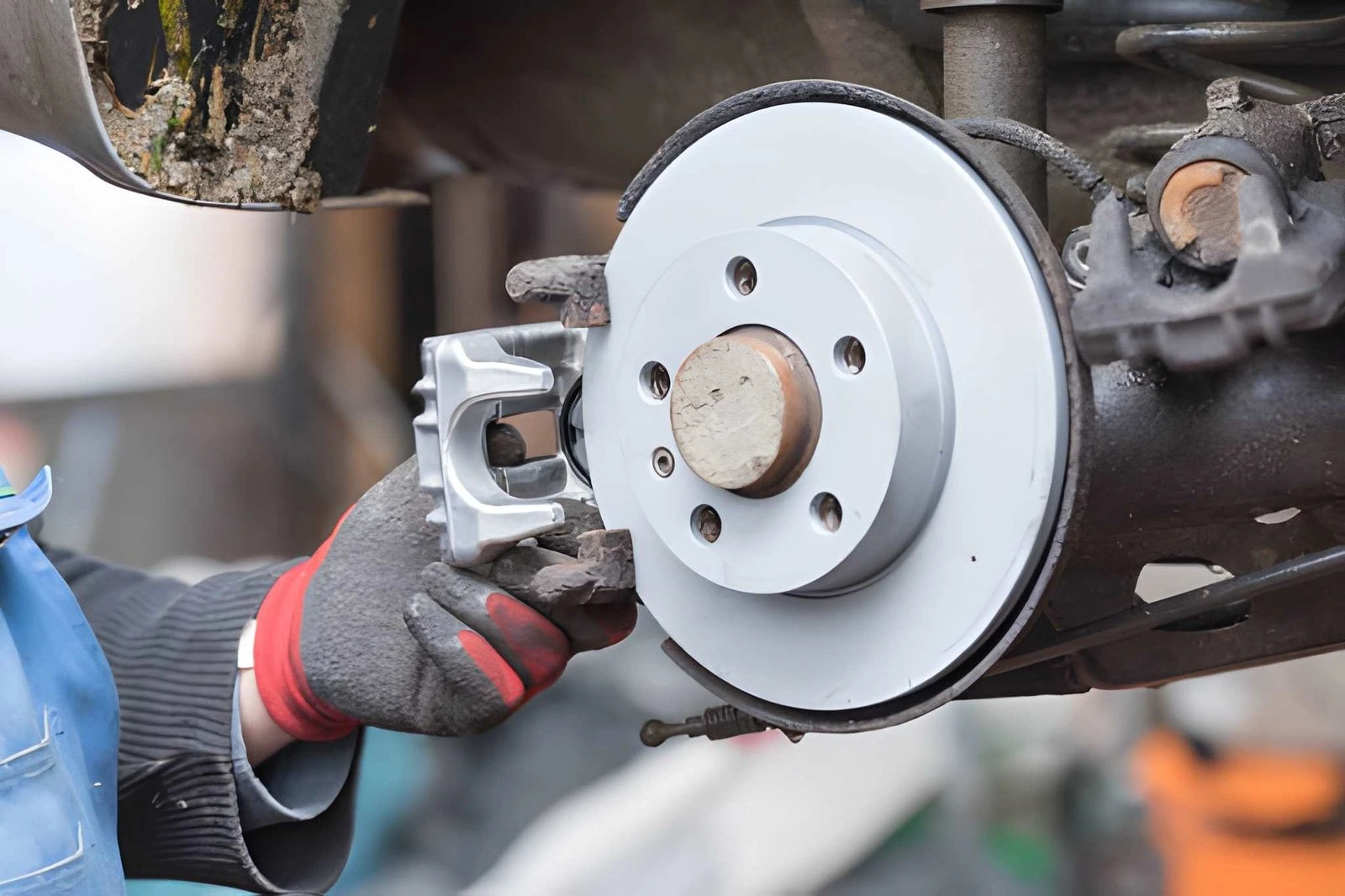
When brakes start showing signs — a squeal on slowing down, a grind under heavier pedal pressure, a slight pull to one side — the search usually starts with brake replacement near me. In Dubai, where stop-start Business Bay traffic and 120 km/h Sheikh Zayed Road runs both happen in the same commute, brakes work harder than in most cities. Getting them replaced properly matters more than getting them replaced quickly.
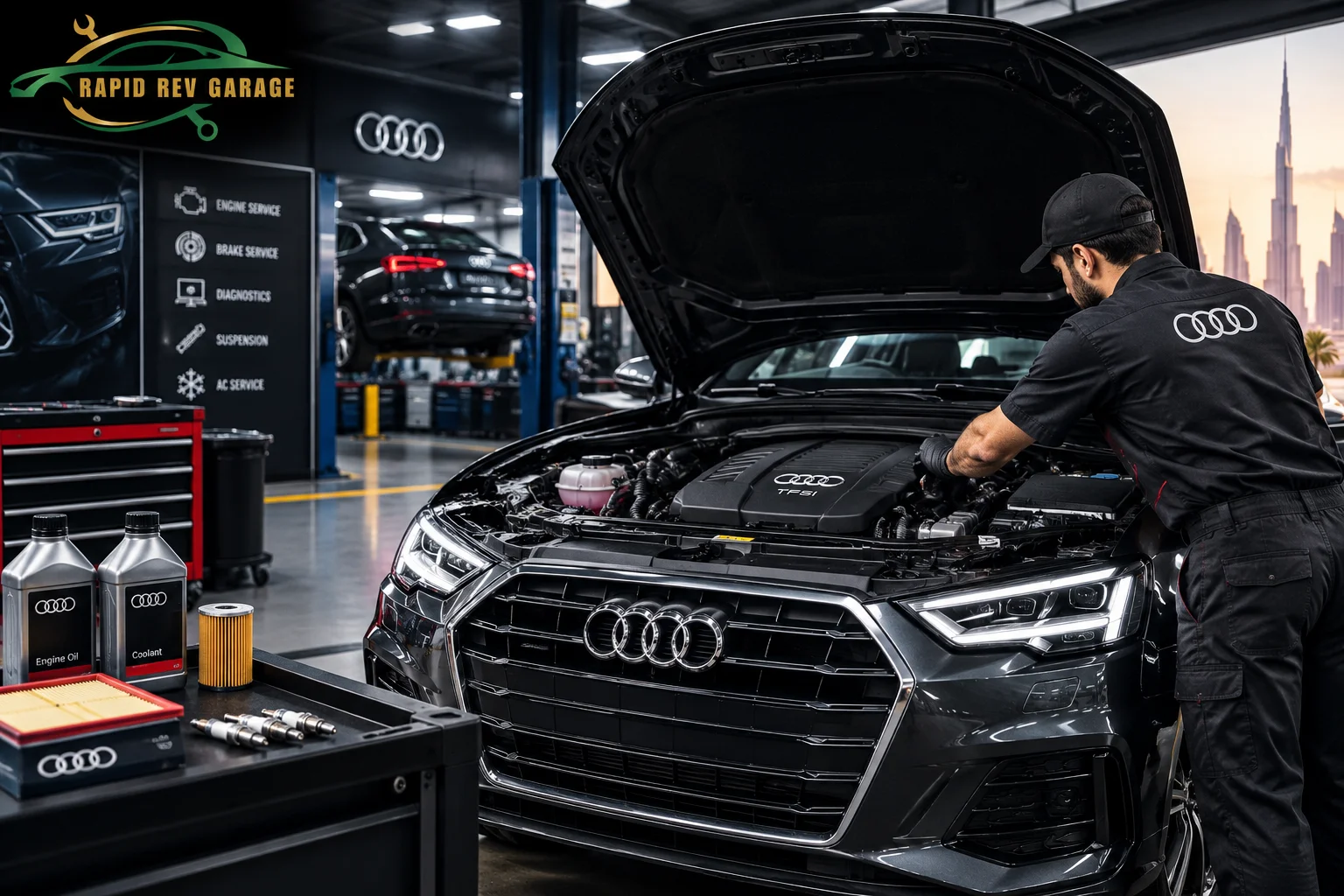
At Rapid Rev Garage in Al Quoz, we handle brake replacement across all makes — European, Japanese, American, and GCC-spec vehicles. Every job starts with a physical inspection and measurement, not an assumption based on mileage alone.
Brake Replacement Near Me in Dubai — What Dubai Does to Brake Components
Searching for brake replacement near me in Dubai usually means the brakes have already given some kind of signal. Understanding what’s behind that signal — and what Dubai’s specific conditions do to brake systems — changes how the repair gets approached.
Brake pads in Dubai wear faster than factory service intervals predict. The constant heat cycling — from underground car park temperatures to 46°C ambient on an afternoon commute — stresses brake components differently than a temperate climate does. Stop-start traffic on Al Khail Road and through Al Quoz’s industrial streets puts more heat into the front brakes per kilometre driven than highway driving does. And heavy vehicles — Landcruisers, Patrols, Tahoes — common across Dubai, require significantly more braking force to stop than lighter cars, accelerating pad and rotor wear further.
A brake replacement near me done properly means measuring what’s actually worn before ordering anything, and replacing only what needs replacing — not doing a blanket four-corner job on a car where the rears still have 60% life.
Brake Replacement Near Me — Pads, Rotors, and How to Know What’s Actually Due
Brake Pads
Pad thickness is the starting point. Most OEM brake pads start at 10–12mm of friction material. Manufacturer minimum thickness — the point at which replacement is required — is typically 2–3mm. The wear sensor triggers a dashboard warning somewhere around 3mm, but sensors can fail, and some cars don’t have them on the rear axle at all. Physical measurement with a calliper at every service visit is the only reliable check.
Glazed pads are a separate issue from worn pads. In Dubai’s heat, pads that have been repeatedly overheated — particularly through extended low-speed braking down a multi-storey car park ramp or repeated heavy stops in summer traffic — can develop a hardened glazed surface that reduces friction efficiency even when thickness is fine. A glazed pad doesn’t always throw a warning light. It just stops less effectively, quietly.
We measure pad thickness front and rear at every service visit and report actual remaining thickness — not just “OK” or “needs replacement.” That lets you plan rather than react.
Brake Rotors
Rotors don’t just wear down — they warp, score, and develop lateral runout. Warping from heat cycling causes the characteristic pedal vibration that feels like a pulse through the brake pedal at highway speed. Scoring from running worn pads too long cuts grooves into the rotor face that reduce pad contact area and increase stopping distance. Lateral runout — where the rotor wobbles slightly as it rotates — causes uneven pad contact and accelerated wear on one side of the pad.
We measure rotor thickness and lateral runout before recommending replacement or resurfacing. Many Dubai workshops replace rotors by default alongside pads. That’s not always wrong, but it’s not always right either. If the rotor is within thickness tolerance and shows no warping or significant scoring, it doesn’t need replacing. If it’s borderline, replacement makes sense. The measurement tells you — guessing doesn’t.
Calipers
Caliper pistons seize in Dubai heat. It happens on every brand and every age of vehicle. A seized front caliper keeps the pad in constant light contact with the rotor, generating drag, heat, and rapid wear on one side. The first signs are uneven pad wear between left and right on the same axle, a slight pull to one side under braking, or a wheel that’s noticeably hotter than the others after a drive. We test caliper piston movement by hand at every brake inspection — it takes two minutes and catches this before the rotor and pad are both destroyed.
Brake Fluid — The Component Nobody Thinks About Until It Fails
Brake fluid is hygroscopic — it absorbs moisture from the air gradually through the rubber seals in the brake circuit. Fresh DOT 4 fluid has a wet boiling point around 155°C. Fluid that’s been in a Dubai car for two years, cycling through summer heat and winter humidity, can have a wet boiling point below 120°C.
Hard braking from motorway speed — approaching the Business Bay interchange on the Dubai-Abu Dhabi highway, or slowing from 120 km/h on Emirates Road for a sudden queue — generates brake temperatures that push right against that threshold in a heavy vehicle. When fluid boils under load, vapour forms in the brake lines. Vapour compresses. Liquid doesn’t. The pedal goes spongy. Stopping distance increases. This is brake fade, and it happens at the worst moment.
We test brake fluid moisture content with a digital tester at every service visit. Anything above 3% moisture triggers a recommendation to flush. A full system bleed — all four corners with fresh DOT 4 — restores wet boiling point and hydraulic firmness. Not a top-up. A flush.
Our car service packages include brake fluid condition testing as a standard item at every major service, not an add-on.
ABS, DSC, and Electronic Brake System Faults
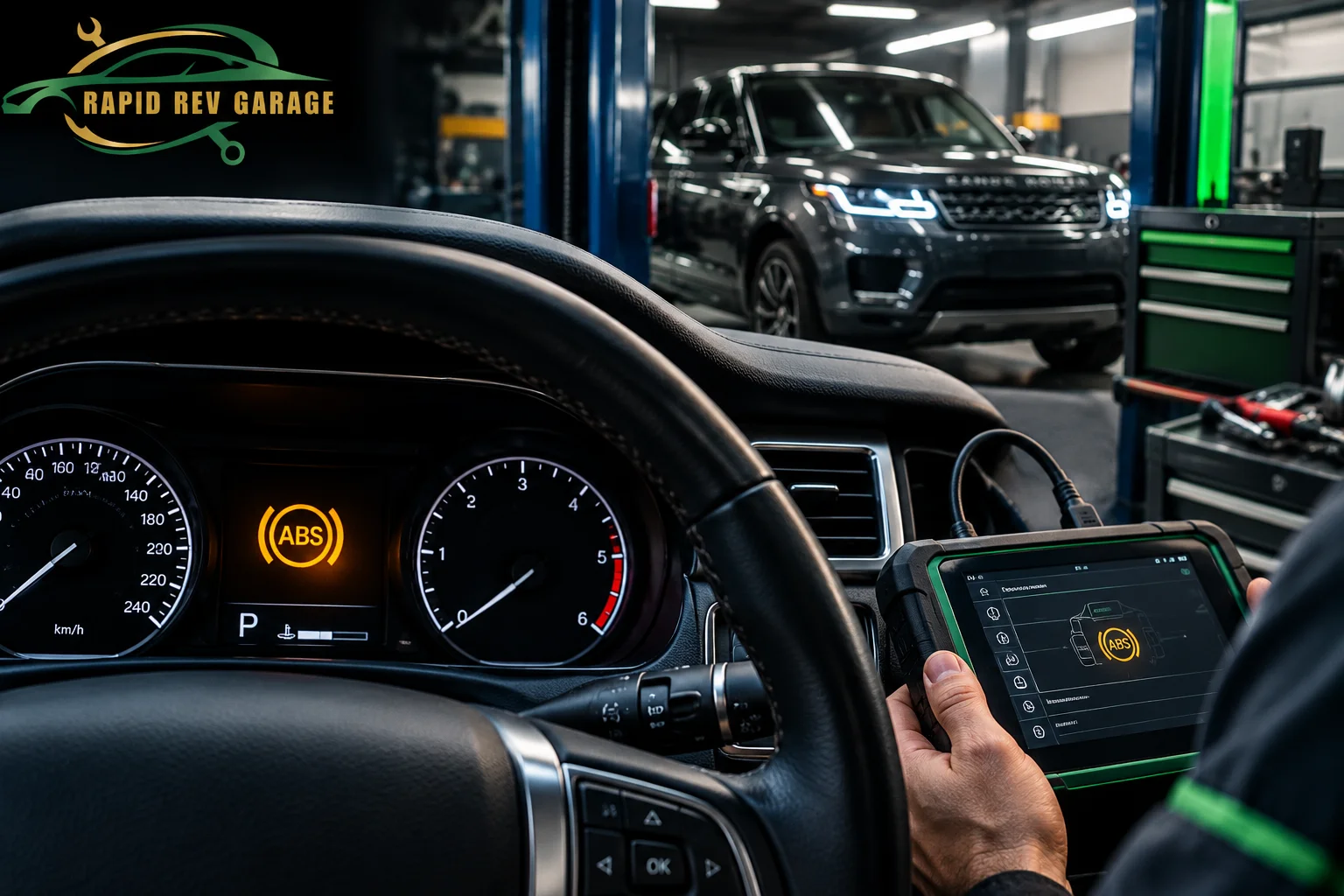
Modern vehicles use wheel speed sensors, brake pressure sensors, and stability control modules to manage ABS, DSC, and emergency braking assist. When a wheel speed sensor fails — common on Dubai-driven cars where the sensor body is exposed to road debris and heat — the ABS deactivates entirely. The car still brakes, but without anti-lock function. On a wet winter road or sudden heavy braking, that matters.
We run full brake system diagnostics using the appropriate brand-compatible scanning equipment at Rapid Rev Garage. Fault codes across ABS, stability control, and brake pressure modules get read properly — not just the engine ECU. A stored fault that hasn’t triggered a warning light yet gets caught before it becomes an active failure.
A customer brought in a Nissan Patrol with a persistent ABS warning that three other workshops had “cleared” without fixing. The warning returned within a day each time. We traced the fault to a cracked wheel speed sensor harness on the rear left — the connector itself was fine, but the loom section behind it had chafed through against the chassis. Repaired and sealed the loom, fault cleared and hasn’t returned.
For any brake fault that makes the car unsafe to drive, our roadside assistance covers Al Quoz and nearby Dubai areas.
What a Proper Brake Replacement Inspection Covers
When someone brings their car in after searching brake replacement near me in Dubai, this is what a proper inspection at Rapid Rev Garage looks like before any work is quoted. Every brake replacement near me job starts here — not with a parts list:
- Front and rear pad thickness measured with callipers — actual mm figure, not a visual estimate
- Rotor thickness measured and compared against manufacturer minimum
- Rotor lateral runout measured with a dial gauge — warp detected before the pedal tells you
- Caliper piston retraction test — free movement confirmed or seized piston identified
- Brake fluid moisture content tested digitally
- Wear sensor condition and connectivity confirmed
- ABS/stability control module scanned for stored faults
- Brake line and hose visual inspection for cracking or weeping
Our car mechanic team completes this inspection before any parts are discussed. The quote follows the findings — not the other way around.
How Long Do Brakes Last in Dubai?
Honest answer: less than the factory interval suggests, and it varies significantly by vehicle, driving style, and axle.
Front pads on a heavy SUV doing Dubai city commuting typically last 25,000–40,000 km. Rear pads last longer — often 40,000–60,000 km on the same vehicle. A lighter sedan doing predominantly highway driving can go 50,000–60,000 km on fronts. A performance vehicle with larger, more aggressive brake components used on track sessions or hard Abu Dhabi highway runs can wear fronts in 15,000 km.
The variables are why mileage-based intervals aren’t reliable for brake service in Dubai. Measurement at every service visit — 6 months or 10,000 km — is the only accurate way to know where you actually stand.
Finding Brake Replacement Near Me in Al Quoz
If you’ve been searching for a garage near me in Dubai for brake replacement, Rapid Rev Garage is in Al Quoz — the brake replacement near me workshop for owners across Business Bay, Jumeirah, Barsha, Satwa, Downtown, and the Sheikh Zayed Road corridor.
We work on all makes including BMW, Mercedes, Toyota, Nissan, Ford, Chevrolet, Range Rover, Kia, Hyundai, and everything in between. Parts are OEM-specification or manufacturer-approved equivalents — no generic pads on a car where the friction coefficient matters to the braking system calibration.
For owners who need an initial assessment before driving the car in, our mobile car mechanic can come to your location to check pad thickness and caliper condition on-site.
Exterior Care Alongside Brake Work
If your car is in for brake replacement and needs cosmetic attention at the same time — stone chips, parking scuffs, alloy wheel kerbing — our car painting team handles colour-matched repairs alongside the mechanical work. One visit for everything.
FAQ — Brake Replacement Near Me in Dubai
How do I know if I need brake replacement or just an inspection?
Any squeal, grind, pedal vibration, soft pedal, or pulling to one side warrants an inspection first. Measurement tells you whether pads need replacing, rotors need replacing, or only fluid and a caliper service are needed. Don't replace by assumption.
How long does brake replacement take at Rapid Rev Garage?
A full four-corner pad and rotor replacement typically takes two to three hours. Pads only on one axle is usually one to one and a half hours. We confirm timing when the inspection is complete and parts are confirmed available.
Should I replace front and rear brakes at the same time?
Only if both axles are due. Front and rear wear at different rates — fronts typically wear 30–40% faster than rears. Replacing both when only the fronts are worn is unnecessary spend. Measurement tells you which axle actually needs attention.
What brake pad material is best for Dubai driving?
Semi-metallic or ceramic pads handle Dubai's heat better than organic pads. Organic pads are quieter but fade faster under repeated heat cycling. For heavier vehicles doing city driving in summer, semi-metallic is the more appropriate choice.
Is it safe to drive with the brake warning light on in Dubai?
It depends on the light. A pad wear indicator is a prompt to book a service — you have some remaining distance. A red brake warning light, a soft pedal, or any grinding means stop driving immediately. Don't push worn brakes in Dubai's traffic.
In Conclusion
Brake replacement near me in Dubai deserves a workshop that measures before it recommends, replaces what’s actually due, and tests the system properly after the work is done. Brakes aren’t a component to cut corners on — and in Dubai’s heat, traffic, and driving conditions, they need more attention, not less.
Rapid Rev Garage is in Al Quoz, serving drivers across nearby Dubai areas — Business Bay, Jumeirah, Downtown, Satwa, Barsha, and the Sheikh Zayed Road corridor. Book your appointment on WhatsApp and find us on Google Maps.
Rapid Rev Garage — Brake Replacement Near Me | Al Quoz, Dubai and Nearby Areas