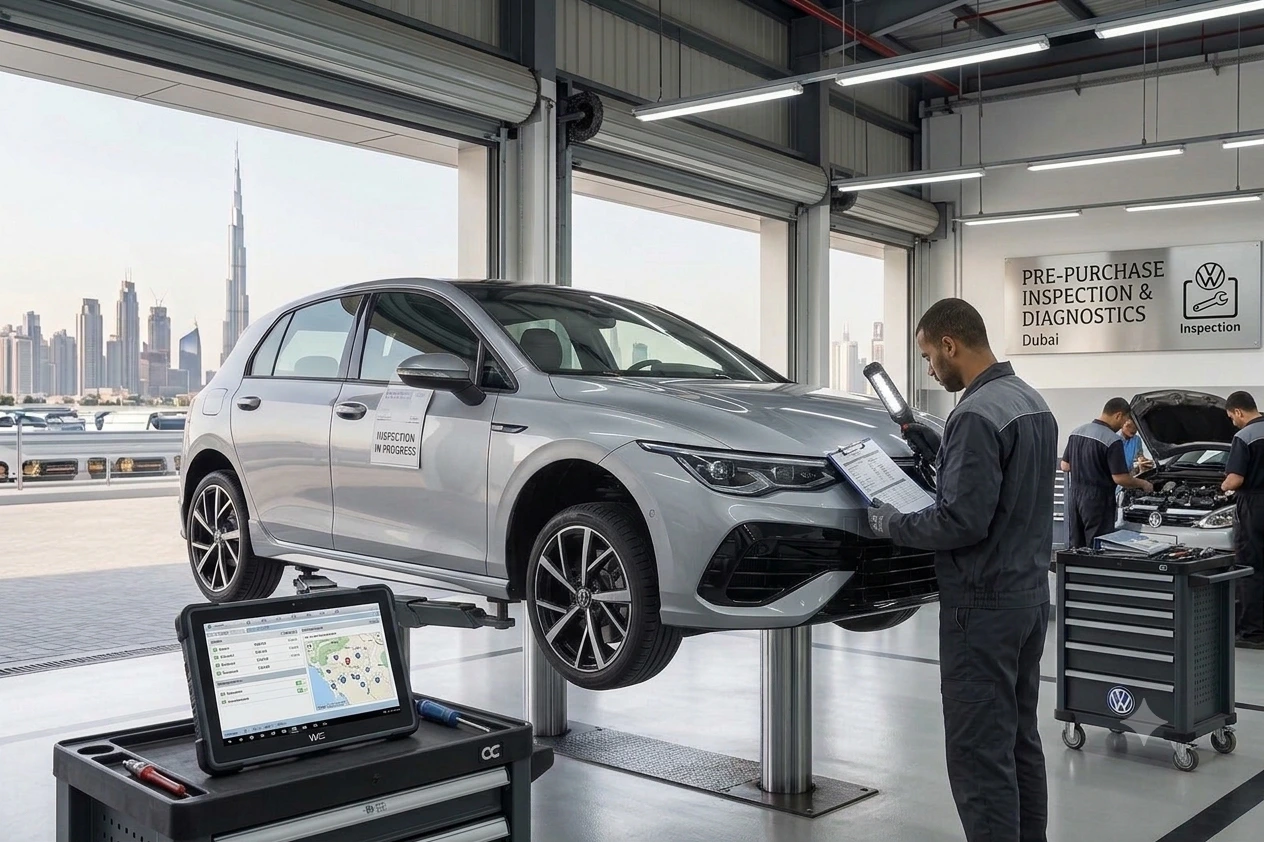
Buying a used car in Dubai without a proper car inspection is one of the most common financial mistakes drivers make in this market. The car looks good in the photos. The seller sounds genuine. The price seems fair. And then three weeks after handover the transmission starts slipping, or the AC compressor fails in June, or a workshop puts the car on a ramp and finds structural damage from an accident nobody mentioned.
This isn’t rare. Dubai’s used car market is large, fast-moving, and operates with varying degrees of transparency. Private sellers aren’t required to disclose every fault. Dealers present cars at their best. Imported vehicles arrive with histories that aren’t always fully documented. And in a city where premium vehicles change hands constantly, where multiple summers of heat stress leave marks on every system, and where traffic incidents are common — the gap between what a car looks like and what it actually is can be significant.
A proper car inspection closes that gap. It turns a transaction based on appearance and trust into one based on actual information — what the car has been through, what it genuinely costs to own going forward, and whether the asking price reflects its real condition.
Car Inspection Dubai — What the Market Doesn’t Tell You
Dubai’s used car market has specific characteristics that make a car inspection more important here than in most other markets. Understanding the risks specific to this environment helps buyers know exactly what they’re protecting themselves against.
Odometer Discrepancy
Mileage fraud is more prevalent in the GCC used car market than most buyers realise. Vehicles imported from Saudi Arabia, Kuwait, Bahrain, and Qatar sometimes arrive with adjusted odometers — a car showing 60,000 km on the clock can carry the physical wear of 140,000 km if the reading has been manipulated.
The physical evidence doesn’t match a manipulated odometer. Steering wheel leather worn through at the nine and three o’clock positions. Driver’s seat bolster cracked and heavily compressed at the entry edge. Pedal rubber worn to the bare metal backing. Suspension components soft and worn beyond what 60,000 km produces. A proper car inspection reads these wear indicators and reconciles them against the stated mileage — giving a realistic picture of what the car has actually experienced regardless of what the dashboard shows.
Concealed Accident History
Not every accident in Dubai goes through the insurance system. Not every repair is documented. Vehicles that have been in significant impacts, repaired at low-cost bodyshops, and returned to the market can pass a casual visual check without difficulty.
A trained inspector looks beyond surface appearance — paint depth measurements across every panel using an electromagnetic gauge, panel gap alignment at every opening, overspray on weather seals and rubber trim, and underbody structural condition on a ramp. These checks reveal what a photo or a showroom viewing never shows. And the distinction between a properly repaired cosmetic accident and structural damage that was never correctly addressed matters enormously — the first is generally acceptable, the second is a safety issue regardless of how the car presents visually.
Heat and Climate Damage
Multiple Dubai summers with neglected maintenance leave marks across every system in a vehicle. Degraded cooling system components, cracked rubber hoses, UV-damaged dashboard plastics, swollen battery cells, and marginal AC systems are all common in Dubai’s used car market and none of them appear in a listing description.
A car inspection in Dubai specifically needs to account for climate-related wear that wouldn’t be a priority concern in a European used car market. Coolant concentration, air spring membrane condition, wiring insulation flexibility, battery health under thermal load — these are Dubai-specific inspection items that a thorough inspector includes as standard.
Import Vehicle Risks
Vehicles imported from outside the GCC carry their own specific risk profile. Cold-climate corrosion on European imports. Flood damage on American vehicles from hurricane-affected states — these do appear in Dubai’s market occasionally. Specification mismatches that create complications with RTA registration and insurance. A proper car inspection for an import vehicle verifies specification compatibility and checks for the specific damage patterns associated with the country of origin.
What a Proper Car Inspection Covers
A genuine car inspection is systematic and complete. Here is exactly what a proper inspection covers and why each element matters.
Exterior and Paint Assessment
Panel gap measurement at every opening — bonnet, all four doors, boot lid, and tailgate. Paint depth measurement at multiple points per panel using a quality gauge — the single most important exterior check for identifying accident repairs. Finish consistency across adjacent panels. Evidence of body filler. Overspray on weather seals, window rubber, and chassis paint at panel edges.
Why Paint Depth Measurement Matters
An original factory-painted panel reads consistently across its surface — typically 90–130 microns depending on the manufacturer and colour. A resprayed panel reads differently from the original panels adjacent to it. A panel with body filler reads lower in the filled areas — sometimes as low as 400–600 microns where thick filler has been applied. A quality gauge doesn’t miss what the eye does under showroom lighting. Every serious car inspection includes paint depth measurement as a core deliverable.
Underbody Ramp Inspection
No proper car inspection can be completed without a ramp. The underbody is the most honest area of any used car — it shows the vehicle’s real history more clearly than any other area because sellers rarely prepare it for presentation.
What the Ramp Reveals
Chassis rail straightness and weld integrity. Floor pan condition for impact damage and previous repair work. Evidence of structural straightening — pull marks, fresh underseal over repaired sections, asymmetric weld patterns. Exhaust system condition. Engine and gearbox oil seal condition — active leaks invisible from the engine bay are often clearly visible from beneath. CV boot condition. Subframe mounting point integrity.
Dubai-Specific Underbody Concerns
Physical damage from speed bump impacts on lower-profile vehicles. Displaced underbody protection panels. Incorrect jacking damage from previous tyre changes. All visible on the ramp, all invisible from a walkaround, all contributing to a realistic picture of how the car has been treated.
Engine Bay Assessment
Coolant condition and concentration — tested with a refractometer, not a visual check. Evidence of oil leaks from valve covers and sump gaskets. Recent steam cleaning that may be concealing active leaks — a suspiciously clean engine bay on a high-mileage vehicle should prompt more careful leak checking during the running assessment. Auxiliary belt condition. Battery terminal corrosion. Battery manufacture date from the casing stamp. Air intake system integrity.
Cold Start and Running Assessment
Cold start behaviour provides some of the most valuable data in a car inspection. How the engine starts from fully cold — idle quality in the first 30 seconds, smoke from the exhaust at start-up, how quickly the idle stabilises and at what rpm. Coolant temperature progression to operating temperature. Throttle response across the rev range once warm. Any unusual noises that appear or disappear with temperature.
Full Diagnostic Scan
This is non-negotiable in any proper car inspection. Every control unit in the vehicle must be scanned — not just the engine and transmission modules, but every body, chassis, safety, and comfort system. A generic OBD-II reader covers approximately 20% of available fault data on a modern vehicle.
Cleared Fault Code History
Sellers who understand diagnostics clear fault codes before listing. But fault history remains in the system log even after clearing — accessible to quality diagnostic tools. A car inspection scan that includes fault history retrieval regularly finds gearbox fault histories, airbag deployment records, and ABS faults that were cleared shortly before the car was listed.
A BMW X5 came through for inspection — full service folder, reasonable asking price, clean presentation. Full system scan showed airbag fault history entries cleared eleven days earlier. Specifically, a front passenger airbag deployment circuit fault. The seller had no explanation for this. The buyer declined. The fault history strongly suggested a deployed airbag that had been reset rather than properly replaced — a serious safety concern.
Transmission Assessment
Automatic Transmission
Shift quality from cold through to operating temperature. Torque converter behaviour under light throttle cruising — shudder indicates fluid degradation or converter wear. Drive and Reverse engagement quality. Any hesitation, slip, or flare between gear changes under load.
Dual-Clutch and CVT
Low-speed engagement shudder on dual-clutch units — the first sign of clutch pack wear that develops into a major repair if ignored. CVT belt smoothness under varied load — surging at steady speed indicates belt-pulley wear from incorrect or degraded fluid. Both are much cheaper to identify before purchase than to repair after.
Manual Transmission
Clutch bite point position and engagement feel. Synchromesh quality through all gears particularly second, which wears fastest. Any crunching or resistance in the gear change. Clutch judder on take-up from stationary.
Brake System
Pad thickness measurement at all four corners. Disc condition — scoring, heat cracking, thickness measurement against minimum specification. Brake fluid moisture content using a calibrated tester. Pedal feel and travel. Handbrake effectiveness. A car inspection that doesn’t measure pad thickness and disc condition at every corner is leaving out basic safety-relevant data.
Suspension and Steering
Test Drive Assessment
Highway speed stability and pull. Steering response and returnability. Suspension noise over speed bumps — deliberately traversing a speed bump at moderate speed exposes worn bushings and failed dampers that a smooth motorway test drive completely masks. Brake pull under firm application.
Ramp Assessment
Ball joint play under load. Tie rod end condition. Subframe bushing compression — soft bushings on a claimed low-mileage car are a mileage discrepancy indicator. Strut top mount condition. Shock absorber condition visually.
AC System
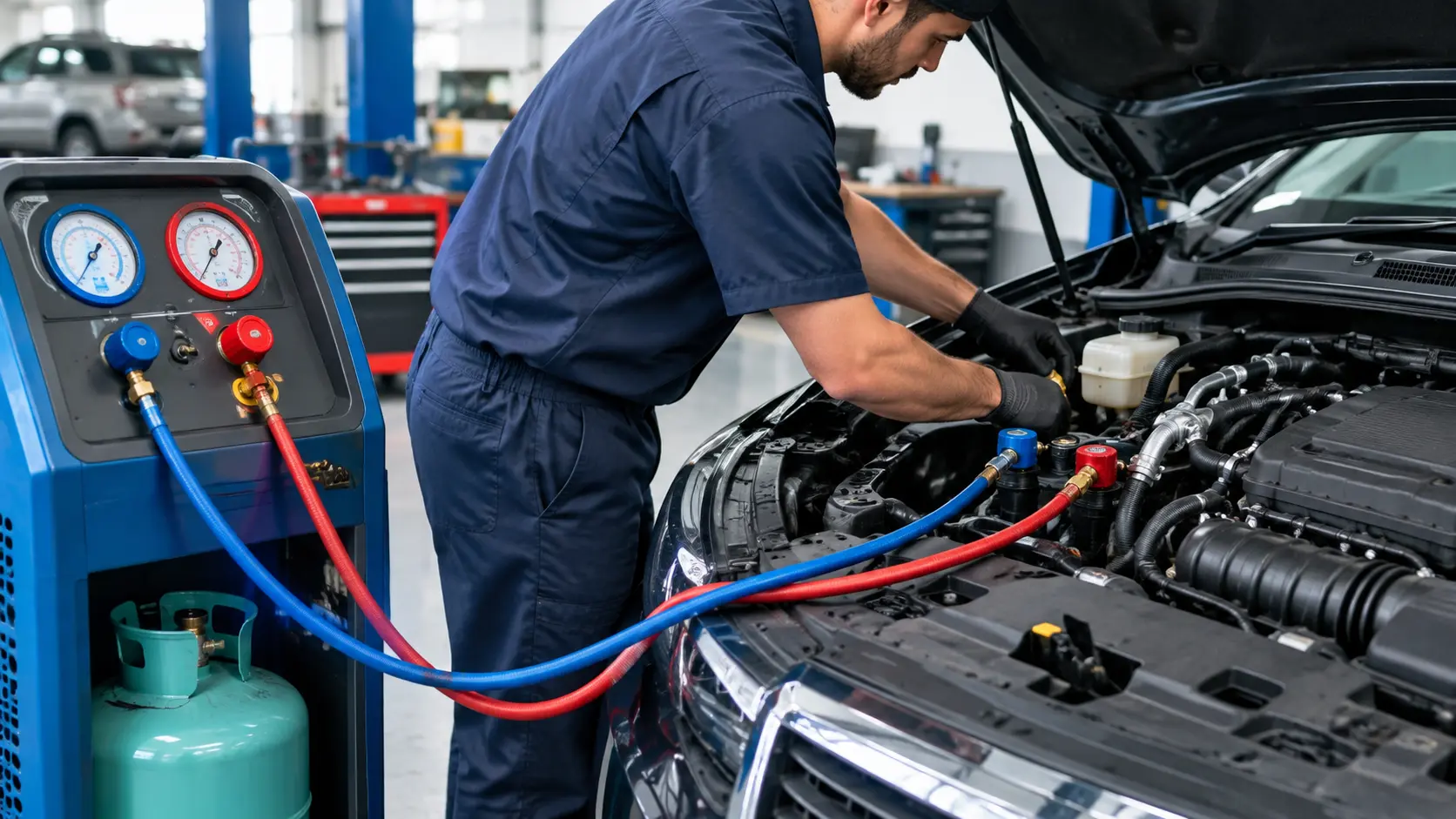
Vent temperature measurement at idle and under engine load. Compressor clutch engagement and cycling behaviour. Refrigerant pressure test — both high and low side. Condenser physical condition. In Dubai, a marginal AC system identified during a spring car inspection will fail completely by July. Refrigerant pressure testing identifies systems operating near the lower limit of acceptable before they fail under peak summer load.
Tyres
Tread depth across the full tyre width at multiple points. DOT age code — tyres over five years old in Dubai’s UV and heat environment are a replacement item regardless of remaining tread. Sidewall condition for cracking, bulging, and impact damage. Uneven wear patterns that reveal alignment or suspension issues. Matching brands across each axle.
What Car Inspections Find Most Often in Dubai
After conducting inspections across all makes, price ranges, and market sources, the same findings appear consistently.
Structural Damage Not in the Paperwork
The most common serious finding. Vehicles that present well at first glance regularly show paint depth anomalies on front quarters, bonnets, or rear panels. Some are cosmetic repairs done adequately. A meaningful proportion involve structural damage that was never properly addressed. These are declined regardless of price. A car inspection is the only reliable way to identify them.
Fault Code Histories That Were Cleared
More common than buyers expect. Gearbox fault histories on high-mileage SUVs. Airbag deployment records. ABS fault patterns that reappear under operating conditions. All found in fault history logs that a quality scanner retrieves even after the active codes were cleared before listing.
Cooling System Neglect
Degraded coolant, thermostat housing cracks from previous overheating, auxiliary water pump wear. None show visually. All require pressure testing and measurement. A car inspection that includes cooling system pressure testing catches these before they become the new owner’s problem.
Mileage Inconsistency
Wear indicators — suspension condition, steering wheel wear, seat bolster compression, pedal wear — that don’t match the stated mileage. Found regularly across all price ranges. Changes the negotiation position and the ownership cost calculation entirely.
Using the Inspection Report
For Negotiation
A written car inspection report gives you documented evidence rather than an opinion. Every finding is measured and recorded. Minor findings support minor price reductions. Significant findings either change the price substantially to reflect true ownership cost or change the decision entirely. The report is the document that converts a gut feeling into a negotiating position.
For Planning
If the inspection clears the car and you proceed, the report becomes the foundation of your ownership record. Items flagged as developing — pads at 35%, a tyre nearing wear limit, a coolant hose to monitor — go into a scheduled maintenance plan. Nothing surprises you in the first twelve months.
For initial service work after purchase, a qualified car mechanic with experience on the specific platform ensures the first service is done correctly to the right specification. A complete car service at the time of purchase sets the correct baseline for everything that follows — you know exactly what’s in the engine and what condition every serviceable item is in.
For paint correction or cosmetic repairs identified during the car inspection, professional car painting with manufacturer-matched colour codes handles everything from minor stone chip work to panel respray correctly.
When the car needs roadside support between services, a qualified mobile car mechanic handles battery issues, minor fault resets, and fluid checks on-site. For genuine emergencies, proper roadside assistance ensures safe recovery without damaging a vehicle you’ve just purchased.
For owners in Al Quoz and surrounding areas looking for a garage near me that conducts thorough, documented car inspections across all makes — the quality of the assessment determines the quality of the purchase decision.
FAQ
How much does a car inspection cost in Dubai?
Most quality workshops charge AED 200–350 — a small fraction of what hidden faults discovered after purchase typically cost to repair.
What does a car inspection include in Dubai?
Exterior paint depth measurement, underbody ramp inspection, engine bay assessment, cold start check, full multi-system diagnostic scan, transmission and brake assessment, suspension check, AC performance test, and a written report.
Can a seller refuse a car inspection in Dubai?
They can — but any seller confident in their car's condition has no reason to refuse, and a refusal is one of the clearest warning signs available before committing to a purchase.
How long does a proper car inspection take?
A thorough inspection covering all major systems with ramp assessment and full diagnostic scan takes 60–90 minutes depending on the vehicle.
Is a car inspection worth it on lower-priced used cars?
Always — the cost of the inspection is fixed regardless of the car's price, and the savings from identifying hidden faults are just as real on a AED 25,000 car as on a AED 150,000 one.
Conclusion
A car inspection is the simplest and most cost-effective protection available in Dubai’s used car market. It replaces uncertainty with information — about the car’s real condition, its genuine ownership costs, and whether the asking price reflects what’s actually being sold. In a market where accident histories get concealed, odometers get adjusted, and heat damage doesn’t show in listing photos, that information is what separates a smart purchase from an expensive one.
Rapid Rev Garage in Al Quoz conducts thorough car inspections for all makes and models — ramp inspection, full multi-system diagnostic scanning, paint depth measurement, and written reports. Book your appointment on WhatsApp or find the workshop on Google Maps.