A dent in a car park. A scrape from a tight ramp exit. A stone chip that’s been ignored long enough to spread. These are everyday realities of driving in Dubai — a city where parking is competitive, road surfaces carry aggregate from construction zones, and UV intensity is among the highest globally.
Searching for a denter painter near me in Dubai means finding a workshop that handles both the structural correction and the paint finish correctly — because either one done poorly makes the other irrelevant. A panel that’s been correctly straightened but poorly painted reveals itself within months. A beautifully sprayed panel that was never properly profiled before painting shows itself in raking light the first time sunlight hits it at the right angle.
A proper denter painter near me in Al Quoz handles the full process — from initial damage assessment through panel correction, preparation, colour matching, and finish application — with the discipline that makes the repair invisible rather than obvious.
Denter Painter Near Me Dubai — Why Preparation Is the Entire Job
Most bodywork complaints in Dubai aren’t about the painting itself — they’re about what happened before the paint went on.
Surface preparation determines everything that follows. A panel that was straightened to approximately the right profile rather than precisely the right profile produces a finish with subtle shape anomalies — visible when low-angle sunlight crosses the panel surface and reveals the undulations that weren’t there on the original pressed steel.
Filler applied too heavily over inadequately prepared metal develops adhesion failure as it cures. A primer coat applied too quickly after filler hasn’t had time to fully cure — producing a solvent-trapped layer that creates surface texture problems in the final finish.
Dubai’s UV intensity and heat cycling accelerate every preparation failure. A repair that was applied correctly but with incorrect primer chemistry for the substrate shows adhesion failure faster here than in a cooler climate. A repair where the clear coat was applied too thinly fades noticeably against the surrounding original panels within a single Dubai summer.
A BMW 5 Series came to Rapid Rev Garage after a budget bodyshop had repaired a rear door following a parking garage impact. Within eight weeks, the paint at the upper door edge had developed a visible step where new paint met original — a feathering failure in the preparation stage where the blend zone wasn’t properly graduated. The door had to be stripped and redone entirely.
The work a denter painter near me does before any paint is applied determines whether the repair needs redoing in eight weeks or holds perfectly for years.
Dent Removal — Choosing the Right Method
The correct dent removal method depends entirely on the damage type. A proper denter painter near me assesses each damage type independently before deciding on the approach.
Paintless Dent Removal
Paintless dent removal (PDR) is the correct technique when the paint surface is unbroken and the metal has deformed without cracking the finish. This covers door dings from neighbouring vehicles in car parks, minor hail damage, and isolated dents from low-energy impacts where the metal has been pushed inward without breaking the paint film.
PDR uses specialised tools to access the back of the panel and massage the metal back to its original profile from behind — no filler, no primer, no paint. The original factory finish is completely preserved. A properly executed PDR repair is invisible — the panel returns to the factory condition with the original paint intact.
PDR Limitations
PDR cannot address damage where the paint surface has cracked or chipped. It cannot address dents at panel edges where the metal has creased rather than simply dented. It cannot address damage in locations where access from behind is blocked by structural reinforcements or pillar sections.
A denter painter near me with PDR capability assesses each case honestly — recommending PDR where it produces the best outcome and conventional repair where PDR would leave the panel with residual damage.
Conventional Dent Repair
When paint has cracked, when the metal has creased, or when the damage is inaccessible from behind, conventional repair involves physical panel straightening, filler application, and respray.
Panel Straightening
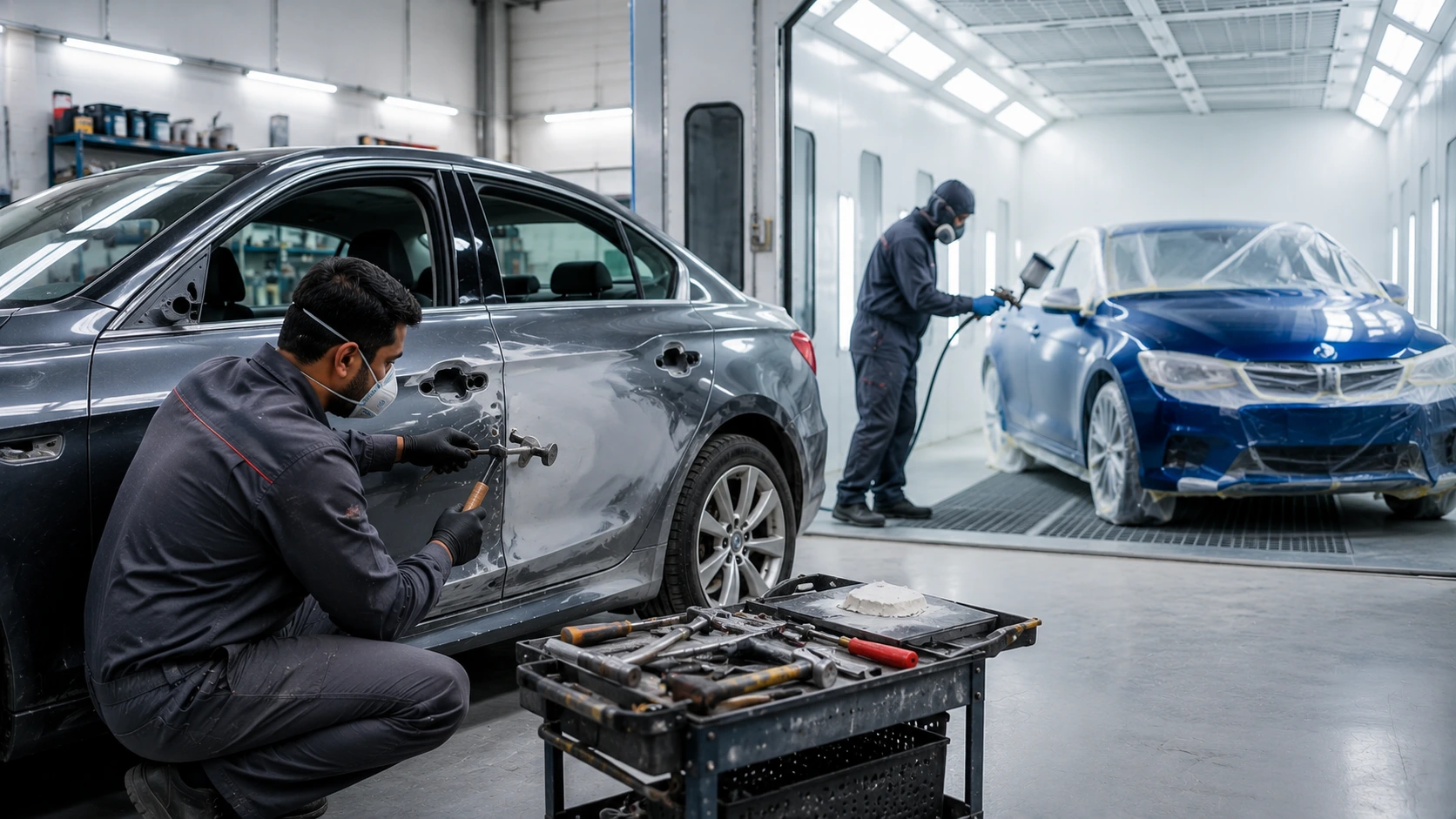
Panel straightening to the correct profile is the foundation of conventional dent repair. Using panel pulling equipment, stud welders, and hand tools, the technician restores the metal to as close to original profile as possible before filler is applied.
The profile quality at this stage determines how much filler is needed — and minimising filler is a quality indicator. Filler is used to restore the final surface profile, not to compensate for inadequate panel straightening. A panel pulled close to correct profile needs minimal filler. A panel that’s been roughly straightened needs significant filler to create the appearance of correct profile — and significant filler carries more adhesion failure risk over time.
Body Filler Application
Filler is applied in thin, sequential coats with correct cure time between each application. Each coat is sanded back to assess the remaining low areas before the next application. This iterative process builds up to the correct profile gradually rather than applying a single heavy coat that will crack as it contracts during cure.
Dubai’s heat affects filler cure rate — in summer ambient temperatures, cure accelerates. Allowing correct cure at the actual surface temperature rather than the room temperature the product was calibrated for requires experience and attention. A denter painter near me in Dubai that respects correct cure times produces filler that bonds correctly. One that rushes produces filler that separates.
Paint Preparation — What Happens Between Filler and Paint
The preparation stages between completed filler work and paint application are where the quality of a denter painter near me is most clearly demonstrated.
Primer Application
Primer serves multiple functions — it provides the correct surface chemistry for paint adhesion, it seals the filler from the environment, and it creates the final surface preparation layer for colour coat application.
The correct primer for each substrate matters — the primer chemistry for steel differs from that for aluminium, which differs from that for plastic bumper material. A denter painter near me that uses one universal primer across every material type is using incorrect chemistry on at least some substrates in every repair.
Primer coat thickness also matters. Too thin provides insufficient adhesion foundation. Too thick creates a layer that hasn’t bonded through to the substrate correctly.
Surface Finishing
After primer application, the surface is wet-sanded progressively through increasingly fine grit paper — removing any remaining surface imperfections, primer texture, and orange peel from the primer application. This creates the smooth, texture-free surface that colour coat requires.
Dubai’s dust environment complicates primer sanding — fine ambient dust that settles on the wet-sanded surface before colour coat is applied creates embedded particles in the finish. A proper denter painter near me applies primer in a controlled environment and applies colour coat before contamination can settle.
Tack Cloth and Final Surface Preparation
Immediately before colour coat application, the prepared surface is wiped with a tack cloth to remove any remaining fine dust. In Dubai’s environment, this step is particularly important — the gap between tack wipe and paint application should be minimised to prevent re-contamination.
Colour Matching — Where the Quality of a Denter Painter Near Me Is Most Visible
Paint colour matching is the element of bodywork that reveals the difference between a skilled denter painter near me and an average one most immediately — and most permanently.
Manufacturer Paint Code
Every vehicle has a manufacturer paint code identifying the precise pigment formulation. This code is the starting point — but not the end point.
Paint colour drifts with age and UV exposure. Original paint on a vehicle that has spent three Dubai summers in outdoor parking has faded slightly from its factory specification. A repair mixed exactly to the original code on a three-year-old Dubai vehicle will be slightly brighter than the surrounding aged original panels — immediately visible at the panel edge where new paint meets original.
Blend Zone Technique
Correct colour matching on an aged vehicle requires blending the new paint into adjacent panels through a gradual graduation zone — disguising the slight colour difference between new and UV-aged paint. A denter painter near me that sprays to the panel edge without a blend zone produces a colour step visible immediately under normal light.
Proper blend zone execution feathers the colour coat progressively into the adjacent panel, applies clear coat to blend the sheen, and polishes the entire affected area to remove any texture variation.
Metallic and Pearl Application
Metallic and pearl paint finishes require specific spray technique for correct visual matching. The metallic flake orientation during spraying — determined by gun distance, air pressure, and movement speed — affects how the colour appears at different viewing angles.
A metallic repair sprayed with incorrect gun speed produces a finish that matches at direct viewing and shows a colour variation at an angle. This is the most common metallic colour match failure in Dubai’s bodywork market.
A proper denter painter near me test-sprays the mixed colour on a test panel, evaluates it at multiple viewing angles including the same angles at which the repaired panel will be viewed on the vehicle, and adjusts the mix before committing to the repair.
Specialist Finishes
Matte finishes, two-tone paint, and custom colours require specific expertise beyond standard metallic repair. Matte clear coat has different chemistry from gloss clear — gloss clear over a matte colour produces a finish that’s obviously wrong. A denter painter near me handling matte finishes uses the correct matte clear coat and understands that polishing matte clear creates irreversible gloss — so standard finishing steps that work on gloss paint cannot be applied to matte.
Clear Coat Application and Quality
The clear coat is the layer that determines the long-term durability and gloss of the repair — and in Dubai’s UV environment, clear coat quality and thickness are more important than in almost any other market.
Clear Coat Specification
UV-resistant clear coat with the correct specification for Dubai’s climate is the correct choice for any denter painter near me repair in the UAE. Clear coat that lacks sufficient UV stabiliser package degrades in Dubai’s solar intensity faster than in European climates — producing the fading at panel edges that is the most common long-term bodywork failure seen in Dubai’s market.
Clear Coat Thickness
Clear coat must be applied at the correct film thickness — thick enough to provide UV protection and allow future polishing if needed, but not so thick that it creates runs or sags.
A single thick coat is never as good as two or three thinner coats with correct flash-off time between applications. Multiple thinner coats cross-link correctly, build the correct film thickness evenly, and avoid the runs and sags that a single heavy coat risks.
Polishing After Clear Coat
After clear coat is fully cured, the repair area is polished with progressively finer compound and polish to remove any orange peel texture from the spray application and to blend the repaired area’s sheen into the surrounding original panels.
Polishing requires experience — too aggressive or too much heat from the polishing machine damages the clear coat. In Dubai’s heat, polishing immediately after a cure bake risks the clear coat being too warm for safe machine polishing.
Common Dent and Paint Damage Scenarios in Dubai
A proper denter painter near me in Dubai sees specific damage patterns repeatedly — the same road conditions, the same parking environments, and the same UV damage patterns that Dubai’s specific environment produces.
Multi-Storey Car Park Damage
Dubai’s multi-storey car parks — tight entry ramps, narrow bays, high vehicle density — produce the highest volume of bodywork enquiries. Door dings, scrapes from bay exit manoeuvres, and bumper contact from parking misjudgements are the most common types.
Most car park damage is PDR territory where paint is intact. Where paint has been broken — a scrape that has cut through to bare metal — conventional repair with primer and paint is required.
Stone Chip Damage on Bonnets
Dubai’s highway conditions and the aggregate from construction traffic create high-frequency stone chip damage on bonnets, front bumpers, and lower door sills. Stone chips left unaddressed are rust entry points on steel panels.
A denter painter near me addressing stone chips correctly uses micro-repair technique — cleaning each chip to bare metal, applying primer, and colour-matching rather than brush-touching which seals the chip but with different surface texture and often poor colour match.
Sun-Faded Clear Coat
Dubai’s UV intensity creates clear coat failure on vehicles consistently parked outdoors — particularly on roof panels, bonnets, and boot lids. The clear coat develops a chalky, dull appearance as UV radiation breaks down the polymer structure.
Where clear coat degradation is limited to surface dulling, machine polishing recovers some of the gloss by removing the degraded surface layer. Where the degradation has penetrated through the clear coat to the colour layer, full panel respray with correct UV-resistant clear coat is the only correct solution.
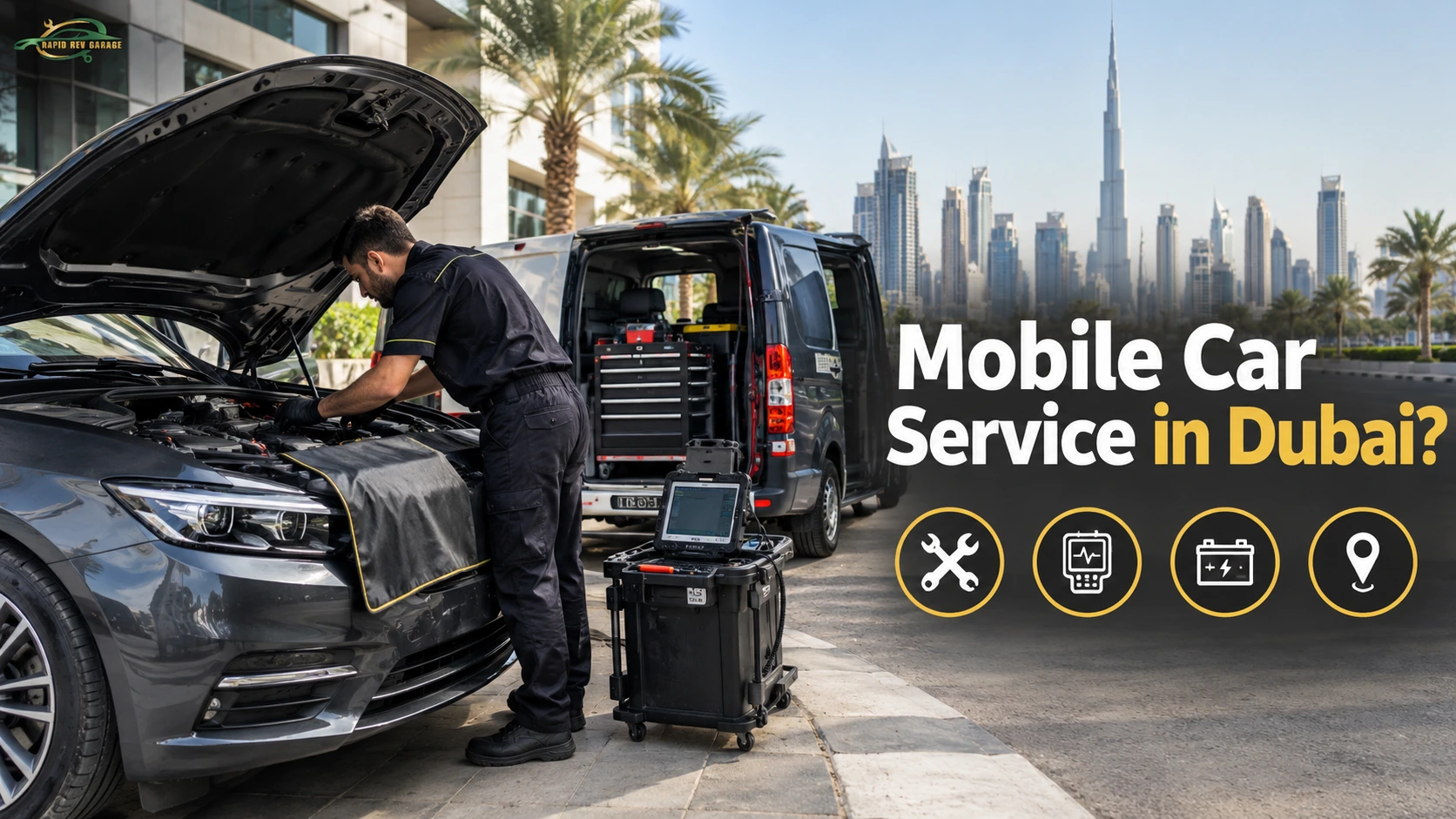
For owners who need initial on-site damage assessment before deciding how to proceed, a qualified mobile car mechanic can attend the vehicle’s location and advise on the extent of damage and whether the car is safe to drive to the workshop.
When collision damage accompanies the bodywork — mechanical or structural damage from an impact that also affected the paint — proper roadside assistance ensures the vehicle reaches the workshop without additional damage during recovery.
A complete car service alongside bodywork is efficient — mechanical and cosmetic issues addressed in one visit rather than separate trips. A qualified car mechanic assesses any mechanical concerns identified during the bodywork inspection.
For owners in Al Quoz and surrounding areas looking for a garage near me that handles dent removal and professional paint finishing correctly — the preparation quality before any paint is applied is the deciding factor in how long the repair lasts.
FAQ
What is the difference between PDR and conventional dent repair?
PDR preserves the original paint by reshaping metal from behind — suitable when paint is undamaged. Conventional repair with filler and respray is required when paint has cracked, metal has creased, or the damage is inaccessible from behind.
How do I know if a denter painter near me will match my car's colour correctly?
Ask whether they test-spray on a panel before committing to the repair, and whether they use blend zone technique on adjacent panels — a proper shop does both as standard.
How long does dent repair and paint work take in Dubai?
Minor single-panel repairs typically take one to two days. Larger collision repairs involving multiple panels and structural assessment can take three to seven days depending on parts availability.
Will the repaired panel fade faster than the original paint in Dubai's heat?
A repair using UV-resistant clear coat at correct thickness will hold up comparably to the original. A repair with insufficient clear coat or incorrect UV stabiliser chemistry will show fading at the panel edge faster.
Is paintless dent removal permanent?
Yes — a correctly executed PDR repair is permanent. The metal is returned to its original profile and the original paint is undisturbed.
Conclusion
A proper denter painter near me in Dubai is defined by preparation discipline — the profile accuracy of the panel straightening, the filler application technique, the primer chemistry for the substrate, the colour match assessment before committing to the repair, and the clear coat specification for Dubai’s UV environment. Paint applied correctly over correctly prepared surfaces lasts. Paint applied over shortcuts shows within months.
Rapid Rev Garage in Al Quoz handles dent removal and professional paint finishing for all makes — PDR, conventional repair, colour matching, and specialist finishes — with preparation standards and clear coat specification suited to Dubai’s conditions. Book your appointment on WhatsApp or find the workshop on Google Maps.