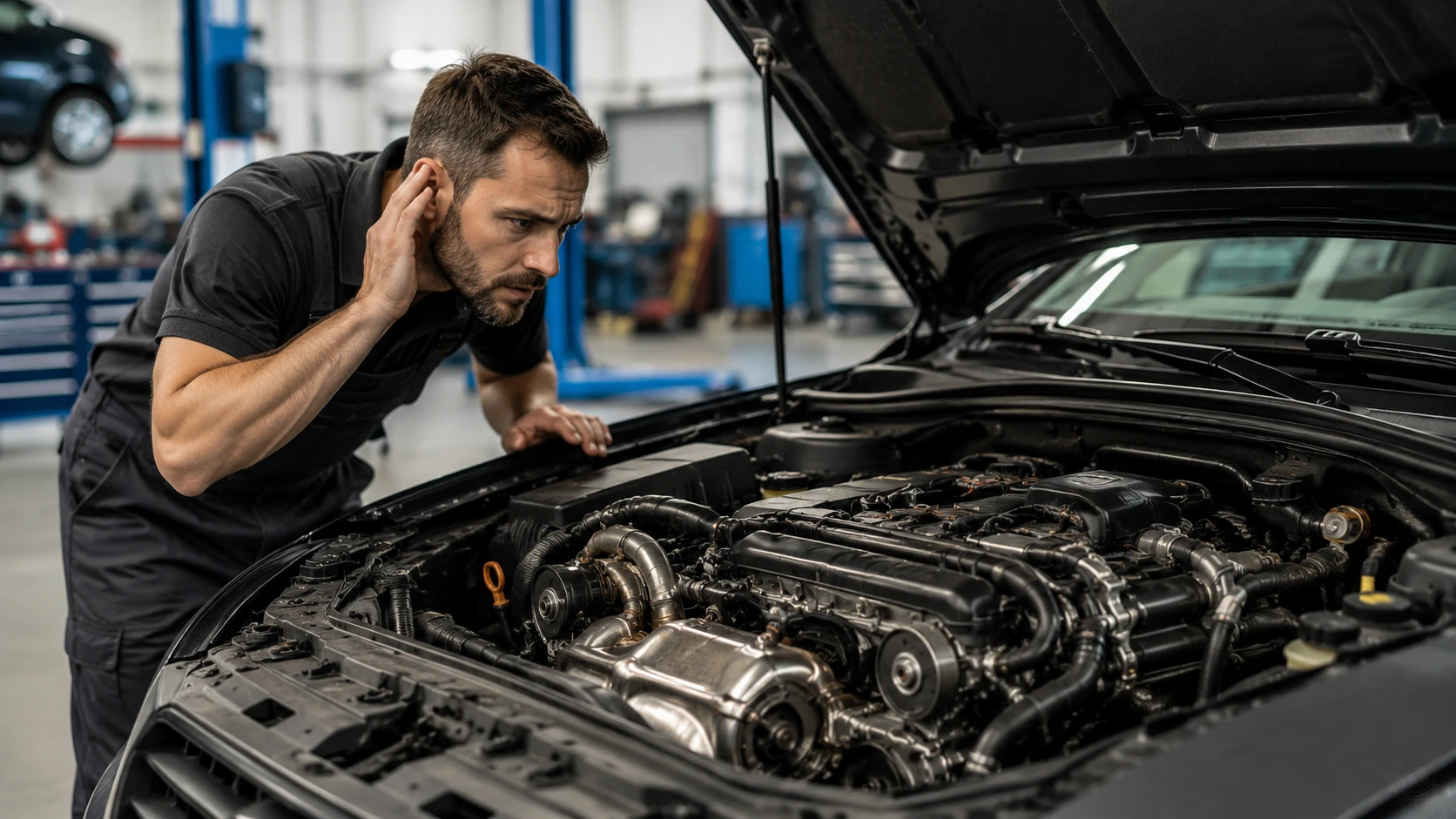
A metallic noise from under the hood is one of those sounds that immediately grabs attention — whether it is a rattle that appears on cold starts, a clinking that changes with engine speed, or a grinding that appears under acceleration. Metallic noise from under the hood has a specific character that points toward a different source, and identifying which component is producing it before opening anything up with metallic noise from under the hood is what makes the difference between a targeted repair and an expensive guessing game.
At Rapid Rev Garage in Al Quoz, we diagnose under-hood metallic noise across all makes and models using a structured listening assessment, ramp inspection, and diagnostic scanning before any component is recommended for replacement.
Metallic Noise From Under the Hood — Quick Verdict
Metallic noise from under the hood in Dubai most commonly comes from loose exhaust heat shields, a failing accessory belt tensioner or pulley bearing, a cracked exhaust manifold or flex section, valve train noise from degraded oil, or a loose engine mount allowing abnormal engine movement. Dubai’s heat and road conditions accelerate all five causes — heat shields corrode faster, belt tensioner bearings dry out sooner, and oil that’s past its service life causes valve train noise earlier than European service intervals assume. The noise character and when it appears are the primary diagnostic tools before any inspection begins.
Table of Contents
- Reading the Noise Before Touching Anything
- The Most Frequent Sources of Metallic Hood Noise
- How Dubai’s Conditions Make This More Common
- How We Identify the Exact Source at Rapid Rev Garage
- Getting It Fixed — Repairs Matched to Each Cause
- When Metallic Noise Signals Something Serious
- Is It Safe to Drive With This Noise?
- How Long the Repair Takes
- What the Repair Costs in Dubai
- Preventing Hood Noise From Developing
- Why Rapid Rev Garage?
- FAQ
- Conclusion
Reading the Noise Before Touching Anything
The noise character is the most useful information when diagnosing metallic noise from under the hood before the bonnet is opened. Taking two minutes to observe the exact pattern narrows the possible sources significantly before any physical inspection begins.
Timing — When Does the Noise Appear?
A metallic rattle that appears immediately on cold start and fades as the engine warms up points toward metal components that have cold-temperature gaps — exhaust manifold cracks, heat shield gaps that close as metal expands, or valve train noise from oil that hasn’t yet circulated. A noise that appears only under acceleration points toward components under load — belt tensioners, engine mounts, or exhaust flex sections. A noise that is constant regardless of engine RPM but changes with vehicle speed points toward wheel bearings or brake components rather than the engine itself.
Location — Where Does the Sound Come From?
A noise from the top of the engine tends to be valve train or cam-related. A noise from the front of the engine near the belts tends to be belt, pulley, or tensioner-related. A noise from underneath the vehicle near the exhaust tends to be heat shield or exhaust component-related. These are starting points for the ramp inspection, not definitive diagnoses.
How the Noise Changes With Conditions
A metallic noise that changes volume when the steering is turned but not when the accelerator is pressed tends to be a belt or pulley fault — the power steering pump belt load changes with steering input. A noise that only appears on acceleration under load tends to be an engine mount or exhaust flex section. A constant random rattle that isn’t connected to RPM or vehicle speed tends to be a loose heat shield vibrating against surrounding components.
The Most Frequent Sources of Metallic Hood Noise
Each source has a specific noise character that helps identify it before physical inspection.
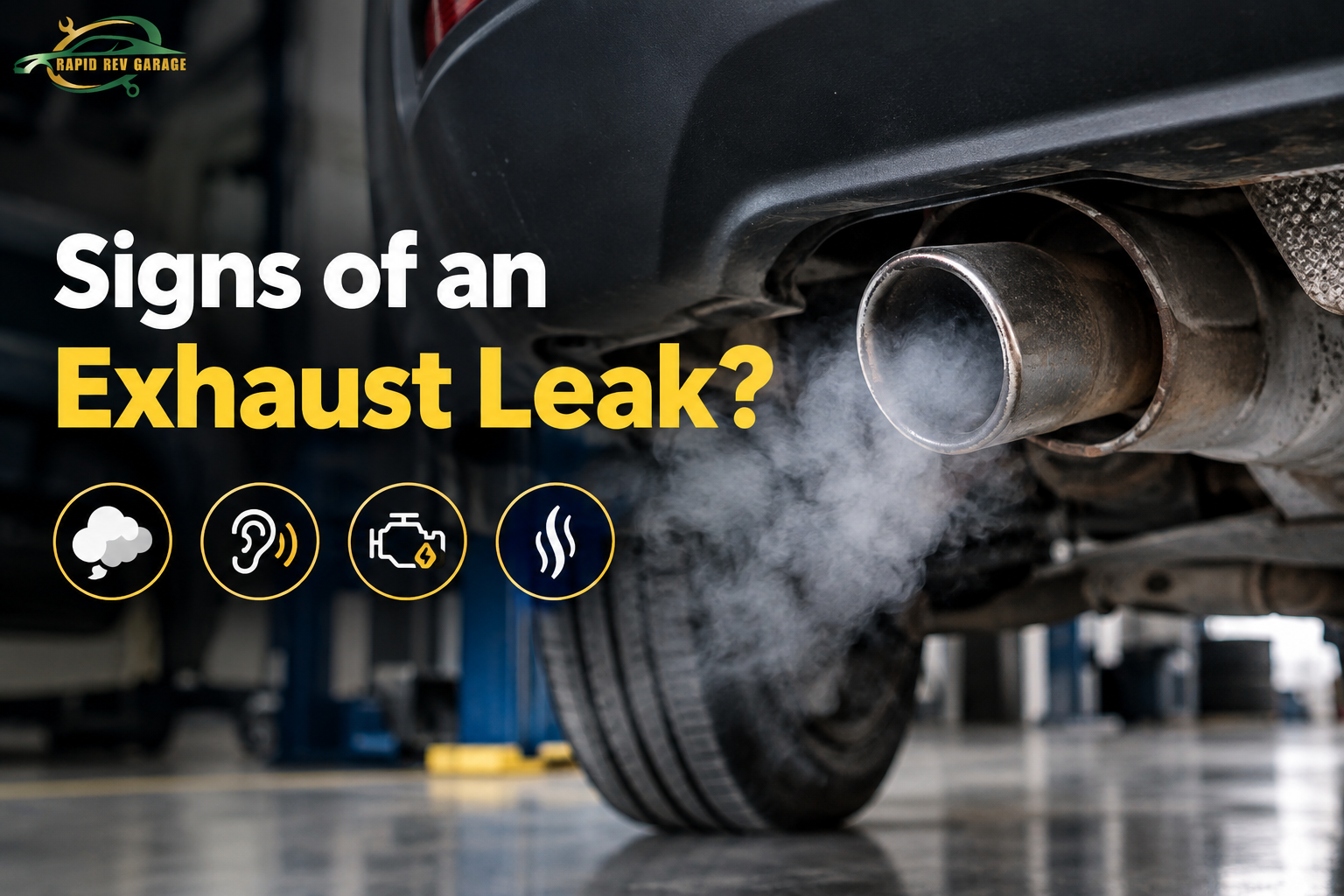
Loose or Cracked Exhaust Heat Shield
Heat shields are thin metal panels mounted to the exhaust manifold, catalytic converter, and exhaust pipes to protect surrounding components. The attachment points — clamps, bolts, and spot welds — corrode and lose clamping force over time, allowing the shield to vibrate against the exhaust or surrounding bodywork.
Why the Noise Changes With RPM
A loose heat shield vibrates sympathetically with exhaust system vibration — which changes with engine RPM. The noise appears or becomes louder at specific RPM ranges where the vibration frequency matches the heat shield’s resonant frequency. This creates the pattern drivers describe as “rattles at certain revs but not at others.”
The Fire Risk If Left Too Long
Heat shields exist to protect fuel lines, brake lines, and wiring from the extreme temperatures the exhaust generates. A shield that has completely separated from its mounting leaves these components exposed. This is the reason heat shield noise should not be dismissed as just a rattle — the consequences of ignoring it extend beyond noise.
Failing Belt Tensioner or Accessory Pulley Bearing
The serpentine belt drives the alternator, power steering pump, air conditioning compressor, and water pump from the crankshaft. The belt tensioner maintains correct belt tension through a spring-loaded pulley. Idler pulleys guide the belt around the engine. When a tensioner or idler pulley bearing fails, it produces a distinctive metallic squealing, chirping, or grinding — often described as a metallic noise coming from the front of the engine bay.
How to Identify a Pulley Fault Specifically
A failed pulley bearing produces a noise that stays constant as the engine RPM changes — because the pulley rotates at belt speed rather than directly at engine speed. Using an automotive stethoscope on each pulley while the engine runs identifies the specific failing bearing before any belt work begins. Our car mechanic team uses this method on every belt and pulley complaint before recommending any component replacement.
Cracked Exhaust Manifold
An exhaust manifold crack produces a distinctive ticking or tapping noise that is loudest on cold start and decreases as the engine warms up and the metal expands — partially closing the crack. This temperature-dependent behaviour is the clearest indicator of a manifold crack. On turbocharged engines, a manifold crack also allows exhaust gases to bypass the turbocharger, reducing boost pressure alongside the noise.
Valve Train Noise From Oil Degradation
A tapping or ticking from the top of the engine — faster than engine RPM, occurring at valve timing speed — indicates the valve train is not receiving adequate oil pressure or is running on degraded oil. Hydraulic lifters and VVT actuators both produce this pattern when oil has degraded below its protective film threshold. In Dubai, where short-trip stop-start driving degrades oil faster than any European service interval assumes, this is a regular finding.
Loose Engine Mounts
Engine mounts absorb the engine’s normal vibration and movement. A failed mount allows the engine to move further than designed under torque, producing a metallic clunk or thud — particularly noticeable when accelerating from rest, when changing gears, or on uneven road surfaces. The engine physically moving and contacting surrounding components produces the metallic sound.
How Dubai’s Conditions Make This More Common
Dubai’s environment accelerates every one of the five causes of metallic noise from under the hood above through specific mechanisms.
Heat Corrosion of Heat Shield Attachment Points
Heat shield mountings corrode faster in Dubai’s alternating heat and occasional humidity than in stable-temperature climates. Bolt threads and clamp contact surfaces exposed to extreme heat and then occasional condensation develop accelerated oxidation that removes clamping force faster than factory replacement intervals assume.
Belt Tensioner Bearing Degradation in Heat
Tensioner and idler pulley bearings are lubricated with sealed grease. Sustained high underbonnet temperatures — particularly in vehicles parked in direct Dubai sun — cause bearing grease to thin and eventually be expelled from the bearing, accelerating dry contact wear. A bearing that would last 100,000 km in European conditions may need replacement at 60,000–70,000 km in Dubai.
Oil Degradation From Stop-Start Heat and Short Trips
Stop-start Business Bay and Al Quoz commuting in sustained heat degrades oil faster than any factory service schedule designed for European motorway patterns assumes. Valve train noise appearing earlier than expected on a Dubai vehicle almost always traces back to oil that’s been extended past its effective service life.
For any breakdown caused by a serious mechanical noise, our roadside assistance covers Al Quoz and nearby Dubai areas.
How We Identify the Exact Source at Rapid Rev Garage
An accurate diagnosis of metallic noise from under the hood requires more than listening from outside the bonnet.
Structured Listening Under Different Conditions
The diagnostic road test assesses the noise under cold start, warm engine idle, acceleration from rest, cruise at different speeds, and engine braking. Each condition loads different components — systematically eliminating those that produce no noise change from the list of suspects.
Stethoscope Inspection of Each Component
An automotive stethoscope applied to each suspected component while the engine runs identifies the specific source that produces the loudest signal. This distinguishes a failing idler pulley bearing from a failing tensioner bearing from a valve train noise — components that are millimetres apart but require different repairs.
Ramp Inspection for Heat Shield and Mount Condition
With the vehicle raised on the ramp, heat shield attachment points are physically checked for corrosion and movement. Engine mount condition is assessed visually and by applying lever force to check for excessive movement. Exhaust flex section condition and manifold crack evidence are checked at this stage.
Diagnostic Scan for Stored Fault Codes
A full diagnostic scan reads any stored fault codes in the engine, VVT, and oil pressure modules — catching electronic faults that produce valve train or engine management noise without any physical component failure being visible during ramp inspection.
Getting It Fixed — Repairs Matched to Each Cause
The repair is confirmed from the diagnostic findings — not assumed from the noise character alone.
Heat Shield Re-securing or Replacement
A loose heat shield is re-secured to the exhaust using the correct clamp or fastener for the specific mounting point. Where the shield itself has cracked or corroded beyond re-securing, replacement is the correct repair. Both are completed in under an hour in most cases.
Belt, Tensioner, and Pulley Replacement
A failing tensioner or idler pulley is replaced with a correctly-specified unit for the vehicle. When a tensioner or pulley requires replacement, the serpentine belt is replaced at the same time — a belt that has been running on a failing tensioner may have developed wear from inconsistent tension that shortens its remaining life. Our car service packages include belt and tensioner condition checks at every scheduled service.
Exhaust Manifold Repair or Replacement
A cracked exhaust manifold is repaired by welding where the crack geometry allows, or replaced where it doesn’t. On turbocharged engines, the turbocharger inlet condition is inspected following manifold work to confirm no debris has entered.
Oil Change and Valve Train Assessment
Valve train noise from oil degradation is addressed first with a correct-specification oil change — often resolving the noise immediately if the oil is the primary cause. Where noise persists after fresh oil, VVT actuator solenoid testing and physical valve clearance assessment determine whether mechanical wear requires further intervention.
Engine Mount Replacement
Failed mounts are replaced as a set on the affected axle. A single failed front mount typically warrants replacement of both front mounts given their similar age and exposure.
When Metallic Noise Signals Something Serious
Not all metallic hood noises carry the same urgency.
Deep Knock From the Lower Engine — Act Immediately
A deep, rhythmic knock from the lower engine that worsens under acceleration is bearing noise — and bearing noise that is allowed to progress produces catastrophic engine failure. This noise is in a completely different urgency category from a heat shield rattle.
Metallic Noise With a Warning Light — Don’t Dismiss Either
A metallic noise accompanied by an oil pressure warning, a check engine light, or a temperature warning is the engine communicating on two channels simultaneously. Neither the noise nor the light should be dismissed while waiting to see what happens next. For exterior repairs needed alongside mechanical work, our car painting team handles colour-matched repairs in the same visit.
Is It Safe to Drive With This Noise?
The answer depends entirely on the type of noise.
Heat Shield Rattle — Driveable Short Term
A heat shield rattle — random, not connected to RPM — is driveable in the short term but should be addressed within the week. The safety risk is the secondary consequence if the shield falls off completely, not the noise itself.
Belt or Pulley Noise — Book This Week
A belt or pulley noise that changes with RPM should be assessed within the week. A pulley bearing that fails completely while driving sheds the serpentine belt, losing power steering, charging, and water pump function simultaneously.
Deep Engine Knock — Stop and Call
A deep knock from the lower engine means minimize driving distance and arrange inspection or recovery as soon as possible.
How Long the Repair Takes
Repair time varies significantly by confirmed source.
Heat Shield Work
Heat shield re-securing or replacement: typically under one hour same-day.
Belt and Pulley Work
Tensioner and pulley replacement with belt: one to two hours depending on engine access.
Manifold and Oil System Work
Exhaust manifold repair or replacement: two to four hours. Valve train oil-related work: oil change in under an hour, VVT actuator work two to three hours.
Engine Mount Replacement
Engine mount replacement: two to four hours depending on the vehicle and mount accessibility.
What the Repair Costs in Dubai
Cost depends entirely on the confirmed cause.
Simple Fixes
Heat shield re-securing or replacement: AED 150–450. Serpentine belt replacement: AED 300–700. Tensioner and idler pulley replacement: AED 500–1,200 depending on the vehicle.
Mid-Range Repairs
Exhaust manifold repair or replacement: AED 800–2,500 depending on vehicle and manifold complexity. Engine mount replacement: AED 600–1,800 for a pair.
Valve Train Work
Oil change: AED 200–600 depending on oil specification. VVT actuator replacement: AED 800–2,000 depending on engine and accessibility. A written estimate is provided after diagnosis and before any work begins. Our mobile car mechanic covers Al Quoz and nearby Dubai areas for on-site initial assessment.
Preventing Hood Noise From Developing
Specific maintenance habits address most metallic noise causes before they develop.
Oil Changes at Dubai-Appropriate Intervals
Valve train noise from oil degradation is the most preventable cause on this list. Oil changes at 8,000 km for Dubai city drivers rather than factory maximum intervals maintain the oil quality that keeps hydraulic lifters, VVT actuators, and timing chain tensioners working correctly and quietly.
Belt and Tensioner Inspection at Every Service
Belt condition and tensioner bearing smoothness are quick visual and tactile checks that take under two minutes during any service visit. Catching a tensioner bearing that’s beginning to feel rough before it produces a noise prevents the belt loss that follows complete bearing failure.
Ramp Inspection Including Heat Shield Attachment Points
A ramp inspection that specifically checks heat shield attachment point integrity catches loose shields before they develop into noise — and before they create the fire risk of a fully detached shield near exhaust components. Our garage near me location in Al Quoz serves drivers across Business Bay, Jumeirah, Barsha, Satwa, Downtown, and the Sheikh Zayed Road corridor.
Why Rapid Rev Garage?
Metallic noise from under the hood at Rapid Rev Garage follows a systematic diagnostic protocol. We identify the specific noise source before recommending any repair — because a heat shield rattle that’s dismissed as a belt noise, or a valve train tick that’s assumed to be a manifold crack, produces the wrong repair. The structured listening assessment, stethoscope inspection, and ramp check together identify the source accurately in most cases within one hour. Every metallic noise complaint follows this sequence before any cost discussion begins.
FAQ — Metallic Noise From Under the Hood
These are the questions most frequently asked about this fault.
Is a metallic rattle under the hood always serious?
Not always — a loose heat shield rattle is a safety concern from the secondary consequences but not an immediate drive-stopping emergency. A deep knock from the lower engine is serious and requires immediate action.
Why does my metallic noise only appear at certain engine speeds?
Components that vibrate sympathetically with exhaust or engine vibration — heat shields, loose brackets, loose heat shrouds — resonate at specific frequencies corresponding to specific RPM ranges. Changing RPM changes the vibration frequency, and the noise appears or disappears as the resonant frequency of the component is crossed.
Can a metallic noise under the hood go away on its own?
Sometimes a noise disappears temporarily as components warm up and expand — closing gaps that were causing contact in cold conditions. A noise that disappears when warm but returns on the next cold start hasn't gone away — the fault is still present and will progress.
Does a serpentine belt noise mean I need a new belt?
Not necessarily — the noise may be from the tensioner bearing rather than the belt itself, or from a specific idler pulley. Testing each component individually identifies the specific failing part before any belt work is recommended.
How often should exhaust heat shields be checked in Dubai?
At every ramp inspection — which should happen at every service visit. The corrosion rate on heat shield mounting hardware in Dubai's conditions is faster than in any European market, and catching a loose shield before it rattles prevents both the noise and the fire risk.
Conclusion
Metallic noise from under the hood in Dubai has specific, identifiable causes — each with a distinctive noise pattern, a specific diagnostic approach, and a matched repair. A structured listening assessment before any bonnet is opened narrows the field significantly. A ramp inspection and stethoscope check then confirm the source. Rapid Rev Garage in Al Quoz diagnoses every under-hood metallic noise through this sequence before any repair is recommended.
Rapid Rev Garage is in Al Quoz, serving drivers across nearby Dubai areas — Business Bay, Jumeirah, Downtown, Barsha, Satwa, and the Sheikh Zayed Road corridor. Book your appointment on WhatsApp or find us on Google Maps.
Rapid Rev Garage — Metallic Noise From Under the Hood | Al Quoz, Dubai