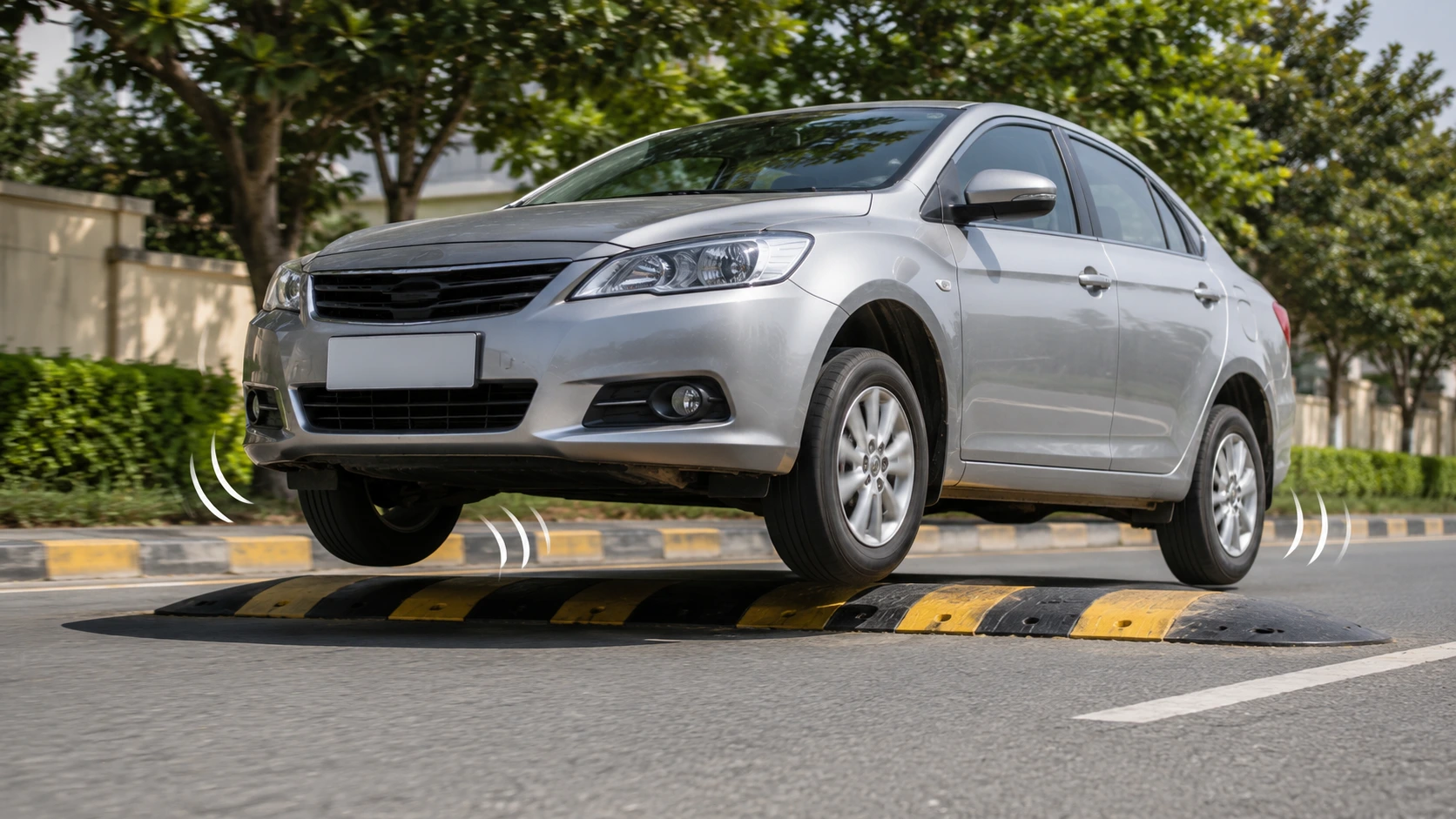
When a car bounce after speed breakers continues for two, three, or more oscillations — the vehicle rising and falling repeatedly instead of settling immediately — the suspension system is not doing its job. A correctly functioning suspension absorbs the impact of a speed breaker and returns the vehicle to its normal ride height in a single, controlled movement. Continued bouncing means the damping that controls that return movement has failed or degraded significantly.
In Dubai, speed breakers are among the most frequent causes of suspension complaints at any workshop. The city has thousands of them — at mall entrances, residential streets, school zones, and petrol station exits — and every single one is a test of the shock absorber’s ability to control body movement. A suspension that is marginal in cooler conditions fails visibly here.
At Rapid Rev Garage in Al Quoz, we diagnose post-speed-breaker bounce with a full suspension inspection and road test before any component is recommended for replacement.
Car Bounce After Speed Breakers — Quick Verdict
A car that bounces after speed breakers in Dubai is almost always caused by worn or failed shock absorbers or struts that can no longer damp the spring’s rebound movement. Secondary causes include broken or weakened coil springs that have lost their rated stiffness, worn top mount bearings that allow the strut to move excessively at its upper attachment point, or degraded suspension bushings that allow components to shift rather than absorb the impact cleanly. In Dubai, shock absorbers wear faster than any factory replacement interval assumes — the combination of high-frequency speed breaker impacts, sustained heat, and loaded vehicles accelerates damper wear significantly. The bounce is the damper telling you it has reached the end of its working life.
Table of Contents
- How a Healthy Suspension Controls a Speed Breaker
- What the Bouncing Is Actually Telling You
- The Parts That Fail and Why — Ranked by Frequency
- Why Dubai’s Speed Breakers and Heat Are a Damaging Combination
- How We Confirm the Exact Fault at Rapid Rev Garage
- Getting It Fixed — The Right Repair for Each Component
- What Happens If This Is Left Without Repair
- Is It Still Safe to Drive?
- How Long the Repair Takes
- What the Repair Costs in Dubai
- Preventing Early Suspension Wear in Dubai
- Why Rapid Rev Garage?
- FAQ
- Conclusion
How a Healthy Suspension Controls a Speed Breaker
Understanding what a correctly working suspension does when crossing a speed breaker explains immediately why continued bouncing means something has failed.
The Spring’s Job — Absorbing the Impact
When the wheel hits a speed breaker, the spring compresses to absorb the upward energy of the impact. This is the suspension’s first job — converting a sharp vertical impact into a controlled spring compression rather than transmitting the full force directly to the vehicle body and occupants.
The Damper’s Job — Controlling the Return
Once the spring has compressed, it stores energy that must be released in a controlled way as the wheel returns to its normal position. The shock absorber — or damper — controls this return movement by converting the spring’s stored energy into heat through a piston moving through hydraulic fluid. A correctly functioning damper allows the spring to return the wheel to ride height in a single, controlled movement with no overshoot.
Why Continued Bouncing Means the Damper Has Failed
When the damper can no longer control the spring’s return energy — because its internal hydraulic fluid has degraded, its valving has worn, or it has lost fluid through seal failure — the spring returns to its normal length and then overshoots. The vehicle rises past ride height, the spring then compresses again from the other side, and the cycle continues. Each subsequent bounce is smaller than the previous one, but the continued oscillation is the direct evidence of a damper that is no longer controlling spring movement.
What the Bouncing Is Actually Telling You
The specific character of the bounce after a speed breaker provides useful information before any inspection begins.
How Many Bounces Before the Car Settles?
A car that bounces once and settles is functioning correctly — the single return movement is expected. A car that bounces two to three times before settling has dampers that are approaching end of life. A car that bounces four or more times, or continues oscillating for several seconds after the speed breaker, has dampers that have already failed their primary function.
Which End Bounces More?
If the rear of the vehicle bounces more than the front after a speed breaker, the rear dampers have worn further than the fronts — which is common on vehicles used for regular passenger or luggage loading. If the front bounces more, the front struts are the primary concern. If both ends bounce equally, the entire suspension has reached end of life — which typically happens on higher-mileage vehicles where all four dampers have worn on a similar timeline.
Does It Feel Different at Different Speeds?
A car bounce after speed breakers that is worse at low speeds but less noticeable at highway speeds indicates the dampers have lost their low-speed valving control. This is actually the most common wear pattern — low-speed damping fails before high-speed damping because low-speed suspension movements happen far more frequently in Dubai’s urban driving than high-speed compression events.
Noise Accompanying the Bounce
A knocking or clunking sound from the suspension when crossing a speed breaker — alongside the continued bounce — adds diagnostic information. Noise from the top of the strut assembly points toward a worn top mount bearing. Noise from the lower suspension area points toward worn lower bushings or a damper that has bottomed out from insufficient travel.
The Parts That Fail and Why — Ranked by Frequency
Several components contribute to post-speed-breaker bounce, but they fail in a specific order of frequency in Dubai’s conditions.
Worn Shock Absorbers and Struts — The Primary Cause
The shock absorber — standalone on vehicles with separate springs and dampers, or integrated into a strut assembly on MacPherson strut systems — is the component responsible for controlling bounce in almost every case. The internal hydraulic fluid degrades from sustained heat exposure, the piston seals wear from millions of compression cycles, and the valving that controls damping force becomes inconsistent.
How Shock Absorber Wear Progresses in Dubai
A shock absorber does not fail suddenly in most cases — it degrades progressively. The first sign is a slightly less controlled ride over large bumps. This progresses to the first extra bounce after a speed breaker. Eventually the damper reaches a state where it provides almost no resistance to rebound movement and the bouncing after speed breakers becomes severe and continuous.
The Visual Test That Confirms Worn Shocks
Pressing firmly down on the corner of the vehicle and releasing quickly — the bounce test — should produce a single rebound and settle. If the vehicle bounces twice or more, the damper on that corner has insufficient rebound control. This test takes 30 seconds per corner and is the fastest preliminary confirmation of shock absorber condition.
Why Dubai’s Speed Breakers Specifically Accelerate Shock Wear
Every speed breaker crossing is a full compression event for the shock absorber. In Dubai, where a typical daily commute crosses dozens of speed breakers — petrol station ramps, mall entrances, residential zones, school zones — a shock absorber accumulates a day’s worth of full compression events in the time a European motorway driver accumulates one or two. The total number of compression cycles on a Dubai urban-driven vehicle is dramatically higher than on any motorway-driven vehicle of equivalent mileage.
Weakened or Broken Coil Springs
Springs themselves can fail — not through wear in the same way a damper fails, but through fatigue cracking or complete fracture. A spring that has cracked typically produces a characteristic metallic sound on speed breaker impacts before it fractures completely. A fractured spring produces a sudden change in ride height on the affected corner — the vehicle sits visibly lower on that side.
How a Weakened Spring Contributes to Bouncing
A spring that has lost its rated stiffness from metal fatigue — without fracturing — allows more compression for the same impact force. Greater compression means more stored energy that the damper must control on rebound. A damper that was marginally adequate for a correctly-rated spring becomes clearly inadequate when the spring deflects further than designed. In Dubai, spring fatigue from repeated full-compression speed breaker crossings at loaded vehicle weight is a real wear mechanism.
Our car mechanic team measures ride height at all four corners as part of every suspension assessment — a corner that sits lower than specification indicates either a weakened spring or a completely failed damper that is allowing the spring to sit at its natural unloaded length.
Worn Top Mount Bearings
The top mount sits at the upper end of the front strut assembly and performs two functions — it attaches the strut to the body, and it contains a bearing that allows the strut to rotate as the steering is turned. When this bearing wears, it produces a knocking noise on speed breaker impacts, a grating or clicking when the steering is turned, and contributes to the feeling of imprecise suspension response over bumps.
Why Top Mounts Fail Earlier in Dubai
The top mount bearing is a sealed unit that cannot be lubricated in service. In Dubai’s sustained heat, the bearing grease degrades faster and the rubber element of the mount hardens, reducing its isolation effectiveness. Both effects compound to produce a noisy, imprecise strut top that changes the character of how the vehicle absorbs speed breaker impacts.
Degraded Suspension Bushings
Suspension bushings — rubber or polyurethane inserts at every pivot and mounting point in the suspension geometry — allow controlled movement while absorbing vibration. When these bushings deteriorate from heat and UV exposure in Dubai, they allow excessive movement at the pivot points — which changes the geometry of how the suspension absorbs and returns from a speed breaker impact.
How Bushing Degradation Feels Different From Shock Wear
Bushing wear produces a suspension that feels loose and imprecise as well as bouncy — the vehicle wanders slightly on road imperfections, and the suspension makes more noise over rough surfaces than worn shocks alone would produce. Worn shocks produce bouncing but not the directional imprecision that bushing wear adds to the combination.
For any situation where a suspension failure makes the vehicle unsafe to drive in, our roadside assistance covers Al Quoz and nearby Dubai areas.
Why Dubai’s Speed Breakers and Heat Are a Damaging Combination
Dubai’s specific conditions create the environment where car bounce after speed breakers appears earlier than any factory service interval assumes.
Speed Breaker Frequency Is Exceptionally High
Dubai’s urban layout — mall-dominated, with controlled access to residential communities and school zones — produces a density of speed breakers per kilometre of urban road that is among the highest of any major city. A driver commuting within Dubai crosses far more speed breakers per day than a driver in London, Frankfurt, or Tokyo covering the same distance.
The Speed Breaker Design in Dubai
Many Dubai speed breakers are sharper-edged and higher-profile than the rounded speed humps common in European markets. The sharper edge produces a more abrupt compression event than a gradual hump — applying the full compression force more rapidly to the shock absorber. This higher rate of compression stresses the damper’s internal valving more aggressively per crossing than a gradual hump would.
Heat Degrades Damper Fluid and Seals
Shock absorber hydraulic fluid degrades from sustained heat exposure — the fluid’s viscosity changes and the additives that maintain consistent damping force deplete faster at high operating temperatures. Damper external seals that prevent fluid leaks harden and crack in Dubai’s underbody heat faster than in any temperate market. A shock absorber that would maintain correct damping performance to 80,000–100,000 km in Europe may need replacement at 50,000–60,000 km in Dubai’s heat-and-frequency combination.
Loaded Vehicles in Dubai
Dubai’s prevalence of large SUVs — QX80, Land Cruiser, Prado, Range Rover, Fortuner — combined with frequent full-passenger loading and roof rack use means many vehicles regularly operate at or near their maximum suspension load rating. A damper operating at maximum load has less capacity to control rebound energy than the same damper on a lightly-loaded vehicle.
How We Confirm the Exact Fault at Rapid Rev Garage
An accurate diagnosis of car bounce after speed breakers requires a structured approach — not just a visual inspection of the shock absorbers.
Road Test Over Known Speed Breakers
The diagnostic process starts with a road test that specifically crosses speed breakers at typical speeds. The technician assesses the number of bounces at each corner, the noise accompanying each impact, and whether one end behaves differently from the other. A road test at controlled speed over a consistent speed breaker provides repeatable, comparable data.
The Bounce Test at All Four Corners
Each corner of the vehicle is pressed down firmly and released. The rebound character — single settle, double bounce, or continuous oscillation — confirms damper condition at that specific corner. This identifies which corners have failed and which are still marginal.
Ride Height Measurement
Ride height is measured at all four corners and compared against the manufacturer’s specification. A corner that is sitting lower than specification has either a spring that has weakened or settled, or a damper that is no longer providing any hydraulic resistance. The combination of low ride height and continuous bounce on that corner confirms the component scope.
Ramp Inspection of Mounts, Bushings, and Leaks
With the vehicle raised, the shock absorbers and struts are inspected for external fluid leaks — a shock that is leaking externally has lost the fluid required for damping. Top mount condition is assessed by attempting to move the strut top in directions it should not move. Bushing condition at lower control arm and subframe mounting points is assessed visually and by applying lever force. Our car service packages include a suspension bounce test and ride height check at every major service visit.
Getting It Fixed — The Right Repair for Each Component
The repair scope is determined by the diagnostic findings — not by replacing all four corners as a default.
Shock Absorber and Strut Replacement
Shock absorbers are replaced in axle pairs — both fronts or both rears together. Replacing a single shock on one side of an axle creates the same asymmetric bounce problem as fitting one new tyre on one side of an axle. The pair ensures matched damping response from left to right.
OEM vs Aftermarket Options
OEM replacement shocks provide the factory-specified damping characteristics. Quality aftermarket brands — Bilstein, Monroe, KYB — provide equivalent or improved performance at competitive cost. Uprated aftermarket options are available for owners who want improved damping performance over the original specification, particularly relevant for vehicles used frequently on Dubai’s speed-breaker-heavy roads.
Replacing Springs at the Same Time
Where strut replacement access requires removing the spring in any case, spring replacement at the same time is worth considering for springs on a high-mileage vehicle — because the spring retains its energy against the new damper and the net ride quality is better than a new damper with a weakened spring.
Top Mount Replacement
A confirmed worn top mount bearing is replaced at the same time as the strut — the strut must be removed to access the top mount in most cases, and leaving a worn mount on a new strut negates some of the improvement from the new damper.
Bushing Replacement
Confirmed worn bushings at control arm and subframe mounting points are replaced with correctly-specified units. On vehicles where the entire control arm is more cost-effective to replace than replacing only the bushings — particularly lower control arms where the bushing press-in process requires machine shop equipment — arm replacement is assessed against bushing-only replacement cost before a recommendation is made.
Post-Replacement Wheel Alignment
Every suspension component replacement that changes geometry — which includes struts, control arms, and any bushing at a wheel-location point — requires a four-wheel alignment after fitting. New components installed without alignment may sit in geometry that produces uneven tyre wear or directional pull. For any exterior repairs needed alongside suspension work, our car painting team handles colour-matched work at the same visit.
What Happens If This Is Left Without Repair
A car bounce after speed breakers that continues without repair affects more than ride comfort.
Tyre Wear Accelerates
A bouncing suspension means the tyre is not maintaining consistent contact with the road surface between bounces. A tyre that intermittently leaves the road surface during a bounce cycle wears unevenly — producing cupping or scalloping on the tyre tread surface that is distinctive and confirms the suspension was in poor condition during that tyre’s service life.
Handling in Emergency Situations
The same bounce that is uncomfortable over speed breakers is also present during emergency lane changes, sudden obstacle avoidance, and hard cornering. A vehicle with failed dampers takes longer to return to a stable state after any sudden directional input — reducing the driver’s ability to control the vehicle’s response in the situations where it matters most.
Secondary Component Damage
A suspension that is bouncing excessively loads the bushings, ball joints, wheel bearings, and steering components with repeated impact forces they were not designed to absorb in the absence of damping control. Premature wheel bearing failure, accelerated ball joint wear, and steering tie rod end wear are all secondary consequences of driving long-term on failed shock absorbers.
Braking Distance Increases
During braking, a vehicle with failed dampers allows the nose to dive and then bounce back — a dynamic that reduces tyre contact patch during the bounce phase and extends stopping distance compared to a correctly-damped vehicle. On Dubai’s roads where sudden stops at speed camera zones happen regularly, this reduction in braking performance has real consequences.
Is It Still Safe to Drive?
The bounce character determines the urgency.
One Extra Bounce — Safe to Drive, Book This Week
A vehicle that bounces twice after a speed breaker and settles is driveable but has shock absorbers at end of life. The risk is progression — the suspension that bounces twice this week will bounce more next month as wear continues. Book within the week.
Three or More Bounces — Limit Driving, Book Today
A vehicle that bounces three or more times after a speed breaker, particularly at highway on-ramps and off-ramps where the speed is higher, has suspension that is affecting handling safety. Limit driving to necessary journeys and book an inspection the same day.
Nose Dipping Severely Under Braking — Stop Driving
If the vehicle dives severely under braking and the front rises and falls after coming to rest, the front struts have failed completely. This produces unpredictable braking behaviour and should not be driven on at any speed.
How Long the Repair Takes
Repair time depends on the confirmed scope.
Front Strut Replacement (Pair)
Front strut assembly replacement including spring transfer, top mount replacement, and post-installation alignment: typically three to four hours for the pair. Same-day service in most cases.
Rear Shock Absorber Replacement (Pair)
Rear shock absorber pair replacement: typically two to three hours on most platforms. Multi-link rear suspension designs with more complex access take longer.
Full Four-Corner Suspension Service
All four corners with alignment: typically a full day’s work — particularly where bushing replacement is included alongside the damper work.
What the Repair Costs in Dubai
Repair cost depends on which components the diagnostic assessment confirms have failed and the vehicle platform.
Front Strut Replacement
Standard family saloon front struts (pair, including top mounts and alignment): AED 1,200–2,500. Premium European or Japanese SUV fronts: AED 2,000–5,000 depending on OEM versus quality aftermarket specification.
Rear Shock Absorbers
Standard saloon rear shocks (pair): AED 700–1,800. SUV rear shocks (pair): AED 1,200–3,500 depending on specification.
Control Arm Bushings
Bushing replacement per arm or arm replacement with bushings: AED 600–1,500 per arm including alignment. A written quote is provided after the diagnostic assessment confirms which components require replacement. Our mobile car mechanic covers Al Quoz and nearby Dubai areas for an on-site bounce test before the vehicle is driven in for repair.
Preventing Early Suspension Wear in Dubai
Specific habits extend shock absorber service life in Dubai’s demanding conditions.
Reduce Speed Over Speed Breakers
The impact force on a shock absorber increases significantly with crossing speed. Crossing a speed breaker at 20 km/h applies roughly four times less impact energy than crossing at 40 km/h. This single habit — slowing appropriately before each speed breaker — has the largest single effect on shock absorber lifespan of any driving behaviour in Dubai.
Avoid Overloading Consistently
A vehicle that regularly carries its maximum passenger load or roof-mounted luggage over speed breakers is applying full rated load to the suspension on every crossing. Where load is unavoidable, reducing crossing speed compensates for the increased force the loaded suspension must absorb.
Annual Suspension Check Including Bounce Test
An annual four-corner bounce test and ride height measurement catches shock absorbers at end of life before the bouncing becomes severe enough to affect tyre wear and handling safety. Identifying one corner at the end of its damping life allows planned replacement rather than emergency repair. Our garage near me location in Al Quoz serves drivers from Business Bay, Jumeirah, Barsha, Satwa, Downtown, and the Sheikh Zayed Road corridor.
Why Rapid Rev Garage?
We diagnose car bounce after speed breakers with a road test over real Dubai speed breakers before recommending any component replacement — because a four-corner bounce assessment on a stationary vehicle gives incomplete information about how the suspension performs under actual crossing conditions and vehicle speed. The road test combined with the stationary bounce test, ride height measurement, and ramp inspection identifies which specific components have failed and which are still serviceable. This prevents replacing all four corners when only two require replacement, and prevents replacing only the obvious corners when a third is borderline.
We carry correct-specification shock absorbers and strut assemblies for the most common makes on Dubai’s roads — Toyota, Nissan, BMW, Mercedes, Audi, Land Rover, Infiniti, Hyundai, Kia — and complete most front strut replacements same-day.
FAQ — Car Bounce After Speed Breakers
These are the questions most frequently asked about this fault at our Al Quoz workshop.
How many bounces after a speed breaker is normal?
One rebound and settle is normal. Two or more bounces indicate the shock absorbers on the affected end have insufficient rebound damping and are approaching or past end of life.
Do all four shock absorbers need to be replaced at the same time?
Not necessarily — they are replaced in axle pairs (both fronts or both rears) rather than all four at once unless all four are confirmed worn. Replacing only the worst corner leaves a mismatch that affects handling balance.
Can a car bounce after speed breakers damage other parts?
Yes — continued driving on failed shock absorbers accelerates wear on tyres, wheel bearings, ball joints, and steering components from the repeated uncontrolled impact forces. The additional repair costs from these secondary failures typically exceed the shock absorber replacement cost.
Why do shock absorbers wear out faster in Dubai than elsewhere?
The combination of high speed-breaker frequency, sharp-edged speed breaker design, sustained heat degrading damper fluid and seals, and frequently-loaded vehicles creates a more demanding environment for shock absorbers than anywhere in Europe or North America.
Is it safe to drive on the highway with worn shock absorbers?
More so than urban driving in terms of frequency of impacts, but a vehicle with failed shock absorbers behaves unpredictably during lane changes, sudden braking, and crosswind conditions on the highway. It is not a safe long-term solution on any road type.
Conclusion
A car bounce after speed breakers in Dubai is a specific, diagnosable suspension fault — almost always a worn or failed shock absorber or strut that can no longer control spring rebound movement. Dubai’s combination of high speed-breaker frequency, sharp-edged breaker design, sustained heat, and loaded vehicles accelerates this wear faster than any factory replacement interval assumes. A bounce test, ride height measurement, and ramp inspection identify which components have failed before any repair is recommended. Rapid Rev Garage in Al Quoz diagnoses every car bounce after speed breakers complaint through this sequence — road test first, component inspection second, and the correct repair matched to the confirmed finding.
Rapid Rev Garage is in Al Quoz, serving drivers across nearby Dubai areas — Business Bay, Jumeirah, Downtown, Barsha, Satwa, and the Sheikh Zayed Road corridor. Book your appointment on WhatsApp or find us on Google Maps.
Rapid Rev Garage — Car Bounce After Speed Breakers | Al Quoz, Dubai