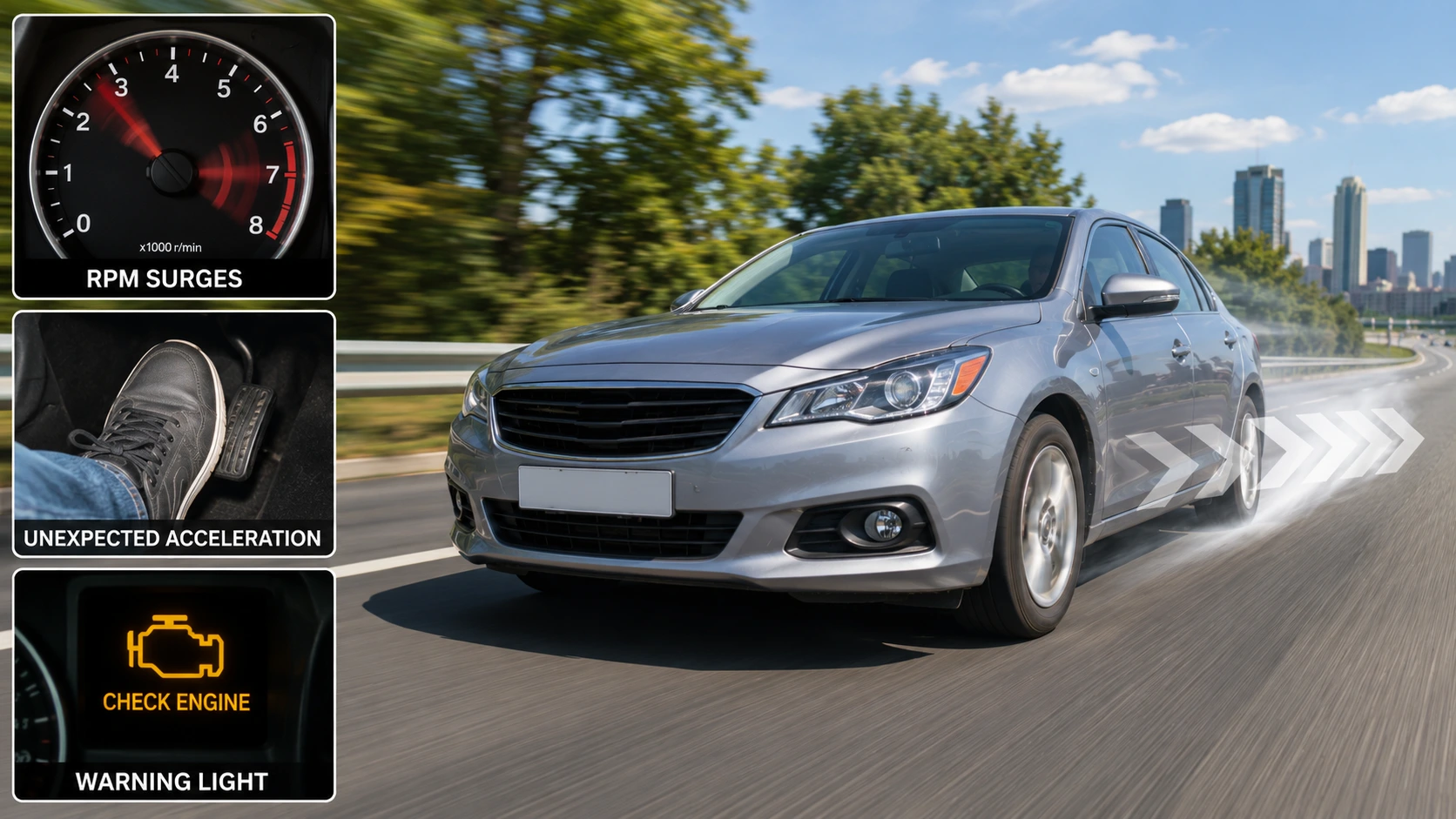
A vehicle surges unexpectedly — accelerating briefly without any throttle input, hunting between different RPM levels at a steady cruise, or lurching forward at a constant speed — is one of the more unsettling faults a driver can experience. The car is doing something the driver did not ask it to do. Unlike a power loss or a rough idle, a surge is the engine producing more output than commanded — and that typically means the fuelling, throttle, or air management system has a fault that is causing the engine management to overcorrect or malfunction.
At Rapid Rev Garage in Al Quoz, vehicle surges unexpectedly cases are diagnosed is diagnosed with live sensor data — idle control valve readings, throttle position, MAF output, and fuel trim corrections — before any component is replaced.
Vehicle Surges Unexpectedly — Quick Verdict
A vehicle that surges unexpectedly while driving is almost always caused by one of five faults: a dirty or failing throttle body that produces erratic throttle plate movement, a vacuum leak that creates an unmeasured air supply causing RPM instability, a failing mass airflow sensor producing incorrect air quantity data that causes the engine to hunt for the correct fuelling, a failing idle air control valve that oscillates instead of holding a stable idle, or a fuel delivery inconsistency — pressure fluctuation or injector irregularity — that creates brief rich spikes. In Dubai’s heat and dust, throttle body carbon fouling and MAF sensor contamination are the most frequent causes. The surge pattern — when it happens, at what speed, and whether it’s reproducible — directs the diagnosis.
Table of Contents
- What a Surge Actually Is — Engine Behaviour vs Driver Input
- Reading the Surge Pattern Before Any Testing
- The Five Most Common Causes in Dubai
- How Dubai’s Dust and Heat Create Surging Faults
- How We Reproduce and Diagnose the Surge at Rapid Rev Garage
- The Correct Fix for Each Confirmed Cause
- What Happens If This Is Left Without Repair
- Is It Safe to Keep Driving?
- How Long the Repair Takes
- What the Repair Costs in Dubai
- Preventing Unexpected Surging in Dubai
- Why Rapid Rev Garage?
- FAQ
- Conclusion
What a Surge Actually Is — Engine Behaviour vs Driver Input
Understanding the distinction between a surge and a hesitation — both of which affect engine output — explains why they have different causes.
A Surge Is the Engine Producing Unasked-For Power
A surge is the engine briefly delivering more power than the throttle position commands. The driver maintains steady throttle but the vehicle briefly accelerates. This means something in the fuelling or air management circuit is momentarily providing more fuel or more air than the commanded throttle position calls for.
How This Differs From a Misfire
A misfire is a combustion failure — the engine produces less than commanded. A surge is the opposite — the engine produces more than commanded. A misfire feels like a stumble or a loss of power. A surge feels like a brief push or lurch. Distinguishing them before any diagnostic work prevents pursuing the wrong fault category.
Why Idle Surging and Driving Surging Have Different Causes
A vehicle surges unexpectedly at idle — the RPM hunting up and down between, say, 600 and 1,000 RPM without any throttle input — almost always traces to the idle air control circuit. A surge while driving at a steady cruise speed — the car accelerating briefly without throttle change — is more likely a throttle body, MAF sensor, or fuel pressure fault. Identifying which condition produces the surge immediately narrows the diagnostic direction.
Reading the Surge Pattern Before Any Testing
The exact conditions under which the surge occurs are the most useful diagnostic information available before any tool is connected.
Surge Only at Idle
RPM hunting at idle — the engine cycling up and down between a low and high RPM without the driver touching the throttle — points directly at the idle air control system. The IAC valve or electronic throttle idle position is oscillating rather than holding steady. This is usually an idle air control valve fault, a throttle body that needs cleaning, or a vacuum leak that the idle control system is attempting to compensate for.
Surge at a Steady Highway Cruise
A brief acceleration while holding steady throttle at highway speed — common on Sheikh Zayed Road at 120 km/h — is the engine management system responding to a sensor reading that is briefly incorrect. A MAF sensor that produces a momentary spike in its output causes the system to inject more fuel than is needed, producing the surge. A throttle position sensor reading that fluctuates briefly produces the same pattern.
Surge When the AC Compressor Cycles
If the surge coincides specifically with the AC compressor engaging or disengaging — the characteristic timing of the AC clutch click — the cause is the engine management system not correctly compensating for the load change the compressor introduces. This is either a programming fault, an idle control calibration issue, or a base idle that needs adjustment.
Surge Only When Fully Warmed Up
A surge that only appears after the engine reaches full operating temperature and not on a cold run points toward a component that changes its behaviour at temperature — a temperature-dependent sensor fault, a fuel pressure regulator that loses pressure at temperature, or a vapour lock in the fuel system from heat.
The Five Most Common Causes in Dubai
Each of the following causes has a specific noise and timing pattern that helps identify it before any component is removed.
Dirty or Failing Throttle Body
The throttle body is the valve that controls airflow into the engine. Carbon deposits accumulate on the throttle plate and bore over time — particularly on direct-injection engines where the cleaning effect of fuel washing the intake is absent. A carbon-fouled throttle body produces an airflow restriction that the engine management system attempts to compensate for by adjusting idle air bypass — and when the compensation oscillates, the RPM hunts.
Why Dubai Stop-Start Driving Accelerates Carbon Fouling
Short-trip stop-start driving in Dubai never sustains the combustion temperatures that burn off carbon deposits naturally. A vehicle doing multiple 5–10 km commutes daily accumulates carbon faster than one doing sustained highway runs. The throttle body is one of the first places this accumulation produces a driveable symptom — the characteristic idle hunt.
The Cleaning vs Replacement Decision
A carbon-fouled throttle body that has no mechanical fault responds to professional cleaning — removing deposits from the plate and bore restores correct airflow. A throttle body with worn position sensors or motor faults requires replacement. A diagnostic scan’s live throttle position data during idle distinguishes the two before any decision is made.
Vacuum Leak
An unmetered air source — a disconnected hose, a cracked inlet boot, a failed PCV connection — introduces air into the intake that the MAF sensor hasn’t measured. The engine management system sees too much oxygen in the exhaust and adds more fuel to compensate. This over-fuelling produces rich running that the system then corrects by reducing fuel — and the oscillation between these corrections creates the surge pattern.
How to Locate a Vacuum Leak Quickly
A smoke test is the definitive method — visible smoke introduced into the intake system reveals every leak point simultaneously. A preliminary check involves listening for a hissing sound at idle from the engine bay, which localises the leak before the smoke test confirms it. Our car mechanic team uses a smoke test on every vehicle surges unexpectedly diagnosis where a vacuum leak is in the differential.
Failing Mass Airflow Sensor
The MAF sensor measures the volume of air entering the engine. A sensor contaminated by dust — from Dubai’s Al Quoz industrial environment — or degraded from heat exposure produces incorrect air quantity readings. When the MAF reading fluctuates rather than tracking smoothly with throttle position, the engine management system responds to the erroneous data by adjusting fuel delivery — and the fluctuation in fuel delivery produces the surge the driver feels.
Why MAF Sensors Fail More Often in Dubai
MAF sensors are sensitive instruments that require clean, debris-free airflow for accurate measurement. Dubai’s fine dust — particularly in Al Quoz and industrial areas — bypasses or loads the air filter faster than in clean-air environments. Dust deposits on the MAF sensor’s hot wire or film element change its calibrated response, producing the output fluctuations that cause surging.
Idle Air Control Valve Fault
On vehicles without fully electronic throttle control, the idle air control valve bypasses a small, controlled amount of air around the throttle plate to maintain the correct idle speed. An IAC valve that is sticking, dirty, or failing produces an idle that oscillates between the valve’s open and closed positions — the classic idle surge pattern where the engine revs up and down rhythmically between 500 and 1,000 RPM.
Fuel Pressure Fluctuation
A fuel pump that is beginning to fail, a fuel pressure regulator that has lost its damping effectiveness, or a partially-blocked fuel filter creates inconsistent fuel pressure at the injectors. Low pressure moments produce a lean condition the system corrects by increasing injector pulse width — which creates a brief rich surge. The cycle between low and recovered pressure produces the rhythmic surge pattern. Our car service packages include fuel pressure testing at every major service for vehicles with histories of intermittent surging or hesitation.
How Dubai’s Dust and Heat Create Surging Faults
Dubai’s operating environment specifically accelerates the throttle body and MAF sensor contamination that cause most unexpected surging in this market.
Dubai’s environment specifically accelerates the faults that cause vehicle surges unexpectedly in this market.
Industrial Dust in Al Quoz Bypasses Air Filters Faster
Fine particulate dust in Al Quoz’s industrial environment clogs air filters faster than residential-area driving and, at high concentrations, can bypass a partially-restricted filter in small amounts. A MAF sensor exposed to even a small quantity of bypass dust accumulates enough deposit on its sensing element to shift its calibrated output over thousands of kilometres.
Heat-Cycling Cracks Vacuum Hoses
Vacuum hoses in Dubai’s underbonnet environment cycle between underground parking cool and peak summer heat daily. Over years of ownership, this repeated expansion and contraction hardens and eventually cracks hose material — particularly at tight bends and connection points. A hose that is visually intact on its outer surface may be cracked internally at a bend, producing a vacuum leak that only opens under specific temperature and manifold vacuum combinations. For any situation where the surge makes the vehicle unsafe to drive in traffic, our roadside assistance covers Al Quoz and nearby Dubai areas.
How We Reproduce and Diagnose the Surge at Rapid Rev Garage
Accurate surging diagnosis requires the fault to be present — or its footprint to be visible in logged data — during the diagnostic process.
Road Test to Reproduce the Exact Conditions
The diagnostic road test specifically recreates the conditions the driver describes — steady highway cruise, stop-start idle, cold start, AC cycling. The exact conditions under which the surge appears identifies which system to investigate first.
Live Data Monitoring During the Road Test
With a diagnostic tool streaming live data during the road test — MAF output, throttle position, fuel trim short-term and long-term, IAC position — the specific parameter that fluctuates at the moment of the surge identifies the fault source. A MAF sensor whose output jumps during cruise identifies the MAF. A fuel trim that spikes rich at the moment of surge identifies either a vacuum leak correction or a fuel pressure event.
Smoke Test for Vacuum Integrity
A smoke test after the road test confirms or rules out vacuum leaks before any other component investigation proceeds — because a vacuum leak produces surging that mimics MAF sensor faults and fuel pressure faults in their symptom pattern.
Throttle Body Physical Inspection
The throttle body is inspected for carbon deposit accumulation, and a live scan of throttle position sensor output during slow manual opening confirms whether the sensor tracks smoothly or produces erratic readings.
The Correct Fix for Each Confirmed Cause
The repair is matched to the specific component the diagnostic sequence above confirms has failed.
Throttle Body Cleaning
Professional throttle body cleaning with the appropriate cleaning agent — not spraying cleaner through the air filter, but direct cleaning with the throttle body accessible and the plate manually held open — removes carbon deposits from the plate and bore. Post-cleaning, a throttle body adaptation reset through the scan tool allows the engine management to recalibrate its idle position with the clean body.
Vacuum Leak Repair
Confirmed leak points are reseated, repaired, or replaced depending on the hose condition. Where an inlet boot has cracked, the boot is replaced rather than patched. The smoke test is repeated after repair to confirm all leak points are sealed.
MAF Sensor Replacement or Cleaning
A MAF sensor with confirmed output fluctuation is cleaned first using MAF-specific cleaning spray — which removes dust deposits from the sensing element without leaving residue. If cleaning does not restore correct output as confirmed by live data, replacement with a correctly-specified sensor is the repair.
IAC Valve Cleaning or Replacement
A stuck or dirty IAC valve is cleaned using appropriate idle air control cleaning procedure. Where the valve mechanism itself is damaged, replacement is the correct repair. Post-replacement, idle adaptation is reset through the scan tool.
Fuel System Service
Where fuel pressure testing confirms pressure fluctuation, the fuel filter is replaced first — as the lowest-cost intervention. If pressure fluctuation persists after filter replacement, the fuel pump output and pressure regulator are assessed separately. For exterior repairs needed alongside engine work, our car painting team handles colour-matched repairs at the same visit.
What Happens If This Is Left Without Repair
A vehicle surges unexpectedly fault that is driven through rather than repaired follows a specific progression.
Throttle Body Carbon Buildup Progresses
Carbon deposits that produce idle hunting at 60,000 km are significantly thicker and harder to clean at 90,000 km. A cleaning that takes 30 minutes at the early stage may require a complete throttle body replacement at an advanced stage because the deposits have hardened beyond cleaning effectiveness.
Catalytic Converter Damage From Rich Surging
A vehicle surges unexpectedly from a vacuum leak that produces repeated rich corrections exposes the catalytic converter to excess fuel. Sustained rich conditions in the exhaust degrade the catalyst substrate, eventually producing a restricted catalytic converter that is expensive to replace.
Safety Risk in Traffic
A surge on Dubai’s highways — unexpected brief acceleration at 120 km/h — reduces the driver’s ability to maintain consistent speed and safe following distance. In dense motorway traffic, unpredictable vehicle behaviour creates a genuine safety concern that accelerates the urgency of repair.
Is It Safe to Keep Driving?
The urgency depends on when and where the surge occurs.
Idle Hunt Only — Driveable, Book This Week
A vehicle that only surges at idle and behaves correctly while driving is driveable in the short term. The fault affects comfort and fuel economy but not driving safety.
Surge at Highway Speed — Book Today
An unexpected surge at cruise or highway speed is a safety concern in dense Dubai traffic. This should be diagnosed the same day or next morning rather than deferred.
Surge With a Check Engine Light — Prioritise
A vehicle surges unexpectedly alongside a check engine light has stored fault codes that identify the specific cause. The light makes the diagnosis faster and its presence alongside a surge confirms a meaningful fault. Book immediately.
How Long the Repair Takes
Repair time depends on the specific component the diagnostic confirms has caused the surge.
Throttle Body Cleaning and Adaptation Reset
90 minutes to two hours including post-cleaning road test to confirm idle stability.
Vacuum Leak Repair
30 minutes to two hours depending on whether the leak point is accessible or requires trim removal.
MAF Sensor Cleaning or Replacement
One to two hours including post-replacement live data confirmation during a road test.
Fuel System Service
Fuel filter replacement: one hour. Full fuel pressure diagnostic with pump and regulator assessment: two to three hours.
What the Repair Costs in Dubai
All costs are provided after the diagnostic confirms the specific fault — not before.
Throttle Body Cleaning
AED 350–700 including adaptation reset. Throttle body replacement where cleaning is insufficient: AED 800–2,500 depending on vehicle platform.
Vacuum Hose and Leak Work
AED 200–600 depending on hose routing and access complexity.
MAF Sensor Work
MAF cleaning: AED 200–400. MAF replacement: AED 600–1,800 depending on sensor specification and vehicle.
Fuel System Work
Fuel filter replacement: AED 250–600. Fuel pump replacement: AED 800–2,500 depending on vehicle. A written quote follows the diagnostic confirmation. Our mobile car mechanic covers Al Quoz and nearby Dubai areas for on-site initial assessment.
Preventing Unexpected Surging in Dubai
Specific maintenance habits address the two most common causes of surging in Dubai before they develop into a noticeable fault.
Air Filter Replacement at Correct Dubai Intervals
An air filter replaced at Dubai-appropriate intervals — shorter than European factory schedules — maintains the clean airflow the MAF sensor requires. A severely restricted air filter creates the conditions for MAF contamination and vacuum instability simultaneously.
Throttle Body Cleaning as Scheduled Maintenance
Including throttle body inspection and cleaning as part of every major service — rather than only when surging appears — prevents the carbon accumulation that causes the fault from reaching the symptom threshold. Our garage near me location in Al Quoz serves drivers from Business Bay, Jumeirah, Barsha, Satwa, Downtown, and the Sheikh Zayed Road corridor.
Why Rapid Rev Garage?
A vehicle surges unexpectedly complaint requires live data during the fault condition — not just a fault code read at idle. The diagnostic road test with live sensor data streaming identifies the specific parameter that fluctuates at the moment of the surge, distinguishing a MAF fault from a vacuum leak from a fuel pressure event from a throttle body fault. These four causes produce similar surge patterns but require completely different repairs. We identify which one is causing the surge before recommending any component replacement.
FAQ — Vehicle Surges Unexpectedly
These are the questions most frequently asked about this fault.
Is a vehicle surge the same as an engine misfire?
No — a misfire is a combustion failure producing a power loss. A surge is the engine briefly producing more power than commanded. They feel different and have different causes.
Why does my car surge only at highway speed and not at idle?
Highway-speed-only surging points toward a MAF sensor or throttle position sensor fault rather than an idle control or vacuum leak issue — because those systems are under different loads at cruise than at idle.
Can a dirty air filter cause unexpected surging?
Indirectly — a severely restricted air filter starves the MAF sensor of clean airflow, which changes the sensor's output characteristics and can produce the fluctuations that cause surging. Air filter condition is always checked as part of a surging investigation.
Will the check engine light come on if my car is surging?
Not always — many surging causes produce intermittent conditions that the system logs as pending codes rather than confirmed faults. A full diagnostic scan reads pending codes that haven't triggered the light but confirm the fault category.
How long can I drive with a surging engine before it causes damage?
At idle, weeks before significant secondary damage. At highway speed, this is a safety concern rather than a damage concern — the unpredictable vehicle behaviour in traffic is the primary risk.
Conclusion
A vehicle surges unexpectedly in Dubai for specific, identifiable reasons — throttle body carbon fouling, vacuum leaks, MAF sensor contamination, IAC valve faults, or fuel pressure instability — all of which are diagnosable through live sensor data during the fault condition. Dubai’s dust and heat accelerate the two most common causes — throttle body fouling and MAF contamination — faster than any factory service interval assumes. Rapid Rev Garage in Al Quoz diagnoses every surge complaint with a live-data road test before any component is recommended for replacement.
Rapid Rev Garage is in Al Quoz, serving drivers across nearby Dubai areas — Business Bay, Jumeirah, Downtown, Barsha, Satwa, and the Sheikh Zayed Road corridor. Book your appointment on WhatsApp or find us on Google Maps.
Rapid Rev Garage — Vehicle Surges Unexpectedly | Al Quoz, Dubai