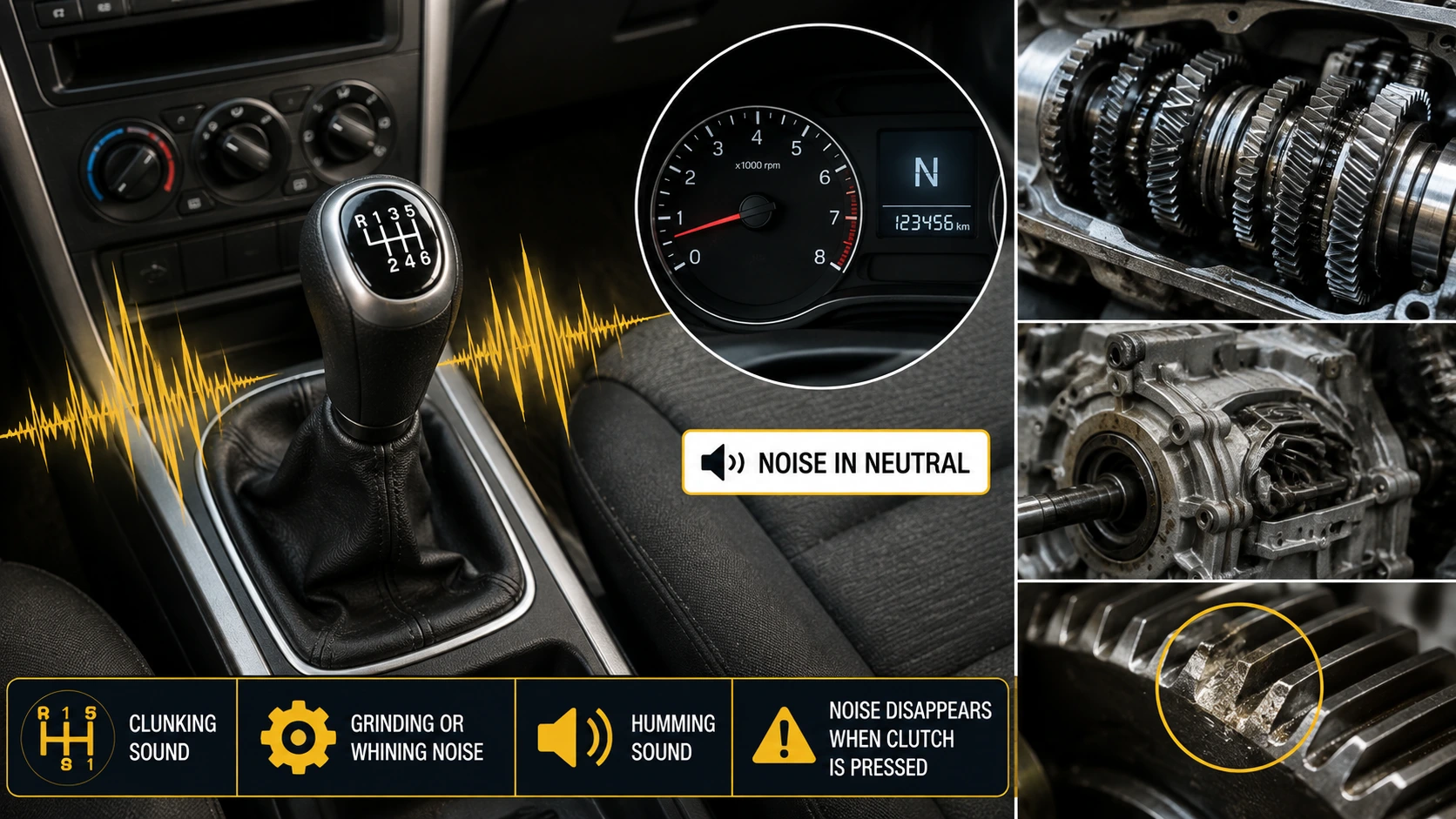
A gearbox makes noise in neutral — a rumbling, rattling, grinding, or whirring sound that appears when the transmission is in neutral and the engine is running, but stops when the clutch pedal is depressed or when a gear is selected — — a gearbox makes noise in neutral situation is specific and diagnostically useful. The neutral-specific character of the noise identifies immediately which components are loaded under that exact condition and points the diagnosis toward a defined set of possible causes. Whether this is concerning depends entirely on which component is making the noise and how far the fault has progressed.
At Rapid Rev Garage in Al Quoz, gearbox neutral noise is diagnosed by understanding exactly what is — and what isn’t — turning when the gearbox is in neutral, then testing the components that match the fault pattern.
Gearbox Makes Noise in Neutral — Quick Verdict
When the gearbox makes noise in neutral, the cause is almost always one of four things: a worn input shaft bearing that is under load in neutral but unloaded when the clutch is depressed, a counter gear set (layshaft) that is rotating in neutral but stops when the clutch is released, degraded or incorrect gearbox oil that is no longer lubricating the gear mesh and bearing surfaces adequately, or worn countershaft bearings that only produce noise under the specific load condition of neutral. The fact that the noise stops when the clutch pedal is depressed is the key diagnostic clue — it confirms the noise source is on the input side of the gearbox, which is driven by the engine through the clutch but disconnects when the pedal is pressed.
Table of Contents
- Why Neutral Is a Unique Gearbox Condition
- The Clutch Pedal Test — What It Reveals Instantly
- The Specific Components Making the Noise
- Manual vs Automatic — Different Neutral Noise Sources
- How Degraded Gearbox Oil Contributes to Neutral Noise
- Why Dubai’s Conditions Accelerate These Faults
- How We Confirm the Exact Cause at Rapid Rev Garage
- The Right Fix for Each Confirmed Fault
- Should You Be Concerned? Urgency Assessment
- Is It Safe to Keep Driving?
- How Long the Repair Takes
- What the Repair Costs in Dubai
- Preventing Gearbox Noise From Developing
- Why Rapid Rev Garage?
- FAQ
- Conclusion
Why Neutral Is a Unique Gearbox Condition
To understand why a gearbox makes noise in neutral pattern occurs, it helps to understand what is actually spinning inside a manual gearbox in each gear state.
What Rotates in Neutral
When the clutch is engaged and the gearbox is in neutral, the input shaft — connected directly to the clutch disc — is rotating at engine speed. The countershaft (layshaft or counter gear), which is permanently meshed with the input shaft, also rotates. However, the output shaft — which drives the wheels — is stationary, because none of the selector forks have engaged a drive gear to connect the countershaft to the output shaft.
What Stops When the Clutch Is Depressed
When the clutch pedal is depressed, the clutch disc separates from the flywheel. The input shaft and countershaft stop receiving drive from the engine and quickly decelerate. Any noise that disappears when the clutch pedal is depressed was produced by something driven by the input shaft — which is everything on the input side of the gearbox.
What Changes When a Gear Is Selected
When a gear is selected from neutral, the selector fork engages a dog clutch or synchroniser that locks the appropriate gear to the output shaft. This changes the load distribution inside the gearbox — components that were unloaded are now loaded, and components that were rotating freely are now under torque. A noise that stops in gear confirms the noise is from components that are loaded differently in neutral versus engaged gear.
The Clutch Pedal Test — What It Reveals Instantly
The clutch pedal test is the fastest diagnostic step for a gearbox makes noise in neutral complaint.
If the Noise Stops When the Clutch Is Depressed
The noise source is on the input side of the gearbox — the input shaft, the countershaft, or the bearings supporting either. The engine is no longer driving these components when the clutch is depressed, and the noise stops because the rotating, noise-producing components have stopped.
If the Noise Continues When the Clutch Is Depressed
The noise source is not driven by the engine through the clutch — it is either in the engine itself, in the clutch mechanism, or in a component driven by the output shaft (which continues rotating if the vehicle is moving). A noise that continues when the clutch is depressed is not a gearbox neutral noise — it is likely a flywheel, clutch release bearing, or primary drive fault.
If the Noise Only Appears When the Clutch Is Depressed
This is the release bearing fault pattern — the clutch release bearing is loaded when the pedal is pressed and unloaded when released. A release bearing noise that appears when the pedal is pressed and disappears when released is immediately identifiable by this test and is separate from a gearbox makes noise in neutral fault.
The Specific Components Making the Noise
Each noise character points toward a specific component before the gearbox is inspected.
Input Shaft Bearing Wear — The Most Common Cause
The input shaft bearing supports the input shaft inside the bellhousing, between the clutch and the gearbox case. This bearing rotates at engine speed whenever the clutch is engaged — regardless of gear selection. In neutral, it is loaded by the weight of the input shaft and the driving load from the rotating countershaft mesh. As the bearing wears, it produces a rumbling, humming, or whirring sound that is directly proportional to engine RPM and stops immediately when the clutch pedal is depressed.
The Input Shaft Bearing Load in Dubai Conditions
Dubai’s stop-start driving pattern maximises the number of clutch engagement/disengagement cycles per kilometre. Each clutch engagement applies a brief impulse load to the input shaft bearing as the clutch disc clamps against the flywheel. Over thousands of stop-start cycles — multiplied by the high frequency of Dubai’s junction driving — this bearing accumulates load cycles faster than highway-dominated driving would produce.
Countershaft (Layshaft) Bearing Wear
The countershaft runs across the gearbox, permanently meshed with the input shaft’s drive gear. When countershaft bearings wear, they produce a noise that is present in neutral — when the countershaft is rotating at speed without the stabilising load of an engaged gear — and that changes or disappears in gear when the load distribution changes. The noise from a worn countershaft bearing is often described as a growling or rattling that is most prominent at idle and changes character at higher RPM.
Countershaft End Float
The countershaft is constrained axially by thrust washers at each end. When these washers wear, the countershaft develops excessive end float — movement along its axis — that produces a rattling or knocking in neutral when the gear mesh forces push the shaft axially. This specific noise often changes when the gear lever is moved laterally in neutral — because this movement changes the axial load on the countershaft slightly.
Gear Teeth Noise in Neutral — Counter Gear Mesh
In neutral, the counter gear set is rotating and meshed with the input shaft’s drive gear but is not under torque load from the output shaft. Worn or chipped gear teeth on the counter gear produce a distinctive clicking or rattling that is rhythmic and proportional to the rotational speed of the counter gear rather than directly proportional to engine RPM (because the gear ratio between input shaft and counter gear is usually not 1:1).
Manual vs Automatic — Different Neutral Noise Sources
While the focus of this blog is primarily manual gearboxes — where the neutral noise pattern is most clearly defined — automatics have their own neutral noise characteristics.
Automatic Transmission in Neutral
In an automatic transmission in neutral, the torque converter is spinning but the transmission clutch packs are all released. A noise in automatic neutral that stops in park or when the engine is switched off points toward the torque converter, the transmission pump, or the oil circulation system. A transmission pump that is worn — producing a whining in neutral that changes with engine RPM — is the most common automatic neutral noise source.
Park vs Neutral Noise Pattern
A noise present in neutral but absent in park on an automatic indicates the transmission pump or torque converter, as the pump operates whenever the engine runs and the converter is spinning in neutral but the mechanical lock of park changes the load pattern. This distinction is confirmed through a diagnostic scan reading transmission pressure data and live input speed. Our car mechanic team distinguishes automatic neutral noise from manual gearbox noise as the first classification step in every gearbox makes noise in neutral diagnosis.
How Degraded Gearbox Oil Contributes to Neutral Noise
Gearbox makes noise in neutral complaints sometimes trace entirely to oil degradation — a contributing and sometimes primary cause that is incorrectly attributed to bearing or gear wear.
What Gearbox Oil Does
Manual gearbox oil lubricates the gear mesh surfaces, the bearings, and the synchroniser assemblies. It also provides a film that separates metal contact surfaces — the input shaft bearing, countershaft bearings, and gear tooth contact points all require a maintained oil film to prevent direct metal contact.
How Degraded Oil Produces Neutral Noise
Oil that is past its service life — from high mileage, from heat degradation in Dubai’s conditions, or from extended service intervals — loses its viscosity index improvers and anti-wear additives. As the protective film thins, the gear mesh and bearing surfaces experience more direct contact, producing noise that presents as a gearbox makes noise in neutral symptom that resolves or significantly reduces after an oil drain and refill.
The Diagnostic Oil Change
Where neutral noise is present and the gearbox oil is found to be dark, burnt-smelling, or metallic-feeling on the dipstick or drain plug, replacing the oil before condemning any mechanical component is a valid diagnostic step. A neutral noise that resolves after fresh oil confirms oil degradation as the primary cause — a significantly less expensive finding than bearing replacement. Our car service packages include gearbox oil condition assessment at every major service for vehicles with manual transmissions.
Why Dubai’s Conditions Accelerate These Faults
Dubai’s specific driving environment accelerates gearbox neutral noise development in ways that European service intervals don’t account for.
Stop-Start Driving Maximises Input Shaft Bearing Load Cycles
Every clutch engagement in stop-start Dubai traffic applies a load cycle to the input shaft bearing. A Dubai commuter engaging the clutch multiple times per minute in Al Quoz and Business Bay traffic accumulates input shaft bearing load cycles at a rate that a highway driver accumulates in weeks. The accelerated cycle count translates directly to earlier bearing fatigue and noise.
Heat Degrades Gearbox Oil Faster
Manual gearbox oil in Dubai operates at sustained temperatures higher than European driving produces. The thermal degradation of oil’s viscosity and additive package happens faster — meaning the oil that would adequately protect the gearbox for 60,000 km in a European market may be significantly degraded at 40,000 km in Dubai’s stop-start heat. Gearbox oil replacement at 40,000–50,000 km rather than the factory maximum interval is appropriate for Dubai conditions.
Dust Contamination of Gearbox Oil
Fine dust that enters the gearbox through vent tubes or degraded seals produces an abrasive contamination of the gearbox oil. Contaminated oil is abrasive rather than lubricating — accelerating bearing and gear surface wear on every revolution. This is more relevant for vehicles used in dusty Al Quoz commercial environments than for residential-area driving. For any breakdown from a gearbox fault, our roadside assistance covers Al Quoz and nearby Dubai areas.
How We Confirm the Exact Cause at Rapid Rev Garage
The diagnostic sequence starts with the fastest tests and progresses to mechanical inspection only when needed.
Clutch Pedal Test at Controlled Conditions
The vehicle is assessed at operating temperature — because gearbox bearing noise is often more pronounced when warm — in neutral with the engine idling and at various RPM levels. The clutch pedal test confirms the noise is on the input shaft side. RPM proportionality confirms whether it is a bearing (directly RPM-proportional) or a counter gear (gear-ratio-proportional to RPM).
Gearbox Oil Assessment
Before any mechanical investigation, the gearbox oil is checked for level, colour, smell, and feel. Dark, burnt, or metallic oil is a significant finding that shifts the first intervention to oil replacement before bearing or gear diagnosis.
Vibration and Sound Stethoscope Assessment
An automotive stethoscope applied to the gearbox housing at different points while the noise is present identifies whether the loudest signal is from the input shaft area (bellhousing end) or the main gearbox case. This localisation confirms which bearing or component set is the source.
Component Assessment Under Controlled Conditions
Where oil replacement doesn’t resolve the noise, the gearbox requires inspection — either through an accessible inspection cover or full removal — to assess input shaft bearing condition, countershaft bearing clearance, and gear tooth surface condition.
The Right Fix for Each Confirmed Fault
The repair is matched to the specific cause confirmed by the diagnostic sequence — oil service before bearing work.
Gearbox Oil Drain and Refill
Where degraded oil is confirmed as the primary cause, a drain and refill with the correct gearbox oil specification for the vehicle resolves the neutral noise. This is the lowest-cost intervention and should always precede any mechanical work when oil condition is confirmed poor. Fresh oil is significantly less expensive than any bearing or gear replacement.
Input Shaft Bearing Replacement
Confirmed input shaft bearing wear requires gearbox removal for access. The bearing is replaced with a correct-specification unit. Post-replacement, fresh gearbox oil is filled before the gearbox is reinstalled. Road test confirms the neutral noise is resolved.
Countershaft Bearing Replacement
Countershaft bearing replacement also requires gearbox removal and partial disassembly. Where countershaft bearings are worn, the countershaft end float is also checked and the thrust washers replaced if outside specification. For exterior work needed alongside gearbox repairs, our car painting team handles colour-matched repairs at the same visit.
Counter Gear Replacement
Where the counter gear tooth surfaces are chipped or severely worn — confirmed by visual inspection during gearbox disassembly — the gear is replaced. This is the highest-cost intervention in this list and warrants confirmation through physical inspection before the cost is committed.
Should You Be Concerned? Urgency Assessment
The urgency depends on which component is producing the noise and how far the fault has progressed.
Fresh Oil Resolves the Noise — Low Urgency
If the neutral noise resolves completely after a gearbox oil drain and refill, the fault was oil-related rather than mechanical wear. The gearbox is healthy — maintain the correct oil change interval going forward.
Noise Persists After Oil Change — Book This Week
A neutral noise that persists after fresh oil indicates mechanical bearing or gear wear. This should be diagnosed within the week. The noise may be stable for some time, but driving on worn bearings without knowing their condition risks unexpected failure.
Noise Worsening Rapidly or Accompanied by Grinding in Gear — Urgent
A neutral noise that has worsened quickly over days or weeks, or that is accompanied by any grinding or difficulty selecting gears, indicates wear that has progressed beyond early-stage bearing fatigue. This should be assessed the same day or next morning.
Is It Safe to Keep Driving?
The urgency depends on which component is confirmed and how quickly the noise is progressing.
Oil-Related Noise — Safe, Address Within a Week
A neutral noise from degraded oil — confirmed by oil condition assessment — is safe for careful driving while the oil service is arranged.
Bearing Noise — Limited Driving, Book This Week
A bearing noise that is stable and not rapidly worsening allows careful driving for a few days. Avoid extended highway runs that generate heat and load the bearing for sustained periods.
Rapidly Worsening Noise — Stop Using the Gearbox
A noise that is getting louder or worse day by day indicates accelerating wear. Continued driving risks the bearing failing completely — which can seize the input shaft and potentially cause sudden gearbox lock-up.
How Long the Repair Takes
Repair time ranges from under an hour for an oil service to several days for a full gearbox removal and rebuild.
Gearbox Oil Service
30–60 minutes including drain, refill, and road test confirmation.
Input Shaft or Countershaft Bearing Replacement
Two to four days including gearbox removal, disassembly, bearing replacement, reassembly, reinstallation, oil refill, and road test.
Counter Gear Replacement
Three to five days including full gearbox overhaul scope once disassembly confirms the gear condition.
What the Repair Costs in Dubai
Cost depends on the confirmed cause — oil service is significantly less expensive than bearing replacement.
Gearbox Oil Service
AED 300–700 depending on the oil specification required and sump capacity. Correct gearbox oil specification for the specific vehicle platform is used — not a generic gear oil of similar viscosity.
Bearing Replacement
Input shaft bearing replacement including gearbox removal and reinstallation: AED 1,500–4,500 depending on the vehicle platform and gearbox complexity.
Counter Gear or Overhaul
Gearbox overhaul with gear and bearing replacement: AED 3,500–9,000 depending on vehicle and the extent of internal wear confirmed during disassembly. A written quote is provided after the diagnostic assessment — oil condition, clutch pedal test, and stethoscope localisation — confirms the specific cause. Our mobile car mechanic covers Al Quoz and nearby Dubai areas for on-site clutch pedal test and oil assessment before driving in.
Preventing Gearbox Noise From Developing
Specific maintenance habits prevent the most common causes of gearbox neutral noise in Dubai.
Gearbox Oil at Dubai-Appropriate Intervals
Manual gearbox oil at 40,000–50,000 km in Dubai’s stop-start heat rather than the factory maximum interval — which may be 80,000–100,000 km or “lifetime” — maintains the protective film that prevents bearing and gear surface metal contact. The oil cost is minimal compared to the bearing replacement cost it prevents.
Smooth Clutch Engagement Reduces Bearing Load
Engaging the clutch smoothly rather than dropping it from the pedal reduces the impulse load applied to the input shaft bearing at each engagement. In Dubai’s stop-start traffic, where clutch engagement is frequent, the cumulative reduction in bearing load from smooth engagement is meaningful over tens of thousands of kilometres. Our garage near me location in Al Quoz serves drivers from Business Bay, Jumeirah, Barsha, Satwa, Downtown, and the Sheikh Zayed Road corridor.
Why Rapid Rev Garage?
When a gearbox makes noise in neutral, the clutch pedal test, RPM proportionality assessment, and gearbox oil evaluation together identify the cause before any gearbox work is recommended. A neutral noise that resolves after a gearbox oil change — the lowest-cost outcome — should not lead to an unnecessary gearbox removal for bearing replacement. And a bearing fault confirmed by stethoscope localisation and oil-change non-resolution should not be left because the oil was fresh. The correct diagnostic sequence produces the correct recommendation — not the most common intervention regardless of what the data shows.
FAQ — Gearbox Makes Noise in Neutral
These are the questions most frequently asked at our Al Quoz workshop.
Why does the gearbox noise stop when I press the clutch pedal?
The clutch pedal disengages the engine from the input shaft. Any component driven by the input shaft — including the countershaft and the input shaft bearing — stops receiving drive and decelerates. Noise from these components stops because they are no longer rotating under load.
Is a noise in neutral always a serious gearbox problem?
Not always — degraded gearbox oil is a common cause that resolves completely with an oil service. A noise that persists after fresh oil indicates mechanical wear, which requires a more involved assessment.
My automatic gearbox makes a noise in neutral — is that the same fault?
An automatic in neutral has a different mechanical state from a manual in neutral — the transmission pump and torque converter are the most likely noise sources rather than the input shaft bearing. The diagnostic approach is different, using transmission pressure data and converter assessment rather than the clutch pedal test.
How do I tell if it's the input shaft bearing or the countershaft bearing?
Input shaft bearing noise is directly proportional to engine RPM — it gets louder as RPM increases at a linear rate. Countershaft bearing noise changes with a ratio corresponding to the countershaft gear reduction rather than linearly. Stethoscope localisation — the loudest signal at the bellhousing end versus the gearbox case — also helps distinguish the two.
Can I add oil additive to stop gearbox noise?
Some oil additives temporarily reduce bearing and gear noise by increasing oil film thickness. However, additives do not repair worn bearing races or gear surfaces — they mask the noise while the wear continues. A proper oil drain and refill with the correct specification is preferable to additive use.
Conclusion
When a gearbox makes noise in neutral, the clutch pedal test immediately identifies the noise as input-side — driven by the engine through the clutch and disconnected when the pedal is pressed. The cause is then identified from oil condition, RPM proportionality, and stethoscope localisation as oil degradation, input shaft bearing wear, or countershaft bearing wear. The urgency depends on which component is confirmed and how fast the noise is progressing. Rapid Rev Garage in Al Quoz diagnoses every neutral gearbox noise through this structured sequence before recommending any gearbox work.
Rapid Rev Garage is in Al Quoz, serving drivers across nearby Dubai areas — Business Bay, Jumeirah, Downtown, Barsha, Satwa, and the Sheikh Zayed Road corridor. Book your appointment on WhatsApp or find us on Google Maps.
Rapid Rev Garage — Gearbox Makes Noise in Neutral | Al Quoz, Dubai