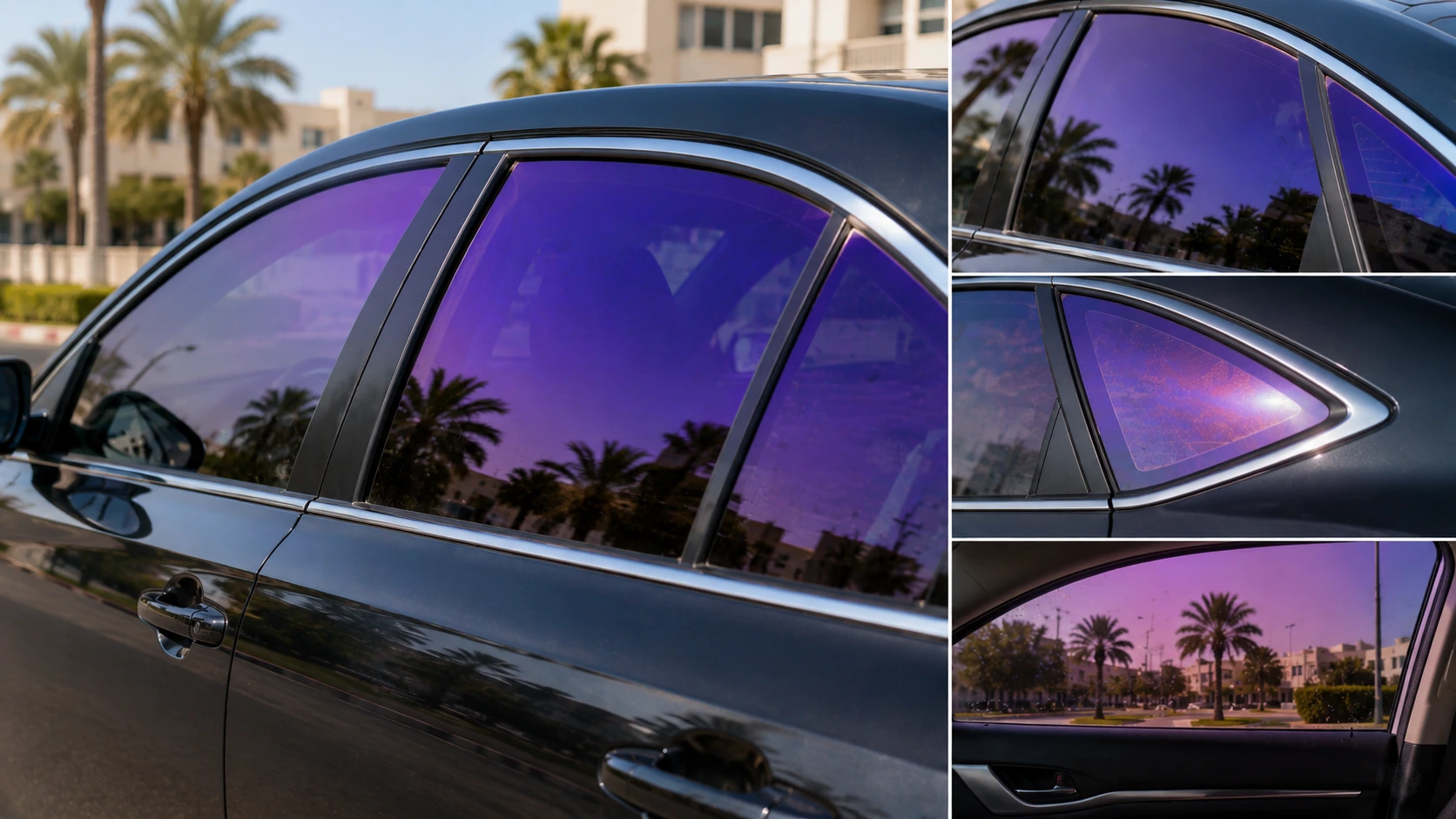
Car window tint turning purple is always a sign of one specific thing: the dye inside the film is breaking down. It’s not a random colour change. It’s not a reaction to cleaning products. It’s the film telling you it’s dying — and in Dubai’s climate, it happens faster than almost anywhere else in the world.
The purple or pink tint you’re seeing used to be black or charcoal. That colour came from dyes added to the film during manufacturing. Dubai’s UV intensity and extreme heat bleach those dyes out over time. And as the dye layer breaks down, the film also loses its heat rejection, its clarity, and eventually its adhesion.
At Rapid Rev Garage in Al Quoz, we replace purple tint regularly. It’s one of the clearest signs that a vehicle has low-quality film — and it means the whole job needs to come off.
Car Window Tint Turning Purple — Quick Answer
Car window tint turning purple happens when the dye inside the film degrades from UV exposure and heat. This only happens with dyed film — the cheapest category of window tint. The dyes used to make the film dark break down under prolonged sun, shifting the colour toward purple, pink, or brown. Once car window tint turning purple begins, it doesn’t stop. The film continues degrading, loses its heat rejection ability, and eventually starts bubbling and peeling. There is no product that reverses it. The film needs to be removed and replaced — ideally with a film type that doesn’t use dyes at all.
Table of Contents
- Why Tint Goes Purple — The Dye Breakdown Explained
- Why Dubai Makes This Happen So Much Faster
- What Dyed Film Actually Is and Why It’s Sold in Dubai
- What Happens to the Film After It Goes Purple
- The Difference Between Dyed, Carbon, and Ceramic Film
- Can Purple Tint Be Fixed Without Replacing It?
- How We Handle Tint Replacement at Rapid Rev Garage
- What the Replacement Costs in Dubai
- How to Make Sure Your Next Tint Doesn’t Turn Purple
- Why Rapid Rev Garage?
- FAQ
- Conclusion
Why Tint Goes Purple — The Dye Breakdown Explained
Window tint film is made up of several thin layers bonded together. In dyed film, one of those layers contains organic dyes. Those dyes absorb light and give the film its dark appearance.
The problem is that organic dyes are not UV-stable. UV radiation breaks the chemical bonds in the dye molecules. When those bonds break, the molecule changes shape — and so does the colour it produces.
Black and charcoal dyes tend to lose their yellow and green components first. What’s left is the red-purple end of the spectrum. That’s the purple colour you’re seeing.
It’s the same chemical process that fades black fabric left in the sun. The difference is that car windows concentrate sunlight, trap heat, and sit in the same position for years. The dye never gets a break.
Why Dubai Makes This Happen So Much Faster
The UV index in Dubai regularly hits 10–11. That’s what drives car window tint turning purple so fast here. That’s classified as “extreme” on the World Health Organisation scale. Most European countries rarely exceed 6–7.
UV radiation is what breaks down the dyes. A higher UV index means faster breakdown.
Add to that the surface temperature of glass in a Dubai summer. A parked car’s windows can hit 80–90°C on the outer surface. Organic dyes don’t just fade at these temperatures — they accelerate their own degradation.
A dyed film in a UK car might last five to seven years. The same film in Dubai turns purple in 12 to 18 months — that’s car window tint turning purple at its most extreme pace. The same film on a Dubai car parked outdoors can go purple in 12 to 18 months. That’s not an exaggeration — it’s what we see at our Al Quoz workshop. Our car mechanic team inspects tint condition on every vehicle that comes in and purple tinting is almost always the car’s main daily parking being outdoors.
What Dyed Film Actually Is and Why It’s Sold in Dubai
Dyed film is the cheapest type of window tint on the market. It’s made from polyester with dye layers added during manufacturing.
It’s cheap to produce. It’s cheap to buy. And it gives the appearance of a dark, tinted window — at least initially.
The problem is that it achieves its darkness through dye. Not through heat-blocking technology, not through metallic layers, not through ceramic particles. Just dye. And dye fades.
It still gets sold across Dubai because the upfront cost is low. Many drivers don’t know the difference when they’re buying. They see a dark window and assume all tint is the same.
It isn’t. The difference between dyed film and ceramic film is like the difference between a painted surface and a powder coat. One holds up. The other doesn’t.
What Happens to the Film After It Goes Purple
Colour change is the first sign, but it’s not the only problem. Here’s what follows as the film continues degrading.
Heat Rejection Drops Significantly
The dye layer was contributing to the film’s heat blocking. As the dyes break down, so does the film’s ability to reject solar energy. Your car gets hotter inside. The AC works harder. Fuel consumption goes up slightly.
The Film Becomes Hazy and Distorts Visibility
As the dye structure breaks down, the film loses optical clarity. At night, oncoming lights create more glare than usual. Rearview visibility through rear windows gets distorted. This is a safety issue, not just cosmetic.
Adhesive Failure Follows
The heat cycling that degrades the dye layer also stresses the adhesive layer. Once the film has turned purple, bubbling usually isn’t far behind. The two problems compound each other. For any urgent roadside help while dealing with tint issues, our roadside assistance team covers Al Quoz and nearby Dubai areas.
The Difference Between Dyed, Carbon, and Ceramic Film
Understanding why car window tint turning purple only happens with dyed film makes sense when you see the comparison.
Dyed Film
Uses organic dyes for darkness. No heat-rejection technology beyond the dye layer itself. UV-unstable. Fades, purples, bubbles. Cheapest upfront, most expensive long-term.
Carbon Film
Uses carbon particles instead of dyes. Carbon is chemically stable — it doesn’t react to UV or heat the way organic dyes do. Won’t turn purple. Better heat rejection. Doesn’t interfere with GPS or phone signals. Costs more than dyed film but holds up properly.
Ceramic Film
Uses nano-ceramic particles. No dye, no metal. Maximum heat rejection, maximum UV stability. Completely stable colour. Won’t purple, won’t bubble from heat alone. Best optical clarity. Most expensive upfront — but easily the most cost-effective over a Dubai car’s lifespan.
Neither carbon nor ceramic film causes car window tint turning purple — the problem is specific to dyed films. The dye degradation problem is specific to dyed film because there are no dyes in the other two. Our car service packages include a tint condition assessment at every major service for vehicles over three years old.
Can Purple Tint Be Fixed Without Replacing It?
The short answer is no. There is no product, treatment, or process that reverses dye degradation in window film.
Some people try applying tint polish or UV-blocking sprays to slow the colour shift. These don’t reverse what’s already happened. They might slow further degradation slightly — but the film is already compromised.
The film also cannot be tinted darker from the outside. Applying new film over old film is a bad idea for two reasons. First, it looks wrong — the old purple shows through and the overall appearance is poor. Second, two layers of film trap more heat between them and accelerate adhesive failure on both layers.
The correct fix is complete removal of the old film, thorough cleaning of the glass, and fresh installation of a better film type.
How We Handle Tint Replacement at Rapid Rev Garage
When car window tint turning purple brings a car in, the process is straightforward — but it has to be done in the right order.
Step One: Full Removal of the Old Film
Purple dyed film has often partially baked itself onto the glass. Removing it takes time. It has to come off in sections without scratching the glass. The adhesive residue left behind is then cleaned off completely using appropriate solvents.
Skipping the residue removal is a common shortcut — and it causes the new film to bond poorly in the contaminated areas. We don’t skip this step.
Step Two: Glass Inspection
Once the glass is bare, we inspect it for scratches, defroster wire damage on rear windows, and any contamination that might affect the new film’s adhesion. Any issues are addressed before the new film goes on.
Step Three: Film Selection
We recommend the right film based on how the car is used. If it parks in covered parking most of the time, a high-quality carbon film is a solid choice. If it’s outdoors daily in Dubai sun, we push for ceramic. It’s the only option that genuinely holds up to this climate. For exterior paintwork needed at the same time, our car painting team handles full colour-matched repairs at the same visit.
Step Four: Controlled Installation
Film goes on in a clean, dust-controlled environment. Proper slip solution ratios. Correct positioning before bonding. Careful squeegee technique to push out air and moisture. Edge trimming to exact measurements.
What the Replacement Costs in Dubai
Here’s what removal and replacement typically costs in Dubai.
Removing Purple Film
AED 200–500 depending on vehicle size and how many windows have film. Heavily baked-on film takes longer and sits at the higher end.
Replacement Film Options
Carbon film replacement: AED 600–1,500 depending on vehicle size. Ceramic film replacement: AED 1,200–3,500 depending on vehicle size and specific film brand.
Dyed film is not something we recommend as a replacement option. The whole point is to avoid repeating the same problem.
The ceramic option costs more — but a car that parks outdoors in Dubai and uses dyed film will be back for another replacement within two years. Ceramic, installed once properly, should last seven to ten years. Our mobile car mechanic covers Al Quoz and nearby Dubai areas if you want us to come to you for an initial tint assessment.
How to Make Sure Your Next Tint Doesn’t Turn Purple
This is the simple version: don’t use dyed film.
If you’re replacing purple tint, the minimum you should go for is a quality carbon film. If the car parks outdoors in Dubai most of the time, ceramic film is the right call.
Beyond film choice, a few habits help your tint last longer.
Use a windscreen sunshade. It reduces interior temperature and reduces the thermal cycling that stresses the film and adhesive daily.
Try to park in shade or underground. Every hour out of direct sun extends film life. This matters more than any other single factor.
Don’t roll windows down immediately after a long hot park. The glass and film are at peak temperature. Letting the interior cool down first before operating the windows reduces stress on the edge seals.
Avoid ammonia-based window cleaners on tinted glass. Ammonia breaks down the adhesive layer. Use a tint-safe cleaner only.
Book a tint condition check every two years. Catching early degradation means you can plan a replacement — instead of driving around with purple windows for a year before noticing. Our garage near me location in Al Quoz serves drivers from Business Bay, Jumeirah, Barsha, Satwa, Downtown, and the Sheikh Zayed Road corridor.
Why Rapid Rev Garage?
Car window tint turning purple has one solution — you replace the dyed film with something that doesn’t use dyes. What matters is doing the removal properly, cleaning the glass fully, and installing the right film type for Dubai’s conditions.
We don’t rush removal. We don’t leave adhesive residue. We don’t recommend dyed film as a replacement. And we tell every customer honestly which film type suits their specific parking situation and budget.
If your tint has already gone through car window tint turning purple, book an assessment. We’ll confirm the film type, remove it cleanly, and install a replacement that actually lasts.
FAQ — Car Window Tint Turning Purple
These are the questions we get asked most often about this issue.
Is purple tint illegal in Dubai?
The colour change itself doesn't make the tint illegal — but if the film has become hazy and reduces visibility significantly, it becomes a road safety concern. Dubai also has tint darkness regulations. A degraded purple film often lets through more light than the original dark film, which changes its VLT (visible light transmission) rating. If the tint is affecting visibility, it should be replaced.
Will my AC work better after I replace the purple tint?
Yes — if you replace with ceramic or carbon film. Purple dyed film has lost most of its heat-rejection ability. A fresh ceramic film blocks solar heat significantly, which reduces the AC load and makes the car noticeably cooler faster.
How do I know if my tint is dyed or ceramic?
Dyed film looks very dark when new. Over time, it fades and may turn purple. Ceramic film doesn't fade or change colour. If your tint is more than two years old and starting to look brownish or purple — it's almost certainly dyed film.
Can I just put new film over the purple film?
No. Two layers of film look poor, trap heat between them, and accelerate adhesive failure on both layers. The old film must come off completely before new film goes on.
Does purple tint affect my view at night?
Yes. As the dye structure breaks down, the film's optical clarity degrades. This shows up most at night — headlights from oncoming cars create more glare and scatter. It's a safety issue and a reason to replace the film promptly.
Conclusion
Car window tint turning purple is always a dyed-film problem — and in Dubai, it happens fast. The UV intensity and heat destroy the dye layer within one to three years in most cases. The colour change is followed by heat rejection loss, haze, and eventually bubbling and peeling.
The fix for car window tint turning purple is a complete removal and replacement with carbon or ceramic film. No repair product reverses dye degradation. Rapid Rev Garage in Al Quoz removes old film cleanly, inspects the glass, and installs the right film for Dubai’s climate.
Rapid Rev Garage is in Al Quoz, serving Business Bay, Jumeirah, Downtown, Barsha, Satwa, and the Sheikh Zayed Road corridor. Book your appointment on WhatsApp or find us on Google Maps.
Rapid Rev Garage — Car Window Tint Turning Purple | Al Quoz, Dubai