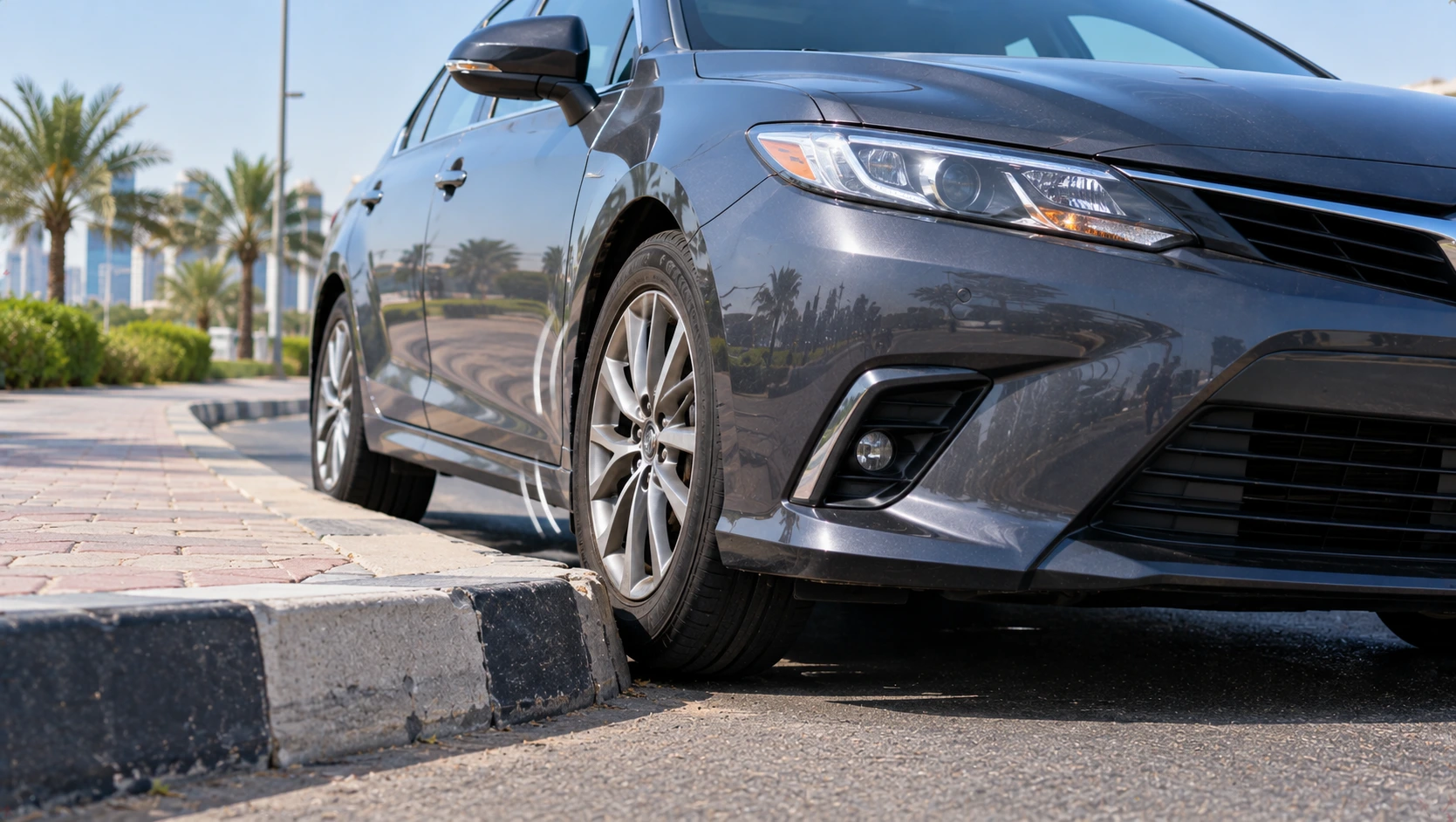
A car feels different after hitting a curb for one reason: something moved that shouldn’t have. The kerb strike transferred force through the tyre and wheel into the steering and suspension geometry — and that geometry is now sitting in a position it wasn’t designed for. The car drives, but it doesn’t drive the way it did.
At Rapid Rev Garage in Al Quoz, we see this every week — when a car feels different after hitting a curb, drivers often underestimate what changed. A driver clips a kerb exiting a petrol station, catches a raised edge on a Dubai Marina access road, or hits a speed bump at the wrong angle. The immediate impact feels minor. But over the next few days, something isn’t right — the steering pulls slightly, the car wanders on the highway, or there’s a knock from the suspension that wasn’t there before.
The longer it’s left, the more expensive it gets. Here’s what a kerb strike actually does.
Car Feels Different After Hitting a Curb — Quick Answer
When a car feels different after hitting a curb, the most likely causes are wheel misalignment, a bent or cracked alloy wheel, damage to a tie rod end or ball joint, a bent steering rack, strut damage, or a combination of several at once. The force involved in a kerb strike — even a slow one — concentrates through a small contact area and transmits directly into suspension and steering components. Alignment geometry changes of fractions of a degree are enough to produce noticeable pulling, wandering, or uneven tyre wear. In Dubai’s tight parking structures and raised kerb environments, these impacts happen regularly and often go unassessed. The correct response is a full inspection — not a wheel alignment alone, because alignment can’t straighten a bent component. Identifying exactly which components were affected before deciding on repair is the only way to avoid paying twice.
Table of Contents
- What Actually Happens During a Kerb Strike
- The Most Common Damage — Wheel and Tyre
- Steering Component Damage
- Suspension Component Damage
- Alignment Geometry Shift
- Symptoms That Tell You Something Was Damaged
- What the Inspection Covers
- Can You Just Get a Wheel Alignment?
- How Long Can You Drive With Kerb Strike Damage?
- Repair Cost Ranges in Dubai
- Why Rapid Rev Garage?
- FAQ
- Conclusion
What Actually Happens During a Kerb Strike
A kerb strike isn’t just a bump. It’s an impact force applied to a system of components — tyre, wheel, hub, ball joint, tie rod, strut, and subframe — that were designed to absorb load from the road below, not a lateral strike from the side.
When the tyre contacts the kerb, the force travels inward. Where it goes depends on the angle and speed of impact. A slow, glancing blow at 10 km/h against a low kerb might only shift the wheel alignment slightly. A direct hit at 30–40 km/h against a raised Dubai roundabout kerb can bend a tie rod, crack a wheel rim, and damage the strut in a single impact.
That’s why a car feels different after hitting a curb even when the impact seemed minor — the components involved are precision parts where small dimensional changes produce large handling differences. Our car mechanic team inspects every affected component individually before recommending any repair or alignment service.
The Most Common Damage — Wheel and Tyre
The wheel and tyre take the direct hit first. This is where the most visible damage occurs — but also where hidden damage is most often missed.
Alloy wheel damage. Alloy wheels crack or bend at the point of kerb contact — the inner rim lip is particularly vulnerable. A crack that’s not visible from the outside may be present on the inner barrel. A slightly bent rim produces a vibration at specific speeds — typically between 80–120 km/h — because the wheel is no longer perfectly round. It also causes persistent slow tyre deflation, because the tyre bead can’t seat properly against a distorted rim surface.
Tyre sidewall damage. The tyre sidewall is not designed to take lateral impact. A kerb strike can cause an internal sidewall cord break that doesn’t show on the surface initially — but creates a bulge within days as air pressure pushes against the weakened cords. A tyres with a sidewall bulge is not safe to drive and should be replaced immediately.
Tyre pressure loss. Even without visible sidewall damage, the bead seal between tyre and rim can be disrupted. This produces a slow leak that drivers initially attribute to a puncture. After a kerb hit, if a tyre is losing pressure without a visible cause, the rim and bead seat need inspection.
Steering Component Damage
The steering system translates the wheel’s directional input to the wheels. Its components run laterally across the front of the vehicle — directly in the path of a kerb strike’s force transmission.
Tie rod end damage. The tie rod ends connect the steering rack to the wheel hub. A direct kerb impact can bend the tie rod itself or damage the ball and socket joint at the outer end. A bent tie rod changes the toe angle on that wheel — the car pulls in the direction of the bent tie rod, and the affected tyre scrubs its inner or outer edge rapidly.
Tie rod damage is one of the most common reasons a car feels different after hitting a curb — it’s also one of the most important. It’s also one of the most important — because a tie rod end that’s been partially damaged but not yet failed represents a progressive safety risk as it continues to wear.
Steering rack damage. On a harder impact, the force can transfer through the tie rod into the steering rack itself. A bent steering rack produces steering that feels uneven — more resistance turning one way than the other, or a vague centre position that the driver can’t pin down. Rack damage is less common than tie rod damage but more expensive to address.
Power steering components. On hydraulic power steering systems, a hard kerb impact can stress the power steering hose or rack seal. Fluid loss from a rack seal isn’t always immediate — it can develop over weeks after the impact.
Suspension Component Damage
The suspension system manages vertical load. A lateral kerb strike introduces force at angles the suspension wasn’t designed to absorb.
Strut damage. The front strut assembly — MacPherson strut on most passenger cars — runs vertically and is not designed for lateral shock loading. A severe kerb strike can bend the strut body, damage the strut top mount bearing, or crack the spring seat. A bent strut is not repairable — it requires replacement. And a strut that’s been bent but not replaced produces handling that’s progressively worse as the damaged strut body causes the wheel to sit at an incorrect angle through its travel.
Ball joint damage. The lower ball joint allows the wheel hub to pivot for steering and move vertically with suspension travel. A lateral strike can damage the ball joint’s internal socket — producing a knock or clunk on low-speed turning that wasn’t there before the impact.
Control arm and bushing damage. The control arm locates the wheel fore-and-aft and absorbs suspension loads. A severe impact can bend the arm itself or damage the rubber bushings at its pivot points. Bent control arms change the caster and camber geometry — exactly the conditions that make the car feels different after hitting a curb complaint so difficult to resolve with alignment alone.
Wheel bearing damage. When a car feels different after hitting a curb weeks after the impact, a damaged wheel bearing is often what’s been developing. The impact force travels through the hub into the wheel bearing. On a hard strike, the bearing race can be damaged internally — producing a drone or rumble at specific speeds, or a grinding sensation on turns. Wheel bearing damage from kerb strikes is often delayed — the bearing works initially but deteriorates faster than normal from the impact.
Alignment Geometry Shift
Even when no component is visibly bent or broken, a kerb strike changes the alignment geometry. This is always the case — because the force has to go somewhere, and the wheel has moved from its designed position even if it moved back when the force was released.
Camber change. The wheel tilts inward or outward relative to vertical. Camber change from a kerb strike causes uneven tyre wear across the tread width — the outside or inside edge wears faster. It also affects straight-line tracking.
Toe change. The wheel points inward or outward relative to straight ahead. Toe change from a kerb strike is the most common alignment consequence and the primary reason the car feels different after hitting a curb — the car pulls toward the affected corner and the tyre scrubs its edge at every kilometre.
Caster change. Less common than toe or camber shifts, but caster changes affect steering return-to-centre behaviour — the wheel that was struck may resist returning to straight after corners.
Symptoms That Tell You Something Was Damaged
After a kerb strike, these are the specific symptoms that confirm damage requiring inspection — not normal post-impact settling.
Each of the following confirms that when a car feels different after hitting a curb, specific components have been affected.
Steering pulls to one side — even after releasing the wheel momentarily, the car drifts toward the kerbed corner. This is toe or camber change, or a bent tie rod.
Steering wheel is off-centre — the wheel sits at an angle when the car is driving straight. This is almost always toe change from a shifted wheel position.
Vibration at highway speed — particularly between 80–120 km/h. This is a bent or damaged wheel rim producing an out-of-round rotation.
Knocking or clunking on turns — particularly at low speed or in car parks. This is ball joint, tie rod end, or strut top mount damage.
Tyre losing pressure — without an obvious puncture. This is rim damage disrupting the bead seal.
Tyre sidewall bulge — visible as a bulge on the tyre sidewall, sometimes only on the inner sidewall. This requires immediate tyre replacement.
Suspension feels different on one side — the ride quality on the impacted corner feels harder, sharper, or produces more noise over road irregularities than the opposite side.
What the Inspection Covers
A proper post-kerb-strike inspection is not just a wheel alignment. Our car service post-impact inspection covers:
Ramp inspection. With the vehicle raised, every steering and suspension component on the affected corner is visually inspected and physically checked — tie rod ends for play or bend, ball joints for stiffness or looseness, strut body for bend, control arm for deformation, subframe mounting points for stress marks.
Wheel and tyre inspection. The wheel is checked for cracks, deformation, and inner barrel damage. The tyre is inspected internally where possible, and the sidewall is checked for bulging or internal cord damage.
Wheel bearing check. The wheel is spun by hand and the bearing is checked for roughness, drone, or play. If there’s any indication of damage, a diagnostic drive confirms whether bearing noise is present at speed.
Four-wheel alignment measurement. After component inspection, alignment is measured across all four corners. Any geometry deviation from specification is documented before any adjustment is made — so the driver knows exactly what the impact changed.
Diagnostic scan. On vehicles with active suspension or electronic stability systems, a fault scan checks whether the impact triggered any stored codes in the ABS, ESP, or air suspension modules.
Can You Just Get a Wheel Alignment?
This is the most common misunderstanding after a kerb strike — and it’s worth being direct about it.
Many drivers whose car feels different after hitting a curb book a wheel alignment first. That instinct is understandable — but it misses the point. A wheel alignment adjusts the geometry of the wheels. It can correct toe, camber, and caster angles. But it can only work with the components that are already there. If a tie rod is bent, alignment machines adjust the angles around the bent component — the car tracks straight for a day or two, then the bent rod produces the same deviation again. The alignment didn’t fail. It was done on a damaged platform.
A wheel alignment after a kerb strike makes sense only after every component has been physically inspected and confirmed undamaged. If anything is bent, those components are replaced first — then alignment is done on the correct geometry. Doing alignment first is the expensive way around this problem. Our garage near me team inspects before aligning, every time, for exactly this reason.
How Long Can You Drive With Kerb Strike Damage?
Tyre sidewall bulge — don’t drive at all. A bulged sidewall can blow out without warning. Call for assistance.
Vibration from a bent rim — the wheel is structurally compromised and can fail progressively. Drive minimally and get it assessed immediately.
Steering pull — driveable short-term but it accelerates tyre wear and becomes increasingly hazardous on highways. Don’t take a road trip with an uninspected post-kerb pull.
Knocking or clunking from the suspension — the component making the noise is failing. A ball joint or tie rod end that’s already noisy is closer to the end of its life. Assess within a few days.
No obvious symptoms but a kerb was hit hard — if a car feels different after hitting a curb but you can’t pinpoint the symptom, alignment-only checks should happen within the same week. The damage you can’t feel yet is the damage that produces an unexpected bill later.
If the vehicle can’t be safely driven to the workshop, our roadside assistance team covers Al Quoz and nearby Dubai areas. Our mobile car mechanic can also perform an on-site initial assessment before the vehicle is moved.
Repair Cost Ranges in Dubai
| Repair | Cost Range |
| Four-wheel alignment | AED 200–400 |
| Alloy wheel repair (minor bend) | AED 200–500 |
| Alloy wheel replacement | AED 400–1,500+ |
| Tyre replacement (sidewall damage) | AED 300–900 |
| Tie rod end replacement + alignment | AED 500–900 |
| Ball joint replacement + alignment | AED 600–1,200 |
| Strut replacement + alignment | AED 800–2,000 |
| Steering rack replacement | AED 1,500–4,500 |
| Wheel bearing replacement | AED 500–1,200 |
The most common reason a car feels different after hitting a curb ends up costing AED 1,200–2,500: tie rod end replacement, new tyre, alloy rim repair or replacement, and four-wheel alignment — AED 1,200–2,500 depending on vehicle type and parts specification.
Why Rapid Rev Garage?
When a car feels different after hitting a curb, the temptation is to book a quick alignment and hope for the best. We don’t work that way. Every post-kerb inspection starts with the ramp and the components — because no alignment produces a lasting result on a bent tie rod or a cracked strut.
We document every finding, explain what was damaged and why, and give a clear repair recommendation before anything starts. If the damage is limited to alignment shift only, we say so. If components need replacement first, we explain which ones and why before any work is authorised.
For bodywork or paint damage from the kerb impact, our car painting team handles the cosmetic repair at the same visit.
FAQ
Here are the questions Dubai drivers most often ask after a kerb strike.
Is it safe to drive after hitting a curb?
It depends on the severity. If there's a tyre sidewall bulge, visible wheel damage, or the car is pulling severely, don't drive it further. If the symptoms are mild — slight pull, minor vibration — it can be driven cautiously to a workshop for inspection. Don't take it on a highway or a long drive before it's been checked.
How do I know if my alignment is off after hitting a curb?
The clearest sign is the steering wheel sitting off-centre when driving straight, or the car pulling consistently to one side when you release the wheel briefly. Uneven tyre wear developing on one corner after a kerb strike also confirms alignment deviation.
Can a kerb strike damage the wheel bearing?
Yes — the lateral impact force travels through the tyre and hub into the bearing race. Bearing damage from a kerb strike often doesn't produce symptoms immediately. It shows up as a drone or grinding sound at specific speeds, usually developing within weeks after the impact as the damaged bearing deteriorates.
Does hitting a curb damage the suspension?
It can — particularly the strut, ball joint, and control arm on the impacted corner. The suspension is designed for vertical load, not lateral impact. A significant kerb strike at speed can bend a strut body or damage a ball joint socket that then produces a clunking noise on low-speed turns.
Why does my car pull to the right after hitting a curb?
Because the geometry on that corner has shifted — most commonly the toe angle. The wheel on the kerbed corner is now pointing slightly inward or outward relative to straight ahead, which pulls the car toward that side. A bent tie rod holds the wheel in the shifted position regardless of alignment adjustments made without replacing the bent component.
Conclusion
When a car feels different after hitting a curb, something structural moved. It’s rarely just alignment. The impact force travels through tyre, rim, tie rod, ball joint, strut, and bearing — and any of those components can absorb damage that changes how the vehicle handles.
Rapid Rev Garage in Al Quoz inspects every post-kerb strike properly — components first, alignment after, nothing guessed. Book your appointment on WhatsApp or find us on Google Maps. We serve Al Quoz, Business Bay, Jumeirah, Downtown, Satwa, and the Sheikh Zayed Road corridor.
Rapid Rev Garage — Car Feels Different After Hitting a Curb | Al Quoz, Dubai