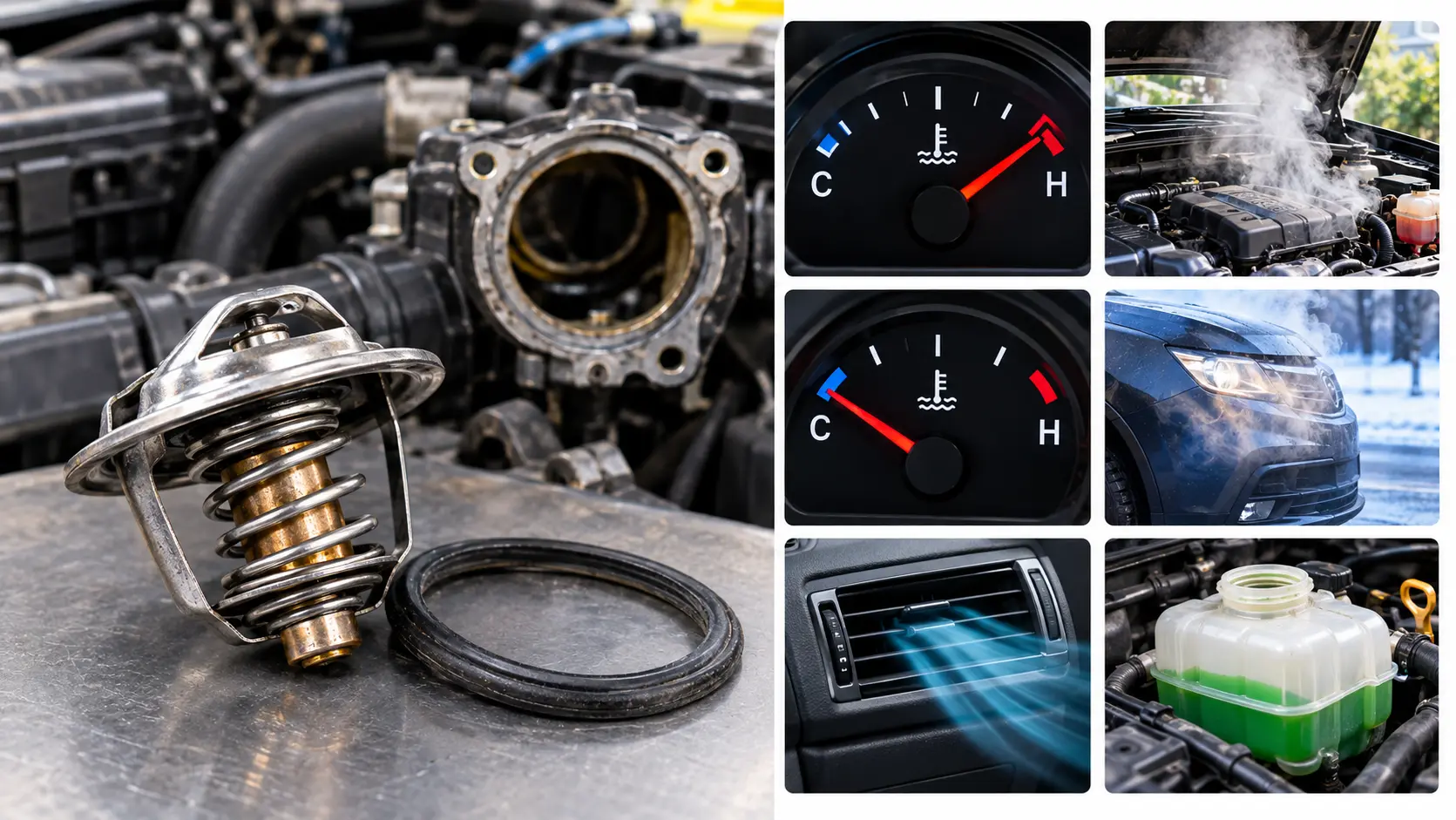
The temperature needle climbs toward the red while you crawl along Sheikh Zayed Road with the AC on, then drops back once traffic moves. Or it sits lower than usual and a check engine light appears with a code about coolant temperature. Both can be bad car thermostat symptoms, and in Dubai, where engines already run close to their cooling limits in summer, a faulty thermostat is not something to leave for later.
The thermostat is a small valve that controls when coolant flows to the radiator. If it sticks closed, the engine overheats. If it sticks open, the engine runs too cool. Both cause problems, but overheating can destroy an engine in minutes.
This guide explains how the thermostat works, the signs it is failing, why UAE conditions put extra strain on it, how a workshop tests it and what replacement involves. It also covers the other cooling faults that look like a bad thermostat.
Bad Car Thermostat Symptoms: Quick Answer
The main bad car thermostat symptoms are overheating with a hot engine and a cool lower radiator hose, a temperature gauge that climbs, drops or jumps around, an engine that takes too long to warm up or runs below normal temperature, coolant leaks around the thermostat housing, higher fuel use and a check engine light with codes P0128 or P0126.
Samarins gives a normal operating range of 90 to 105°C. A thermostat stuck closed causes overheating, while one stuck open keeps the engine too cool. A mechanic checks coolant level, compares upper and lower hose temperatures with an infrared thermometer and watches engine temperature on a scan tool.
Table of Contents
- What the Car Thermostat Does
- Why Thermostats Fail Faster in Dubai
- Overheating and a Climbing Temperature Gauge
- A Cool Lower Radiator Hose on a Hot Engine
- Temperature Gauge Jumping Up and Down
- Engine Slow to Warm Up or Running Too Cool
- Check Engine Light With Codes P0128 or P0126
- Coolant Leaks Around the Thermostat Housing
- Higher Fuel Use and Rough Running When Cool
- AC Cooling Less When the Engine Runs Hot
- Faults That Look Like a Bad Thermostat
- How a Workshop Tests a Thermostat
- What Thermostat Replacement Involves
- Should the Thermostat Be Replaced With the Water Pump?
- Is It Safe to Drive With a Bad Thermostat?
- How to Look After the Cooling System in Dubai
- Why Does My Car Overheat Only in Traffic?
- Can a Bad Thermostat Cause Low Coolant?
- How Long Does a Thermostat Usually Last?
- FAQ
- Conclusion
What the Car Thermostat Does
The thermostat sits between the engine and the radiator. Samarins describes it as a temperature controlled valve that helps the engine warm up faster and stops it running too cool.
When the engine is cold, the thermostat stays closed. Coolant then moves only inside the engine, so it warms up quickly. As the coolant reaches its opening temperature, a wax pellet inside the thermostat expands and opens the valve. Hot coolant then flows to the radiator to be cooled.
Samarins gives a normal operating range of 90 to 105°C, and describes an example engine where the thermostat began opening at about 85°C and the radiator fan came on at about 96°C. Your engine’s exact figures are in the workshop manual.
Why Thermostats Fail Faster in Dubai
UAE conditions push the cooling system harder than in most places. Long idling in stop and start traffic on Al Khail Road means very little airflow through the radiator. The AC also adds load to the engine and heat to the condenser in front of the radiator.
On a summer afternoon when the air passes 45°C, the radiator has much less cooling margin, so any weakness shows up quickly. The thermostat works through thousands of heat cycles a year, and its wax element and spring wear out over time.
Old or wrong coolant speeds up failure. Coolant that has not been changed loses its corrosion protection, and deposits can make the thermostat stick. Topping up with plain water dilutes the coolant and lowers its boiling point.
Overheating and a Climbing Temperature Gauge
Overheating is the most dangerous sign. Samarins explains that a thermostat stuck closed can make the engine overheat, because coolant cannot reach the radiator.
The temperature gauge climbs above its normal position, often toward the red. You may see steam from under the bonnet, smell hot coolant, or see a warning light. Overheating often shows first in slow traffic or on long climbs, then gets worse quickly.
Pull over and switch off as soon as it is safe. Driving on an overheating engine can warp the cylinder head and blow the head gasket, which costs far more than a thermostat. Never open the radiator cap on a hot engine.
A Cool Lower Radiator Hose on a Hot Engine
Samarins notes that when a thermostat is stuck closed, the lower radiator hose stays cool because coolant is not flowing through the radiator. The upper hose, which comes from the engine, gets very hot.
A mechanic checks this with an infrared thermometer, comparing the two hoses while watching the engine temperature on a scan tool. A large difference once the engine is fully warm points to a stuck thermostat.
Do not squeeze or touch hoses on a hot engine with bare hands. The coolant is under pressure and can be well above 100°C.
With the engine cold, you can feel the hoses yourself to check they are firm and not cracked or swollen. A soft or bulging hose is a separate fault, but it should be replaced at the same time as the thermostat.
Temperature Gauge Jumping Up and Down
A gauge that climbs, then suddenly drops, then climbs again can mean the thermostat is sticking and releasing. It opens late, the engine gets hot, it then opens fully and the temperature falls, and the cycle repeats.
Air trapped in the cooling system after a repair causes a similar pattern, because air pockets around the thermostat or the temperature sensor give false readings. A low coolant level can also make the gauge jump.
If the gauge behaves this way, check the coolant level with the engine cold. If it is low, the leak needs to be found as well as the thermostat checked.
Engine Slow to Warm Up or Running Too Cool
A thermostat stuck open lets coolant flow to the radiator all the time, so the engine takes much longer to warm up and may never reach normal temperature. Samarins notes this is most noticeable on the highway in cooler weather.
In Dubai’s hot climate, this fault is often missed because the outside heat keeps the engine reasonably warm. It shows more in the cooler months from December to February, on early morning drives or on long highway runs.
The temperature gauge may sit lower than usual. Samarins also notes that the heater may produce little heat, although many Dubai drivers rarely use the heater and may not notice.
Check Engine Light With Codes P0128 or P0126
Samarins lists P0128 as a common thermostat related code, along with P0126. P0128 means the coolant temperature stayed below the thermostat’s regulating temperature for longer than expected.
Samarins notes that some engines take longer to warm up even when the thermostat is fine, so codes and symptoms should be checked together. A faulty coolant temperature sensor can also set the code.
Samarins adds that some manufacturers recommend a software update for the engine computer after replacing the thermostat if thermostat codes were present. A good workshop checks for this.
Coolant Leaks Around the Thermostat Housing
Samarins notes that a leaking thermostat housing can also mean the thermostat needs replacing. The housing has a gasket or O ring that hardens with age and heat, and plastic housings can crack.
Look for dried coolant crust, often white, green or pink, around the housing, or drips under the engine. A sweet smell after driving can also point to a leak.
If coolant boils over or sprays from a leak, it can land on the bodywork. Coolant left on hot paint can mark the clear coat, and stains that are not washed off may need paint and panel repair.
Higher Fuel Use and Rough Running When Cool
An engine that runs too cool uses more fuel. The engine computer reads a low coolant temperature and adds extra fuel, the same way it does during a cold start. Fuel use rises and emissions increase.
A cool engine can also idle slightly higher and run less smoothly. Oil stays thicker for longer, and moisture in the oil does not burn off, which adds sludge over time.
If your fuel use has crept up and the temperature gauge sits lower than it used to, a thermostat stuck open is a likely cause.
Keep a note of how many kilometres you get from a full tank. A drop with no change in your driving is easier to spot when you know your normal figure.
AC Cooling Less When the Engine Runs Hot
The AC condenser sits in front of the radiator and shares the same cooling fans and airflow. When the engine runs hot, the whole front of the car is hotter, and the AC has to work harder.
Some cars also reduce or switch off the AC when engine temperature climbs too high, to protect the engine. If your AC blows warmer air in traffic at the same time as the temperature gauge rises, the cooling system may be at fault rather than the AC itself.
Ask for both systems to be checked. An AC system check and a cooling system test together find which one is the real cause.
Faults That Look Like a Bad Thermostat
Several other faults cause overheating or odd gauge readings. A low coolant level from a leak is the most common. A failing water pump, a blocked radiator, a cooling fan that does not run or a leaking head gasket can all cause overheating.
A faulty coolant temperature sensor can make the gauge read wrong even with a good thermostat. Air pockets after a coolant change cause jumping readings. A radiator clogged with dust and insects reduces cooling, and Dubai dust makes this common.
Samarins advises checking the coolant level first. Testing the hoses, fan, sensor and pressure finds the real cause before the thermostat is replaced.
How a Workshop Tests a Thermostat
A proper test starts with the coolant level and condition, checked with the engine cold. Samarins recommends this as the first step.
The mechanic then starts the engine and watches the coolant temperature on a scan tool as it warms up. At the same time, an infrared thermometer measures the upper and lower radiator hoses. When the engine reaches its opening temperature, the lower hose should warm up quickly as the thermostat opens.
The mechanic also checks the cooling fans, pressure tests the system for leaks and checks the temperature sensor reading against the thermometer. Book this test with an experienced car mechanic near you so the right part is replaced.
What Thermostat Replacement Involves
The coolant is drained, the thermostat housing is removed and the old thermostat and gasket are taken out. A new thermostat with the correct opening temperature is fitted with a new gasket or seal.
Samarins notes that the cooling system must be refilled and bled after replacement, and that the fans should be checked to run when warm. Bleeding removes air pockets, which otherwise cause overheating and false gauge readings.
On some engines, the thermostat is built into a housing that is replaced as one unit. Use the coolant type your manufacturer specifies, mixed to the correct strength, rather than plain water.
Should the Thermostat Be Replaced With the Water Pump?
Samarins notes that the thermostat is often replaced along with the water pump, and that it is worth replacing when the engine is rebuilt or replaced. Since the coolant has to be drained for either job, doing both at once saves labour.
Samarins also notes that thermostat replacement is not required as routine maintenance. On a car with no symptoms, there is no need to replace it on a schedule.
If the water pump is being replaced because of a leak or noise, ask whether the thermostat should be changed at the same time, especially on a high mileage car.
The same applies to radiator replacement. Any job that drains the coolant is a good time to check the thermostat, the hoses and the radiator cap. A worn cap that cannot hold pressure lets coolant boil at a lower temperature.
Is It Safe to Drive With a Bad Thermostat?
A thermostat stuck closed is not safe to drive with, because the engine can overheat within minutes. If the gauge climbs toward the red, pull over and switch off. Driving on can cause head gasket and cylinder head damage, which an engine repair specialist would then need to fix.
If the engine overheats on a highway, use the speed you have to reach the hard shoulder or an exit. Stopping in a live lane because of a breakdown brings a AED 1,000 fine and six black points under Article 98 of the UAE Federal Traffic Law. Once safe, switch off and call roadside assistance. An overheated car should go on a flatbed tow truck, not be driven.
A thermostat stuck open is less urgent, but it raises fuel use and can set a check engine light. A mobile mechanic can check the coolant level and read codes at your home.
How to Look After the Cooling System in Dubai
Check the coolant level every two weeks with the engine cold, and top up only with the correct coolant mix. Change the coolant at the interval in your owner’s manual, because old coolant loses its protection and can make the thermostat stick.
Keep the front of the radiator and AC condenser clean, because dust and insects block airflow. Watch the temperature gauge in slow summer traffic, and learn where it normally sits so changes are easy to spot.
A regular car service in Dubai includes a check of coolant, hoses and the cooling fans. Before each summer, choose a car garage near you that pressure tests the cooling system and checks the thermostat’s opening temperature.
Why Does My Car Overheat Only in Traffic?
Overheating only in slow traffic usually points to poor airflow. At speed, air rushes through the radiator. In traffic, the cooling fans have to do all the work.
A fan that has failed or runs too slowly lets the temperature climb at the lights. Then it drops again once you start moving. A radiator or AC condenser blocked with dust and insects causes the same pattern.
A thermostat that only opens part of the way can also cause it. The engine copes at speed but not when airflow drops. A mechanic checks the fans, the radiator and the thermostat together.
In Dubai, this often shows on summer evenings on Sheikh Zayed Road, when traffic is slow and the AC is on full.
Can a Bad Thermostat Cause Low Coolant?
It can, in two ways. A leaking thermostat housing lets coolant escape slowly. And when a stuck thermostat makes the engine overheat, coolant can boil and push out of the overflow tank.
You may see the level drop in the overflow tank between checks. You may also smell coolant after driving or see drips under the engine.
Always find out why the level is low. Topping up without fixing the cause means the engine can run short of coolant again.
How Long Does a Thermostat Usually Last?
There is no fixed life for a thermostat. Samarins notes that replacement is not part of routine maintenance. Many last for many years without trouble.
Heat, old coolant and corrosion shorten their life. In UAE conditions, thermostats work through more heat cycles each year than in cooler places. If your car has high mileage and has never had its coolant changed, the thermostat is more likely to stick.
FAQ
Here are the questions Dubai drivers most often ask about car thermostats.
What happens when a thermostat goes bad?
If it sticks closed, coolant cannot reach the radiator and the engine overheats. If it sticks open, the engine runs too cool, uses more fuel and may set code P0128. Both need checking.
Can a bad thermostat cause overheating?
Yes. A thermostat stuck closed stops coolant flowing to the radiator, so the engine overheats, often in slow traffic first. The lower radiator hose stays cool while the engine gets very hot.
What temperature should my engine run at?
Samarins gives a normal operating range of about 90 to 105°C. On most cars, the temperature gauge sits near the middle once warm. Check where your gauge normally sits so you notice changes.
How do mechanics test a thermostat?
They check the coolant level, then watch engine temperature on a scan tool while measuring the upper and lower radiator hoses with an infrared thermometer. The lower hose should warm quickly when the thermostat opens.
Is it safe to drive with P0128?
Usually for a short time, because P0128 means the engine is running too cool, not too hot. It raises fuel use and can make the car fail an emissions check, so book a repair soon.
Conclusion
A bad thermostat shows up as overheating, a cool lower hose on a hot engine, a jumping or low temperature gauge, slow warm up, codes P0128 or P0126, leaks around the housing, higher fuel use and weaker AC in traffic. A thermostat stuck closed is urgent in UAE heat. Checking coolant level, comparing hose temperatures and watching scan tool data confirms the fault, and the system must be bled after replacement.
Rapid Rev Garage is a full workshop open 24 hours at Al Khail Gate, 12th Street, Al Quoz Industrial Area 2, serving passenger cars across Al Quoz, Business Bay, Jumeirah, Al Barsha, Satwa, Downtown and the Sheikh Zayed Road corridor. Visit https://rapidrevgarage.com, send your car model and symptoms on WhatsApp, or get directions on Google Maps.
Rapid Rev Garage | Bad Car Thermostat Symptoms | Al Quoz, Dubai