The early signs of car problems are almost always there before anything actually breaks. The engine that misfires on the motorway gave a rough idle in traffic three weeks earlier. The gearbox that slips under load hesitated from a standstill before that. The brake disc that warped into a pedal vibration started as a barely noticeable pull when braking.
The problem isn’t that these signals don’t appear. It’s that Dubai driving conditions — air conditioning constantly running, stop-start traffic, desert dust — make it easy to dismiss small changes as normal variation. By the time the symptom is undeniable, the repair is no longer the small one it could have been.
This guide covers the early signs of car problems across every major system, what each signal means, and when it crosses from something to monitor into something that needs workshop attention immediately.
Early Signs of Car Problems — Quick Answer
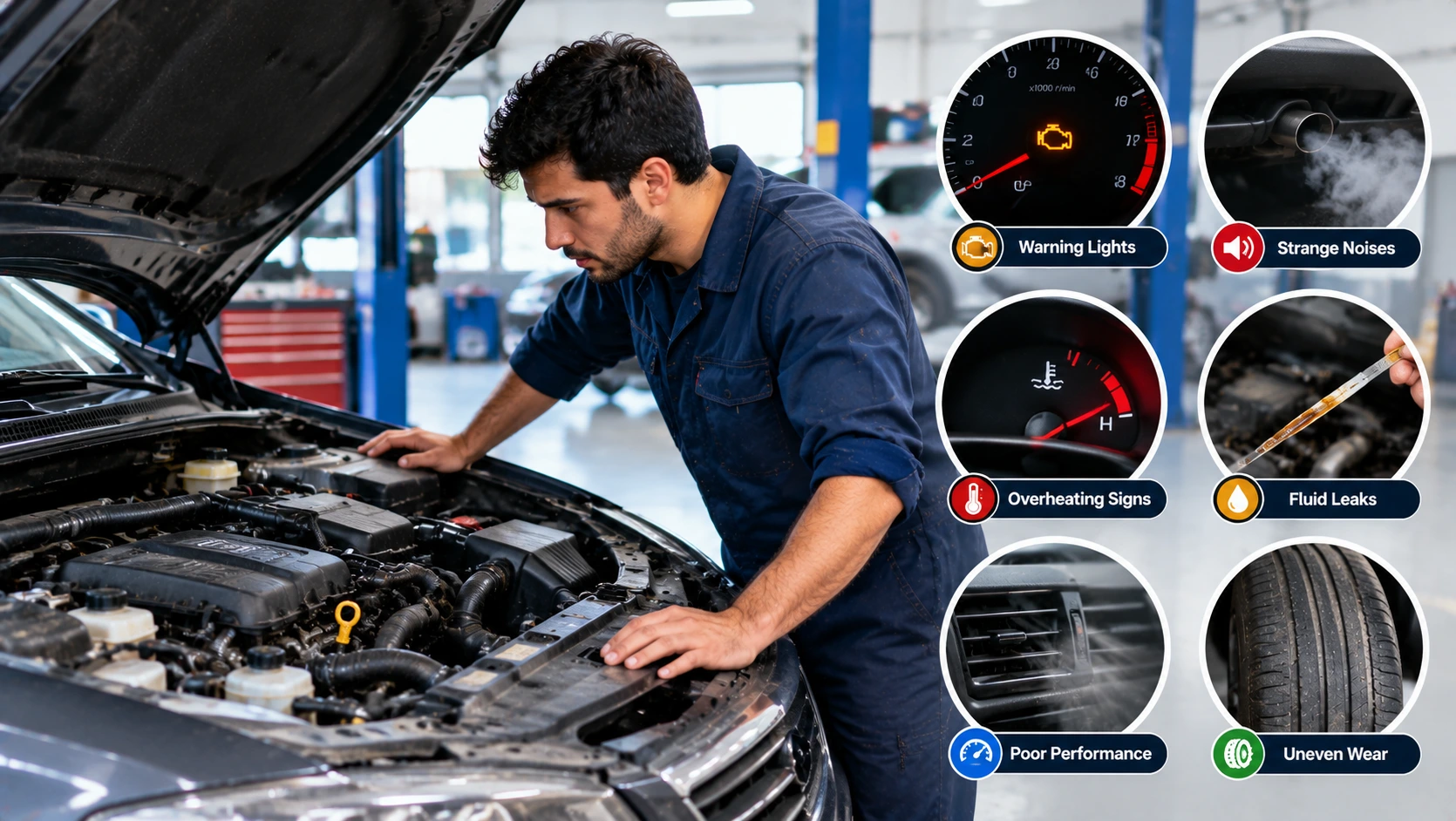
Early signs of car problems fall into five categories: sounds that weren’t there before, changes in how the car drives or handles, warning lights that appear and disappear, fluid changes visible on the ground or dipstick, and smells that don’t belong. In Dubai’s heat and stop-start environment, the most consequential early warnings are a rising temperature gauge (coolant system stress before overheating), a slight pull under braking (brake or suspension geometry before a serious fault develops), a brief hesitation from a standstill (transmission or fuel system before a stall or slip), and any burning smell from the engine bay or under the car (electrical, belt, or fluid contact with hot components). None of these are emergencies in their early form. All of them become emergencies if ignored long enough.
Table of Contents
- Engine Early Warning Signs
- Transmission and Gearbox Early Warning Signs
- Brake System Early Warning Signs
- Suspension and Steering Early Warning Signs
- Electrical Early Warning Signs
- Cooling System Early Warning Signs
- Tyre Early Warning Signs
- The Dubai Factor — Why Symptoms Develop Faster Here
- When to Drive It In vs. When to Stop
- Why Rapid Rev Garage?
- FAQ
- Conclusion
Engine Early Warning Signs
The engine produces the most varied early warning signals — because it has the most components that can begin to fail gradually.
Rough idle. The engine that used to sit smoothly at 700–800 RPM in traffic now occasionally hunts — revs drift slightly up or down, or there’s a faint shudder through the steering wheel at a standstill. This is one of the clearest early signs of car problems in the engine — it indicates a misfire, a vacuum leak, dirty fuel injectors, or a failing idle control system. None of these are expensive at this stage. All of them become expensive if left until the idle is permanently rough or the engine stalls at traffic lights.
Longer cranking before start. The car that used to fire instantly now takes an extra beat to start — one rotation before it catches instead of firing immediately. This points to fuel pressure dropping while the engine sits overnight, a weak battery, or beginning spark plug wear. Caught early, it’s a fuel pressure test and possibly a fuel pump relay — missed, it becomes a no-start fault that may require roadside recovery.
Brief hesitation under acceleration. Pulling out of a junction on Al Khail Road, the engine momentarily stumbles before building power. This hesitation is fuel delivery inconsistency — injector fouling, a degraded MAF sensor reading, or early coil-on-plug wear. It’s intermittent at this stage and easy to dismiss as a traffic disruption. It escalates into a persistent flat spot or engine misfire code.
Faint ticking from the engine at startup. A tick that’s loudest in the first 30 seconds of running and then reduces — often associated with low oil viscosity, delayed oil pressure build, or the beginning of variable valve timing system wear. If the tick disappears within a minute, it doesn’t mean it’s fine — it means the system is compensating while it can.
Slightly higher fuel consumption. A 10–15% increase in fuel consumption without a change in driving pattern is one of the most ignored early signs of car problems. It indicates an injector issue, a degraded oxygen sensor, an air filter approaching restriction, or a small exhaust leak affecting the oxygen sensor reading. Our car mechanic team includes fuel consumption assessment in every diagnostic visit precisely because drivers don’t track this closely enough.
Transmission and Gearbox Early Warning Signs
Slight hesitation before engaging drive or reverse. The automatic transmission that normally selects drive immediately now pauses for a beat after you move the selector. This hesitation indicates low or degraded transmission fluid, or early wear in the hydraulic circuits that pressurise the clutch pack. Caught at this stage, an ATF service often resolves it. Missed, it progresses to gear slip and eventually clutch pack failure.
A barely noticeable shudder between gears. At city speeds — particularly the 2nd-to-3rd shift in stop-start traffic — there’s an almost imperceptible jerk that wasn’t there six months ago. The friction modifier additives in the transmission fluid are depleting. This is the Stage 1 signal for a fluid that’s overdue for replacement. The shudder will become a harsh shift and eventually a transmission fault code if the fluid isn’t changed.
The gearbox feels different when cold vs. warm. Harsh shifts that smooth out after ten minutes of driving are one of the subtler early signs of car problems in the transmission — the fluid is degraded enough that it doesn’t cushion properly until it reaches temperature. A fresh ATF has consistent properties from cold start through operating temperature.
Brake System Early Warning Signs
A faint squeal when braking gently. Not the sharp squeal of fully worn pads hitting the disc — a faint, intermittent squeal during light braking, particularly after the car has been parked overnight. This is the brake pad wear indicator making first contact. There’s still pad life remaining, but the replacement window has opened. Most Dubai drivers have 3,000–5,000 km from first squeal before the indicator is in full contact. Our car service packages check pad thickness at every major service — so this stage is caught on the ramp, not on the road.
Slight pull when braking. The car that tracks straight under normal driving pulls slightly left or right when the brake pedal is applied firmly. This is an early sign of uneven brake pad wear, a partially seized caliper, or brake disc wear on one side progressing ahead of the other. At this stage it’s a minor inconvenience. Under emergency braking from motorway speed, an uninspected pull becomes a much larger problem.
Brake pedal feels slightly different first thing in the morning. The pedal feels slightly higher or requires fractionally more travel before the brakes bite. This is one of the earliest early signs of car problems in the hydraulic system — brake fluid that has absorbed moisture, reducing the hydraulic pressure consistency at the start of the day before the system warms up.
A very brief pedal pulsation at low speed. A subtle cycling sensation through the pedal during light braking at under 50 km/h — like a very faint pulse. This is disc thickness variation developing — the beginning of disc warping. At this stage, the discs can often last another service interval if the wear is caught and the cause identified. Left until the pulse is unmistakeable, replacement is required immediately.
Suspension and Steering Early Warning Signs
The car doesn’t settle as quickly after a speed bump. A car with healthy suspension absorbs a speed bump and returns to its normal ride height within one or two oscillations. A car whose shock absorbers are beginning to wear bounces an extra time or takes slightly longer to stabilise. In Dubai’s roads — speed bumps every few hundred metres in residential areas — this is noticed daily once the degradation begins.
A subtle clunk or knock over specific road imperfections. Not a loud knock on every bump — a specific knock that appears over a sharp-edged crack in the road surface or a certain type of undulation. This is a worn ball joint, a degraded control arm bushing, or a failing strut mount beginning to allow movement that the worn component should absorb. These sounds are intermittent at first and easy to attribute to the road quality. They become constant before they become critical.
Steering that requires slightly more effort at low speed. Not a dramatic increase — just the sense that the steering is fractionally heavier in car parks and when manoeuvring at low speed. This is often early power steering fluid degradation or a beginning pump wear signal. On electric power steering vehicles, it can indicate EPS torque sensor drift.
The car wanders slightly on straight roads. On a motorway stretch — the E11 toward Abu Dhabi, the E66 toward Al Ain — the car requires fractionally more steering correction to maintain a straight line than it used to. This is caster or toe geometry drift, worn steering rack bushings, or the beginning of a tie rod end that’s developing internal play.
Electrical Early Warning Signs
Warning lights that appear briefly and then clear. A battery light, ABS light, or engine management light that appears for a minute and then goes out is not a system working correctly — it’s a fault that triggered, cleared itself, and logged a code. The code remains in the ECU memory even after the light goes out. A diagnostic scan reads stored codes that aren’t showing on the dashboard. A light that appears once is a fault event that will recur.
One headlight that’s visibly dimmer than the other. Not failed — functioning, but noticeably less bright. This is one of the clearest early signs of car problems in the electrical system — bulb degradation, a ground connection with increasing resistance, or a failing headlight module on newer LED systems. It’s also a roadside inspection issue — asymmetric headlight output is a defect in UAE traffic law.
Power windows that move more slowly than they used to. A window that used to operate immediately and smoothly now takes slightly longer to travel its full range. This is motor wear or a window regulator channel that’s beginning to bind — a very early signal before the window stops mid-travel or fails to close on a Dubai summer afternoon in a car park.
The car taking slightly longer to lock/unlock with the key remote. Increased RF transmission lag, intermittent failure to respond on the first press. This is battery degradation in the key fob, or the beginning of a receiver module fault. It’s a small inconvenience until the car doesn’t unlock at all.
Cooling System Early Warning Signs
Dubai’s summer heat makes the cooling system one of the highest-priority monitoring areas. The penalty for missing early signals is a warped cylinder head or a cracked block — repairs measured in five figures.
Temperature gauge sitting slightly higher than usual. Most drivers establish an intuitive sense of where their temperature gauge normally sits under normal driving conditions. A gauge that sits one mark higher than usual in stop-start traffic is one of the most important early signs of car problems — it indicates a coolant system under stress before it escalates. The cause might be a thermostat beginning to stick, a coolant level that’s slightly low, or a fan that’s not pulling at full efficiency.
A sweet smell from the engine bay or heater vents. Ethylene glycol coolant has a sweet, distinctive smell when it burns off a hot surface or leaks into the heating system. This smell in the cabin or from under the bonnet is a coolant leak signal — even when no puddle is visible under the car. Small leaks evaporate on hot engine components before reaching the ground.
The coolant reservoir that needs topping up between services. A correctly sealed cooling system is a closed loop — it shouldn’t consume coolant. A reservoir that needs regular topping up indicates a slow external leak, an internal leak into the combustion system, or a head gasket under stress. All three require investigation before the level drops enough to trigger an overheating event.
Tyre Early Warning Signs
Tyre wear patterns are among the easiest early signs of car problems to spot without any tools.
Uneven wear across the tread width. A tyre whose inner or outer shoulder is wearing faster than the centre of the tread is telling you about geometry — camber or toe angle that’s placing more load on one side than the other. This wear pattern develops over thousands of kilometres — finding it early means resolving the alignment issue before the tyre is ruined. Our mobile car mechanic can check tyre wear patterns at the vehicle’s location as an initial assessment.
A vibration at a specific speed that wasn’t there last month. Tyre balance changes over time as tyres wear unevenly. A new vibration at 100–120 km/h is almost always a balance issue before it’s a tyre structural issue. But a vibration that persists despite balancing is a flat spot — permanent tyre distortion from being stationary for extended periods in the heat — or a rim that’s developing a minor bend.
Tyres losing pressure more frequently than they should. If a tyre needs inflation every 2–3 weeks rather than holding pressure for months, there’s a slow leak — either a nail or debris in the tread, a degraded valve stem, or the beginning of a bead seal issue.
The Dubai Factor — Why Symptoms Develop Faster Here
These early signs of car problems appear faster in Dubai’s environment than in any European market, for specific reasons.
The air conditioning system runs continuously — placing a permanent auxiliary load on the engine and cooling system. The stop-start traffic on Sheikh Zayed Road and Al Khail Road executes far more shift cycles on the transmission and braking events per kilometre than highway driving. Desert dust enters the air filter and eventually the intake system. Summer heat accelerates fluid degradation — engine oil, transmission fluid, brake fluid, power steering fluid — beyond the intervals the manufacturer assumed in their testing environment.
A car in Dubai accumulates wear faster than the same vehicle driven the same mileage in a cooler, highway-dominated environment. Recognising this means adjusting how closely you monitor for early signs of car problems — not waiting for the scheduled service interval to ask if something has changed. Our roadside assistance team covers Al Quoz and nearby Dubai areas when a developing problem reaches the point where the car shouldn’t be driven to a workshop.
When to Drive It In vs. When to Stop
Drive it in for assessment this week: Rough idle, slight hesitation, first-brake squeal, minor pull under braking, temperature gauge slightly raised, tyre pressure dropping intermittently, power window slowing.
Drive it in today: Knocking or clunking from suspension, consistent brake pedal pulsation, warning light that appeared and cleared, one headlight noticeably dimmer.
Don’t drive it — call for assistance: Temperature gauge in the red, burning smell, brake pedal going low or spongy, tyre sidewall bulge, significant pull on braking that requires correction.
Our garage near me in Al Quoz handles same-day assessments for urgent symptoms. If the car can’t be driven, call for assistance and we’ll arrange to assess it at the location.
Why Rapid Rev Garage?
The early signs of car problems are exactly what a good workshop catches before they become the expensive ones. At Rapid Rev Garage in Al Quoz, every service visit includes a multi-point check across the systems most likely to show early warning signals in Dubai’s conditions — cooling, brakes, transmission fluid condition, tyre wear pattern, and a diagnostic scan for stored fault codes that haven’t yet triggered a dashboard light.
We don’t tell customers their car is fine when a fluid is due or a component is beginning to show wear. We flag it, explain it, and let the driver decide. That conversation at the right time is what prevents the unplanned breakdown. For any cosmetic issues alongside mechanical assessment — stone chips, paint damage from sand and grit — our car painting team handles repairs at the same visit.
FAQ
Here are the questions Dubai drivers most often ask about early vehicle warning signs.
What are the first signs a car engine is going bad?
Rough idle, longer cranking before start, brief hesitation under acceleration, faint ticking at startup, and a 10–15% increase in fuel consumption without a change in driving pattern. These appear well before an engine fault code or a warning light.
How do I know if my brakes need attention soon?
A faint squeal during light braking after the car has been parked overnight, a slight pull to one side when braking firmly, or a barely perceptible pedal pulsation at low speed are all early brake signals. None require immediate stopping — all require inspection within the current service period.
Can a warning light come on and then go off by itself?
Yes — and the fault code it generated remains stored in the ECU even after the light clears. A scan reads stored codes. A warning light that appeared and cleared is not a system that's working correctly. It's a fault event that will recur and should be diagnosed before it does.
Is a slight pull in the steering wheel normal?
No — the car should track straight with minimal correction on a flat road. A pull indicates alignment deviation, uneven tyre wear, or a brake system that's applying more force on one side. It also places more load on the tyres on the pulled side, accelerating wear.
How often should I check my car between services in Dubai?
Once a week: a visual check of all four tyre pressures, a quick look under the car for fluid spots, and a note of any new sounds or smells during the first few minutes of driving. This takes three minutes and catches most early signals before the next scheduled service.
Conclusion
The early signs of car problems are consistent, predictable, and almost always present before the serious fault develops. Recognising them is the skill that separates an AED 400 repair from an AED 4,000 one.
Rapid Rev Garage in Al Quoz inspects for early warning signals at every service visit — fluid condition, brake wear, tyre patterns, fault codes, and cooling system health — giving drivers the information they need before a small signal becomes an unscheduled workshop visit. Book your appointment on WhatsApp or find us on Google Maps. We serve Al Quoz, Business Bay, Jumeirah, Barsha, Satwa, Downtown, and the Sheikh Zayed Road corridor.
Rapid Rev Garage — Early Signs of Car Problems | Al Quoz, Dubai