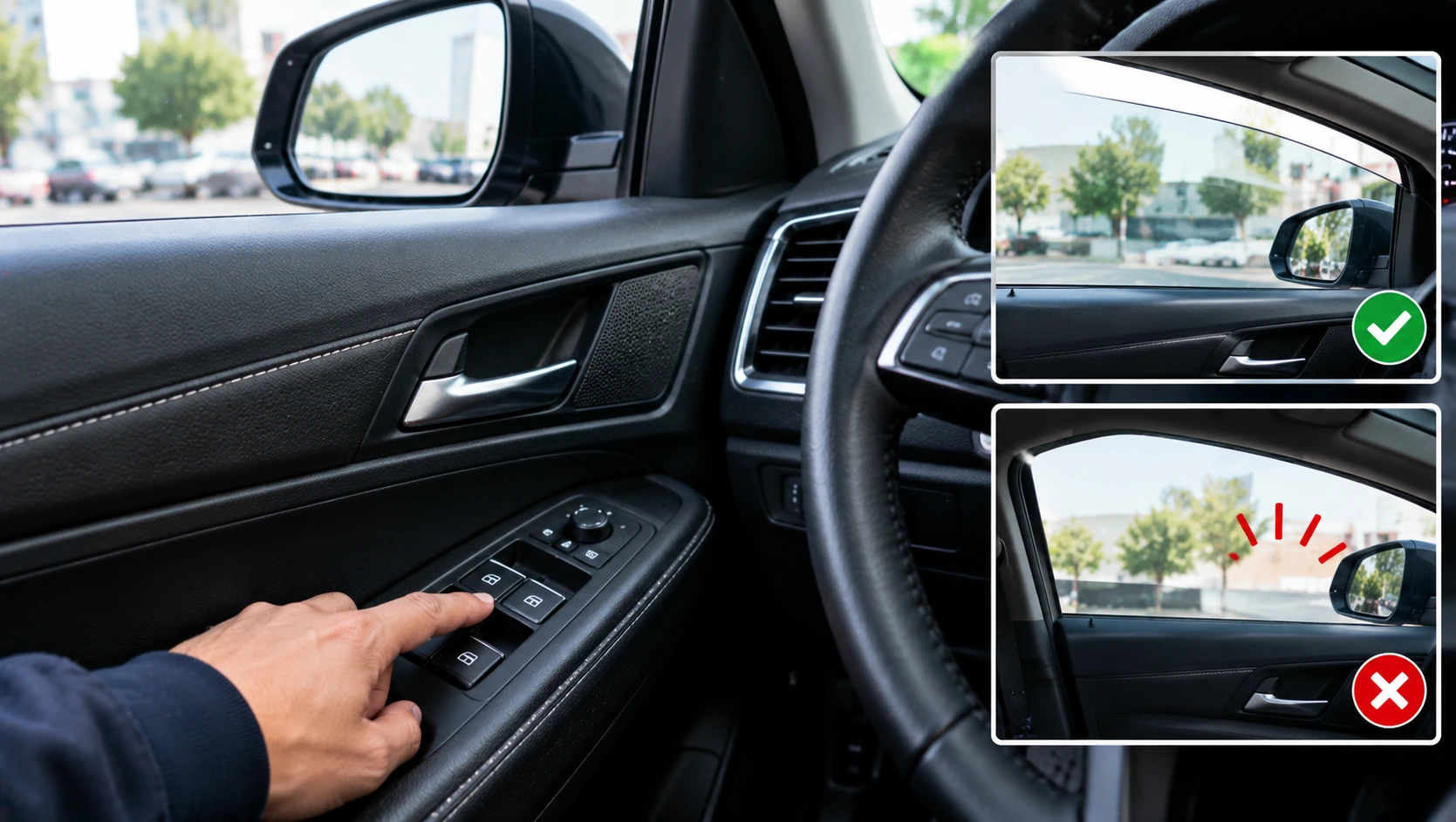
Power windows stop working for a handful of specific reasons — and most of them have nothing to do with the window itself. The motor, the regulator, the switch, the wiring, or the fuse can each cause the same symptom: a window that won’t move. Knowing which one failed determines whether the repair takes an hour or a full day.
In Dubai’s heat, power windows stop working more often than in cooler climates. The cable regulators that most modern vehicles use expand and bind in high temperatures. The window motor that runs in a 55°C parked car starts every cycle under thermal stress. The electrical connectors in the door lining — exposed to direct sun and constantly flexed as the door opens and closes — develop resistance faults faster than the manufacturer’s design assumptions account for.
This guide covers every cause, how each is diagnosed, and what the repair involves.
Power Windows Stop Working — Quick Answer
Power windows stop working because of a failed window motor, a broken or jammed window regulator, a faulty window switch, a blown fuse, or a wiring fault in the door harness. In Dubai, the most common causes are motor failure from heat stress and regulator cable failure from expansion and binding. The least common — but most misdiagnosed — is an intermittent wiring fault in the door hinge area, where the door harness flexes thousands of times per year and eventually fractures a wire. Before replacing any component, the correct diagnostic step is a voltage test at the motor and switch — this confirms whether the fault is electrical supply, switch output, or motor internal failure. Most power window repairs in Dubai are resolved within a day.
Table of Contents
- How the Power Window System Works
- The Most Common Cause — Window Motor Failure
- Window Regulator Failure — Cable and Scissor Types
- Window Switch Faults
- Fuse and Relay Failures
- Door Wiring Harness Faults — The One Most Often Missed
- Child Lock and Window Lock Activations
- How We Diagnose Power Window Faults at Rapid Rev Garage
- How Long Can You Drive With a Window That Won’t Close?
- Repair Cost Ranges in Dubai
- Why Rapid Rev Garage?
- FAQ
- Conclusion
How the Power Window System Works
Each window is operated by its own circuit: a dedicated fuse, a switch that applies voltage to the motor in either direction, a motor that drives a regulator mechanism, and the regulator that physically raises and lowers the glass.
When power windows stop working, the fault is in one of these links. The fuse protects the circuit from overcurrent. The switch routes battery voltage to either the up or down terminal of the motor. The motor converts that voltage into rotational output. The regulator converts rotation into linear glass movement.
Some vehicles add a window control module between the switches and motors — particularly on vehicles with anti-pinch and one-touch open features. On these systems, a module fault can cause power windows stop working across multiple windows simultaneously, because the module controls all four circuits.
The Most Common Cause — Window Motor Failure
The window motor is a DC electric motor mounted inside the door behind the door card. It drives the regulator mechanism directly.
How it fails in Dubai. The motor’s armature windings and brushes degrade faster under heat. A parked vehicle in Dubai’s summer reaches interior temperatures of 70–80°C. The motor’s thermal insulation breaks down over time, and the armature resistance rises. Eventually the motor draws too much current to operate and either blows the fuse or stops mid-travel.
A motor that’s beginning to fail often shows early signs: power windows stop working intermittently — the window moves on the first press but needs a second attempt on the next cycle, or it moves slowly before stopping. This intermittent phase is the best time to address the fault, before the motor stops entirely and leaves the window partially open.
How we diagnose it. With the door card removed, a voltage test at the motor terminals confirms that correct voltage is reaching the motor when the switch is pressed. If voltage is correct and the motor doesn’t run, the motor has failed. If voltage is absent, the fault is upstream — switch, fuse, or wiring. Our car electrical repair team performs this test before any component is ordered — we don’t replace motors on assumption.
Window Regulator Failure — Cable and Scissor Types
The window regulator is the mechanical assembly that translates the motor’s rotation into the up-and-down movement of the glass. There are two types in common use.
Cable regulators. The majority of modern vehicles — Toyota Camry, Nissan Altima, Hyundai Tucson, most Japanese and Korean models — use cable regulators. The motor drives a drum that winds and unwinds two cables connected to the glass carrier. In Dubai’s heat, the cables expand and the drum channel can bind. When the cable snaps — which it does suddenly, usually mid-travel — the window drops to the bottom of the door.
When power windows stop working and the window falls into the door, a cable regulator failure is nearly certain. The glass is still intact. The motor may still run. But the broken cable means the glass has nothing to connect it to the drive.
Scissor regulators. Older European vehicles and some commercial vans use scissor-type regulators — a folding metal arm mechanism. These fail by seizing at the pivot points rather than cable snap. The window moves slowly, then not at all.
Regulator replacement. Regulators are replaced as an assembly with the motor on most modern vehicles — the two components are not cost-effectively separated. Our car mechanic team stocks common regulator assemblies for Toyota, Nissan, Mitsubishi, Honda, and Hyundai models, so most repairs don’t require ordering and waiting.
Window Switch Faults
Each window has a switch at the door, and the driver’s door typically has a master switch panel controlling all four windows. Either can fail.
Individual switch failure. The switch that controls only one window fails while all others work normally. The switch contacts corrode or the internal mechanism wears. A quick test — applying direct voltage to the motor terminals while bypassing the switch — confirms whether the switch is at fault.
Master switch failure. The driver’s door master panel controls all four windows. A fault in this panel can cause power windows stop working across multiple windows at once — which drivers sometimes misattribute to a blown fuse or electrical system fault.
Water ingress. Dubai’s car wash frequency and the occasional heavy rain mean water occasionally enters the door through poor window seals. Switch panels in the armrest are directly exposed to water pooled in the door pocket. A switch that intermittently fails after rain or washing is water-damaged internally.
Fuse and Relay Failures
Every power window circuit is protected by a fuse. When the fuse blows, that window stops completely — no response at all from the switch.
A blown fuse is often the first thing to check, but it’s rarely the root cause. Fuses blow because of overcurrent — usually a failing motor drawing more current than the circuit is rated for, or a wiring short. Replacing a blown fuse without identifying why it blew produces the same failure.
Some vehicles use a separate power window relay in the fuse box. A failed relay cuts power to all window circuits simultaneously — all four windows stop working at once. A relay fault is diagnosed by substituting a known-good relay from the same fuse box before replacing any window component. Our car service team checks the fuse box condition as part of every electrical fault diagnosis.
Door Wiring Harness Faults — The One Most Often Missed
The wiring that runs between the door and the car body passes through a rubber conduit at the door hinge. This conduit flexes every time the door opens — thousands of times per year on a daily-use vehicle.
Over time, individual wires inside the conduit develop hairline fractures. The wire still conducts normally when the door is in a specific position, but loses continuity when the door is fully open or at a certain angle. This produces an intermittent fault — power windows stop working on some occasions but operating normally on others, with no other apparent pattern.
This is specifically why power windows stop working intermittently without any visible damage to the motor or switch.
This is the fault most often misdiagnosed as a switch or motor fault. The switch tests fine. The motor tests fine. But the window fails intermittently. The correct diagnostic step is a continuity test on every wire in the door harness with the door being moved through its full range — the fracture will open and close as the door moves.
Once located, the repair is a harness splice or a full door harness replacement depending on how many wires are affected. Our garage near me team handles this repair regularly on high-mileage Toyota Land Cruisers and Nissan Patrols where the door hinge conduit has seen years of daily flex in Dubai’s conditions.
Child Lock and Window Lock Activations
Before diagnosing a fault, confirm that the window lock hasn’t been accidentally activated. Most vehicles have a window lock button on the driver’s master panel that disables all rear window switches — leaving the rear windows unresponsive to their own switches while still operating from the driver’s panel.
Similarly, the rear door child safety lock can occasionally be mistaken for a window fault by drivers unfamiliar with the vehicle.
Neither of these is a mechanical fault. A quick check of the window lock button — usually illuminated when active — rules this out before any diagnosis begins.
How We Diagnose Power Window Faults at Rapid Rev Garage
Step 1 — Function check. Every window is tested from its own switch and from the driver’s master panel. This isolates whether the fault is in the individual switch circuit, the master panel, or the motor and regulator on that door.
Step 2 — Fuse and relay check. The relevant fuse is inspected and the relay is tested.
Step 3 — Voltage test at the motor. Door card removed, voltage is applied at the motor terminals. A motor that runs under direct voltage but not through the switch circuit confirms the fault is in the switch or wiring, not the motor.
Step 4 — Harness continuity test. With the door moved through its full range, continuity is checked on the door harness. Intermittent faults that appear and disappear with door movement are identified here.
Step 5 — Regulator inspection. With the door card off, the regulator is visually inspected for cable condition, drum integrity, and carrier movement.
If the vehicle can’t be brought in, our mobile car mechanic can perform the initial voltage and switch test at the vehicle’s location to confirm what needs to be ordered before the repair visit.
How Long Can You Drive With a Window That Won’t Close?
Window stuck open — a security and weather risk. Don’t leave the vehicle unattended with a window open in Dubai’s dust and sand environment. If the window is stuck open and can’t be raised, park indoors or have it assessed immediately.
Window stuck closed — driveable. There’s no immediate safety issue. Arrange repair within the current week, particularly before the shamal dust season.
Window partially open and can’t be moved — cover the gap with temporary film or tape to keep dust out, and arrange repair within a few days. A partially open window in Dubai’s summer lets cabin temperature climb significantly in a parked car. For emergency roadside assistance when a vehicle can’t be safely secured, our roadside assistance team covers Al Quoz and surrounding Dubai areas.
Repair Cost Ranges in Dubai
| Repair | Cost Range |
| Window motor replacement | AED 300–800 |
| Window regulator replacement | AED 400–900 |
| Motor and regulator assembly | AED 600–1,400 |
| Window switch replacement | AED 150–500 |
| Door wiring harness repair | AED 300–700 |
| Fuse/relay replacement | AED 50–200 |
Costs vary by vehicle model and whether OEM or aftermarket components are used. Most single-window repairs are completed in 2–4 hours. The most common repair — motor and regulator assembly on a Toyota or Nissan — falls in the AED 600–900 range for parts and labour.
Why Rapid Rev Garage?
When power windows stop working, the temptation is to replace the motor first because it’s the most familiar component. We don’t work that way. Every repair starts with a voltage test and a wiring check — because replacing a motor on a switch or harness fault wastes the cost of the part and doesn’t fix the problem.
We diagnose before we order. We explain what was found and what needs replacement before any work begins.
For paintwork or door card repairs alongside a window fault, our car painting team handles any cosmetic damage from door card removal or prior repair attempts at the same visit.
FAQ
Here are the questions Dubai drivers most often ask about power window faults.
Why does my power window work sometimes but not always?
Intermittent operation almost always points to a wiring fault in the door harness conduit, a switch with worn internal contacts, or a motor that's developing an open circuit in the armature windings. A fault that appears and disappears without a clear pattern is nearly always electrical rather than mechanical — because a mechanical failure (broken cable, failed motor) is usually complete rather than intermittent.
Can a blown fuse cause power windows to stop working?
Yes — a blown fuse cuts power to the window motor circuit entirely. But fuses blow because of overcurrent, which usually means a motor that's drawing too much current before failing, or a wiring short. Replacing the fuse without diagnosing why it blew produces the same failure again within days.
Why do all four windows stop working at once?
All four windows failing simultaneously usually means a blown main window fuse, a failed window relay, a faulty master switch panel, or a window control module fault. It's less likely to be individual motor or switch failures on four separate circuits simultaneously. Check the fuse box first — a single fuse failure can kill all four circuits on some vehicles.
How long does a power window repair take?
Most single-window repairs — motor or regulator replacement — take 2–4 hours once the parts are available. A wiring harness splice or a switch replacement takes less. Master switch panel replacement depends on whether the panel is sourced from stock or ordered. We confirm parts availability before booking the repair appointment.
Is it safe to drive with a window stuck open?
Temporarily, yes — but don't leave the car unattended with a window open. In Dubai, an open window in a parked car admits dust, insects, and in car parks, a security risk. If the window can't be raised manually by removing the door card and pushing the glass up by hand, temporary film over the gap keeps the interior protected until the repair is done.
Conclusion
Power windows stop working because of a motor, regulator, switch, fuse, or wiring fault — and the correct repair depends entirely on which one has failed. Every case where power windows stop working has a diagnosable cause; guesswork is not a repair strategy. Replacing parts by guesswork is the expensive way to reach the same diagnosis that a voltage test confirms in twenty minutes.
Rapid Rev Garage in Al Quoz diagnoses every power window fault with a voltage test and harness check before any component is ordered. Book your appointment on WhatsApp or find us on Google Maps. We serve Al Quoz, Business Bay, Jumeirah, Barsha, Satwa, Downtown, and the Sheikh Zayed Road corridor.
Rapid Rev Garage — Power Windows Stop Working | Al Quoz, Dubai