Strange noises coming from car components are the most reliable early warning system a vehicle has. Drivers who pay attention to strange noises coming from car systems catch faults at the stage that costs hundreds — not thousands. The knock from under the bonnet that appears at idle. The squeal from the front when braking. The rattle from below over speed bumps. The grinding that starts at low speed. None of these sounds appear without a reason — and every one of them points to something specific.
The problem is interpretation. Most drivers know that strange noises coming from car systems mean something is wrong, but can’t tell which system is producing the noise or what the noise actually means. The grinding from the front left during a turn sounds alarming — but is it the wheel bearing, the CV joint, the brake pad, or the steering rack? Each requires a different repair.
This guide maps every common strange noise coming from car — by location, by driving condition, and by what it actually means — so the sound can be connected to the fault before the fault becomes an emergency.
Strange Noises Coming From Car — Quick Answer
Strange noises coming from car systems fall into five sound types: knocking, squealing, grinding, rattling, and humming. Each type, combined with when it appears and where it comes from, narrows the cause to a specific component. A knock from the engine at startup points to low oil pressure or valve train wear. A squeal under braking is brake pad wear indicators or glazed rotors. A grinding when turning indicates a CV joint or wheel bearing.
A rattle from below over bumps is a heat shield, exhaust mount, or suspension component. A hum that varies with speed is almost always a wheel bearing. In Dubai, stop-start traffic, desert dust, and extreme heat accelerate wear in every system that produces these sounds — meaning symptoms appear sooner and escalate faster than in any European driving environment.
Table of Contents
- Why Dubai Makes Strange Noises Worse
- Knocking Noises — Engine, Suspension, and Brakes
- Squealing Noises — Brakes, Belts, and Steering
- Grinding Noises — Brakes, Wheel Bearings, and CV Joints
- Rattling Noises — Heat Shields, Exhaust, and Interior
- Humming Noises — Wheel Bearings and Tyres
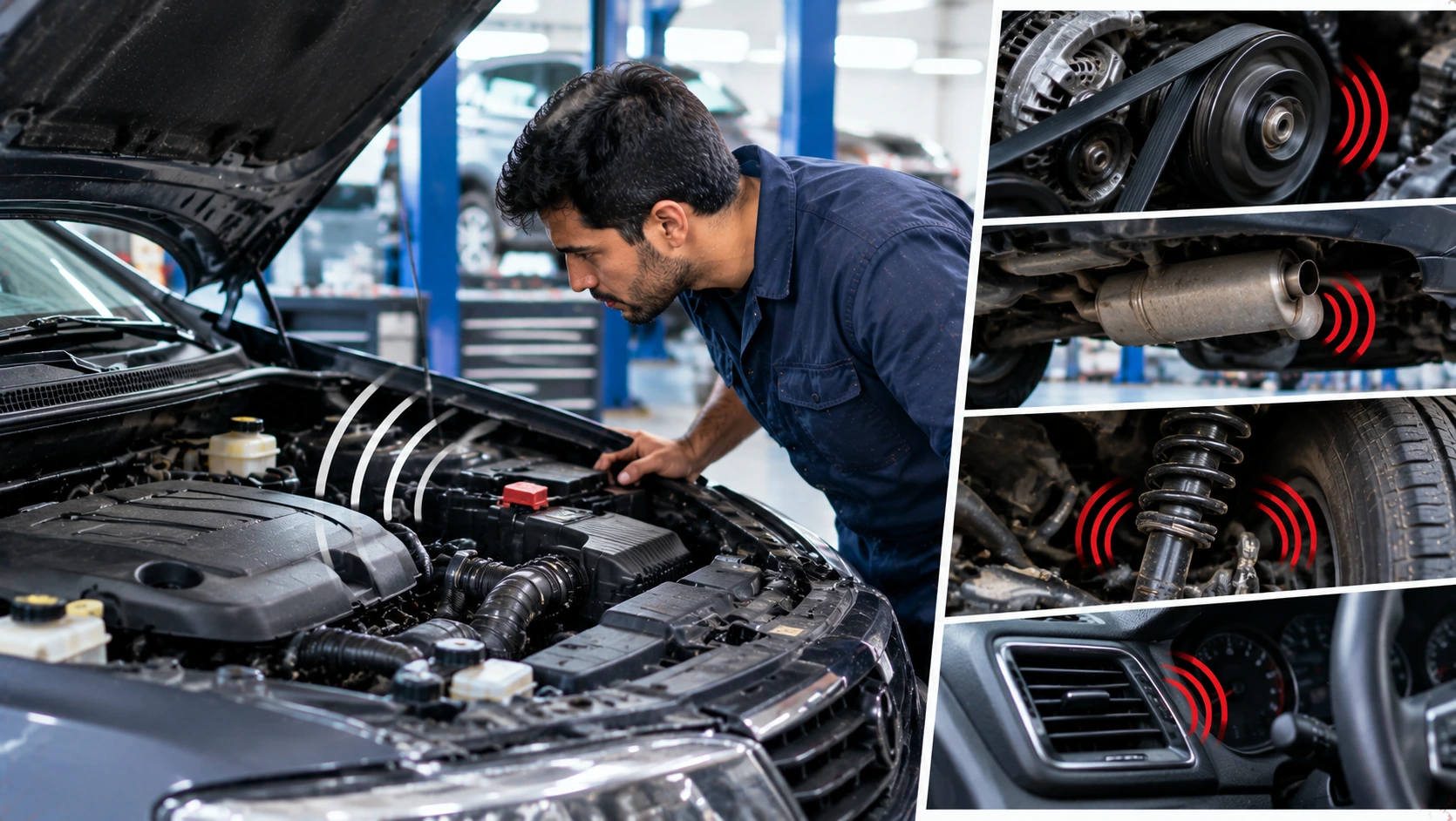
- How Location Helps Diagnose the Noise
- When the Noise Appears Matters
- How We Diagnose Strange Noises at Rapid Rev Garage
- Drive It In vs. Stop Immediately
- Why Rapid Rev Garage?
- FAQ
- Conclusion
Why Dubai Makes Strange Noises Worse
Strange noises coming from car components develop faster in Dubai’s conditions for three specific reasons. Understanding why helps predict which sounds to watch for — and why strange noises coming from car systems appear at lower mileages here than in any European market.
Heat accelerates rubber degradation. The engine mounts, suspension bushings, CV boot seals, and exhaust mount rubbers that normally last 80,000–100,000 km in a European climate degrade at 50,000–60,000 km in Dubai’s summer heat. When a rubber component fails, the metal-to-metal contact it was preventing produces a knock or rattle that wasn’t there the week before.
Stop-start traffic multiplies component cycles. Every brake application wears pad material. Every gear change shifts the transmission. Every standstill-to-motion cycle loads the CV joints and wheel bearings. Dubai’s city traffic executes two to three times more of these cycles per kilometre than any motorway-dominated environment — which means components reach the noise-producing stage of wear faster.
Desert dust enters every system. Fine silica from the desert works into wheel bearing seals, brake assemblies, and air intake systems. A wheel bearing that’s had its seal integrity compromised by dust contamination produces noise earlier than one in a clean environment.
Knocking Noises — Engine, Suspension, and Brakes
Engine knock at startup. A knock that’s loudest in the first 10–20 seconds of running and then diminishes is an oil pressure delay — the oil hasn’t reached the valve train and upper engine before the knock appears. Common causes are an engine that’s slightly low on oil, a degraded oil viscosity that doesn’t hold pressure overnight, or a failing oil pressure relief valve. If the knock disappears within 30 seconds, it doesn’t mean it’s harmless — it means the system is compensating. Our car mechanic team checks oil pressure and valve clearance as the first step on any engine knock complaint.
Deep engine knock under load. A low, heavy knock that appears when the engine is under acceleration — pulling onto the E311, overtaking — and is felt through the car is a bearing knock. Rod bearings or main bearings have worn beyond their clearance tolerance. This is a serious fault. The knock will worsen with every hundred kilometres of continued driving. Do not ignore a knock that appears under load.
Knocking from suspension on bumps. A knock that appears over speed bumps, road joints, or sharp road imperfections — particularly from the front — is a worn ball joint, a degraded control arm bushing, or a failing strut top mount. These components allow micro-movement that produces a knock as they absorb impact. The knock is intermittent at first and becomes constant as wear progresses.
Knocking from brakes at low speed. A knock that appears during light braking at under 30 km/h — felt through the brake pedal or heard from a specific wheel — is usually a caliper slide pin that’s seized and causing uneven brake contact, or a brake pad that’s worn enough to rattle in its carrier.
Squealing Noises — Brakes, Belts, and Steering
Brake squeal during light braking. The most common of all strange noises coming from car brake systems. A faint, intermittent squeal during gentle braking — particularly after the car has been parked overnight — is the brake pad wear indicator making first contact with the disc. The indicator is a metal tab designed to produce exactly this sound as a warning. There’s still pad material remaining, but the replacement window has opened.
Brake squeal on every stop. Constant squealing on every brake application, present even at low speed, indicates pad glazing — the pad surface has hardened from heat cycling and no longer grips the disc cleanly — or the wear indicator is now in full contact. Our car service packages include brake inspection at every major service, because pad condition is one of the clearest predictors of strange noises coming from car brake systems.
Belt squeal at startup. A squeal that’s loudest immediately after a cold start and reduces as the engine warms up is a drive belt or serpentine belt that’s slipping on the accessory pulleys. The belt has stretched with age and no longer maintains tension at cold temperatures. In Dubai’s heat, belt compounds degrade faster — a belt that looks intact can be glazed on the contact surface and slipping. If the squeal persists beyond two minutes of running, the belt or the tensioner needs inspection.
Power steering squeal when turning. A squeal or whine when turning the steering wheel — particularly on full lock in a car park — is a power steering pump that’s working at the edge of its pressure range. It can indicate low power steering fluid, a pump that’s developing wear, or a steering rack seal that’s beginning to leak. On electric power steering vehicles, this sound is replaced by a motor whine from the EPS unit.
Grinding Noises — Brakes, Wheel Bearings, and CV Joints
Grinding when braking. Metal-to-metal contact in the brake system. The pad has worn through its friction material and the steel backing plate is contacting the disc directly. This is the next stage after the squeal warning — it means the warning was present and missed. Continued driving in this condition scores the disc and increases the repair cost from pad replacement alone to pad and disc replacement. Stop driving and get this assessed immediately.
Grinding when turning. A grinding or crunching sound that appears specifically during turns — particularly at low speed in a car park — is a CV (constant velocity) joint with a failed boot seal. The CV joint grease has escaped through a torn boot, and the joint is running dry. In Dubai, the combination of heat, dust, and tight car park turns accelerates CV boot degradation. A torn boot can be addressed with a boot replacement alone if caught early. A dry CV joint that’s been running on metal contact requires a full joint replacement. Our car suspension repair team inspects both front CV boots at every service.
Grinding or growling that varies with speed. A grinding or rumbling sound that increases in pitch and volume with vehicle speed — and sometimes varies as the car turns — is a wheel bearing. The bearing race has worn beyond its tolerance. On a left turn, weight shifts to the right wheel — if the grinding quietens on a left turn and increases on a right turn, the right bearing is the one failing. This diagnosis by load shift is reliable enough to confirm before the vehicle reaches the ramp.
Rattling Noises — Heat Shields, Exhaust, and Interior
Rattle from below over bumps. One of the most common strange noises coming from car undercarriages in Dubai. Heat shields are thin metal panels mounted over the exhaust system to protect the floor from heat. They’re attached with small bolts that corrode and loosen over time. A loose heat shield produces a metallic rattle over road imperfections — loud over the speed bumps that appear every few hundred metres in Al Quoz’s residential roads.
A heat shield rattle is not dangerous, but it can mask other sounds that are. Getting it secured is a 30-minute repair. Our workshop team identifies and secures loose heat shields as part of every underbody inspection.
Rattle from the exhaust. A louder, lower-pitched metallic rattle from the rear of the vehicle is an exhaust bracket that’s failed — the rubber mount that holds the exhaust has cracked, allowing the exhaust to contact the vehicle body over road irregularities. In Dubai’s heat, exhaust rubber mounts degrade faster than their rated life.
Interior rattle. Rattles from the dashboard, door panels, or the rear parcel shelf are trim fit issues rather than mechanical faults. They’re annoying rather than serious. But an interior rattle that appears and then disappears — particularly if it coincides with specific road conditions — is worth isolating, because occasionally what sounds like an interior trim rattle is actually a component in the door assembly or behind the dashboard.
Humming Noises — Wheel Bearings and Tyres
A hum that’s present at highway speed and increases with vehicle speed has two likely causes.
Wheel bearing hum. A constant, load-bearing drone that rises in pitch with speed and sometimes changes character on curves. Wheel bearing hum is the classic sound of bearing race wear — it’s consistent, directional (it comes from the affected corner), and worsens progressively. In Dubai, wheel bearings accumulate dust contamination faster, shortening their operating life below the manufacturer’s design rating.
Tyre hum. Uneven tyre wear — from a wheel alignment that’s been out of spec — produces a hum from tyre tread edges that’s in contact at an angle. Unlike a wheel bearing hum, tyre hum is usually consistent on both left and right turns and may have a rhythmic quality from the tread pattern.
The distinction matters for the repair. A bearing replacement and a wheel alignment are different interventions. Our garage near me team spins each wheel by hand on the ramp and applies a lateral load test to confirm bearing condition before attributing highway hum to either cause.
How Location Helps Diagnose the Noise
Front left or front right — brake, wheel bearing, ball joint, CV joint, strut mount, or tie rod end on that corner.
Rear — exhaust mount, rear wheel bearing, rear brake, or differential noise on four-wheel-drive vehicles.
Under the bonnet — engine, drive belt, power steering pump, alternator, or air conditioning compressor.
From below, centre of the vehicle — exhaust, heat shield, catalytic converter bracket, or transmission mount.
Interior — door cards, dashboard trim, glove box, rear parcel shelf, or door window seal.
Location is the first diagnostic filter. A sound that’s definitely coming from the front right narrows the cause immediately — whatever is making strange noises coming from car systems at that location has a short list of possibilities. Combining location with the conditions that trigger strange noises coming from car components — cold start, braking, turning, bumps — narrows the diagnosis further before the vehicle reaches the ramp.
When the Noise Appears Matters
When strange noises coming from car systems appear also narrows the cause:
Only at cold start — oil pressure-related (engine), or rubber component stiffness (engine mount, suspension bushing).
Only when braking — brake system: pads, discs, caliper, or brake hardware.
Only when turning — CV joint, power steering pump, or wheel bearing under lateral load.
Only over bumps — suspension: ball joint, control arm bushing, strut mount, or heat shield.
All the time, increasing with speed — wheel bearing, tyre wear, or exhaust contact.
Only under acceleration — engine bearing knock, transmission mount, or drive shaft imbalance.
How We Diagnose Strange Noises at Rapid Rev Garage
Road test first. We replicate the noise condition — cold start, bumps, braking, turning — before lifting the vehicle. A noise that only appears under specific conditions needs to be reproduced before it can be located.
Ramp inspection. The vehicle is raised and every suspension, steering, and brake component on the affected corner is physically checked for play and wear. Ball joints are loaded and checked for movement. CV boots are inspected for tears. Brake pad thickness is measured. Wheel bearings are spun and loaded.
Stethoscope on engine components. For under-bonnet noises, a mechanical stethoscope is applied to the accessory pulleys, valve cover, and engine mounts to isolate where the sound originates before the engine is disassembled.
Exhaust and underbody check. The full exhaust run is checked for loose mounts, cracked sections, and loose heat shields.
Diagnostic scan. Any fault codes stored in the ABS, suspension, or engine modules that correspond to the noise complaint are read and cross-referenced with the physical findings.
For a noise that’s developed suddenly, our mobile car mechanic can perform an initial on-site assessment at the vehicle’s location before it’s driven to the workshop — particularly useful when the noise is severe enough that driving might worsen the underlying fault. If the vehicle can’t be safely driven at all, our roadside assistance team covers Al Quoz and surrounding Dubai areas.
Drive It In vs. Stop Immediately
Drive it in today: Intermittent knock over bumps, belt squeal at cold start, brake squeal (first stage), rattle from below, power steering whine.
Drive it in this week: Constant brake squeal on every stop, humming at highway speed that’s getting louder, knock from engine at startup that lasts more than 30 seconds.
Stop and call for assistance: Grinding when braking (metal on metal), deep engine knock under acceleration, grinding when turning with loss of steering precision, brake pedal going low with any grinding.
Why Rapid Rev Garage?
Strange noises coming from car systems are the earliest form of mechanical communication a vehicle produces. At Rapid Rev Garage in Al Quoz, every noise complaint starts with a road test to replicate the sound — because a noise that can’t be reproduced can’t be located. We don’t guess at causes. We test them.
Every ramp inspection covers suspension geometry, brake condition, CV boot integrity, wheel bearing play, and exhaust mount security. The diagnosis is documented and explained before any repair is authorised.
For any bodywork or paint damage that’s occurred alongside a mechanical fault — stone chips, panel damage from road debris — our car painting team handles cosmetic repair at the same visit.
FAQ
Here are the questions Dubai drivers most often ask about strange car noises.
Why does my car make a knocking sound on bumps?
A knock over bumps is almost always a worn suspension component — a ball joint, control arm bushing, or strut top mount that's allowing movement it should absorb. The knock is intermittent when wear first develops and becomes constant as the component deteriorates further. Have it inspected before the intermittent knock becomes a continuous one.
What causes a grinding noise when braking?
Grinding during braking means the brake pad friction material has worn through and the steel backing plate is contacting the disc directly. This is the stage after the squeal warning has been present and missed. The disc will be scored with continued driving. Stop and get it assessed — continuing to brake in this condition increases the repair cost and the stopping distance.
Why does my car hum at highway speed?
A hum that increases with speed is either a worn wheel bearing or tyre wear from a misaligned wheel. Wheel bearing hum often changes character slightly when the car turns — weight shift loads the bearing differently. Tyre hum is more consistent across turning directions. Both are diagnosed by spinning the wheel on the ramp and checking bearing play before attributing the hum to either cause.
Can a loose heat shield be dangerous?
A loose heat shield that's only rattling is not immediately dangerous. But a heat shield that's fallen and is making contact with the exhaust or the road surface can create a fire risk if it directs heat onto the body undercoating, and a road hazard if it detaches fully. Get a rattling heat shield secured — it's a quick repair, and it eliminates a noise that can otherwise mask other developing faults.
Why does my car squeal when I first start it?
A squeal at cold start that disappears after a minute or two is usually a drive belt or serpentine belt that's slipping at low temperature. The belt has stretched or its surface has glazed, and the cold temperature means it's not gripping the pulleys correctly until it warms and expands slightly. A belt that's been slipping will eventually squeal continuously, regardless of temperature, and then fail.
Conclusion
Strange noises coming from car systems are not background noise — they’re specific signals from specific components. Every strange noise coming from car components has a root cause that a voltage test, a ramp inspection, or a road test can confirm. A knock, squeal, grind, rattle, or hum each points to a different fault, and the combination of what the noise sounds like, where it comes from, and when it appears narrows the cause to a short list before the vehicle reaches the ramp.
Rapid Rev Garage in Al Quoz starts every noise complaint with a road test and ramp inspection — replicating the sound before diagnosing it, and explaining the finding before any repair is authorised. Book your appointment on WhatsApp or find us on Google Maps. We serve Al Quoz, Business Bay, Jumeirah, Barsha, Satwa, Downtown, and the Sheikh Zayed Road corridor.
Rapid Rev Garage — Strange Noises Coming From Car | Al Quoz, Dubai