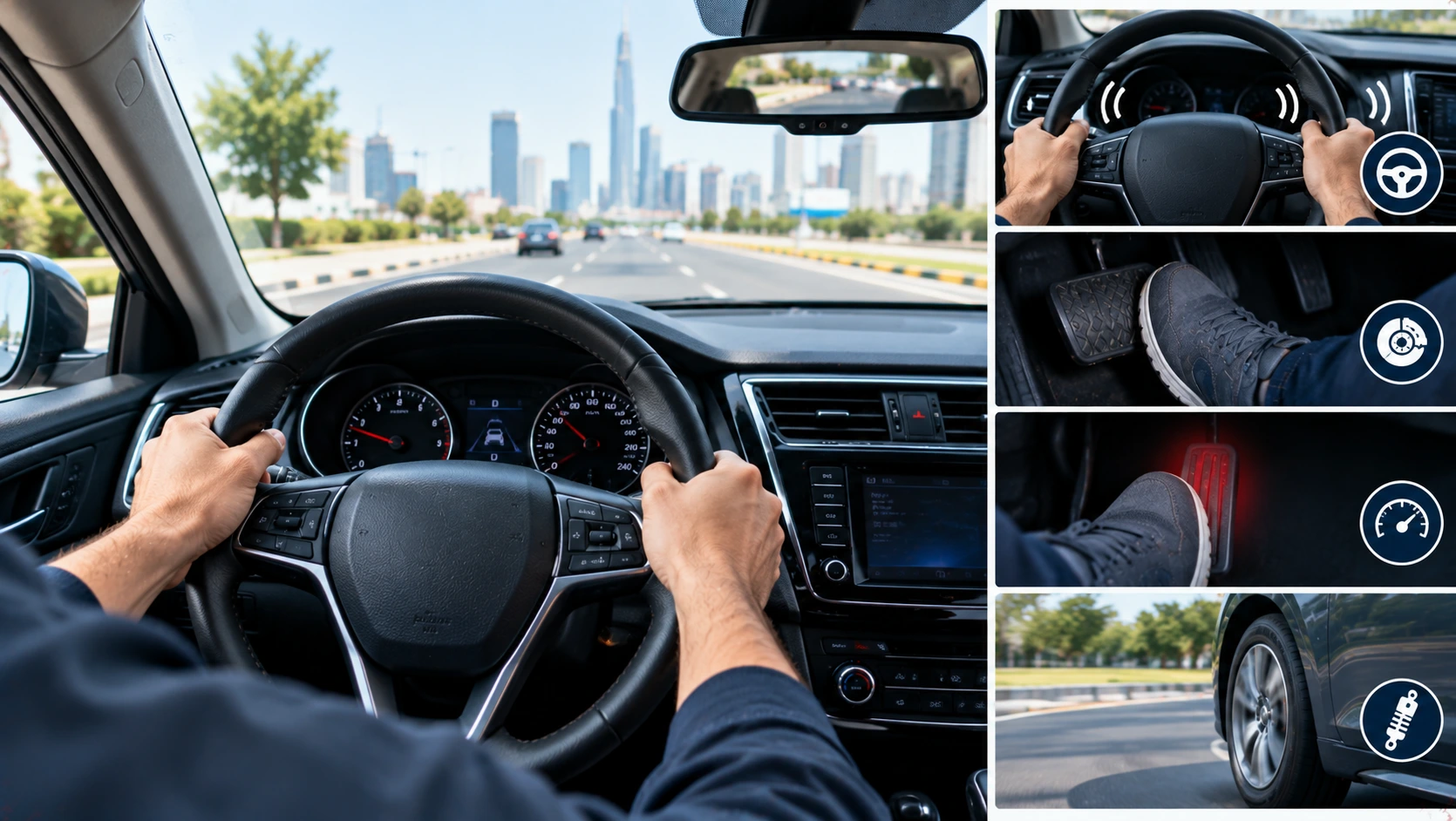
When a car feels different to drive than it did a month ago, something has changed. The steering that used to feel planted now floats slightly. The brakes that used to bite cleanly now need a little more travel before the car slows. The engine that used to pull crisply now hesitates at junctions. The ride that used to absorb speed bumps now transmits every one of them.
None of these changes appear without a cause. A car feels different to drive because one or more systems have moved away from their correct operating parameters — and the driver’s sensory feedback is the most reliable early detector of this shift. Most mechanical faults give a feel-based warning before they show up as a warning light or a breakdown.
In Dubai, a car feels different to drive more quickly than in cooler climates. The combination of constant air conditioning load, stop-start traffic on Sheikh Zayed Road and Al Khail Road, desert dust entering intake and suspension systems, and the thermal stress of summer heat accelerates the wear cycles that change how a vehicle handles.
This guide covers every system that produces a change in how the car drives, what the feeling means, and when it crosses from something to monitor into something to have checked immediately.
Car feels different to drive — Quick Answer
A car feels different to drive because of changes in the steering, suspension, brakes, tyres, or engine. The most common causes in Dubai are wheel alignment drift from speed bump impacts, worn shock absorbers that no longer settle the car after road irregularities, brake pad wear that changes pedal feel and stopping power, tyre pressure loss or uneven wear that affects how the car tracks, and engine or transmission issues that change throttle response and acceleration feel.
Any change in how the car drives — heavier steering, a softer or spongier brake pedal, a pull to one side, a rough idle felt through the seat or wheel — is a mechanical signal that deserves investigation. In Dubai’s conditions, these signals appear sooner and escalate faster than the manufacturer’s design assumptions account for.
Table of Contents
- Why Driving Feel Is the First Warning System
- Steering That Feels Different — Heavy, Light, or Pulling
- Suspension Changes — Bounce, Wander, and Instability
- Brake Pedal That Feels Different — Soft, High, or Pulling
- Engine and Transmission Changes — Hesitation, Sluggishness, and Vibration
- Tyre-Related Changes — Vibration, Pull, and Uneven Response
- Why Dubai Conditions Make Cars Feel Different Sooner
- How We Diagnose Driving Feel Changes at Rapid Rev Garage
- When a Different Driving Feel Needs Immediate Attention
- Why Rapid Rev Garage?
- FAQ
- Conclusion
Why Driving Feel Is the First Warning System
A vehicle’s feel communicates through the steering wheel, the brake pedal, the seat, and the accelerator response. These are live data channels — the driver is receiving information from the tyres, suspension, brakes, and drivetrain on every trip.
When a car feels different to drive, the driver is detecting a real change in the system’s output. The steering wheel isn’t just heavier by coincidence — something in the power steering or steering geometry has changed. The brake pedal isn’t just softer because of the weather — the hydraulic system or the pad compound has changed.
The value of paying attention to feel is timing. A mechanical issue that’s detectable by feel in week one is almost always cheaper to fix than the same issue detected by a breakdown in month three. Our car mechanic team starts every diagnostic visit by asking how the car feels — because the driver’s description is the fastest route to the affected system.
Steering That Feels Different — Heavy, Light, or Pulling
Heavier steering than usual. The steering that used to turn easily in a car park now requires noticeably more effort. This is the first sign of power steering system change — low power steering fluid on hydraulic systems, a pump beginning to wear, or a rack seal that’s developing internal resistance. On electric power steering vehicles, heavy steering indicates EPS motor wear or a torque sensor that’s starting to drift. In both cases, the change is gradual — the Car feels different to drive at low speed first, before highway handling is affected.
Steering that pulls to one side. The car that used to track straight on the E11 now drifts left or right when the wheel is released briefly. A consistent pull indicates wheel alignment deviation — camber or toe angle out of spec. In Dubai, speed bump impacts shift alignment geometry regularly. A pull that appeared after hitting a kerb or a speed bump at speed should be assessed within the week, before the misalignment wears the tyres on the affected corner. Our car service includes a four-wheel alignment check at every major service precisely because Dubai’s road conditions move geometry faster than the service interval assumes.
Steering that feels vague or floaty. The steering that used to feel precise and connected now requires constant small corrections to maintain a straight line. This vagueness indicates worn steering rack bushings, loose tie rod ends, or worn wheel bearings that allow micro-movement at the hub. It’s most noticeable at motorway speeds and worst in crosswind conditions on open stretches of the E66 or E611.
Steering wheel vibration at highway speed. A vibration felt through the wheel at 100–120 km/h that wasn’t there before is almost always wheel balance — either a balance weight that’s fallen off, or new uneven wear developing on the tyres. It can also be a bent wheel rim from a hard kerb or pothole impact. Wheel balance changes produce vibration at a specific speed range; road irregularities tend to produce it across all speeds.
Suspension Changes — Bounce, Wander, and Instability
The car doesn’t settle after bumps. A vehicle with healthy shock absorbers absorbs a speed bump and returns to its normal ride height in one or two oscillations. A vehicle whose shocks are wearing bounces an extra time — the Car feels different to drive over Dubai’s residential speed bumps, where a well-maintained car settles immediately and a car with worn shocks keeps moving. This is the clearest daily indicator of shock absorber degradation.
Body roll that’s increased on corners. The car that used to corner flatly now leans noticeably on the roundabouts of Al Quoz or in the curves approaching Dubai Marina. Increased body roll indicates worn or degraded anti-roll bar links or bushings — these components limit how far the body rolls relative to the wheels in cornering. Their rubber elements degrade in Dubai’s heat.
The ride has become harsher on one side. When the Car feels different to drive on the left versus the right — one side transmitting more impact from road irregularities than the other — a spring has lost its rated rate on the softer side, or a shock absorber has failed unevenly. Asymmetric ride quality is one of the clearest signs of single-component failure rather than general system wear. Our car suspension repair team diagnoses asymmetric ride by comparing damper response on both sides of the vehicle on the ramp.
Brake Pedal That Feels Different — Soft, High, or Pulling
A softer brake pedal than before. The pedal that used to bite at the top of its travel now requires slightly more depression before the brakes engage. This is the most important feel-change to act on. A progressively softer pedal in a hydraulic brake system indicates moisture contamination in the brake fluid — water absorbed into hygroscopic brake fluid lowers its boiling point and reduces hydraulic pressure consistency. Dubai’s temperature cycling between underground car parks and outdoor heat accelerates fluid moisture absorption. A brake fluid test confirms moisture percentage; replacement restores the pedal feel.
A pedal that pulses under braking. A rhythmic pulsation felt through the brake pedal — like the brakes are releasing and re-engaging rapidly — is disc thickness variation. The disc has developed an uneven surface from heat-induced warping or from pad deposits. At low speed the pulsation is faint; at higher braking speeds it becomes a noticeable shudder through the pedal and the steering wheel.
The car pulled to one side when braking. A pull that only appears under brake application — the car tracks straight otherwise — indicates uneven brake force between the left and right callipers. A seized calliper slide pin, uneven pad wear, or a brake hose that’s begun to restrict flow internally can all produce this. Under normal driving it’s inconvenient. Under emergency braking from motorway speed, a brake-only pull is a serious handling problem.
Engine and Transmission Changes — Hesitation, Sluggishness, and Vibration
The engine feels less responsive than before. The Car feels different to drive under acceleration — pulling out of a junction feels more laboured, overtaking requires more planning. This reduced responsiveness points to fuel system changes (fuel pressure dropping, injector fouling), intake restriction (a loading air filter in Dubai’s dust), or ignition system wear (spark plugs approaching the end of their service life). A 10–15% increase in fuel consumption alongside reduced responsiveness confirms the engine is working harder for less output.
Vibration at idle felt through the seat or wheel. The engine that used to sit smoothly at a standstill now transmits a subtle shudder through the steering wheel or the seat. This is either a misfire (one or more cylinders not completing combustion on every cycle), a degraded engine mount that’s no longer isolating engine vibration from the chassis, or a transmission mount under stress. In Dubai’s stop-start traffic, idle vibration is noticed quickly because drivers spend more time stationary than in any highway-dominant environment.
Hesitation between gears. The automatic transmission that shifted smoothly now pauses between ratios or produces a slight jerk on the 2nd-to-3rd shift. Friction modifier additives in the ATF are depleted — every shift cycle deposits a little more heat and strips a little more additive from fluid that’s past its service interval. This hesitation is the first of a six-stage degradation sequence that ends in transmission failure if the fluid isn’t changed.
Tyre-Related Changes — Vibration, Pull, and Uneven Response
Tyres are where every other system’s wear manifests. The alignment that’s off wears a tyre edge. The shock absorber that’s failed allows tyre bounce that produces cup wear. The wheel bearing that’s worn allows hub wobble that changes how the tyre contacts the road.
A new vibration at a specific speed. A vibration that only exists between 90–110 km/h and disappears at higher or lower speeds is tyre balance. At that specific speed, the imbalance excites the unsprung mass of the wheel and tyre. It can also be a flat spot — permanent tyre distortion from sitting stationary in Dubai’s summer heat.
The car feels like it wanders between lane markings. Lane wander without a clear pull indicates toe deviation — both front wheels pointing slightly in different directions — or rear axle alignment that’s shifted. On a straight stretch of highway, the driver has to make constant small corrections. This is alignment, not driver error.
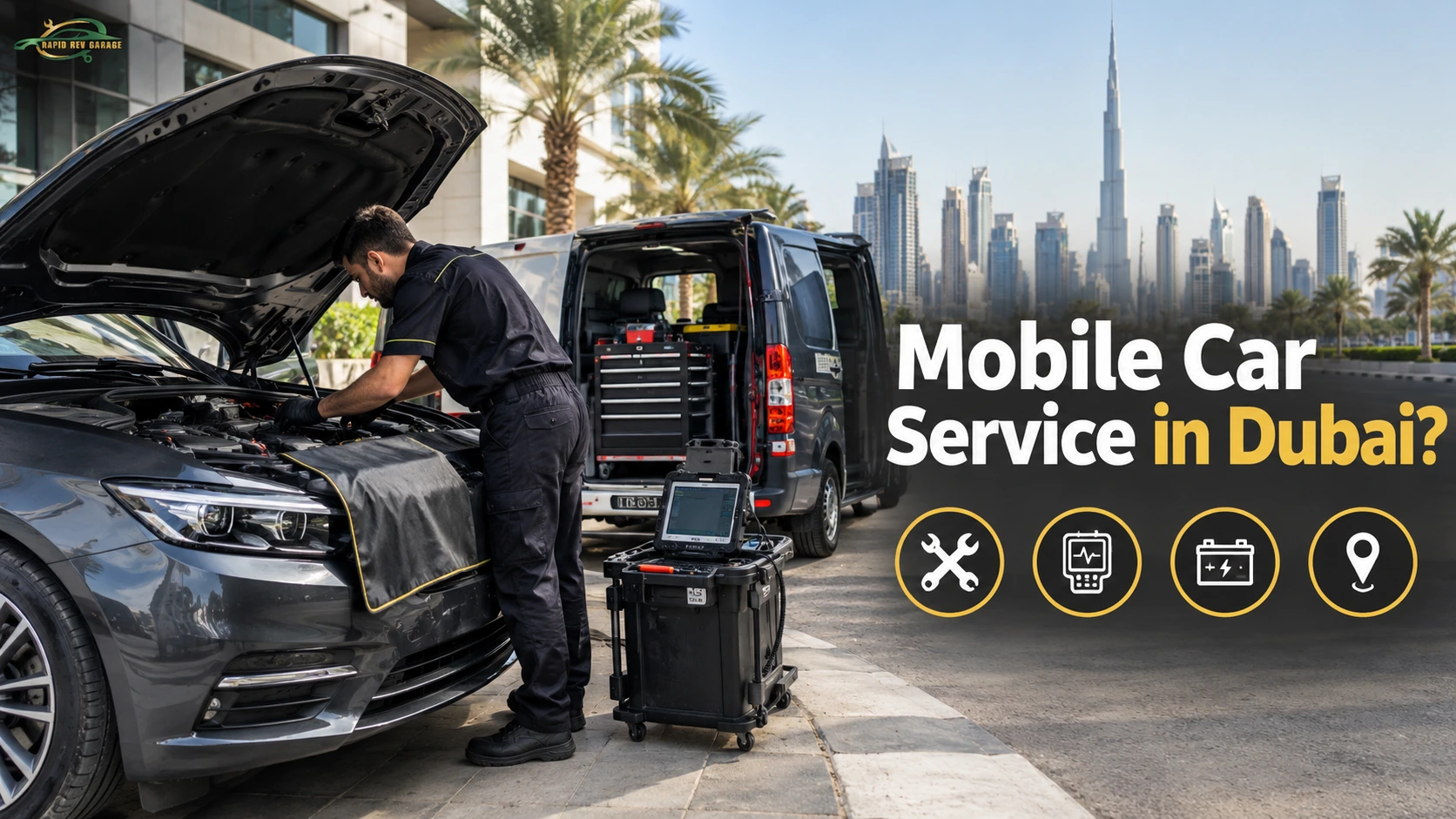
Tyre scrub noise from the front. A faint scrubbing sound from the front tyres during low-speed manoeuvring — in a car park, during a U-turn — that wasn’t there before is a tyre whose inner or outer edge is dragging at an angle. This is camber or toe misalignment audibly evident. Our mobile car mechanic can check tyre wear pattern and confirm alignment deviation at the vehicle’s location before the car is driven further.
Why Dubai Conditions Make Cars Feel Different Sooner
The European or Japanese driving environment that a vehicle’s service schedule is designed for is fundamentally different from Dubai’s daily reality.
Heat degrades every rubber component faster. Engine mounts, suspension bushings, anti-roll bar links, brake hoses, and CV boot seals all have rated service lives calculated in cooler environments. In Dubai’s summer, these components reach end of life at 60–70% of the European mileage rating. When a rubber component fails, the metal-to-metal contact it was preventing changes how the car feels.
Speed bumps misalign geometry continuously. Dubai’s residential streets have speed bumps every 200–400 metres. A vehicle crossing 30–40 speed bumps per day accumulates alignment impacts that a European vehicle on smooth motorways never sees. Camber and toe angles shift. The Car feels different to drive because its geometry is drifting between services.
Stop-start traffic multiplies wear cycles. Every brake application, every gear change, every standstill-to-motion cycle counts toward the component’s service life. Dubai’s traffic executes these cycles at two to three times the rate of highway driving — which is why a Car feels different to drive at 40,000 km of Dubai city use than a European vehicle at the same reading on motorway kilometres.
How We Diagnose Driving Feel Changes at Rapid Rev Garage
Road test first. Every driving complaint begins with a road test that replicates the exact condition the driver described — the speed bump response, the motorway pull, the cold-start idle vibration. A symptom that can’t be reproduced can’t be diagnosed.
Alignment measurement. Four-wheel alignment is measured on the ramp against manufacturer specification. Any deviation is documented before adjustment — so the driver knows exactly what changed and what was corrected.
Suspension and steering ramp inspection. Every ball joint, tie rod end, control arm bushing, anti-roll bar link, and strut mount on the affected corners is physically loaded and checked for play or movement. Worn components are identified before they produce noise loud enough to be undeniable.
Brake system check. Pad thickness is measured, disc surface is inspected, caliper slide pins are tested for free movement, and brake fluid moisture content is tested. Brake feel changes are the most safety-critical and are treated as priority findings.
Engine diagnostic scan. Stored fault codes, live fuel trim data, and misfire counters are read. An engine that feels sluggish but shows no warning light often has stored codes from intermittent faults and fuel trim corrections that explain the feel-change precisely.
For a car feels different to drive after a specific event — a kerb impact, a hard speed bump, a minor collision — our car garage near me in Al Quoz handles same-day assessment appointments. If the change in feel is severe enough that driving is uncertain, our roadside assistance team covers Al Quoz and surrounding Dubai areas.
When a Different Driving Feel Needs Immediate Attention
Don’t drive — call for assistance: Brake pedal going to the floor or feeling spongy with no resistance, steering with no response to input, pulling so severe the driver can’t maintain direction, engine vibration so significant it can be felt through the entire body of the car.
Assess today: Any brake feel change, a pull under braking, steering that’s suddenly heavier than normal, vibration at idle felt through the seat or steering wheel.
Assess this week: Steering pull on a straight road, highway wander, increased body roll, ride that’s become harsher on one side, reduced throttle response alongside higher fuel consumption.
Why Rapid Rev Garage?
A car feels different to drive is exactly the kind of complaint that gets resolved permanently when the right system is diagnosed rather than guessed at. At Rapid Rev Garage in Al Quoz, every feel-change diagnostic starts with a road test — because a mechanic who hasn’t driven the car can’t confirm what changed. The ramp inspection that follows is targeted at the system the road test points to, not a generic check of everything.
We document every finding, explain it, and give the driver a clear picture of what’s changed and what fixing it involves — before any repair is authorised. For cosmetic damage alongside a mechanical feel issue — paint chips from road debris, a scuffed alloy — our car painting team handles the repair at the same visit.
FAQ
Here are the questions Dubai drivers most often ask when their car feels different.
Why does my car feel different after a speed bump?
A hard speed bump impact can shift wheel alignment geometry, damage a ball joint or strut mount, or crack a wheel rim. If the Car feels different to drive after a specific speed bump or kerb hit — pulling to one side, vibrating at speed, or making a new knock — the affected components need physical inspection before a wheel alignment is done. Alignment on a bent component doesn't hold.
Why is my steering heavier than usual?
Heavy steering at low speed is usually low or degraded power steering fluid on hydraulic systems, or EPS torque sensor drift on electric systems. Heavy steering that developed suddenly — particularly if accompanied by a whining noise when turning — points to a power steering pump under stress. Heavy steering that's developed gradually over months points to fluid condition or rack seal wear.
What causes a soft brake pedal?
A brake pedal that's softer than it used to be is almost always brake fluid that's absorbed moisture. Hydraulic brake fluid is hygroscopic — it absorbs water from the atmosphere over time. As moisture content rises, the fluid's boiling point drops and its hydraulic consistency reduces. A brake fluid exchange restores full pedal firmness when caught before air enters the system.
Why does my car vibrate at highway speed?
A vibration specifically at 90–120 km/h that wasn't there last month is tyre balance. A balance weight may have come off, or the tyres have developed uneven wear from running on misaligned geometry. A vibration that's present at all speeds is more likely a wheel bearing or a tyre with a structural flat spot from extended parking in Dubai's heat.
Can worn shock absorbers change how a car drives?
Yes — worn shocks are one of the most common reasons a Car feels different to drive. As dampers lose their ability to control spring oscillation, the car bounces more over bumps, corners with more body roll, and feels less planted at motorway speed. Most drivers adapt to the change gradually and don't notice how significant the degradation has been until new shocks are fitted and the improvement is immediate.
Conclusion
When a car feels different to drive, it’s communicating through the only channels it has — the steering, the pedal, the seat, and the engine response. These signals appear before warning lights and before breakdowns. Acting on them at the feel stage is the difference between a straightforward service repair and an unplanned workshop visit.
Rapid Rev Garage in Al Quoz road-tests every feel-change complaint, diagnoses the system causing it, and explains the finding before any work begins. Book your appointment on WhatsApp or find us on Google Maps. We serve Al Quoz, Business Bay, Jumeirah, Barsha, Satwa, Downtown, and the Sheikh Zayed Road corridor.
Rapid Rev Garage — Car feels different to drive | Al Quoz, Dubai