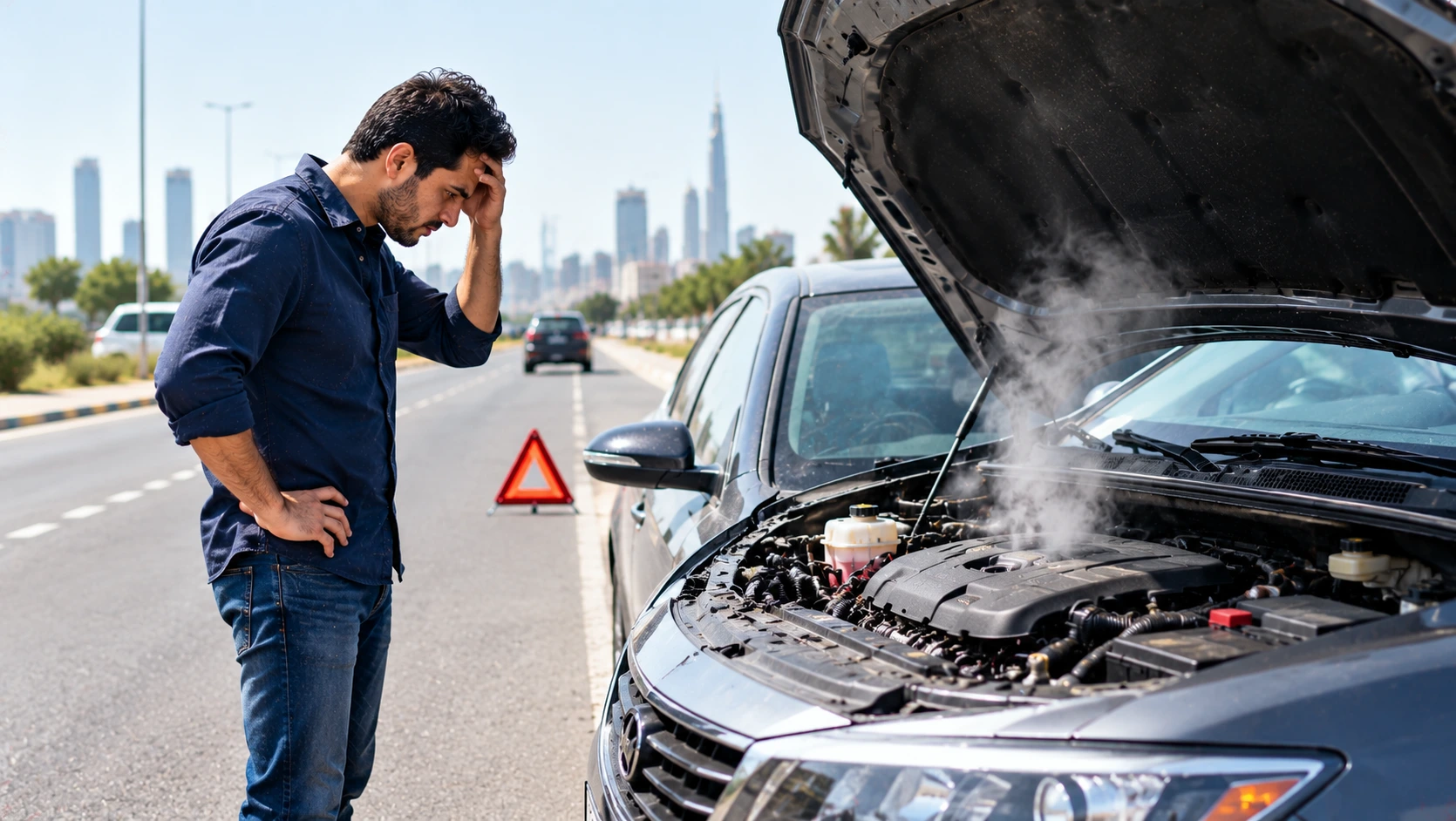
The oil light flickers, the engine loses power, and traffic on Sheikh Zayed Road keeps coming at 100 km/h behind you. When your car breaks down in Dubai, the next ten minutes decide whether you pay only for a repair or for a fine and black points as well.
Dubai rules are stricter than most drivers expect. Under Article 98 of the UAE Federal Traffic Law, stopping in a live lane because of a breakdown, an empty tank or a tyre failure can cost AED 1,000 and six black points, plus another AED 500 for blocking traffic. Dubai Police also tell drivers to leave a car that is stuck in a lane and move away from the road. That is the opposite of what many American and British guides say.
At Rapid Rev Garage in Al Quoz, we see the results of roadside breakdowns every week: flat batteries, cooked radiators, split hoses and fuel pumps that gave up in traffic. This guide covers what to do on the road, who to call, what to tell the recovery driver and which checks stop it from happening again.
What to Do When Your Car Breaks Down: Quick Answer
If your car breaks down in Dubai, switch on your hazard lights and use the speed you still have to reach the hard shoulder or the nearest exit. Stopping in a live lane when you could have moved carries a AED 1,000 fine and six black points. Once stopped, pull the handbrake and turn the wheels away from traffic.
If the car cannot move, place a warning triangle 100 metres behind it, get everyone out through the passenger side and stand behind the barrier. Call 999 if you are stuck in a lane or anyone is in danger. Once safely off the road, call roadside assistance or car recovery and share your live location on WhatsApp.
Table of Contents
- The First Thing to Do When Your Car Breaks Down on the Road
- Why Stopping in a Live Lane Costs AED 1,000 and Six Black Points
- What Dubai Police Expect You to Do After a Breakdown
- What to Tell the Recovery Driver So Help Reaches You Faster
- What to Do If Your Car Breaks Down in the Desert or on a Remote Road
- What to Do If Your Car Breaks Down on a Tram or Rail Crossing
- Why Cars Break Down So Often in Dubai
- Dashboard Warning Lights That Show a Breakdown Is Coming
- Roadside Fixes vs Towing: When Your Car Needs a Flatbed
- How Rapid Rev Garage Diagnoses a Car After a Breakdown
- Does Car Insurance Cover Breakdown Recovery in the UAE?
- What Every Dubai Driver Should Keep in the Boot
- Services That Stop Your Car Breaking Down Again
- FAQ
- Conclusion
The First Thing to Do When Your Car Breaks Down on the Road
The first thing to do is switch on your hazard lights, before you brake and before you try to work out what failed. Most cars give a few seconds of warning, such as a juddering engine, a burning smell, steam from the bonnet or a sudden loss of power. Those seconds are your best chance to leave the traffic lane.
Leave the Traffic Lane Without Braking Hard
Take your foot off the accelerator and let the car slow down on its own. Hard braking on Sheikh Zayed Road or Al Khail Road gives the driver behind you almost no time to react, especially if they are following close. Signal early, check your mirror and steer gently toward the right hard shoulder.
If an exit is close, head for it. A slip road or a quiet side street in Al Barsha is far safer than any highway shoulder. Power steering and brake assist get weaker once the engine stops, so the wheel and the pedal will feel heavy. Push harder than normal, because the car will still steer and stop.
Hazard Lights, Handbrake and Wheels Turned Away From Traffic
Once the car has stopped, pull the handbrake and put an automatic into P. Turn the front wheels away from the road, so the car rolls away from traffic if it gets hit from behind. Keep the hazard lights on the whole time, even in daylight. At night, switch on the interior light as well so passing drivers can see there are people nearby.
Why Stopping in a Live Lane Costs AED 1,000 and Six Black Points
Stopping in a moving lane is one of the most dangerous traffic violations in the UAE, and the law treats it that way. Under Article 98 of the UAE Federal Traffic Law, stopping in the middle of the road because of a breakdown, an empty fuel tank or a tyre failure brings a AED 1,000 fine and six black points. Dubai Police add a further AED 500 for obstructing traffic.
The fine targets drivers who stop when they could have kept rolling to the shoulder or an exit. A car that dies instantly and cannot be moved is a different case. Dubai Police ask those drivers to call them straight away, so a patrol can secure the scene and protect the people in the car.
The danger is real. In 2026, Dubai Police reported a collision involving three vehicles on Al Khail Road after a driver stopped in the lane to pick up a fallen number plate. Three people were injured. In another case, a motorcyclist was seriously hurt on Sheikh Mohammed bin Zayed Road after hitting a truck that broke down in the lane near Hessa Bridge.
What Dubai Police Expect You to Do After a Breakdown
Dubai Police give clear steps for a car that cannot be moved off the road: hazard lights on, a warning triangle behind the car, everyone out, move to a safe area and call the police. Each step has a reason behind it.
Place the Warning Triangle 100 Metres Behind the Car
Road Safety UAE advises placing a reflective warning triangle at least 100 metres behind the car, on the same side of the road. Some websites quote 45 metres, but at 100 km/h a car covers 45 metres in about 1.6 seconds. At 100 metres, drivers get roughly 3.6 seconds to see the triangle and change lanes.
Walk along the shoulder facing oncoming traffic and stay close to the barrier. Only place the triangle if the shoulder is wide enough to walk safely. If it isn’t, skip the triangle and get clear of the road.
Leave Through the Passenger Side and Stand Behind the Barrier
Get everyone out through the doors facing away from traffic, which on UAE highways is usually the passenger side. Help children and older passengers out first. Stand behind the crash barrier or well up the verge, and never stand between the car and oncoming traffic. Take your phone, water and ID with you.
Why Dubai Rules Differ From “Stay in Your Car” Advice Online
Many guides written for the United States tell drivers to stay seated with their seatbelt on, and that advice comes from American insurers such as Progressive and the Insurance Information Institute. Dubai Police give different instructions for a car stuck on the road: get out and move away from it.
On a wide Dubai highway with heavy trucks and high speeds, a stopped car faces a real risk of being hit from behind. People standing behind a barrier are safer than people sitting inside the car. If you are on the shoulder and traffic is passing very close, get out through the passenger side as soon as there is a gap.
When to Call 999, 901 or Roadside Assistance
Call 999 if your car is stuck in a traffic lane, if anyone is hurt or if you see smoke or fire. For police help that is not an emergency, call the Dubai Police contact centre on 901. Dubai Police ask the public to keep 999 for real emergencies, so urgent calls get answered faster.
Once you and your passengers are safe, call a recovery or repair team to jump start the battery, fit the spare wheel or tow the car. Our roadside assistance team covers Al Quoz, Business Bay, Jumeirah, Al Barsha, Satwa and Downtown.
What to Tell the Recovery Driver So Help Reaches You Faster
The details you give in the first call decide how fast the right truck reaches you. Send your live location on WhatsApp, because a map pin is far more accurate than “Sheikh Zayed Road near Mall of the Emirates” on a road with traffic in both directions.
Give your plate number and the car’s make, model and year. This tells the crew whether they need a flatbed for an automatic, an all wheel drive car or a low sports car. Describe what happened before the car stopped, such as a warning light, a bang, steam, a smell of burning oil or a slow crank when you tried to restart.
Say if the car is in an underground car park, because some tow trucks cannot clear low ceilings at places like Dubai Mall parking or Ibn Battuta. With these details, a crew can send a recovery truck that fits your car on the first trip.
What to Do If a Rental Car Breaks Down in Dubai
Call the rental company first, using the assistance number in your agreement or booking message. Do not book your own tow or take the car to a garage without their approval, because unapproved repairs can make you liable under the rental contract. Follow the same safety steps on the road, then give the company your booking number, plate, location and a description of the fault.
What to Do If Your Car Breaks Down in the Desert or on a Remote Road
If your car breaks down far from the city, stay with it. A car is easy for a patrol or recovery truck to spot from a distance. A person walking on sand or along an empty road is not.
Stay With the Car Instead of Walking for Help
Park in the most visible spot you can reach, turn on the hazard lights and lift the bonnet as a signal. Call 999, share your live location and describe landmarks you passed, such as the Al Qudra Lakes turn or the last petrol station on the Hatta road. Walking for help in summer is dangerous, because heat exhaustion can set in quickly when the temperature passes 45°C.
Water, Shade and Phone Battery Before Anything Else
Drink water in small amounts and sit in the shade of the car, not inside a closed car with the engine off. A parked car in the UAE sun gets far hotter inside than the air outside within minutes. Switch your phone to low power mode so the battery lasts until help arrives. If the engine still runs with no warning lights, run the AC in short periods and keep an eye on the temperature gauge.
What to Do If Your Car Breaks Down on a Tram or Rail Crossing
Get everyone out of the car at once and move well away from the tracks. Do not stay inside trying to restart the engine, and do not push the car unless you are certain nothing is coming. A tram needs a long distance to stop and cannot steer around you.
Once you are clear, call 999 and give the exact junction, so the tram operator can be warned. In Dubai, this matters around Dubai Marina, JBR and Al Sufouh, where the Dubai Tram crosses road junctions at street level with traffic signals. Never stop on the tracks while waiting at a red light, even in heavy traffic.
Why Cars Break Down So Often in Dubai
Dubai conditions wear out the same few parts again and again. Heat, fine silica dust, stop and start traffic, speed bumps every few hundred metres and long hours in open car parks all add strain. These are the failures we see most often in our Al Quoz workshop.
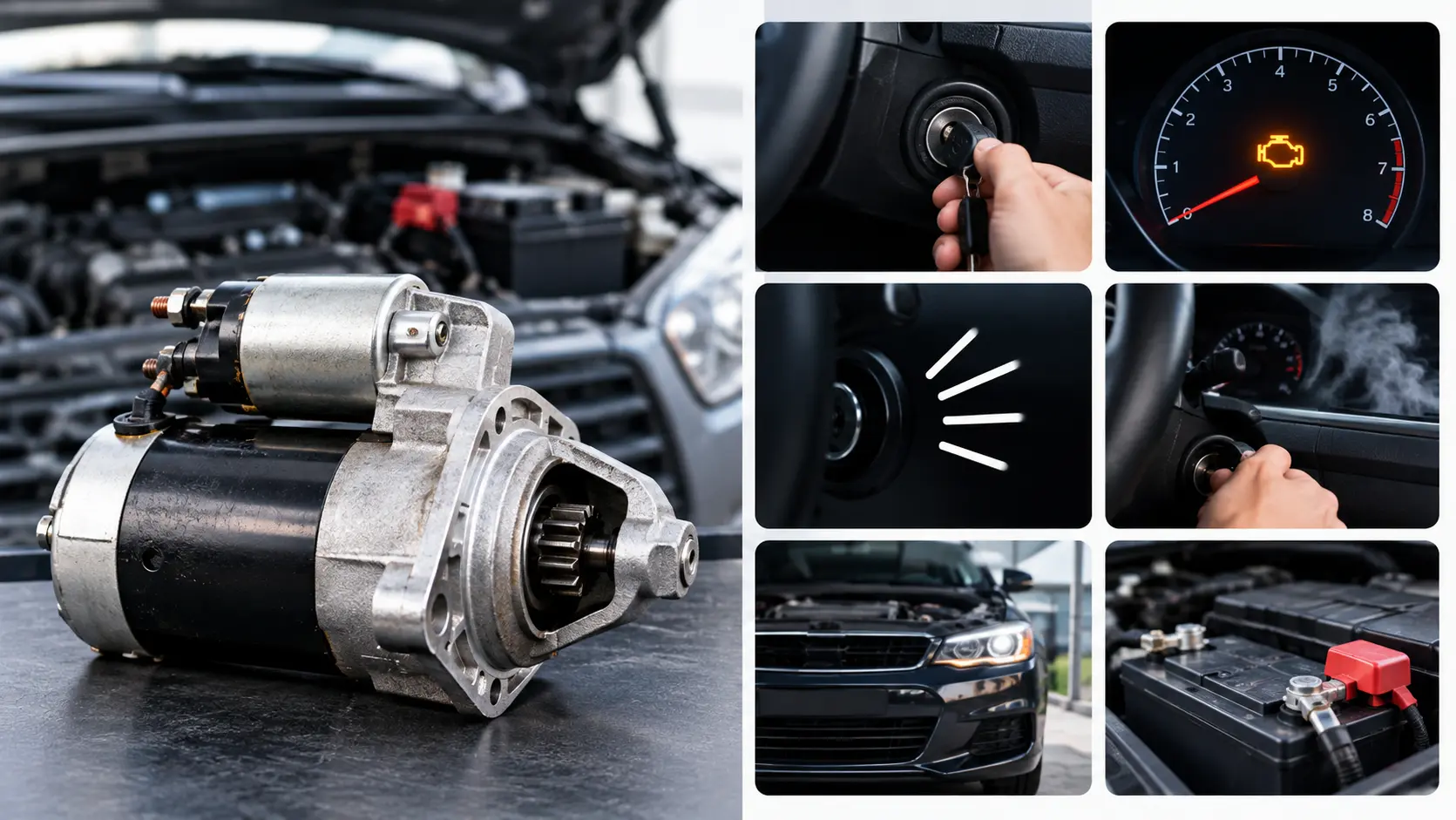
Dead Batteries After Months in Open Car Parks
Heat is harder on car batteries than cold. It speeds up the chemical reactions inside and evaporates the electrolyte, which is why UAE car experts quoted by Gulf News say most batteries here last only a couple of years. In milder climates, the same battery often lasts four to five years.
A standard lead acid battery usually costs AED 250 to 500, while an AGM battery for cars with start stop systems costs AED 450 to 950, according to Pitstop Arabia. If your battery is more than two years old, book a battery test and replacement check before summer.
Engine Overheating in Stop and Start Traffic
Crawling along Sheikh Zayed Road at rush hour means little airflow through the radiator, while the AC compressor adds extra load to the engine. A weak cooling fan, a small coolant leak or a radiator packed with dust can push the temperature gauge into the red within minutes.
Pull over and switch off at the first sign of steam or a rising gauge. Driving on with an overheated engine can warp the cylinder head and cause head gasket and engine damage that costs many times more than a new hose or fan.
Tyre Blowouts on Hot Highways
Hot asphalt raises tyre pressure and temperature, and old rubber cracks under that stress. UAE rules treat a tyre as expired five years after its manufacture date. Driving on expired tyres brings a AED 500 fine, four black points and a seven day impound.
Read the four digit date code on the sidewall: 2321 means week 23 of 2021. Checking tyre age and pressure once a month, in the morning when the tyres are cold, prevents most blowouts. A blowout at speed can also tear the wheel arch liner and scrape the bumper and wing, which is why many blowout repairs end with a visit to a car painting and panel team.
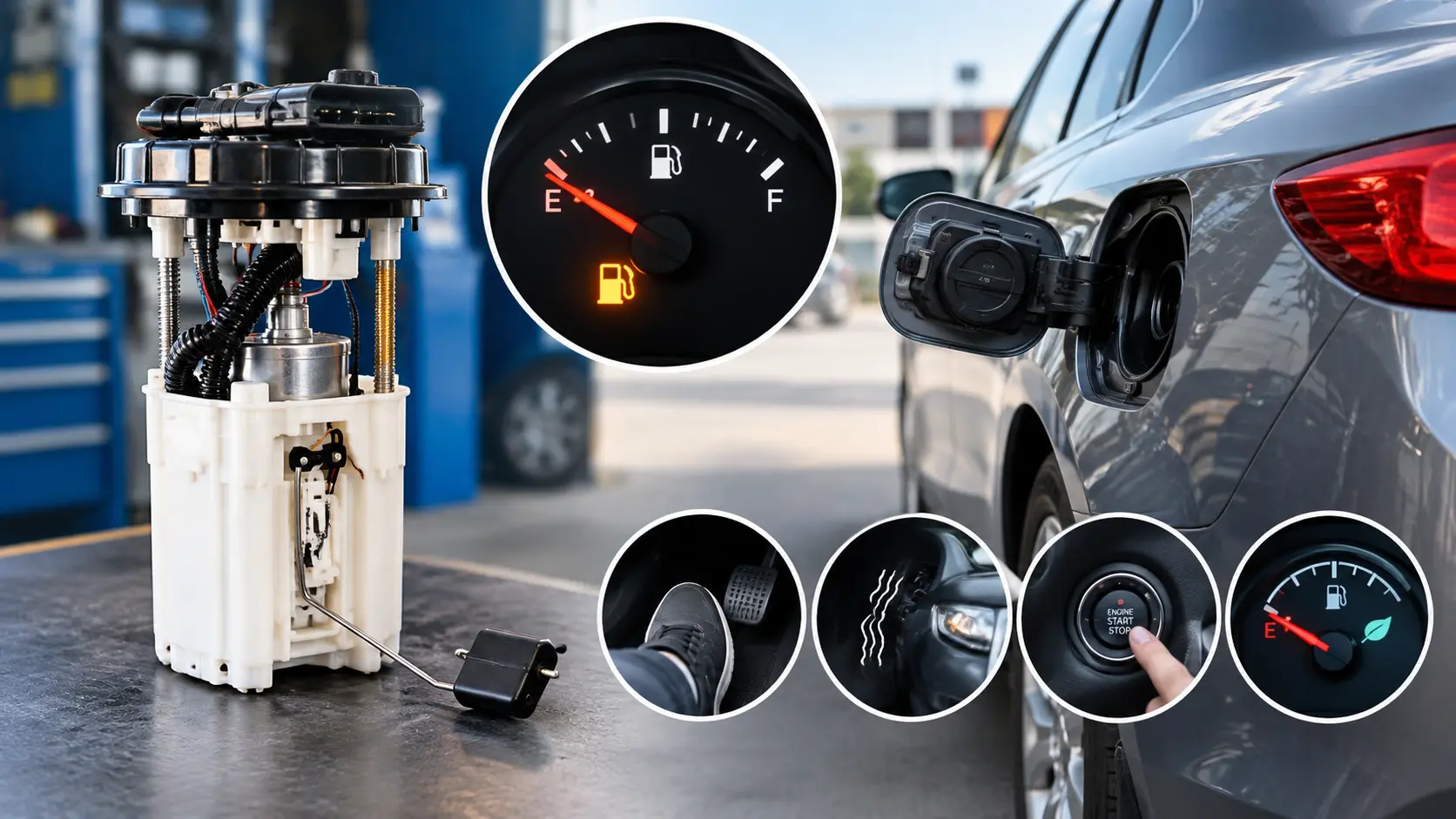
Fuel Pump Failure From Driving on a Nearly Empty Tank
Most modern cars have an electric fuel pump inside the tank, and the fuel around it keeps it cool. UAE mechanics told Khaleej Times that driving close to empty leaves the pump without that cooling, and summer heat makes it fail sooner.
Research published by SAE International adds a second risk. Petrol can start to boil at around 40°C, and the vapour lowers fuel pump pressure until the engine stalls. Refuelling at a quarter tank, instead of waiting for the warning light, is the cheapest way to protect the pump.
Alternator and Drive Belt Failures
The alternator charges the battery and powers the electrics while you drive. When it fails, the battery warning light comes on, and the car keeps running only until the battery runs flat. A cracked or slipping drive belt can stop the alternator, the water pump and the AC compressor at the same time. If your engine cuts out with no warning light at all, our guide on what causes a car to stall on the road explains the likely faults.
Dashboard Warning Lights That Show a Breakdown Is Coming
Four warning lights tell you a breakdown may be close, and each one needs a different response. Red lights mean stop soon, while amber lights mean book a check.
| Warning light | What it usually means | Can you keep driving? | What to do |
| Check engine (steady amber) | The engine computer has logged a sensor, ignition or fuel fault | Yes, gently, for a short time | Book a diagnostic scan within a few days |
| Check engine (flashing) | Severe misfire that can damage the catalytic converter | No | Slow down, stop safely and call for help |
| Battery (red) | The alternator is not charging | Only a short distance | Switch off the AC and radio, then head to a garage or stop safely |
| Temperature (red) | The engine is overheating | No | Stop, switch off, and never open the radiator cap while hot |
| Oil pressure (red) | Oil pressure has dropped too low | No | Stop and switch off the engine at once |
Roadside Fixes vs Towing: When Your Car Needs a Flatbed
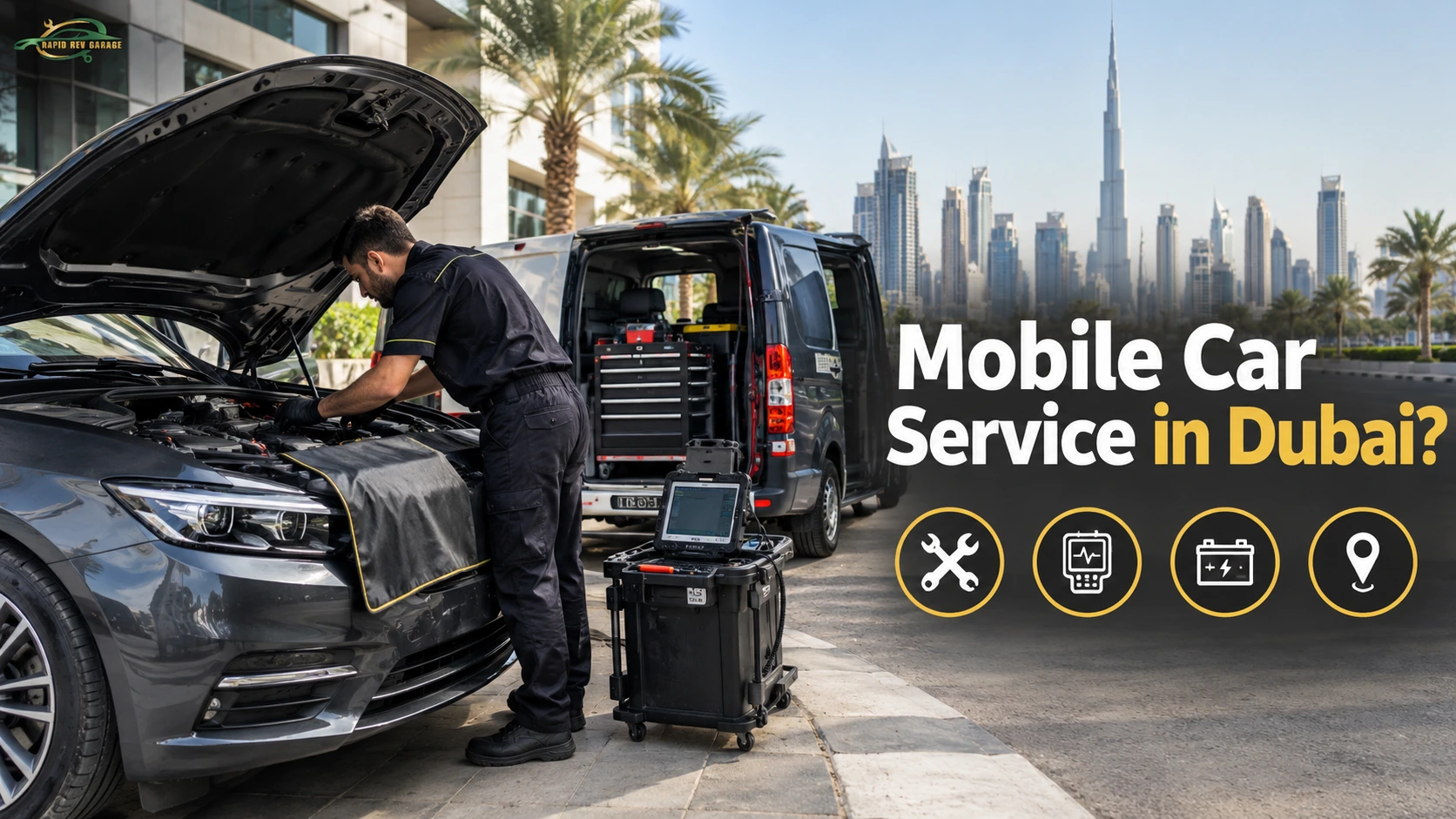
Many breakdowns can be fixed where the car stands. A flat battery needs a jump start, a puncture needs the spare wheel fitted, an empty tank needs fuel delivery and a lockout needs a key specialist. A mechanic who comes to you can handle these in your office car park in Business Bay or outside your villa in Jumeirah.
Other faults need a tow. Overheating with steam or coolant loss, a red oil pressure light, gearbox faults, a loud knock from the engine and any car that won’t move in gear should go on a flatbed. Automatic, all wheel drive and 4×4 cars should be carried on a flatbed rather than towed with two wheels on the road, because dragging them can damage the transmission.
Inside Dubai, flatbed towing usually costs from AED 100 to about AED 300, depending on distance and vehicle size, based on figures published by Pitstop Arabia and dubizzle. Trips to another emirate cost more.
How Rapid Rev Garage Diagnoses a Car After a Breakdown
When a broken down car reaches our Al Quoz workshop, we test before we replace anything. Guessing wastes the customer’s money, and many breakdowns have more than one cause.
The first step is an OBD2 scan that reads the fault codes stored by the engine computer, along with live data such as coolant temperature, fuel trims and sensor voltages. A fault code only points to a circuit, so we confirm the fault with a physical test before recommending a part.
For no start and electrical faults, we run a battery load test and an alternator output test. A healthy charging system usually shows about 13.5 to 14.7 volts with the engine running. For overheating, we pressure test the cooling system to find leaks, then check the fan, thermostat and radiator flow. For stalling and power loss, we measure fuel pressure and check how much current the fuel pump draws.
Most of these tests take under an hour, and we explain the findings and the cost before any repair starts. If your car limps home with a warning light still on, book a check with a mechanic near you in Al Quoz before it turns into a second breakdown.
Does Car Insurance Cover Breakdown Recovery in the UAE?
Many full cover car insurance policies in the UAE include roadside assistance, which usually covers towing, jump starts, tyre changes and fuel delivery. On other policies it is an optional extra, and third party policies often leave it out. InsuranceMarket.ae notes that a dead battery counts as wear and tear, so the battery itself is not covered, even when the jump start or tow is.
Check your policy schedule for the words “roadside assistance” or “recovery”, and save the helpline number in your phone today. Newer cars may also come with free manufacturer assistance during the warranty period, so check your service booklet or the dealer app.
What Every Dubai Driver Should Keep in the Boot
A small kit turns a dangerous breakdown into a manageable one. For visibility, carry a reflective warning triangle and a high visibility vest, so other drivers see you on the shoulder at night. For power, keep jumper cables or a portable jump starter, plus a charged power bank for your phone.
For tyres, a working spare, the jack and wheel brace, and a 12 volt tyre inflator cover most punctures. For heat and first aid, keep four to five litres of water, a torch, a small fire extinguisher and a first aid kit. Check the kit every three months, because summer heat drains power banks and ages plastic water bottles.
Services That Stop Your Car Breaking Down Again
Many of the breakdowns we see come from parts that showed warning signs weeks earlier. A pre summer check in April or May catches the common ones before temperatures peak. It should cover a battery load test, a coolant level and leak check, the cooling fan and radiator, the drive belt and hoses, tyre age and pressure, and a scan for stored fault codes.
Keep up with scheduled servicing as well. Many manufacturers set oil change intervals between 10,000 and 15,000 km, but they list heat, dust and heavy stop and start traffic as severe conditions, which shortens the interval. A regular car service in Dubai keeps oil, filters and fluids fresh, and gives a mechanic the chance to spot a weeping hose or cracked belt early.
If you are not sure where to go, choose a car garage near you that tests before it replaces parts and explains the findings in plain language. Rapid Rev Garage works on passenger cars only, from daily commuters to family SUVs.
FAQ
Here are the questions Dubai drivers most often ask about car breakdowns.
How much does towing cost in Dubai?
A flatbed tow within Dubai usually costs AED 100 to 300, depending on distance, time of day and vehicle size. Large 4x4s, low sports cars and trips to another emirate cost more. Check your insurance first, because towing is often included in full cover policies.
Can I push my car off the road?
Only on a quiet road with a clear gap in traffic, with the car in neutral and enough people to move it. Never push a car across lanes on a highway like Sheikh Zayed Road. If the car will not roll to the shoulder, get everyone clear and call 999.
Is it safer to stay inside the car?
Not if the car is stuck on the road. Dubai Police advise drivers to leave the car, move to a safe area away from the road and call them. On the hard shoulder, get out through the passenger side and stand behind the crash barrier until help arrives.
Will insurance pay for breakdown towing?
Most full cover UAE policies pay for towing through their roadside assistance benefit. Some sell it as an optional extra, and third party policies often exclude it. The failed part, such as a dead battery, is usually treated as wear and tear and is not covered.
What number do I call for breakdowns?
Call 999 if your car is stuck in a live lane, anyone is hurt or you see smoke. For police help that is not urgent in Dubai, call 901. For towing, jump starts or tyre changes, call your insurer's helpline or a roadside assistance service.
Conclusion
When your car breaks down, your safety comes first and the repair comes second. Reach the shoulder or an exit, keep your hazard lights on, get everyone clear of traffic and call the right number. Then let a mechanic find the real cause, so the same fault does not leave you stranded again.
Rapid Rev Garage handles recovery, roadside repairs and full diagnostics for passenger cars across Al Quoz, Business Bay, Jumeirah, Al Barsha, Satwa, Downtown and the Sheikh Zayed Road corridor. Visit https://rapidrevgarage.com, send your location and car model on WhatsApp, or get directions to our workshop on Google Maps.
Rapid Rev Garage | Car Breaks Down | Al Quoz, Dubai