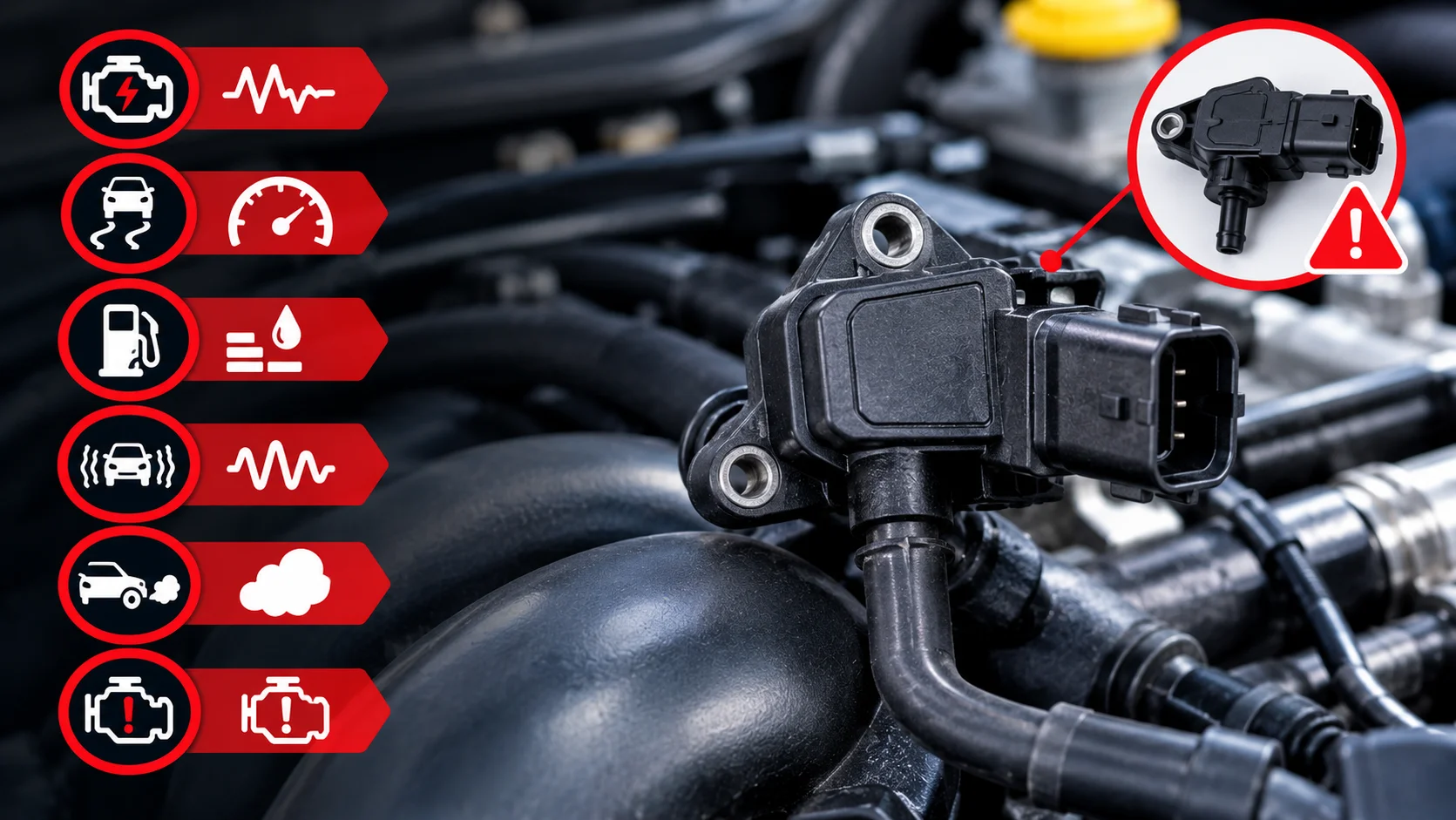
Your fuel use has crept up, the exhaust smells of petrol at the lights in Business Bay, and the engine stumbles when you accelerate. On many cars, these are classic bad MAP sensor symptoms. The manifold absolute pressure sensor helps the engine computer work out how much air is entering the engine, and when its reading drifts, the fuel mixture goes wrong.
The MAP sensor is small and often cheap, but its effects reach the idle, the power, the fuel use and the emissions. It is also easy to confuse with other faults, especially a vacuum leak or a failing MAF sensor, because they all upset the same air and fuel balance.
This guide explains what the MAP sensor does, how it differs from the MAF sensor, the signs of failure, why Dubai conditions affect it, how a workshop tests it and what the fix involves.
Bad MAP Sensor Symptoms: Quick Answer
The main bad MAP sensor symptoms are a rough or unstable idle, hesitation and slow acceleration, hard starting, higher fuel use, a petrol smell or black smoke from the exhaust, a failed emissions check and a check engine light with codes P0105 to P0108.
A MAP sensor that reads too high makes the engine run rich, while one that reads too low makes it run lean. A cracked vacuum hose to the sensor causes the same symptoms. A mechanic compares the sensor’s reading with engine off and at idle, checks the hose and wiring, then replaces the sensor if it fails the test.
Table of Contents
- What the MAP Sensor Does
- How the MAP Sensor Differs From the MAF Sensor
- Why MAP Sensors and Their Hoses Fail in Dubai
- Rough or Unstable Idle
- Hesitation and Slow Acceleration
- Hard Starting
- Higher Fuel Use and a Petrol Smell
- Black Smoke and Fouled Spark Plugs
- Failed Emissions Check
- Check Engine Light and MAP Fault Codes
- Turbo Engines and Boost Problems
- Faults That Look Like a Bad MAP Sensor
- How a Workshop Tests a MAP Sensor
- What MAP Sensor Repair Involves
- Can You Drive With a Bad MAP Sensor?
- Can a MAP Sensor Be Cleaned?
- How to Prevent MAP Sensor Problems
- Does Altitude Affect the MAP Sensor Reading?
- Can a Bad MAP Sensor Cause Stalling?
- How Long Does a MAP Sensor Usually Last?
- FAQ
- Conclusion
What the MAP Sensor Does
The MAP sensor measures the air pressure inside the intake manifold. ReRev explains that it sends this reading to the engine computer, which uses it to work out the air density and calculate how much fuel to inject.
When the engine idles with the throttle almost closed, the pistons pull a strong vacuum, so the pressure in the manifold is low. When you press the accelerator, the throttle opens, and the pressure rises toward the outside air pressure. On a turbo engine, it rises above outside pressure as the turbo builds boost.
The computer combines the MAP reading with engine speed and air temperature to estimate how much air the engine is taking in. Some engines use the MAP sensor as their main air measurement. Others use it alongside a MAF sensor.
How the MAP Sensor Differs From the MAF Sensor
The two sensors measure different things. ReRev explains that the MAF sensor measures the mass of air coming through the air filter, while the MAP sensor measures the pressure in the intake manifold.
The MAF sensor sits in the intake tube before the throttle body. The MAP sensor sits on or near the intake manifold, after the throttle, and on some older cars it connects to the manifold through a small vacuum hose.
Many cars have only one of the two. Most turbo engines have both, using the MAP sensor to measure boost pressure. The guide on bad MAF sensor symptoms explains the airflow sensor’s own warning signs.
Why MAP Sensors and Their Hoses Fail in Dubai
The MAP sensor is an electronic part mounted on a hot engine. Repeated heat cycles stress its circuit board and its plastic housing, and the connector can crack or corrode. On a summer afternoon when the air passes 45°C, the engine bay of a car idling in traffic gets far hotter.
On cars with a hose to the MAP sensor, the hose is often the weak point. Heat hardens the rubber until it cracks or comes loose, and the sensor then reads the wrong pressure. Long idling in stop and start traffic on Sheikh Zayed Road and the shake from speed bumps every 200 to 400 metres on residential streets speed up the cracking.
Oil and carbon can also block the small port the sensor reads from, especially on engines with heavy oil vapour from the PCV system.
Rough or Unstable Idle
A rough idle is one of the main signs. ReRev lists rough running, rough idling and rpm changes among the symptoms of a faulty MAP sensor. At idle, the sensor’s reading has a big effect on the fuel mixture, so even a small error makes the engine shake or hunt.
The idle may rise and fall every few seconds, or dip low enough to stall when you stop. A cracked hose to the sensor causes the same problem, so a mechanic checks the hose before the sensor.
The guide on high idle RPM explains other reasons the idle may sit too high or surge.
Hesitation and Slow Acceleration
ReRev lists slow acceleration, poor throttle response and jerky acceleration among the signs of a bad MAP sensor. When you press the accelerator, the pressure in the manifold should rise, and the computer should add fuel to match. If the sensor responds slowly or reads wrong, the fuel lags behind.
The car may stumble when pulling out from the lights near Mall of the Emirates, or feel weak when merging onto Al Khail Road. ReRev notes that a lean condition from a faulty sensor reduces engine power.
Hard Starting
ReRev lists difficult starting among the signs of a failing MAP sensor. At cranking, the computer uses the MAP reading to set the starting fuel amount. A sensor reading too high or too low gives the wrong amount, so the engine cranks for longer or starts and then stumbles.
Some cars start better with the throttle pressed slightly. That is a clue the fuel mixture is wrong at cranking, which can come from the MAP sensor, the coolant temperature sensor or a weak fuel pump.
Higher Fuel Use and a Petrol Smell
A MAP sensor that reads higher pressure than is really in the manifold tells the computer the engine is under more load. The computer then injects extra fuel. ReRev lists an increased petrol smell from the tailpipe among the signs of a bad MAP sensor.
Fuel use rises, sometimes sharply. Drivers in Dubai often notice they are filling up more often before they notice any other symptom. Keep track of how many kilometres you get from a full tank, so changes are easier to spot.
Black Smoke and Fouled Spark Plugs
A rich mixture leaves black soot at the tailpipe and can foul the spark plugs. ReRev warns that driving with a bad MAP sensor risks spark plug failure from carbon deposits caused by the rich fuel condition.
Fouled plugs cause misfires, rough running and more hesitation. Soot can also collect on the rear bumper and exhaust tips. Left in the sun, that soot can stain the clear coat, and heavy staining may need paint and panel repair once the engine fault is fixed.
The guide on carbon buildup inside the engine explains how rich running adds deposits to the valves and pistons over time.
Failed Emissions Check
ReRev lists a failed emissions test among the symptoms of a bad MAP sensor, because the rich fuel mixture raises exhaust emissions. A rich engine produces more carbon monoxide and hydrocarbons, and the catalytic converter cannot clean all of it.
The vehicle inspection required for registration renewal in Dubai includes an emissions check. A car that runs rich because of a faulty MAP sensor may fail and need a second visit. Booking a vehicle inspection check before the official test can catch the problem early.
Check Engine Light and MAP Fault Codes
A failing MAP sensor usually turns on the check engine light. The standard codes for the MAP circuit are P0105 for a circuit malfunction, P0106 for a range or performance problem, P0107 for a low input and P0108 for a high input.
The computer may also set lean or rich codes, such as P0171 or P0172, and misfire codes if the mixture is far enough off. A code points to a circuit, not always the sensor itself. A damaged connector or broken wire sets the same codes.
An auto electrical check tests the sensor’s power supply, ground and signal wire before the part is replaced.
Turbo Engines and Boost Problems
On turbo engines, the MAP sensor, often called the boost pressure sensor, measures the pressure the turbo builds. The computer uses it to control boost and fuel. A faulty sensor can make the computer limit boost to protect the engine.
The car then feels weak at higher speeds and may go into limp mode with a warning light. Boost leaks from split intercooler hoses cause similar symptoms, so a mechanic checks the hoses as well as the sensor.
Faults That Look Like a Bad MAP Sensor
Several faults produce the same symptoms. A vacuum leak raises the pressure in the manifold, so even a good MAP sensor reports higher pressure and the computer adds fuel. The guide on the symptoms of an engine vacuum leak explains how to find these leaks.
A faulty oxygen sensor can make the computer adjust the mixture wrongly, causing rich or lean running. A dirty throttle body upsets the idle. A worn timing chain or a valve problem can also change manifold vacuum, which a good MAP sensor will faithfully report.
This is why the sensor’s reading is compared with a separate vacuum gauge before it is replaced.
How a Workshop Tests a MAP Sensor
A proper test starts with the engine off and the ignition on. With no vacuum in the manifold, the MAP sensor should read close to outside air pressure. Dubai sits close to sea level, so that is about 100 kPa on most scan tools.
With the engine idling, the reading should drop sharply, because the engine pulls a vacuum. The mechanic then snaps the throttle open and watches the reading rise and fall again. A slow or stuck reading points to a faulty sensor or a blocked port.
The mechanic checks the vacuum hose to the sensor, the connector and the wiring, and compares the sensor reading with a mechanical vacuum gauge. Book the test with an experienced car mechanic near me so a vacuum leak or wiring fault is ruled out first.
What MAP Sensor Repair Involves
If the hose is cracked, it is replaced. If the port is blocked with carbon or oil, it is cleaned. If the wiring is damaged, it is repaired. These fixes are often enough, and the sensor itself does not need replacing.
If the sensor fails the tests, it is replaced. On most engines, it is held by one or two bolts and a connector, and the job is short. After replacement, the mechanic clears the codes, checks the readings and road tests the car.
On some engines, the MAP sensor is part of a combined unit with the air temperature sensor. If the engine has carbon or valve problems behind the symptoms, an engine repair specialist may need to look further.
Can You Drive With a Bad MAP Sensor?
ReRev notes that you can technically drive with a bad MAP sensor, but it risks spark plug failure from carbon deposits caused by rich running. Long term rich running can also overheat the catalytic converter, which is far more expensive to replace than the sensor.
Stalling, hard starting and sudden power loss are safety problems. If the car stalls or goes into limp mode on a highway, move to the hard shoulder rather than stopping in a live lane, which brings a AED 1,000 fine and six black points under Article 98 of the UAE Federal Traffic Law. Then call roadside assistance.
If the car still drives safely, a mobile mechanic can read the codes and MAP readings at your home or office.
Can a MAP Sensor Be Cleaned?
Sometimes. If carbon or oil has blocked the sensor’s port, gently cleaning the port and the sensor tip with a suitable electronic or sensor cleaner can restore the reading. Never push anything into the sensor opening, because the element inside is delicate.
Cleaning will not fix a sensor that has failed electrically or a cracked housing. If the readings are still wrong after cleaning, replacement is the fix. If the port keeps blocking, check the PCV system for excess oil vapour.
How to Prevent MAP Sensor Problems
Most MAP sensor problems start with heat, oil vapour or a cracked hose. Have the vacuum hoses, including the one to the MAP sensor, checked at every service once the car passes five years old. Replace any hose that feels hard or cracked.
Fix PCV faults early, because oil vapour can block the sensor port. Keep the oil changed at the severe conditions interval in your service book, since heat, dust and stop and start traffic count as severe in most schedules. Regular car maintenance catches these small faults before they set codes.
A regular car service in Dubai covers hose and sensor checks. If you already have rough running or a MAP code, choose a car garage near me that tests the sensor against a vacuum gauge before replacing it.
Does Altitude Affect the MAP Sensor Reading?
Yes. The MAP sensor measures absolute pressure, and outside air pressure falls as you climb. On many cars, the computer also uses the MAP sensor at key on, before the engine starts, to learn the outside air pressure.
Dubai sits close to sea level, where outside pressure is about 100 kPa. On the road up Jebel Jais in Ras Al Khaimah, the highest road in the UAE, pressure near the top is closer to 80 kPa. A healthy sensor reads the change, and the computer adjusts the fuel to match.
A faulty sensor that reads the same at every height can make the engine run rich in the mountains. If your car runs badly only on mountain drives, such as to Jebel Jais or Hatta, ask the mechanic to check the MAP sensor’s key on reading.
Can a Bad MAP Sensor Cause Stalling?
Yes. At idle, the computer relies heavily on the MAP reading to set the fuel. A sensor that reads far too high floods the engine with fuel, and one that reads far too low starves it. Either can make the engine stall, often as you slow to a stop.
A cracked or disconnected hose to the sensor can cause the same stalling. The guide on what causes a car to stall on the road covers the other faults that cause this pattern, so they can be ruled out at the same time.
How Long Does a MAP Sensor Usually Last?
There is no set replacement interval for MAP sensors. Many last the life of the car. Others fail early because of heat, oil contamination or a damaged connector.
In Dubai, the hose and connector often fail before the sensor itself. Heat hardens the rubber hose on older designs, and the plastic connector can crack after years of heat cycles. That is why a mechanic checks the hose and wiring first.
If your car has passed 150,000 km and shows rough running or rich codes, testing the MAP sensor’s readings is a sensible early step. The test takes far less time than chasing other faults.
FAQ
Here are the questions Dubai drivers most often ask about MAP sensors.
What does a bad MAP sensor do?
It gives the engine computer the wrong manifold pressure, so the fuel mixture goes wrong. The engine may idle roughly, hesitate, start hard, use more fuel, smell of petrol and fail an emissions check. The check engine light usually comes on.
Can a bad MAP sensor cause misfires?
Yes. A rich mixture from a faulty MAP sensor can foul the spark plugs, and a lean mixture can make cylinders misfire. Misfire codes such as P0300 may appear alongside MAP codes P0105 to P0108.
How do mechanics test a MAP sensor?
They read it with the engine off, where it should show close to outside air pressure, about 100 kPa near sea level. At idle, the reading should drop sharply. They also check the hose, wiring and a mechanical vacuum gauge.
Is MAP the same as MAF?
No. The MAF sensor measures the mass of air entering through the filter, while the MAP sensor measures pressure in the intake manifold. Some cars have one, and many turbo engines have both.
Will a bad MAP sensor fail inspection?
It can. A faulty MAP sensor often makes the engine run rich, which raises exhaust emissions. The Dubai vehicle inspection includes an emissions check, so a rich running car may fail until the sensor or hose is fixed.
Conclusion
A bad MAP sensor causes rough idle, hesitation, hard starting, higher fuel use, a petrol smell, black smoke, fouled plugs, failed emissions checks and codes P0105 to P0108. Heat, oil vapour and cracked hoses are the usual reasons in Dubai. Comparing the sensor’s reading with engine off, at idle and against a vacuum gauge confirms the fault before the part is changed.
Rapid Rev Garage is a full workshop open 24 hours at Al Khail Gate, 12th Street, Al Quoz Industrial Area 2, serving passenger cars across Al Quoz, Business Bay, Jumeirah, Al Barsha, Satwa, Downtown and the Sheikh Zayed Road corridor. Visit https://rapidrevgarage.com, send your car model and symptoms on WhatsApp, or get directions on Google Maps.
Rapid Rev Garage | Bad MAP Sensor Symptoms | Al Quoz, Dubai