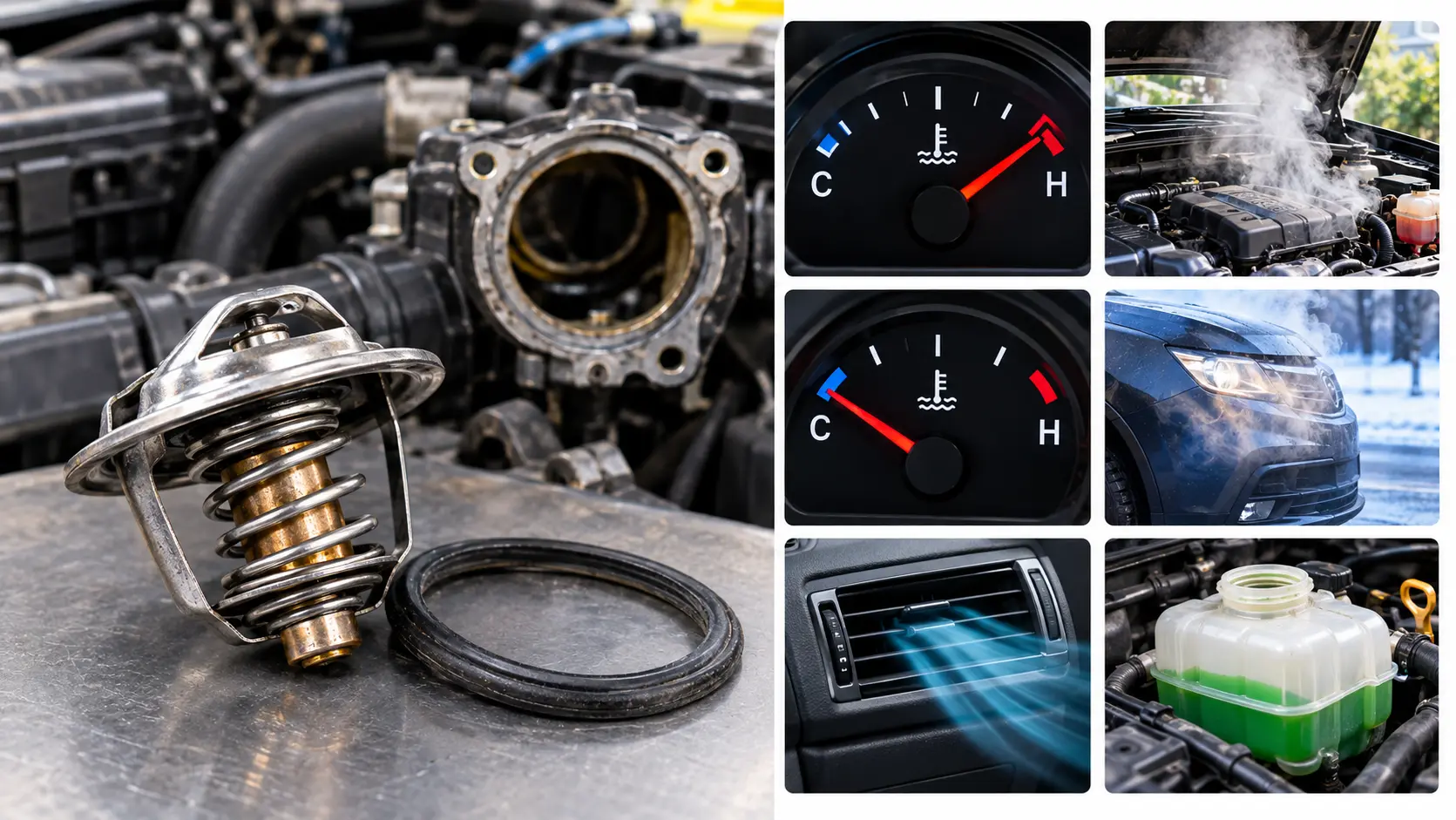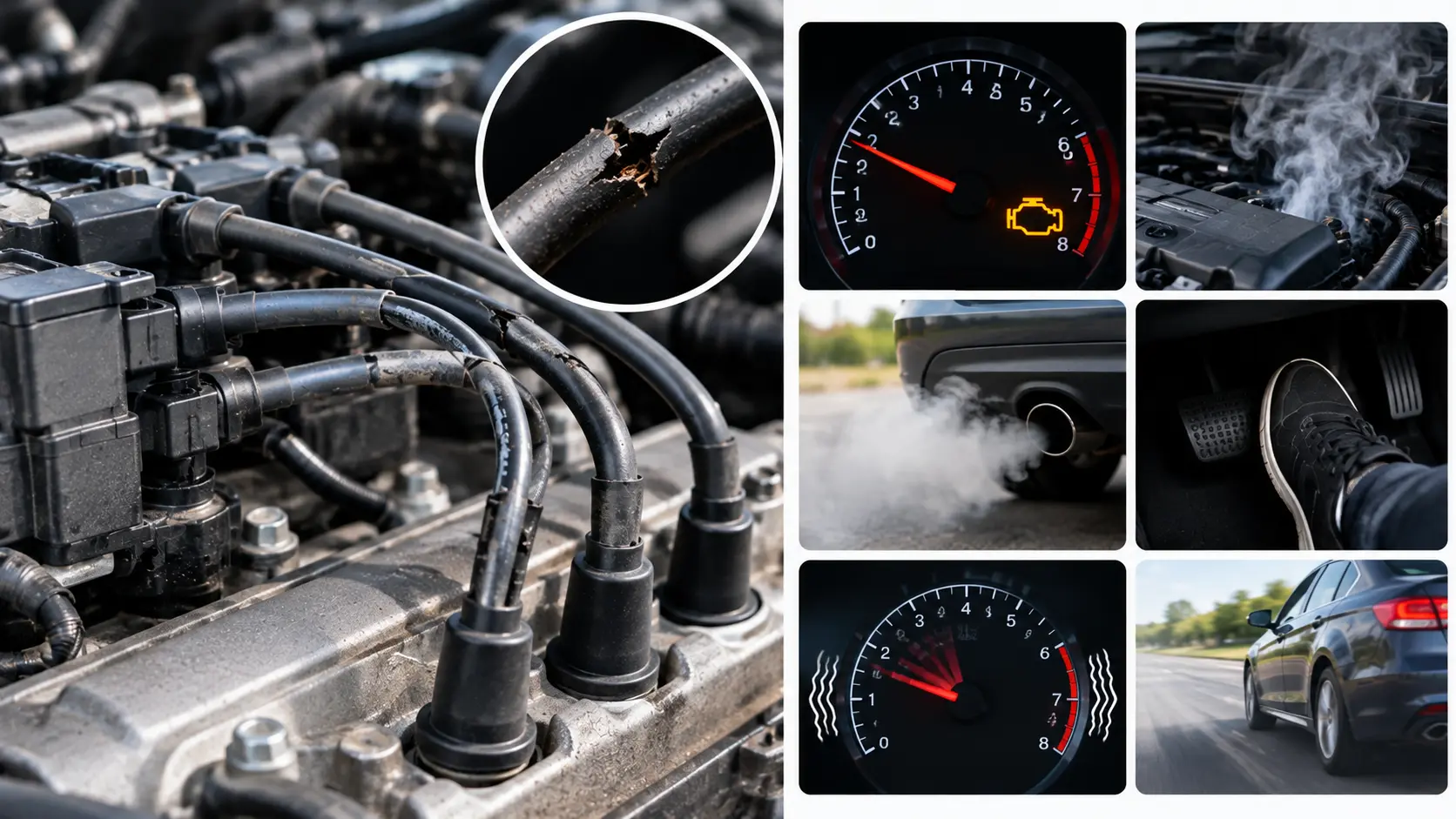
The engine shakes at the lights near City Centre Deira, the check engine light flashes on the ramp out of the car park, and the car feels flat when you pull away. On engines that use ignition leads, these are common bad spark plug wire symptoms. The wires carry tens of thousands of volts from the coil to each spark plug, and heat slowly breaks them down.
Many newer engines no longer use plug wires. They have a separate coil sitting on top of each spark plug. But plenty of cars on UAE roads still use them, including many older Toyota, Nissan, Mitsubishi and Chevrolet models, along with some V8 engines that use coil packs with short leads.
This guide explains what spark plug wires do, the signs they are failing, why Dubai heat wears them out, how to test them with a simple resistance check, and when to replace them. It also covers the coil boots and extensions on coil on plug engines, which fail in a similar way.
Bad Spark Plug Wire Symptoms: Quick Answer
The main bad spark plug wire symptoms are a rough idle, misfires, hesitation and weak acceleration, a flashing check engine light with misfire codes P0300 to P0308, visible sparks jumping from the wires at night, cracked or burned insulation and boots, fouled spark plugs and higher fuel use. JEGS lists these among the main signs of damaged wires.
Heat from exhaust manifolds and long idling breaks down the insulation. A mechanic checks each wire’s resistance with a multimeter, compares the wires with each other and with the specification, and flexes them to find breaks. Damaged or corroded wires are replaced as a set.
Table of Contents
- What Spark Plug Wires Do
- Which Cars Still Use Spark Plug Wires
- Why Plug Wires Wear Out Faster in Dubai
- Rough Idle and Engine Shake
- Misfires and a Flashing Check Engine Light
- Hesitation and Weak Acceleration
- Sparks Jumping From the Wires at Night
- Cracked, Burned or Melted Insulation and Boots
- Corrosion on the Wire Terminals
- Fouled Spark Plugs
- Higher Fuel Use and Failed Emissions
- Coil on Plug Boots and Extensions
- How to Test Spark Plug Wires
- When to Replace Spark Plug Wires
- Can Bad Plug Wires Damage the Engine?
- How to Protect Spark Plug Wires
- Can Bad Plug Wires Cause Radio Interference?
- Should Spark Plugs Be Changed With the Wires?
- FAQ
- Conclusion
What Spark Plug Wires Do
Spark plug wires, also called ignition leads or HT leads, connect the ignition coil or distributor to each spark plug. The coil turns the car’s 12 volt supply into a very high voltage, and the wire carries that voltage to the plug, where it jumps across the gap and lights the fuel.
Each wire has a conductive core, thick insulation and rubber boots at each end that seal the connection and stop the spark escaping. Most modern wires have a resistive core that reduces radio interference.
If the insulation cracks, the core breaks or the terminals corrode, less voltage reaches the plug. JEGS explains that damaged wires reduce or stop the voltage reaching the spark plug, and weak or missing spark causes incomplete combustion.
Which Cars Still Use Spark Plug Wires
Many engines built since the early 2000s use coil on plug ignition, with a separate coil mounted directly on each spark plug and no long wires. On these engines, the coil boots and extensions do the job the wires used to do.
Plenty of cars in the UAE still use plug wires. These include older models from Toyota, Nissan, Mitsubishi, Hyundai, Kia and Chevrolet, many classic and older 4×4 vehicles, and some engines that use a coil pack with short leads to each plug.
Open the bonnet and look at the top of the engine. If you see thick rubber leads running from a coil pack or distributor to each plug, your car has plug wires. If you see a row of separate coils bolted on top of the engine, it uses coil on plug.
Why Plug Wires Wear Out Faster in Dubai
Heat is the main enemy. JEGS notes that boots are often burned or melted by nearby exhaust parts or headers, and recommends keeping wires away from manifolds and the engine block.
Engine bay temperatures in Dubai climb far above the outside air. On a summer afternoon when the air passes 45°C, a car idling in stop and start traffic on Sheikh Zayed Road has little cooling airflow, and wires routed near the exhaust manifold bake. The rubber hardens and cracks, and the boots shrink and lose their seal.
Fine dust from Al Quoz industrial roads settles on the wires. Mixed with oil from a leaking valve cover, it can form a conductive film that lets the spark track along the outside of the wire.
Rough Idle and Engine Shake
A rough idle is one of the first signs. JEGS lists rough idle among the signs of damaged plug wires. When one wire leaks voltage, its cylinder fires weakly or not at all, and the engine shakes.
The shake is usually most noticeable at idle, when the engine is running slowly and each cylinder’s work is easy to feel. You may feel it through the steering wheel, the seat and the gear lever while waiting at the lights.
A rough idle can also come from vacuum leaks, a dirty throttle body or worn spark plugs. The guide on the symptoms of a bad throttle body covers idle problems from the air side.
Misfires and a Flashing Check Engine Light
Misfires are the most common result of bad wires. JEGS describes misfiring as backfiring, popping, banging and jerking on acceleration. A misfire happens when a cylinder fails to burn its fuel properly.
The engine computer counts misfires on each cylinder and sets a code. P0300 means random misfires across several cylinders, while P0301 to P0308 point to a specific cylinder. A wire fault usually shows on the cylinder that wire feeds.
A flashing check engine light means the misfire is severe enough to damage the catalytic converter, because unburned fuel is reaching it. Reduce speed and avoid hard acceleration until the car is checked.
Hesitation and Weak Acceleration
JEGS lists hesitation, bogging, stumbling and low power during acceleration among the signs of damaged plug wires. The weak spot shows most under load, because the coil has to produce more voltage to fire the plug when cylinder pressure is high.
A cracked wire may work at idle but leak under load, so the car pulls badly when you overtake, climb ramps in multi storey car parks or carry a full load. The hesitation may come and go.
Misfires under load also make automatic cars feel like they are slipping, because the engine stumbles while the gearbox tries to shift. Testing the ignition system before blaming the gearbox avoids an expensive mistake.
Sparks Jumping From the Wires at Night
One of the clearest signs is visible sparking. JEGS advises checking the engine at night with it running, and notes that no sparks should be seen with a properly working ignition system.
Open the bonnet in a dark place, such as a dim basement car park, with the engine idling. Look and listen along the wires. You may see tiny blue sparks jumping from a wire to the engine or to another wire, or hear a ticking or snapping sound.
Do not touch the wires while the engine is running. The voltage is high enough to give a painful shock. Keep your hands well clear of the fan and belts too.
Cracked, Burned or Melted Insulation and Boots
Physical damage is easy to spot in good light. JEGS lists boots that are burned or melted, often from nearby exhaust parts, and cracked or degraded boots or outer covering among the signs of damaged wires.
Look for hard, shiny or cracked rubber, white or grey tracking marks, and boots that look swollen or shrunken. Wires that have been rubbing on brackets or engine parts may have worn through the insulation.
Damaged insulation lets the spark escape to the nearest metal instead of reaching the plug. Wires with visible damage should be replaced even if the engine runs well, because they will get worse.
Corrosion on the Wire Terminals
The metal terminals inside the boots can corrode, especially where moisture or engine bay cleaning water has reached them. JEGS states that if there is any corrosion on the terminals, the wire should be replaced.
JEGS also notes that cleaning corroded terminals is usually only temporary, because the corrosion comes back in a short time. Corrosion raises resistance, so less voltage reaches the plug.
Look for green, white or brown powder on the terminals when the boots are pulled off. The coil or distributor terminals should be checked at the same time.
Pull each boot off by gripping the boot itself, not the wire. Pulling on the wire can separate the core from the terminal inside, which creates a new fault that is hard to see.
Fouled Spark Plugs
Bad wires lead to fouled plugs. JEGS explains that without enough voltage, raw fuel and sediment build up on the plug, making ignition harder, and lists fouled plugs with a darkened insulator, tip or electrode as a sign.
A fouled plug misfires even with a new wire, so plugs and wires are usually checked together. If the plugs are due by mileage, it makes sense to replace both in the same visit.
Plugs fouled with oil rather than carbon point to a different problem, such as oil leaking into the plug wells from a failed valve cover gasket or worn valve stem seals. The guide on the symptoms of a bad valve cover gasket explains that fault.
Higher Fuel Use and Failed Emissions
A misfiring cylinder wastes the fuel it was given. The engine works harder to make the same power, so fuel use rises. Drivers often notice they are filling up more often before the misfire becomes obvious.
Unburned fuel also raises exhaust emissions and overheats the catalytic converter. The vehicle inspection needed for registration renewal in Dubai includes an emissions check, and a misfiring car may fail. The guide on bad oxygen sensor symptoms explains how misfires also upset the oxygen sensor readings.
Coil on Plug Boots and Extensions
On coil on plug engines, each coil connects to its plug through a rubber boot or extension. These boots fail in the same way as plug wires. Heat hardens them, they crack, and the spark tracks down the outside to the cylinder head.
Oil in the spark plug wells, often from a leaking valve cover gasket, softens the boots and speeds up failure. The symptoms are the same as bad plug wires: rough idle, misfires and codes P0300 to P0308.
Many coils can be swapped between cylinders as a test. If the misfire moves to the new cylinder, the coil or boot is faulty. An auto electrical check tests the coils and their wiring.
How to Test Spark Plug Wires
JEGS describes a simple resistance test with a digital multimeter. Set the meter to ohms and place one probe on each end of the wire. Divide the reading by the wire’s length to get the resistance per foot. JEGS gives the example of a 2 foot wire reading 3,000 ohms, which is 1,500 ohms per foot.
Compare the result with the specification in the workshop manual. If you do not have a specification, JEGS suggests comparing the wires with each other. If three or more read consistently and one reads higher per foot, that wire may be bad.
JEGS also advises gently flexing the wire, especially near the boots, while measuring. A big change in the reading means the core is broken inside and the wire should be replaced. Book a full ignition test with an experienced car mechanic near you if you are not comfortable doing it yourself.
When to Replace Spark Plug Wires
JEGS advises replacing wires with corroded terminals, wires whose resistance is too high compared with the specification or the other wires, and wires whose resistance changes significantly when flexed. Visible burns, cracks or melted boots are also clear reasons.
Replace wires as a full set, because they are the same age and the others are usually close to failing. Route the new wires exactly as the originals were, using the factory clips and separators, so they stay away from hot parts.
Replace or clean fouled spark plugs at the same time. Many workshops also check the coil pack or distributor cap and rotor on older engines, because worn parts there cause the same symptoms.
Can Bad Plug Wires Damage the Engine?
Bad wires rarely damage the engine directly, but the misfires they cause can. Unburned fuel reaching the catalytic converter can overheat and damage it, which is far more expensive than a set of wires.
Weak spark makes the ignition coil work harder, which can shorten its life. A misfiring engine also shakes more on its mounts. Severe or long running misfires can wash oil off the cylinder walls and add wear.
If misfires continue after new wires and plugs, an engine repair specialist can run a compression test to check for mechanical causes.
How to Protect Spark Plug Wires
JEGS recommends keeping wires away from headers, manifolds and the engine block, using looms or separators to hold them in place, and using boot guards or heat sleeves to protect the boots from heat. Always refit wires into their original clips after any engine work.
Avoid pressure washing the engine bay, because water forced into the boots causes corrosion. Fix oil leaks from the valve cover early, so oil does not soak the boots or the wires.
A regular car service in Dubai includes a look at the ignition parts. A misfiring car can also jerk and lurch in tight basement car parks, which can lead to bumps against pillars and scrapes that need paint and panel repair.
When the Engine Misfires on the Road
If the check engine light flashes or the car loses power on a highway, reduce speed and move to the hard shoulder. Stopping in a live lane because of a breakdown brings a AED 1,000 fine and six black points under Article 98 of the UAE Federal Traffic Law. Once safe, call roadside assistance.
If the car is parked at home and runs roughly, a mobile mechanic can read the misfire codes and check the wires in your parking space. For a full ignition test, choose a car garage near you that tests resistance before replacing parts.
Can Bad Plug Wires Cause Radio Interference?
Yes. Most modern plug wires have a resistive core that reduces radio interference. When the core breaks down, or the insulation leaks, the wires can send electrical noise into the car’s radio.
The usual sign is a buzzing or whining sound through the speakers that rises and falls with engine speed. It is most noticeable on AM radio and in quiet areas such as basement car parks.
Interference can also come from a faulty alternator or a poor ground. If the noise appears with misfires or rough running, the plug wires are the first thing to check.
Should Spark Plugs Be Changed With the Wires?
It often makes sense. JEGS notes that weak spark leaves raw fuel and deposits on the plugs, so plugs fed by bad wires are often fouled. A fouled plug can keep misfiring even after new wires are fitted.
If the plugs are close to their replacement mileage, changing both in one visit saves labour, because the wires have to come off anyway. Check the gap on new plugs before fitting, and use the type in your owner’s manual.
Regular car maintenance at the intervals your manufacturer lists keeps plugs and wires from failing together.
FAQ
Here are the questions Dubai drivers most often ask about spark plug wires.
What happens when spark plug wires go bad?
Less voltage reaches the spark plugs, so cylinders fire weakly or not at all. The engine idles roughly, misfires, hesitates and uses more fuel. The check engine light may flash with codes P0300 to P0308.
Can bad plug wires cause misfires?
Yes. A cracked, burned or corroded wire leaks voltage before it reaches the plug, so that cylinder misfires. The code usually points to the cylinder the faulty wire feeds, such as P0302 for cylinder 2.
How do you test spark plug wires?
Measure each wire's resistance with a multimeter, divide by its length and compare with the specification or the other wires. Flex the wire while measuring. At night, look for sparks jumping from the wires with the engine running.
How often should plug wires be replaced?
There is no single interval. Replace them when they test high, show cracks, burns or corrosion, or when the resistance changes as you flex them. In Dubai heat, many wires need replacing sooner than in cooler climates.
Does every modern car use plug wires?
No. Most engines built since the early 2000s use coil on plug ignition, with a coil on each plug. Their coil boots can fail in the same way as wires, causing the same misfires.
Conclusion
Bad spark plug wires show up as rough idle, misfires, hesitation, visible sparking at night, cracked or burned insulation, corroded terminals, fouled plugs and higher fuel use. Dubai heat and long idling break the insulation down faster. A resistance test, a flex test and a night check confirm the fault, and wires should be replaced as a full set and routed away from hot parts.
Rapid Rev Garage is a full workshop open 24 hours at Al Khail Gate, 12th Street, Al Quoz Industrial Area 2, serving passenger cars across Al Quoz, Business Bay, Jumeirah, Al Barsha, Satwa, Downtown and the Sheikh Zayed Road corridor. Visit https://rapidrevgarage.com, send your car model and symptoms on WhatsApp, or get directions on Google Maps.
Rapid Rev Garage | Bad Spark Plug Wire Symptoms | Al Quoz, Dubai