Your car used to pull cleanly up the ramp at Mall of the Emirates. Now it hesitates, the idle shakes at the lights on Umm Suqeim Street and the trip computer shows more litres per 100 km than it did two years ago. Nothing is leaking, the service is up to date and no warning light is on. Mechanics often trace this kind of carbon buildup engine performance loss to deposits inside the engine.
Yes, carbon buildup can reduce engine performance. Deposits on intake valves, injectors, pistons and combustion chambers change how air and fuel get into the engine and how they burn. The engine computer can hide some of the loss for a while, but over time you feel it as weaker acceleration, rough running and higher fuel use.
This guide focuses on what carbon does to performance, which engines suffer most, how a workshop measures the loss and which cleaning methods actually restore power. If you want the full story of why carbon forms in the first place, the related guide on carbon buildup inside the engine covers the causes.
Carbon Buildup Engine Performance: Quick Answer
Yes. Carbon buildup engine performance loss shows up as weaker acceleration, hesitation, rough or shaky idle, cold start misfires, engine knock or pinging, higher fuel use and higher emissions. Deposits restrict airflow past the intake valves, disturb the injector spray and raise compression, which makes the computer pull back ignition timing.
AAA research found that engines run on fuel with a stronger detergent package had 19 times fewer intake valve deposits after 4,000 miles of testing, and that long term use of fuel without a strong detergent package can cut fuel economy by 2 to 4 per cent. A workshop confirms carbon with live data, a misfire check and a borescope before cleaning.
Table of Contents
- How Carbon Deposits Rob an Engine of Power
- Intake Valve Deposits and Lost Airflow
- Injector Deposits and Poor Fuel Spray
- Combustion Chamber Deposits, Knock and Timing Retard
- Why Direct Injection Engines Lose the Most Performance
- Why Dubai Driving Makes Carbon Worse
- Weak Acceleration and Hesitation
- Rough Idle and Cold Start Misfires
- Higher Fuel Use
- Knocking or Pinging Under Load
- Higher Emissions and Catalytic Converter Stress
- Faults That Feel Like Carbon Buildup
- How a Workshop Measures Carbon Related Power Loss
- Cleaning Methods That Restore Performance
- How Much Performance Comes Back After Cleaning?
- Can Better Fuel Reverse Carbon Buildup?
- Does Engine Oil Affect Carbon Buildup?
- How to Keep Carbon From Coming Back
- Is It Safe to Drive With Heavy Carbon Buildup?
- FAQ
- Conclusion
How Carbon Deposits Rob an Engine of Power
An engine makes power by pulling in air, mixing it with the right amount of fuel, compressing the mix and burning it at exactly the right moment. Carbon interferes with every one of those steps.
Deposits on the intake valves narrow the path for air. Deposits on injector tips break up the fuel spray. Deposits on pistons and in the combustion chamber change the shape of the chamber and hold heat. Each change is small on its own, but together they add up.
Modern engine computers adjust fuel and ignition to make up for small changes. That is why carbon problems often build slowly with no warning light. By the time you notice the car feels weak, the deposits are usually well established.
Intake Valve Deposits and Lost Airflow
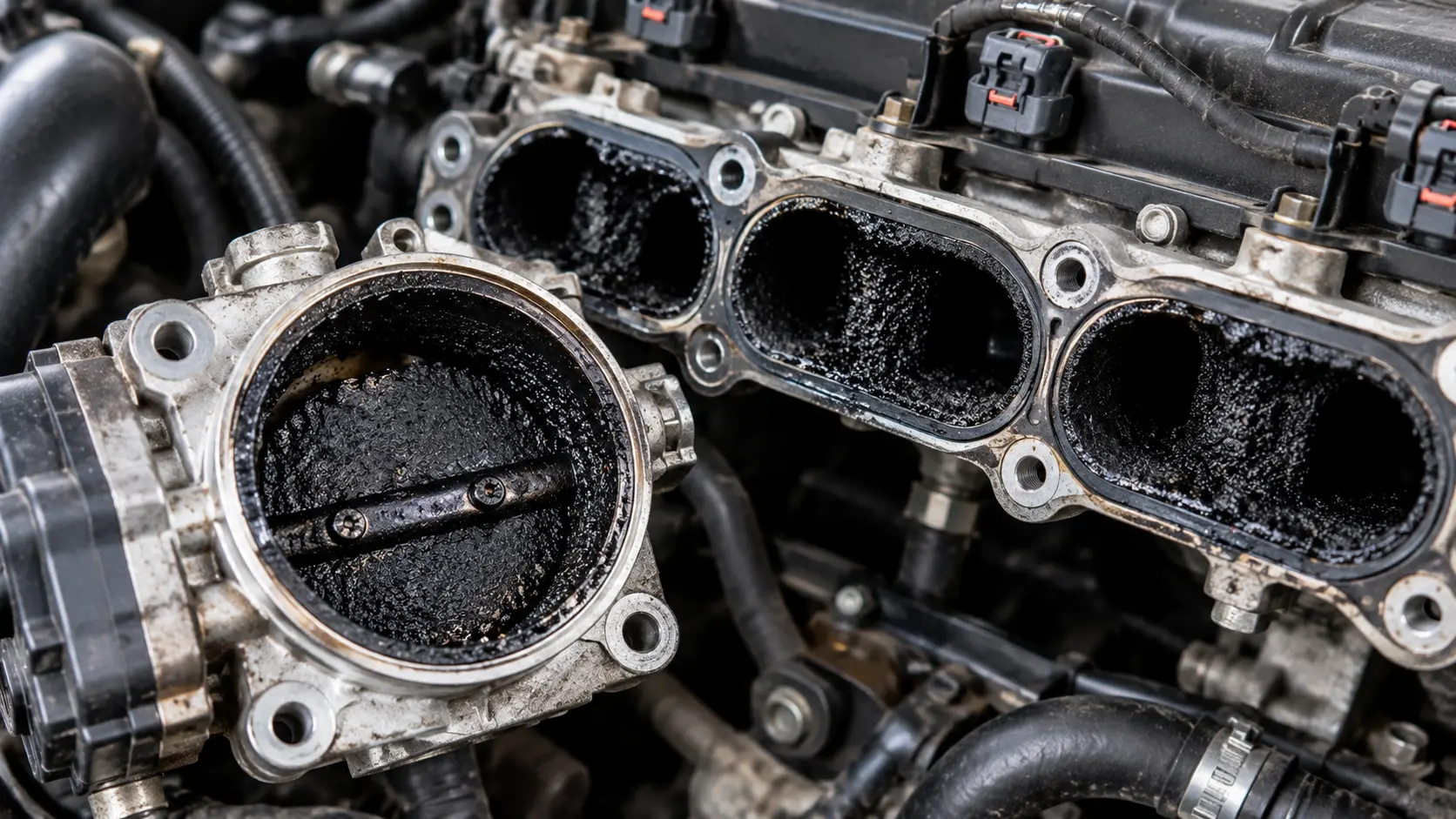
Air enters each cylinder past the intake valves. When the valves are clean, air flows smoothly around them. When black, crusty carbon builds up on the back of the valves, it narrows the opening and disturbs the airflow.
Less air means less power, because the engine can only burn as much fuel as it has air for. The effect is strongest at higher engine speeds, when the engine needs the most air in the least time.
Rough deposits also make the airflow uneven from cylinder to cylinder. One cylinder may get less air than another, which shows up as a slight shake at idle or uneven running.
Injector Deposits and Poor Fuel Spray
Fuel injectors spray fuel through tiny holes in a fine cone or pattern. Carbon and varnish on the injector tip can block some holes or bend the spray.
A poor spray does not mix as well with the air. Some fuel arrives as larger droplets that burn slowly or not at all. The result is weaker combustion, rough running and wasted fuel.
On direct injection engines, the injector tip sits inside the combustion chamber, where it is exposed to heat and soot. That makes injector tip deposits more common on these engines.
Combustion Chamber Deposits, Knock and Timing Retard
Carbon also builds up on the tops of the pistons and the roof of the combustion chamber. These deposits take up space, which slightly raises the compression ratio. They also hold heat and can glow during the compression stroke.
Higher compression and hot spots make the fuel more likely to ignite too early. This is called knock or pinging. The engine’s knock sensor hears it and tells the computer to delay the spark timing to protect the engine.
Delayed timing stops the knock, but it also cuts power and raises fuel use. Many drivers never hear the knock. They just notice the engine feels flatter than it used to.
Why Direct Injection Engines Lose the Most Performance
Older port injection engines spray fuel onto the back of the intake valves. The detergents in the fuel wash the valves each time, which helps keep them clean.
Direct injection engines spray fuel straight into the cylinder, so fuel never touches the intake valves. Oil vapour from the crankcase ventilation system and exhaust gas from the EGR system still pass over the valves, and with no fuel to wash them, carbon builds up faster.
Many modern cars sold in the UAE use direct injection, including turbocharged engines from Volkswagen, Audi, BMW, Mercedes, Ford, Hyundai, Kia and others. Some newer engines use both direct and port injection to reduce valve deposits. Your workshop can confirm which system your engine uses.
Why Dubai Driving Makes Carbon Worse
Short trips and long idling are the biggest factors. Commutes through Al Barsha, Business Bay or Deira often mean slow traffic, long stops at lights and short drives. Engines that rarely run at steady speed and full temperature leave more carbon behind.
Idling with the AC on adds to it. Many drivers in Dubai leave the engine running in car parks to keep the cabin cool. Idling burns fuel at low combustion temperatures, which is ideal for soot.
Heat affects oil. On summer afternoons when the air passes 45°C, engine oil runs hotter and gives off more vapour. On direct injection engines, that vapour ends up on the intake valves.
Dust adds load. A dusty air filter makes the engine work harder and can push the mixture rich, which adds soot. Fine dust from Al Quoz roads and building sites clogs filters quickly.
Weak Acceleration and Hesitation
Weak acceleration is often the first thing drivers notice. The car feels slow to pick up speed from the lights, or it hesitates when you press the accelerator to overtake on Sheikh Zayed Road.
Hesitation happens when the engine cannot get enough air or the fuel spray is poor at the moment you ask for more power. On turbo engines, the turbo may also take longer to build boost.
The change is usually slow. Many owners only realise how much power was lost after the engine is cleaned and the car suddenly feels sharper.
Rough Idle and Cold Start Misfires
Uneven airflow between cylinders shows most at idle, when the engine is running slowly and every small difference is felt. The steering wheel and seats may shake slightly at the lights.
Cold starts are often worst on direct injection engines with heavy valve deposits. The carbon can soak up fuel and disturb airflow when the engine is cold, causing misfires in the first minute. The check engine light may flash, then go out once the engine warms.
Rough idle also comes from vacuum leaks, worn spark plugs and dirty throttle bodies. The guide on bad throttle body symptoms explains how a dirty throttle body causes similar problems.
Higher Fuel Use
AAA research found that long term use of fuel without a strong detergent package can cause a 2 to 4 per cent drop in fuel economy, along with drivability problems and higher emissions.
Carbon raises fuel use in several ways. Poor fuel spray wastes fuel. Delayed ignition timing makes each litre do less work. Rough running and weak acceleration make drivers press harder on the pedal.
Track your fuel use over a few weeks on the same commute. A steady rise with no change in driving or route can point to carbon, along with other faults such as a weak oxygen sensor.
Knocking or Pinging Under Load
You may hear a light metallic rattle, like marbles in a tin, when accelerating hard or climbing a ramp in a high gear. That is knock caused by early ignition.
Modern knock sensors usually stop it before you can hear it, by delaying the spark. On some engines, especially turbo engines and older cars, knock can still be heard.
Knock that appears even with the correct octane fuel points to carbon in the combustion chamber or an engine running too hot. Using a lower octane fuel than your manual recommends makes knock more likely.
Higher Emissions and Catalytic Converter Stress
AAA research links fuel without a strong detergent package to higher emissions. Poor combustion from carbon leaves unburned fuel and more soot in the exhaust.
Unburned fuel reaching the catalytic converter makes it run hotter. Over time, that can damage the converter, which causes power loss of its own and a check engine light.
An engine with heavy carbon may also struggle on an emissions check. A vehicle inspection can show whether emissions are higher than they should be.
Faults That Feel Like Carbon Buildup
Several faults cause weak power, rough idle and high fuel use:
- Dirty air filter. Restricts airflow and wastes fuel.
- Worn spark plugs or ignition coils. Cause misfires and rough running.
- Dirty throttle body. Causes rough idle and stalling.
- Faulty mass airflow or oxygen sensor. Gives the computer wrong data.
- Vacuum leak. Causes lean running and rough idle.
- Low fuel pressure. Causes hesitation and power loss.
- Clogged catalytic converter. Restricts the exhaust and cuts power.
The guides on bad MAF sensor symptoms and bad oxygen sensor symptoms explain those faults. Checking the cheaper causes first stops you paying for carbon cleaning that will not help.
How a Workshop Measures Carbon Related Power Loss
A trained car mechanic near you starts with a scan tool. Live data can show fuel trims, ignition timing, knock retard, misfire counts per cylinder and airflow readings. High knock retard and misfires that come and go point toward carbon.
A road test confirms when the problem happens, such as on cold start, at idle or under load.
The best direct evidence comes from a borescope, a small camera that goes through the intake ports or a spark plug hole. It shows deposits on the intake valves and the tops of the pistons.
A compression test or leak down test checks that the rings and valves are sealing. Very heavy valve deposits can stop a valve closing fully, which shows as low compression on that cylinder. These tests also rule out mechanical damage that cleaning will not fix.
Cleaning Methods That Restore Performance
The right method depends on where the carbon is and how heavy it is.
Intake valve cleaning by blasting. On direct injection engines, the intake manifold is removed and the valves are blasted with crushed walnut shell media while the ports are sealed. This removes heavy carbon from the valves and ports without damaging the metal. It is the most effective method for heavy valve deposits.
Chemical induction cleaning. A cleaning solution is fed into the intake while the engine runs. It works best on light to moderate deposits and on throttle bodies.
Fuel system cleaning. A cleaner is added through the fuel system to clean injectors and some combustion chamber deposits. On port injection engines, this also helps clean intake valves.
Throttle body and sensor cleaning. Often done at the same time to restore smooth idle.
After cleaning, the technician resets the engine computer’s adaptive values on many cars, and road tests to confirm idle, power and fuel trims are back to normal. Fresh spark plugs and a new air filter are often fitted at the same visit. A filter change covers the air and cabin filters.
How Much Performance Comes Back After Cleaning?
It depends on how bad the deposits were and whether anything else was worn. On engines with heavy valve deposits, owners often report smoother idle, sharper throttle response and fewer cold start misfires after cleaning.
If the carbon caused knock retard, timing returns to normal as deposits are removed, which brings back power and economy.
Cleaning will not fix worn piston rings, a damaged catalytic converter or a failing sensor. If performance does not improve, an engine repair specialist can look deeper with compression and leak down tests.
Can Better Fuel Reverse Carbon Buildup?
Partly, on the right engines. AAA found that engines run on fuel with a stronger detergent package had 19 times fewer intake valve deposits after 4,000 miles of testing. AAA also found that existing carbon deposits can be reduced or removed by switching to such fuel.
The benefit is strongest on port injection engines, where fuel washes the intake valves. On direct injection engines, fuel never touches the intake valves, so fuel detergents mainly help the injectors and combustion chamber.
Using the octane grade your owner’s manual recommends also helps. Lower octane fuel in an engine designed for higher octane makes knock and timing retard more likely.
Does Engine Oil Affect Carbon Buildup?
Yes. On direct injection engines, much of the carbon on intake valves comes from oil vapour that passes through the crankcase ventilation system. Oil that breaks down in heat gives off more vapour.
Using the oil grade and specification in your owner’s manual, and changing it at the right interval for hot, dusty conditions, reduces vapour and slows deposits. A regular oil change with the correct oil is one of the simplest ways to protect performance.
A faulty PCV valve can also send more oil vapour into the intake. The guide on bad PCV valve symptoms explains that fault.
How to Keep Carbon From Coming Back
Give the engine a steady highway drive of 20 to 30 minutes at least once a week if most of your trips are short. A run along Emirates Road or to Al Ain at a steady legal speed helps the engine reach full temperature.
Avoid long idling with the AC on when you could switch off.
Use the octane grade in your owner’s manual, and fill up at busy, reputable stations.
Change the oil and air filter at the intervals for severe conditions, which usually fit Dubai driving.
Fix misfires, rich running and oil burning early, because each one adds carbon.
If exhaust soot has stained the rear bumper around the tailpipe, the marks can be cleaned or treated through paint and panel repair once the engine is running cleanly.
A regular car service in Dubai should include a check of fuel trims and misfire data. If your car feels weaker than it used to, take it to a car garage near you that confirms carbon with a borescope before recommending cleaning.
Is It Safe to Drive With Heavy Carbon Buildup?
Carbon buildup is not usually an emergency, but it should not be ignored. Misfires can damage the catalytic converter, and heavy knock can damage pistons over time.
If the check engine light flashes, the engine is misfiring badly. Drive gently to a workshop or stop and arrange help.
On a highway, turn on your hazard lights and move to the hard shoulder. Stopping in a live lane because of a breakdown brings a AED 1,000 fine and six black points under Article 98 of the UAE Federal Traffic Law. Once safe, call roadside assistance.
If the car is at home and only feels a little weak, a mobile mechanic can read the misfire and knock data before you book a cleaning.
FAQ
Here are the questions Dubai drivers most often ask about carbon and engine performance.
Can carbon buildup cause loss of power?
Yes. Carbon on intake valves restricts airflow, injector deposits disturb the fuel spray and chamber deposits cause knock, which makes the computer delay timing. All of these cut power.
What are signs of engine carbon buildup?
Common signs are weak acceleration, rough idle, cold start misfires, knocking under load and higher fuel use. A workshop confirms it with live data and a borescope inspection.
Does carbon buildup increase fuel consumption?
Yes. AAA found that long term use of fuel without strong detergents can cut fuel economy by 2 to 4 per cent. Poor spray and delayed timing waste fuel.
Will walnut blasting improve engine performance?
On direct injection engines with heavy valve deposits, it usually restores smoother idle, sharper response and fewer cold start misfires. It cannot fix worn rings or damaged parts.
Why do direct injection engines get carbon?
Fuel is sprayed straight into the cylinder, so it never washes the intake valves. Oil vapour and exhaust gas still pass over the valves and leave carbon behind.
Conclusion
Carbon buildup reduces engine performance by restricting airflow, disturbing the fuel spray and causing knock that makes the computer pull back timing. You feel it as weak acceleration, rough idle, cold start misfires, knocking and higher fuel use. Short trips, idling and heat speed it up in Dubai, especially on direct injection engines. Live data and a borescope confirm the deposits, and the right cleaning method brings most of the lost performance back.
Rapid Rev Garage is a full workshop open 24 hours at Al Khail Gate, 12th Street, Al Quoz Industrial Area 2, serving passenger cars across Al Quoz, Business Bay, Jumeirah, Al Barsha, Satwa, Downtown and the Sheikh Zayed Road corridor. Visit https://rapidrevgarage.com, send your car model, engine size and mileage on WhatsApp, or get directions on Google Maps.
Rapid Rev Garage | Carbon Buildup Engine Performance | Al Quoz, Dubai