You start your Honda V6 in an Al Barsha car park and hear a light rattle from the side of the engine that fades as it warms up. Over the next few weeks it gets louder at idle, the engine feels a little sluggish pulling away on Al Khail Road and one cold morning it takes longer than usual to start. These are typical bad timing belt tensioner symptoms, and they should never be left until the next service.
A timing belt links the crankshaft to the camshafts so the valves open and close at exactly the right moment for each piston. The tensioner keeps that belt tight. If the tensioner weakens, the belt can flap, jump a tooth or come off, and on many engines that means the valves hit the pistons.
This guide explains what the tensioner does, the signs it is failing, why Dubai heat and traffic shorten its life, how a workshop checks it and why it is almost always replaced with the belt. It also covers which engines use belts and which use chains.
Bad Timing Belt Tensioner Symptoms: Quick Answer
The main bad timing belt tensioner symptoms are rattling, ticking, squeaking or knocking from the timing cover area, especially at idle, hard starting, rough running or misfires, sluggish acceleration, an engine that briefly loses timing when you open the throttle sharply, oil leaking from a hydraulic tensioner and a check engine light with camshaft and crankshaft correlation codes.
GMB lists sluggish acceleration, hard starting, rattling or squealing from the timing cover and the engine falling out of timing for a moment under sudden throttle among the signs. A workshop listens with a stethoscope, removes the upper timing cover where possible, checks belt tension and tensioner movement, and replaces the tensioner, idlers and belt together.
Table of Contents
- What a Timing Belt Tensioner Does
- Automatic, Hydraulic and Manual Tensioners
- Which Engines Use a Timing Belt
- Why Timing Belt Tensioners Wear Faster in Dubai
- Rattling, Ticking or Squeaking From the Timing Cover
- Hard Starting
- Rough Running and Misfires
- Sluggish Acceleration
- Timing Slipping Under Sudden Throttle
- Oil Leaking From a Hydraulic Tensioner
- Check Engine Light and Timing Codes
- What Happens When the Tensioner Fails
- Faults That Sound Like a Bad Timing Belt Tensioner
- How a Workshop Checks the Tensioner
- Why the Tensioner Is Replaced With the Belt
- What a Timing Belt Kit Replacement Involves
- Is It Safe to Drive With a Bad Tensioner?
- How Often Should the Timing Belt Tensioner Change?
- Can a Bad Tensioner Damage the Engine?
- How to Protect the Timing Belt System
- FAQ
- Conclusion
What a Timing Belt Tensioner Does
A timing belt is a toothed rubber belt with strong fibre cords inside. Its teeth mesh with sprockets on the crankshaft and camshafts. As the crankshaft turns, the belt turns the camshafts at exactly half crank speed.
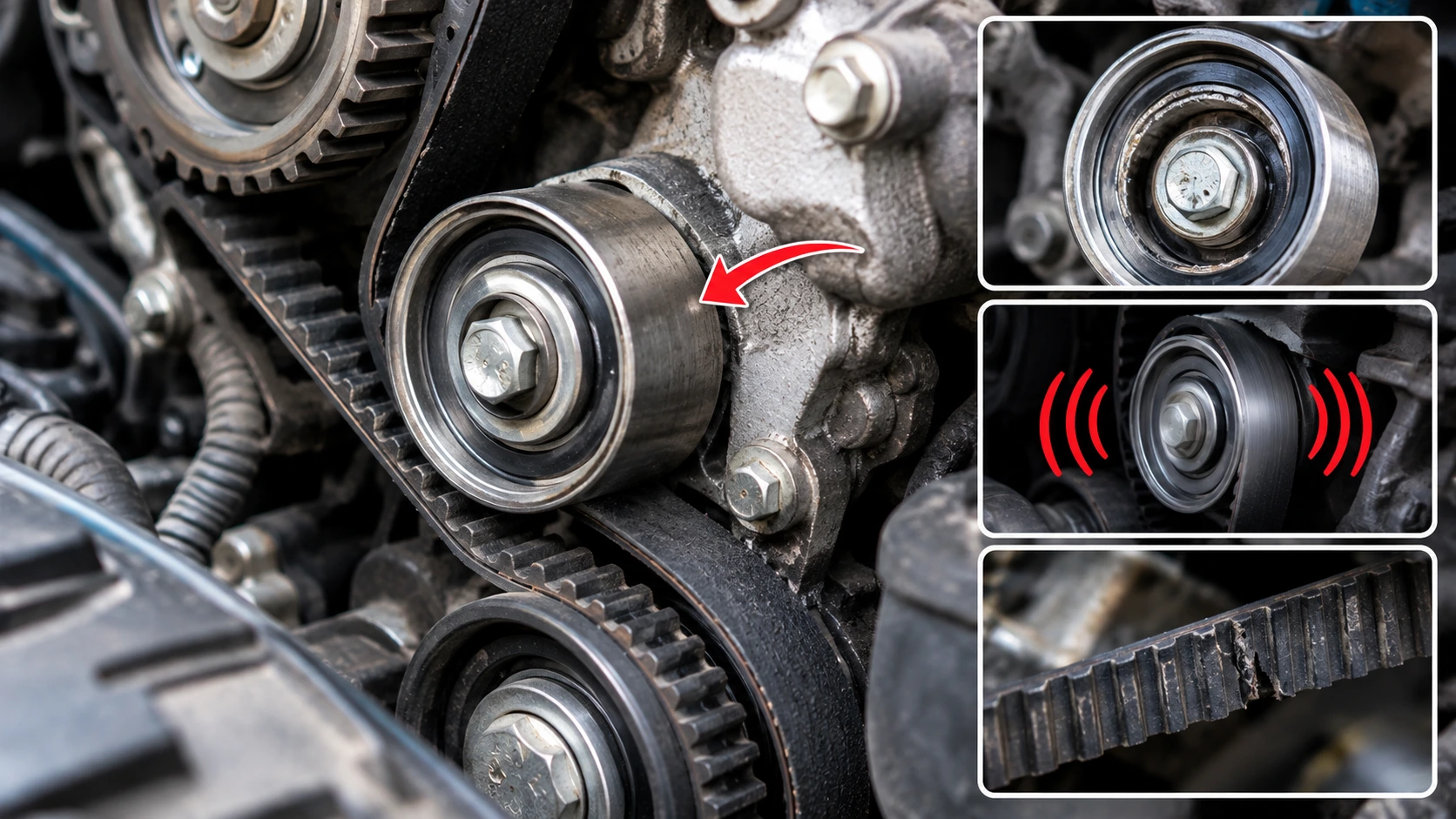
The tensioner presses a smooth pulley against the back or side of the belt. It takes up slack so the belt stays tight on the sprockets as the engine speeds up, slows down, heats up and cools down.
If the belt is too loose, its teeth can ride up on the sprocket and jump. Even one tooth changes the valve timing. If it is too tight, the belt and the pulley bearings wear quickly.
Idler pulleys guide the belt around the engine. On many engines, the water pump is also driven by the timing belt.
Automatic, Hydraulic and Manual Tensioners
Most modern engines use an automatic tensioner. A spring pushes an arm and pulley against the belt, and a small damper stops it bouncing. Some designs have a pointer and a window that shows when the tension is correct.
Many engines use a hydraulic tensioner. An oil filled cylinder with a piston pushes on a pulley arm. The oil slows sudden movement while the spring inside keeps steady pressure. Honda V6 engines and many others use this type.
Older engines use a manual tensioner. The technician sets it once with a tool, and it stays in place. If the bolt loosens, the belt goes slack.
GMB explains that the tensioner spring can stretch over time and lose tension, and that a hydraulic tensioner that leaks oil loses the force it needs to keep the belt tight.
Which Engines Use a Timing Belt
Not every engine has a timing belt. Many modern engines use a metal timing chain inside the engine instead, which does not need regular replacement. Many Toyota and Nissan petrol engines sold in the UAE use chains.
Timing belts are still common on several popular engines. Honda V6 engines in models such as the Pilot, Odyssey and some Accords use belts, as do many small Volkswagen and Audi engines, some Mitsubishi engines and a number of older Hyundai and Kia V6 engines. Many older cars of all brands also use belts.
Your owner’s manual or service schedule tells you which type you have. If the schedule lists a timing belt replacement, your engine has a belt and a tensioner. On many Honda models, the Maintenance Minder shows sub code 4 when the timing belt is due.
Why Timing Belt Tensioners Wear Faster in Dubai
Heat is the main stress. The timing belt and tensioner sit at the end of the engine, often close to the exhaust side. On summer afternoons when the air passes 45°C, the engine bay runs very hot for hours. Heat ages the rubber in the belt and the grease in the tensioner and idler bearings.
Hydraulic tensioners suffer in heat too. The seals around the piston harden and start to leak, and once oil escapes, the tensioner loses pressure.
Long idling adds wear. In traffic on Sheikh Zayed Road or while waiting in a car park with the AC on, the engine runs for long periods at low speed. The belt and tensioner do not rest, even when the car is not moving. Many service books treat lots of idling and hot climates as severe use, which shortens the replacement interval.
Dust and leaks finish the list. GMB lists dirt and dust build up on the tensioner pulley as a cause of trouble, which can let the belt slip off. Oil or coolant leaks onto the belt area soften the rubber and damage the bearings.
Rattling, Ticking or Squeaking From the Timing Cover
Noise is often the first sign. GMB describes rattling, squeaking or squealing and knocking from the timing cover area, especially at idle.
A rattle usually means the belt is slack enough to flap or slap against the timing cover. It is often worse on cold start and when the engine is idling.
A squeal or whine often comes from a dry or worn bearing in the tensioner pulley or an idler. A ticking that follows engine speed can come from a pulley bearing that is starting to break up.
The noise is easy to confuse with valve tick or the serpentine belt. The difference is where it comes from. Timing belt noise comes from behind the plastic timing cover at the end of the engine.
Hard Starting
GMB lists hard starting, with a delay before the engine fires properly, among the signs of tensioner failure. If the belt has jumped a tooth because of low tension, the valve timing is slightly wrong. The engine still runs but finds it harder to start.
You may notice longer cranking on cold mornings or after the car has been parked for a few hours. The engine may run roughly for the first few seconds.
Hard starting has many causes, including a weak battery, a failing starter, a fuel pressure fault or a sensor fault. If it comes with a rattle from the timing cover, the tensioner is a strong suspect.
Rough Running and Misfires
GMB notes that misfiring or rough running may follow hard starts when timing is off. With the valves opening slightly early or late, combustion in each cylinder is weaker and less even.
The idle may shake, the engine may hunt up and down and the check engine light may flash with misfire codes.
Misfires usually point to plugs, coils or injectors. When misfires appear on several cylinders at once along with timing noise, the timing belt system needs checking.
Sluggish Acceleration
GMB lists sluggish acceleration as a sign, noting that a lack of perfect timing leads to acceleration problems. The engine feels flat when you press the accelerator, especially from low speed.
You may notice the car struggles more on the ramps of multi storey car parks or when joining Emirates Road. The power loss is often gradual, so many drivers only notice it when it gets worse.
Timing Slipping Under Sudden Throttle
GMB explains that when the throttle opens sharply, the crankshaft and camshaft may fall out of timing for a moment or two. A weak tensioner cannot stop the belt from stretching and flapping under the sudden load.
You may feel a stumble, hesitation or a brief loss of power when you floor the accelerator to overtake. The engine then recovers once the belt settles.
This is a serious warning. Each time the belt flaps, there is a chance it will jump teeth or come off its sprockets.
Oil Leaking From a Hydraulic Tensioner
GMB lists a hydraulic oil leak as a cause of tensioner failure. On hydraulic tensioners, oil leaking from the cylinder means the piston can no longer hold the belt tight.
You usually cannot see this without removing the timing cover. A technician may find oil on the tensioner body, a piston that pushes in too easily or a tensioner that has collapsed.
Oil on the timing belt itself, from a leaking camshaft or crankshaft seal, is also dangerous. Oil softens the belt rubber and makes the teeth weaker.
Check Engine Light and Timing Codes
When the belt jumps a tooth, the engine computer sees that the camshaft and crankshaft signals no longer line up. It often sets a correlation code, such as P0016 for crankshaft and camshaft position correlation on bank 1, along with misfire codes.
Some engines also set camshaft position sensor codes or variable valve timing codes when the timing is off.
A correlation code with a rattle from the timing area should be checked straight away. Running the engine for long with the timing out can lead to a belt failure.
What Happens When the Tensioner Fails
If the tensioner fails completely, the belt goes slack, jumps several teeth or comes off. The camshafts stop turning while the crankshaft keeps spinning, and the engine stops immediately.
On a non interference engine, the valves and pistons never share the same space, so the engine usually survives. A new belt and tensioner get it running again.
On an interference engine, the valves and pistons do share space at different moments. When the camshafts stop, open valves get hit by rising pistons. That bends valves, can break valve guides and can damage pistons. Many modern engines are interference designs, including many of the belt driven engines in the UAE.
The repair after an interference failure often means removing the cylinder head, replacing valves and checking the pistons. That costs many times more than a timing belt kit.
Faults That Sound Like a Bad Timing Belt Tensioner
Several parts make similar noises:
- Serpentine belt tensioner or pulleys. These squeal, chirp and rattle at the front of the engine.
- Valve tick. Noisy hydraulic lifters tick from the top of the engine.
- Water pump bearing. A failing pump driven by the timing belt can grind or whine.
- Loose timing cover. A cracked or loose plastic cover can rattle on its own.
- Exhaust heat shield. A loose shield rattles at certain engine speeds.
- Timing chain stretch. On chain engines, a rattle on start up points to a chain or its tensioner.
The guide on bad serpentine belt symptoms covers the accessory belt and its tensioner.
How a Workshop Checks the Tensioner
A trained car mechanic near you starts by listening at idle and while revving, using a mechanic’s stethoscope on the timing cover, the tensioner area and each accessory.
Next, the codes and live data are read. Camshaft and crankshaft correlation data shows whether the timing has drifted.
On many engines, the upper timing cover can be removed to look at the belt and tensioner. The technician checks belt tension, looks at the tensioner pointer if it has one, checks for oil on the tensioner and belt, and turns the idler pulleys by hand where possible to feel for rough bearings.
The belt is also inspected for cracks, worn teeth, glazing, frayed edges and oil. The service history is checked to see when the belt and tensioner were last replaced.
Why the Tensioner Is Replaced With the Belt
The tensioner, idlers and belt all wear together. A new belt on an old tensioner is at risk if the tensioner fails, and a new tensioner on an old belt leaves a worn belt in place.
The labour to reach the tensioner is almost the same as the labour to replace the belt. On most engines, the timing covers, accessory belts, engine mount and sometimes the crank pulley must come off. Paying that labour twice makes little sense.
That is why parts makers sell timing belt kits with the belt, tensioner and idler pulleys together. On engines where the timing belt drives the water pump, the pump is usually replaced at the same time.
What a Timing Belt Kit Replacement Involves
The engine is set to its timing marks, usually with the first cylinder at top dead centre. On some engines, special locking tools hold the camshafts and crankshaft in place.
The accessory belts, timing covers and often an engine mount are removed. The old tensioner is released, the old belt comes off, and the tensioner and idlers are unbolted.
The new tensioner, idlers and water pump are fitted. The new belt goes on following the maker’s routing, and the tensioner is set exactly as the maker describes. On hydraulic tensioners, a pin holds the piston back until the belt is fitted, then the pin is pulled to release it.
The engine is turned by hand through two full turns to check that the timing marks still line up. Only then are the covers refitted and the engine started. Any coolant lost from a water pump change is refilled and the system is bled.
Is It Safe to Drive With a Bad Tensioner?
No. A tensioner that rattles, leaks or lets the timing slip can fail without further warning. On an interference engine, that failure can wreck the engine.
If you hear a rattle from the timing area or see timing correlation codes, have the car checked before driving any distance. If the engine suddenly stops while driving and will not restart, do not keep cranking it, as that can add damage.
If the engine stops on a highway, turn on your hazard lights and move to the hard shoulder if the car is still rolling. Stopping in a live lane because of a breakdown brings a AED 1,000 fine and six black points under Article 98 of the UAE Federal Traffic Law. Once safe, call roadside assistance.
A car with a suspected timing fault should travel on a flatbed tow truck. If the car is parked at home and only rattles, a mobile mechanic can listen to the engine and check the service history before you decide on the next step.
How Often Should the Timing Belt Tensioner Change?
Follow your owner’s manual. Most makers list a timing belt interval in kilometres and years, whichever comes first, and the tensioner is changed at the same time. Many intervals fall somewhere between 90,000 and 160,000 km, depending on the engine.
Hot climates and long idling often count as severe use in service schedules, which can shorten the interval. Rubber also ages with time, so a low mileage car that is many years old can still need a new belt and tensioner.
If you buy a used car with a timing belt and no proof of replacement, treat it as due. A car maintenance plan that tracks the belt interval avoids missing it.
Can a Bad Tensioner Damage the Engine?
Yes, badly, on interference engines. When the belt fails, valves hit pistons, which can bend valves, damage pistons and crack valve guides. The engine may need a cylinder head rebuild or more.
Even on non interference engines, a belt that jumps teeth can cause rough running and stress on parts. Pieces of a failing pulley can also damage the belt and timing covers.
If the worst has happened, an engine repair specialist can do a compression or leak down test to see how much damage has been done before deciding on the repair.
How to Protect the Timing Belt System
Replace the timing belt kit on time, by kilometres or years, whichever comes first.
Fix oil and coolant leaks near the timing cover quickly. Fluids on the belt soften the rubber and damage the tensioner and idlers.
Use a full timing belt kit with a new tensioner and idlers, not just a new belt.
Listen for new noises from the side of the engine, especially at idle and on cold start, and have them checked early.
Keep a record of when the belt was last changed, with the invoice. It helps when selling the car and stops the work being missed.
If removing an engine mount or covers during the job marked any painted surfaces in the engine bay or on the wing, a careful workshop protects them, and any marks can be fixed through paint and panel repair.
A regular car service in Dubai should flag when the timing belt is due. If you hear a rattle from the timing cover, take the car to a car garage near you that checks the tensioner and belt before driving it further.
FAQ
Here are the questions Dubai drivers most often ask about timing belt tensioners.
What does a bad timing tensioner sound like?
It usually rattles, ticks, squeaks or knocks from the timing cover area at the side of the engine, often worse at idle and on cold start. GMB lists rattling and squealing among the main signs.
Can a bad tensioner cause hard starting?
Yes. If the belt jumps a tooth because of low tension, the valve timing is off. GMB notes the engine may be slow to fire, then misfire or run roughly.
What happens if the tensioner fails?
The belt goes slack, jumps teeth or comes off, and the engine stops. On an interference engine, the valves can hit the pistons, causing serious engine damage.
Does the tensioner change with the timing belt?
Yes. The labour is almost the same, and the parts wear together. Most workshops fit a full kit with the belt, tensioner and idlers, plus the water pump on many engines.
Does my car have a timing belt?
Check your owner's manual or service schedule. If it lists a timing belt replacement interval, your engine has a belt. Many Toyota and Nissan petrol engines use timing chains instead.
Conclusion
A bad timing belt tensioner shows up as rattling or squealing from the timing cover, hard starting, rough running, sluggish acceleration, timing that slips under sudden throttle and timing correlation codes. Heat, long idling, dust and oil leaks wear tensioners faster in Dubai. A stethoscope check, a look under the timing cover and a code scan confirm the fault, and a full timing belt kit replacement protects the engine from expensive valve damage.
Rapid Rev Garage is a full workshop open 24 hours at Al Khail Gate, 12th Street, Al Quoz Industrial Area 2, serving passenger cars across Al Quoz, Business Bay, Jumeirah, Al Barsha, Satwa, Downtown and the Sheikh Zayed Road corridor. Visit https://rapidrevgarage.com, send your car model, mileage and a short video of the noise on WhatsApp, or get directions on Google Maps.
Rapid Rev Garage | Bad Timing Belt Tensioner Symptoms | Al Quoz, Dubai