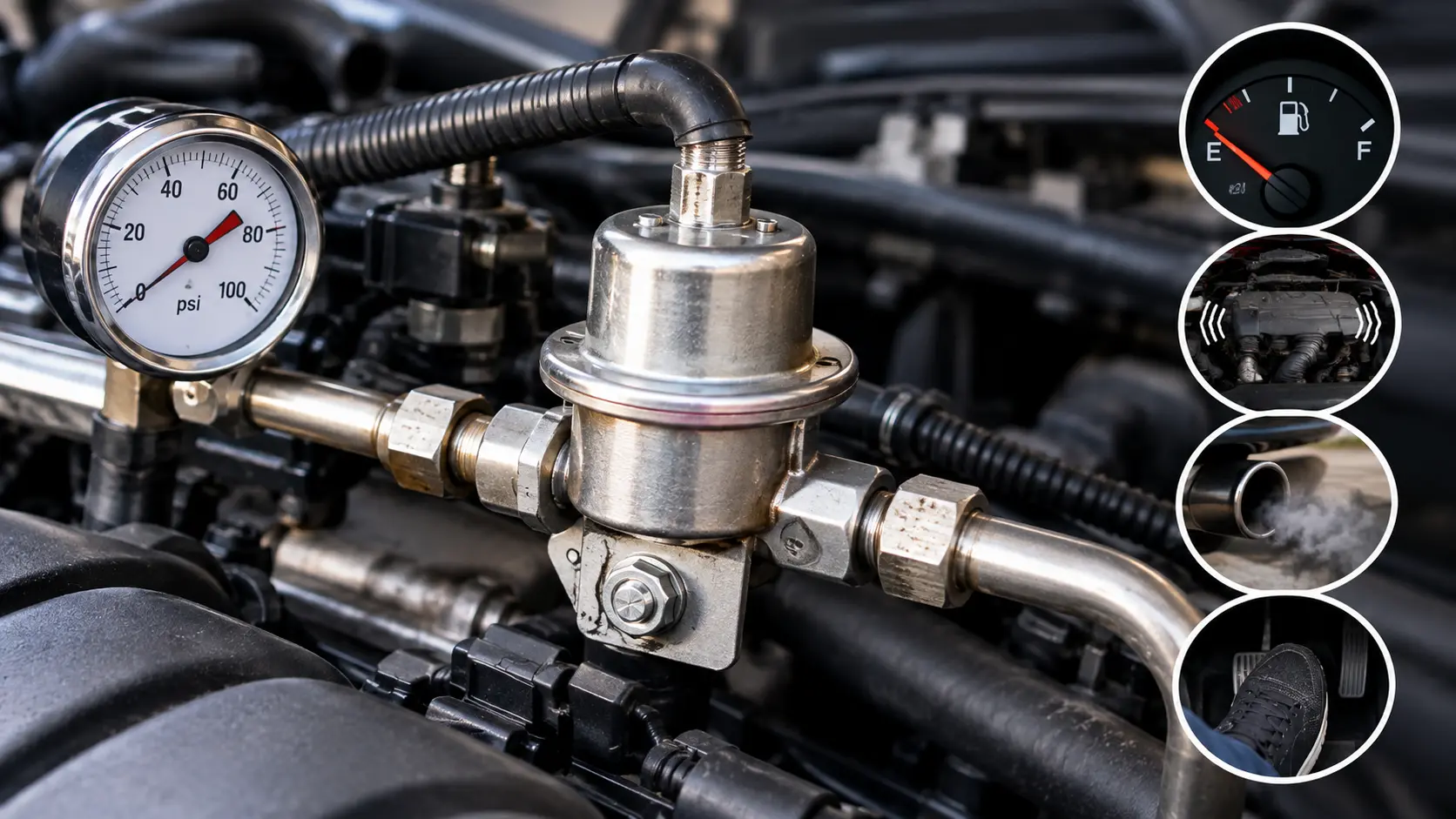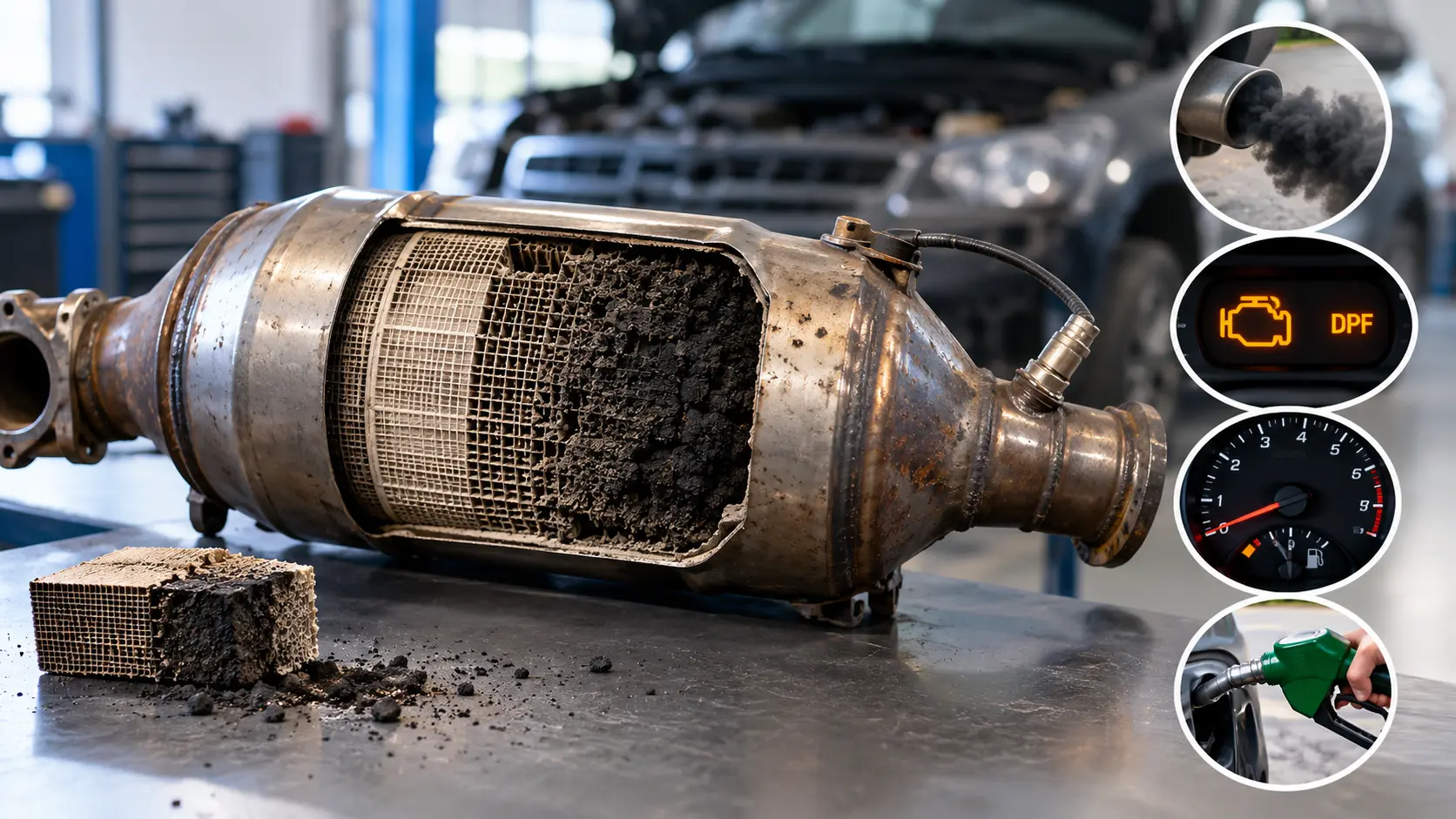
You drive your diesel pickup from Al Quoz to Business Bay and back every day, mostly in slow traffic. One afternoon an amber light with a box full of dots appears on the dashboard. A week later the engine feels flat on the ramp onto Sheikh Zayed Road, the cooling fan runs on after you park, and the fuel gauge drops faster than usual. These are classic bad DPF symptoms, and they are common on diesels that rarely see an open road.
A diesel particulate filter, or DPF, sits in the exhaust and traps the soot that a diesel engine makes. It cleans itself by burning that soot off at high temperature, a process called regeneration. When the car never gets hot enough or long enough to finish a regeneration, soot builds up, the exhaust backs up and the engine loses power.
This guide explains how a DPF works, the signs it is blocking, why Dubai driving patterns cause it, how a workshop tests it and what the repair options are. It also covers the sensor and engine faults that set the same warning light.
Bad DPF Symptoms: Quick Answer
The main bad DPF symptoms are a DPF warning light, loss of power, limp mode, higher fuel use, a cooling fan and idle that run on after you switch off, frequent regenerations, a smell of hot exhaust, a check engine light and, on some models, oil level rising on the dipstick.
Toyota explains that its DPF traps about 80 per cent of soot, regenerates automatically above about 40 mph, which is roughly 65 km/h, and that the warning light means the filter is overloaded. A workshop reads the soot load and pressure readings, then decides between a forced regeneration, a clean or a new filter.
Table of Contents
- What a Diesel Particulate Filter Does
- How DPF Regeneration Works
- Which Cars in the UAE Have a DPF
- Why DPFs Block Faster in Dubai Traffic
- DPF Warning Light Solid or Flashing
- Loss of Power and Limp Mode
- Higher Fuel Use and Frequent Regenerations
- Fan and Idle Running On After You Park
- Rising Oil Level on the Dipstick
- Smells, Smoke and Exhaust Noise
- Faults That Look Like a Blocked DPF
- How a Workshop Diagnoses a DPF
- Forced Regeneration, Cleaning or Replacement
- Can You Clear a DPF by Driving?
- Is It Safe to Drive With a Blocked DPF?
- What Is DPF Ash and Why Does It Matter?
- How Long Does a DPF Last?
- Will a Blocked DPF Fail the Vehicle Inspection?
- How to Keep a DPF Healthy in Dubai
- FAQ
- Conclusion
What a Diesel Particulate Filter Does
Diesel engines produce fine soot when they burn fuel. A DPF is a ceramic block, often made of silicon carbide or cordierite, with thousands of tiny channels inside. The channels are blocked at alternate ends, so exhaust gas must pass through the porous walls. The soot gets caught on the walls while the cleaned gas flows out.
Toyota explains that the DPF traps about 80 per cent of the soot particles from combustion. Over time, that soot builds up and starts to restrict the exhaust flow.
Pressure sensors before and after the filter, or a single differential pressure sensor, tell the engine computer how much soot has built up. Temperature sensors in the exhaust tell it whether the filter is hot enough to clean itself.
How DPF Regeneration Works
Regeneration is the process of burning off the trapped soot. Toyota explains that the engine computer regenerates the filter automatically by burning the soot at high temperature, usually without the driver noticing.
Passive regeneration happens on its own when the exhaust is hot during steady, fast driving. Toyota notes that normal regeneration usually happens once the engine and exhaust are at operating temperature and the car is above 40 mph, about 65 km/h.
Active regeneration is triggered by the computer when soot reaches a set level. Toyota explains that for mainly urban driving, the computer injects small amounts of fuel after combustion to raise the exhaust temperature and burn off the soot. Some cars also use a catalyst in front of the DPF to help heat the filter.
If an active regeneration is interrupted, Toyota notes that it resumes once the engine is restarted and back at temperature. Repeated interruptions are what lead to a blocked filter.
Which Cars in the UAE Have a DPF
Most passenger cars in the UAE run on petrol, so many drivers never deal with a DPF. Diesels are more common in pickups, vans, commercial fleets and some European SUVs.
Popular diesel models in the region include pickups such as the Toyota Hilux, Mitsubishi L200 and Nissan Navara in some versions, as well as diesel vans and some Land Rover, Mercedes and BMW SUVs. Whether a particular diesel has a DPF depends on the model year and the emissions standard it was built to.
Your owner’s manual lists the DPF warning light if your car has one. A workshop can also confirm it by looking under the car or reading the engine computer.
Why DPFs Block Faster in Dubai Traffic
Short trips and slow traffic are the main cause. A commute through Al Quoz, Business Bay or Deira often means 20 to 40 minutes at low speed with long stops. The exhaust rarely gets hot enough for passive regeneration, and active regenerations get interrupted when you park.
Toyota advises avoiding unnecessary idling and limiting short trips of under ten minutes. Many delivery vans and pickups in Dubai do exactly the opposite, idling with the AC on during deliveries and making many short trips a day.
Heat can help and hurt. Hot weather raises engine bay temperatures, but it does not make up for low exhaust temperature at idle. Long idling with the AC on at 45°C still produces soot without giving the filter a chance to burn it.
Engine faults add soot. A leaking injector, a failing turbo, a stuck EGR valve or a blocked air filter all make the engine produce more soot than normal. Fine dust from Dubai roads can clog the air filter quickly, which makes the engine run rich.
DPF Warning Light Solid or Flashing
The DPF warning light is usually an amber symbol of a box with dots inside, though the design varies between makers. BookMyGarage explains that a solid light means the filter is approaching its maximum soot level and needs to regenerate, while a flashing light means the soot level is close to full.
Toyota explains that the warning light comes on when the DPF is overloaded and the computer could not complete a regeneration. Toyota warns that the light should not be ignored, because the filter can be damaged beyond repair.
A solid light can often be cleared with the right drive, as explained later. A flashing light or a light that comes back quickly usually needs a workshop.
Loss of Power and Limp Mode
A blocked DPF restricts the exhaust, so the engine cannot breathe out freely. You may notice weak acceleration, a turbo that seems slow to build boost and less pulling power on ramps and hills.
BookMyGarage notes that when the filter reaches about 70 per cent soot load, many cars enter limp mode to protect the engine, restricting power. In limp mode, the engine may refuse to rev beyond a low limit and the car can struggle to keep up with traffic.
Limp mode on Emirates Road or Sheikh Mohammed bin Zayed Road is dangerous, because the car may not be able to hold highway speed. Plan to get the filter checked as soon as the light appears, before it reaches this point.
Higher Fuel Use and Frequent Regenerations
BookMyGarage lists lower fuel efficiency among the signs of a blocked DPF. A restricted exhaust makes the engine work harder, and every active regeneration uses extra fuel to heat the filter.
If the filter is struggling, the computer tries to regenerate more often. You may notice the fuel use rise by a clear margin over a few weeks, with no change in how you drive.
Some cars show regeneration in progress on the dashboard. On others, the signs are a higher idle speed, the cooling fan running hard and a hot smell from the exhaust.
Fan and Idle Running On After You Park
During an active regeneration, many diesels raise the idle speed, switch on the cooling fan and turn on extra electrical loads such as the rear window heater to help heat the exhaust.
If you switch off in the middle of a regeneration, the cooling fan may keep running for a few minutes after you lock the car. That is normal on many models once in a while.
If it happens almost every time you park, the filter is trying to regenerate too often and never finishing. That is an early warning that a blockage is building up.
Rising Oil Level on the Dipstick
On many diesels, active regeneration injects a small amount of extra fuel late in the combustion cycle. Some of that fuel can slip past the piston rings into the oil. When regenerations keep getting interrupted, more fuel ends up in the oil.
The oil level on the dipstick can then rise above the maximum mark, and the oil may smell of diesel. Diluted oil is thinner and protects the engine less well.
Some cars have an oil dilution warning or a service message for this. If the oil level is rising, have the oil changed and the DPF checked. Regular car service in Dubai intervals matter more on diesels that do mostly short trips.
Smells, Smoke and Exhaust Noise
A hot, acrid smell from the exhaust after a drive can mean an active regeneration has been running. A healthy DPF does not usually let visible black smoke out of the tailpipe.
Black smoke from a car with a DPF is a warning sign. It can mean the filter has cracked or been removed, or that soot is escaping past a damaged seal.
A rattle from the exhaust can come from a broken heat shield or, in rare cases, a cracked filter core. A cracked DPF lets soot pass straight through and usually sets a fault code.
Faults That Look Like a Blocked DPF
Several faults set the DPF light or cause the same symptoms:
- Faulty differential pressure sensor or hoses. BookMyGarage lists faulty sensors among the causes. A split sensor hose gives false soot readings.
- Faulty exhaust temperature sensor. The computer may stop regeneration if it cannot read the temperature.
- Stuck EGR valve. This adds soot and reduces power.
- Leaking or worn injectors. These cause extra soot and smoke.
- Turbo problems. A failing turbo causes power loss and can feed oil into the exhaust.
- Blocked air filter. A dusty filter makes the engine run rich and produce more soot.
- Wrong engine oil. Oil that is not rated for a DPF engine leaves more ash in the filter.
Testing these first stops you paying for a new filter when a sensor or hose is the real problem.
How a Workshop Diagnoses a DPF
A trained car mechanic near you starts with a scan tool that reads the engine computer. Live data shows the soot load estimate, ash load, differential pressure, exhaust temperatures and how many regenerations have been completed or interrupted.
Next, the differential pressure sensor and its hoses are checked. A cracked hose or a sensor reading wrongly is a common and cheap fix.
The technician then checks the engine for causes of extra soot, such as a stuck EGR valve, leaking injectors, a dirty air filter or a boost leak. If these are not fixed, a new or cleaned DPF will block again quickly.
The oil level and condition are checked for fuel dilution. On some cars, the technician also inspects the DPF visually after removing a sensor, or measures back pressure in the exhaust.
Forced Regeneration, Cleaning or Replacement
There are three main repair options, depending on how blocked the filter is.
Forced regeneration. Using a scan tool, the technician tells the engine computer to run a regeneration while the car is parked or on a road test. The engine runs at higher speed and the exhaust gets very hot. This works when the soot load is high but not extreme. Toyota notes that once the warning light appears, the filter must be regenerated manually at a dealer or workshop.
Off car cleaning. The DPF is removed and cleaned with a specialist machine that uses air, water or heat to push out soot and ash. BookMyGarage recommends a DPF clean every 6 to 9 months for cars at risk, and lists an average UK clean price of £110.77 from its bookings.
Replacement. If the filter is cracked, melted or packed with ash, it must be replaced. BookMyGarage notes that at about 90 per cent soot load, there is little that can prevent the need for a replacement, and quotes a UK price of upwards of £1,000 plus labour. Prices in Dubai vary by model and part type.
After any repair, the computer’s soot and ash counters are reset with a scan tool, and the cause of the blockage is fixed. For deeper engine faults that caused the soot, an engine repair specialist can check the injectors, turbo and EGR.
Can You Clear a DPF by Driving?
Often, yes, if you act when the light first appears. BookMyGarage suggests driving for 15 minutes or more at at least 40 mph, about 65 km/h, on a motorway to help clear the light. Toyota recommends 20 to 30 minutes at 40 to 55 mph, about 65 to 90 km/h.
In Dubai, a run along Emirates Road, Sheikh Mohammed bin Zayed Road or the Dubai to Al Ain road at a steady legal speed can give the filter the heat it needs. Keep to a lower gear than usual so the engine runs a little faster.
Some models, such as certain diesel pickups, have a switch that lets the driver start a regeneration while parked. Check your owner’s manual before using it.
If the light is flashing, the car is in limp mode or the light comes back within days, driving is unlikely to fix it. Book a workshop check instead.
Is It Safe to Drive With a Blocked DPF?
A solid DPF light is not an immediate danger, but it needs attention within days. A flashing light or limp mode means the filter is close to full and the engine is protecting itself.
Driving for weeks with a blocked filter can raise exhaust temperature, damage the turbo, dilute the oil and, in the worst case, crack or melt the filter. A filter that would have cleaned with a forced regeneration may then need replacing.
If the car goes into limp mode on a highway, turn on your hazard lights and move to the hard shoulder or take the next exit. Stopping in a live lane because of a breakdown brings a AED 1,000 fine and six black points under Article 98 of the UAE Federal Traffic Law. Once safe, call roadside assistance.
A car that will not move under its own power should travel on a flatbed tow truck. If the car is parked at home with a solid light, a mobile mechanic can read the soot load and check the sensor hoses before you drive it.
What Is DPF Ash and Why Does It Matter?
Soot burns off during regeneration, but ash does not. Ash comes mainly from additives in the engine oil that burn in small amounts. It builds up slowly inside the filter and cannot be removed by regeneration.
Over many thousands of kilometres, ash fills part of the filter for good. The computer tracks an ash estimate, and when it gets too high, the filter needs off car cleaning or replacement.
Using the correct low ash engine oil, often labelled with an ACEA C rating or the maker’s own DPF approval, slows ash build up. The wrong oil can shorten the filter’s life. Burning oil from worn rings or a leaking turbo also adds ash.
How Long Does a DPF Last?
There is no fixed life. A DPF on a diesel that does regular highway runs can last a very long time. One that spends its life in short trips and idling may block within a couple of years.
The biggest factors are driving pattern, engine condition, oil type and whether warnings were acted on quickly. A filter that is regenerated and cleaned on time often outlasts one that is driven in limp mode for weeks.
Will a Blocked DPF Fail the Vehicle Inspection?
A lit warning light can lead to problems at a roadworthiness test, and a missing or damaged DPF can cause high emissions readings. BookMyGarage notes that a DPF light left on can lead to a UK MOT failure.
Removing a DPF to avoid repairs is not a fix. It raises emissions, can set fault codes and may affect warranty and inspection results.
A vehicle inspection before your registration renewal or before buying a used diesel includes a scan for DPF faults and a check of the exhaust.
How to Keep a DPF Healthy in Dubai
Take your diesel for a steady highway run of 20 to 30 minutes at least once a week if most of your driving is short trips. A run to Al Ain, Hatta or Abu Dhabi at a steady legal speed works well.
Avoid long idling, especially with the AC on, when you could switch off. Toyota advises avoiding unnecessary idling.
Never ignore the DPF light. Act on a solid light straight away by driving or booking a check.
Use the engine oil type in your owner’s manual, and change the air filter often in dusty conditions. A clean air filter helps the engine burn fuel cleanly.
Fix engine faults such as injector leaks, EGR problems and boost leaks early, because they add soot.
If exhaust soot or heat has stained the rear bumper around the tailpipe, the marks can be treated through paint and panel repair once the cause is fixed.
For any DPF warning, choose a car garage near you that reads live soot and pressure data before recommending a new filter.
FAQ
Here are the questions Dubai diesel drivers most often ask about DPFs.
What does the DPF warning light mean?
It means soot in the diesel particulate filter is close to its limit and the filter could not regenerate. A solid light can often be cleared by driving. A flashing light usually needs a workshop.
Can a blocked DPF cause power loss?
Yes. A blocked filter restricts the exhaust, so the engine cannot breathe out freely. At high soot levels, many cars enter limp mode to protect the engine, cutting power sharply.
How do you clear a DPF light?
Drive for 20 to 30 minutes at a steady 65 to 90 km/h when the light first comes on, as Toyota advises. If the light stays on or flashes, a workshop can run a forced regeneration.
Why does my DPF keep blocking?
Short trips, long idling and slow traffic stop the filter from getting hot enough to regenerate. Engine faults such as leaking injectors, a stuck EGR valve or a dirty air filter add extra soot.
Is DPF cleaning cheaper than replacement?
Usually yes. A forced regeneration or off car clean costs far less than a new filter. Replacement is needed when the filter is cracked, melted or packed with ash.
Conclusion
A bad DPF shows up as a DPF warning light, power loss, limp mode, higher fuel use, frequent regenerations, a fan that runs on after you park and a rising oil level. Short trips, idling and slow Dubai traffic stop diesels from finishing regenerations. Reading the soot and pressure data, checking the sensors and fixing the source of the soot decides whether a forced regeneration, a clean or a new filter is needed.
Rapid Rev Garage is a full workshop open 24 hours at Al Khail Gate, 12th Street, Al Quoz Industrial Area 2, serving passenger cars across Al Quoz, Business Bay, Jumeirah, Al Barsha, Satwa, Downtown and the Sheikh Zayed Road corridor. Visit https://rapidrevgarage.com, send your car model and a photo of the warning light on WhatsApp, or get directions on Google Maps.
Rapid Rev Garage | Bad DPF Symptoms | Al Quoz, Dubai