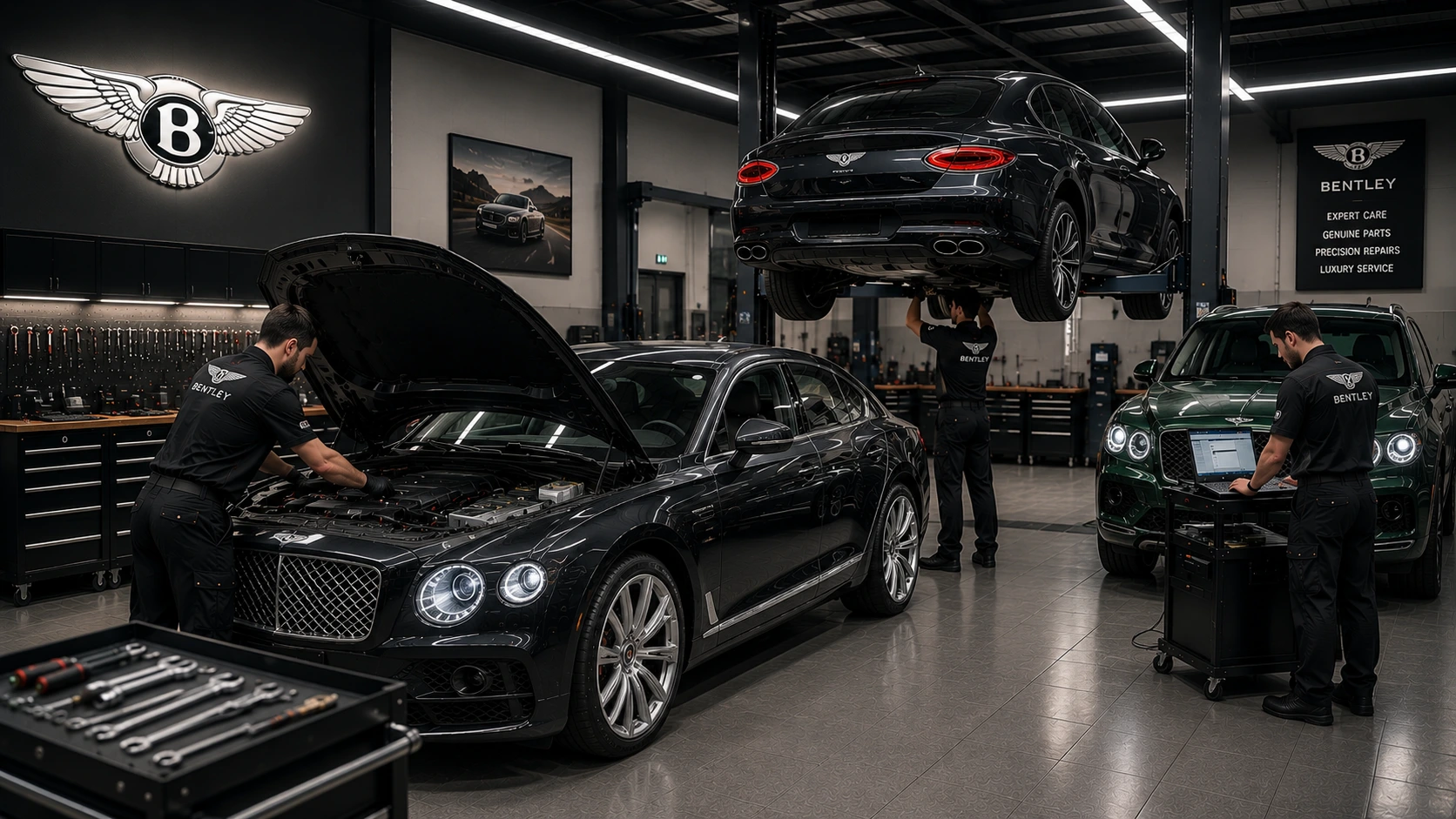
Most repair quotes in Dubai start with a symptom and end with a parts list. A suspension warning becomes “two air springs and a compressor.” A check engine light becomes “three sensors.” The owner pays, the fault sometimes clears, sometimes doesn’t, and either way nobody actually confirmed which component had failed before it was replaced.
This is the part of luxury car repair in Dubai that doesn’t get talked about openly: a significant proportion of parts replaced on Bentleys in Dubai were never actually faulty. The symptom was real. The diagnosis wasn’t. At Rapid Rev Garage in Al Quoz, every Bentley job starts with confirming exactly which component has failed — before any part is ordered, not after.
Bentley Repair — Why the Wrong Diagnosis Costs More Than the Wrong Part
A Bentley’s complexity cuts both ways. The W12 twin-turbo engine, the adaptive air suspension, the ZF 8HP gearbox, and the multi-module CAN bus electronics genuinely do fail in specific, documented ways. But that same complexity means a symptom rarely points to a single obvious cause — a warning light or a noise can have three or four plausible sources, and only proper diagnostic data narrows it to the actual one.
The pattern we see repeatedly at Rapid Rev Garage: an owner arrives having already paid for a Bentley repair elsewhere that didn’t resolve the original fault. The part that was replaced wasn’t necessarily wrong to suspect — it just wasn’t tested before being swapped. Diagnosis by elimination, paid for by the customer, one part at a time.
Bentley Repair — Air Suspension Is Where This Happens Most
Air suspension faults are the most common reason a Bentley comes in for repair in Dubai, and the most common place where parts get replaced without confirmation across any Bentley repair workshop in Dubai.
The system uses height-adjustable air springs at each corner, a compressor, a valve block, and ride height sensors. A vehicle sitting low on one corner, or a compressor running audibly while parked, has one of several possible causes — a leaking spring, a failing compressor, a stuck valve, or a miscalibrated height sensor. Each produces a similar-looking symptom. Replacing the most likely-sounding part without testing the others is how a customer ends up paying for a new compressor that was never actually broken.
The correct sequence: test pressure retention at each corner individually over a timed interval. Measure compressor output against specification under load. Check valve block solenoid response per corner. Confirm ride height sensor calibration against the actual measured ride height. This data identifies exactly one failing component — not the two or three that get replaced when the diagnosis skips this step.
A Continental GT came to us after a quote of AED 9,800 for a compressor and two air springs elsewhere. We ran the full per-corner test. One rear spring was leaking. The compressor was straining from compensating for that single leak but had not failed. New spring, recalibration: AED 2,300. The repair the owner had been about to authorise included two components that didn’t need replacing.
Engine Faults and the Sensor Replacement Cycle
The W12 and V8 engines generate fault codes that point to a sensor far more often than the sensor itself is the actual problem. A boost pressure code, an oxygen sensor code, or a MAP sensor fault frequently traces back to a vacuum hose, a wiring fault, or a connector issue upstream of the sensor — the sensor is reading correctly; what it’s reading is wrong because something else in the system has failed.
Replacing the sensor that the code references, without checking what’s feeding it bad data, is the single most common pattern behind repeat Bentley repair visits in Dubai. The new sensor reports the same abnormal reading because the actual fault — a split vacuum hose, a chafed wire, a corroded ground — was never addressed.
Proper diagnosis means live data review during a road test: boost pressure target versus actual, fuel trim correction values, and signal consistency from the sensor in question. If the sensor’s own output is internally consistent but the value itself is wrong, the fault is upstream. If the sensor’s output is erratic or out of range entirely, the sensor itself is the more likely cause.
A customer’s Flying Spur had two sensors replaced at a previous workshop for a persistent boost fault — no improvement either time. Live boost data during a road test traced it to a split vacuum hose behind the intake manifold. The hose, not either sensor, was the actual fault. Repair cost: a fraction of what had already been spent.
Our car mechanic team runs this live data review on every engine fault before recommending any component.
ZF Gearbox — Fluid Service First, Component Replacement Second
A gearbox that hesitates, shifts firmly, or shudders at low speed is frequently degraded ZF Lifeguard ATF — not a failing mechatronic unit or a worn clutch pack. In Dubai’s stop-start heat, this fluid breaks down faster than the “sealed for life” guidance accounts for, and the resulting symptoms look mechanically serious even when the gearbox itself is fine.
The cost difference between a fluid service and a mechatronic unit replacement is substantial. A proper diagnostic sequence — adaptation values reviewed, fluid condition assessed, a fluid exchange and adaptation reset attempted first — resolves the majority of these complaints before any disassembly is justified. Going straight to component replacement based on the symptom alone risks an expensive repair for a problem that fluid service would have solved.
Our car service packages include transmission fluid condition assessment at every major visit, catching this before it becomes a misdiagnosed repair.
What Proper Diagnosis Actually Looks Like
At Rapid Rev Garage, every Bentley fault follows the same sequence regardless of system:
Confirm the symptom — road test or physical inspection to verify exactly what’s happening and under what conditions.
Read live data, not just stored codes — a stored fault code is a starting point. Live data during the actual fault condition shows what’s really happening in the circuit or system.
Test the suspected component directly — pressure tests for suspension, voltage drop tests for electrical circuits, fluid condition tests for transmission — rather than inferring condition from the symptom alone.
Confirm before ordering — the part gets ordered once the test data confirms it’s the actual cause, not before.
This sequence takes longer than guessing. It also means the repair that follows actually resolves the fault, and the owner isn’t paying for components that were never broken.
If your Bentley has broken down and needs recovery, our roadside assistance covers Al Quoz and nearby Dubai areas.
Cooling System and Electrical Faults — Same Principle Applies
Coolant pipe fitting cracks, expansion tank stress fractures, and water pump seal weeping are all common Bentley cooling faults in Dubai’s heat — and all distinguishable from each other through a proper pressure test rather than assumption. A temperature gauge that rises in traffic doesn’t tell you which component has failed. A pressure test does.
Electrical faults — warning lights across multiple systems, battery drain, infotainment glitches — follow the same logic. A single corroded ground connection can generate codes in three separate modules. Replacing three components individually costs three times what fixing the actual ground connection costs. Full module communication scanning identifies the shared fault before any parts are touched.
For cosmetic repairs alongside mechanical work, our car painting team handles colour-matched Bentley repairs using correct factory paint codes. For on-site assessment before driving in, our mobile car mechanic covers Al Quoz and nearby Dubai areas.
Finding Honest Bentley Repair in Al Quoz
If you’ve already paid for a Bentley repair that didn’t resolve the original fault, or you want a diagnosis before authorising any work, Rapid Rev Garage is a garage near me in Al Quoz accessible from Business Bay, Jumeirah, Barsha, Satwa, Downtown, and the Sheikh Zayed Road corridor.
In Conclusion
Bentley repair done honestly means confirming the actual fault before ordering any part — not replacing the most likely-sounding component and hoping it resolves the symptom. That discipline is what prevents Bentley owners in Dubai from paying for parts they never needed.
Rapid Rev Garage is in Al Quoz, serving Bentley owners across nearby Dubai areas — Business Bay, Jumeirah, Downtown, Barsha, Satwa, and the Sheikh Zayed Road corridor. Book your appointment on WhatsApp and find us on Google Maps.
Rapid Rev Garage — Bentley Repair Dubai | Al Quoz and Nearby Areas