A brake pedal feels spongy in morning — pressing down further than usual before braking resistance builds, feeling soft or lacking the firmness expected — — this brake pedal feels spongy in morning pattern is a brake system fault that should not be normalised or ignored. In Dubai, brake pedal feels spongy in morning presentations often trace to a brake fluid that has absorbed moisture overnight, a caliper that is releasing correctly but then allowing slight pad movement back from the disc, or in more serious cases, a master cylinder seal that is beginning to bypass fluid internally. Each of these is identifiable and fixable — but none improves on its own.
At Rapid Rev Garage in Al Quoz, a spongy pedal complaint is diagnosed through a brake fluid condition test, a system pressure test, and a caliper piston retraction check before any repair is recommended.
Brake Pedal Feels Spongy in Morning — Quick Verdict
A brake pedal that feels spongy in the morning but firms up after a few applications is almost always one of three things: absorbed moisture in the brake fluid that has caused slight vapour formation at low overnight temperatures, disc brake pad knockback from a disc with runout that pushes the caliper piston slightly back overnight, or the early stages of master cylinder internal seal wear. Morning-specific sponginess that firms up with pumping is less urgent than constant sponginess — but it still warrants investigation because both the fluid condition and the master cylinder causes progress to more serious brake performance issues without repair.
Table of Contents
- Why This Happens in the Morning Specifically
- What a Spongy Pedal Feels Like — and What Normal Feels Like
- The Three Most Likely Causes in Dubai
- How Dubai Makes This More Common
- How We Find the Exact Cause
- Getting It Fixed — The Right Repair for Each Cause
- What Happens If This Is Left
- When Should You Stop Driving?
- How Long the Repair Takes
- What the Repair Costs in Dubai
- Preventing Morning Pedal Sponginess
- Why Rapid Rev Garage?
- FAQ
- Conclusion
Why This Happens in the Morning Specifically
The morning-specific nature of brake pedal feels spongy in morning is the most useful diagnostic clue — and it explains immediately why this fault often gets dismissed by drivers who notice it firms up after the first few brake applications.
Temperature Drops Overnight in Dubai
Despite Dubai’s reputation for constant heat, nighttime temperatures — particularly in winter and in air-conditioned underground parking — are significantly lower than daytime driving temperatures. Brake fluid and caliper components cool substantially overnight from their driving temperatures.
Brake Fluid Absorbs Moisture Over Time
Brake fluid is hygroscopic — it absorbs moisture from the atmosphere through microscopic permeation in brake hoses and reservoir seals over time. As this moisture content increases, the fluid’s effective boiling point decreases. At low overnight temperatures, absorbed moisture can produce very small vapour pockets within the fluid — which compress slightly when pedal pressure is first applied, producing the soft, spongy feel that dissipates as the fluid warms and the vapour pockets collapse.
Pad Knockback From Disc Runout
When a disc has lateral runout — even a small deviation from perfectly flat — it rotates against the brake pads as it turns and pushes the caliper pistons slightly back into their bores. After the vehicle sits overnight, this slight piston retraction leaves a small gap between the pad and disc. The first brake application of the day must close this gap before pressure builds — producing one or two soft, spongy pedal applications before the pads contact the disc normally.
These Morning Effects Dissipate With Use
In both cases — fluid moisture vapour and pad knockback — the sponginess disappears after a few brake applications because either the vapour collapses under heat and pressure, or the gap is closed and normal pad-disc contact is established. This self-resolving morning character is what causes drivers to accept it as normal rather than having it investigated.
What a Spongy Pedal Feels Like — and What Normal Feels Like
Understanding the distinction when a brake pedal feels spongy in morning situation appears helps a driver accurately describe the symptom.
Normal Brake Pedal Behaviour
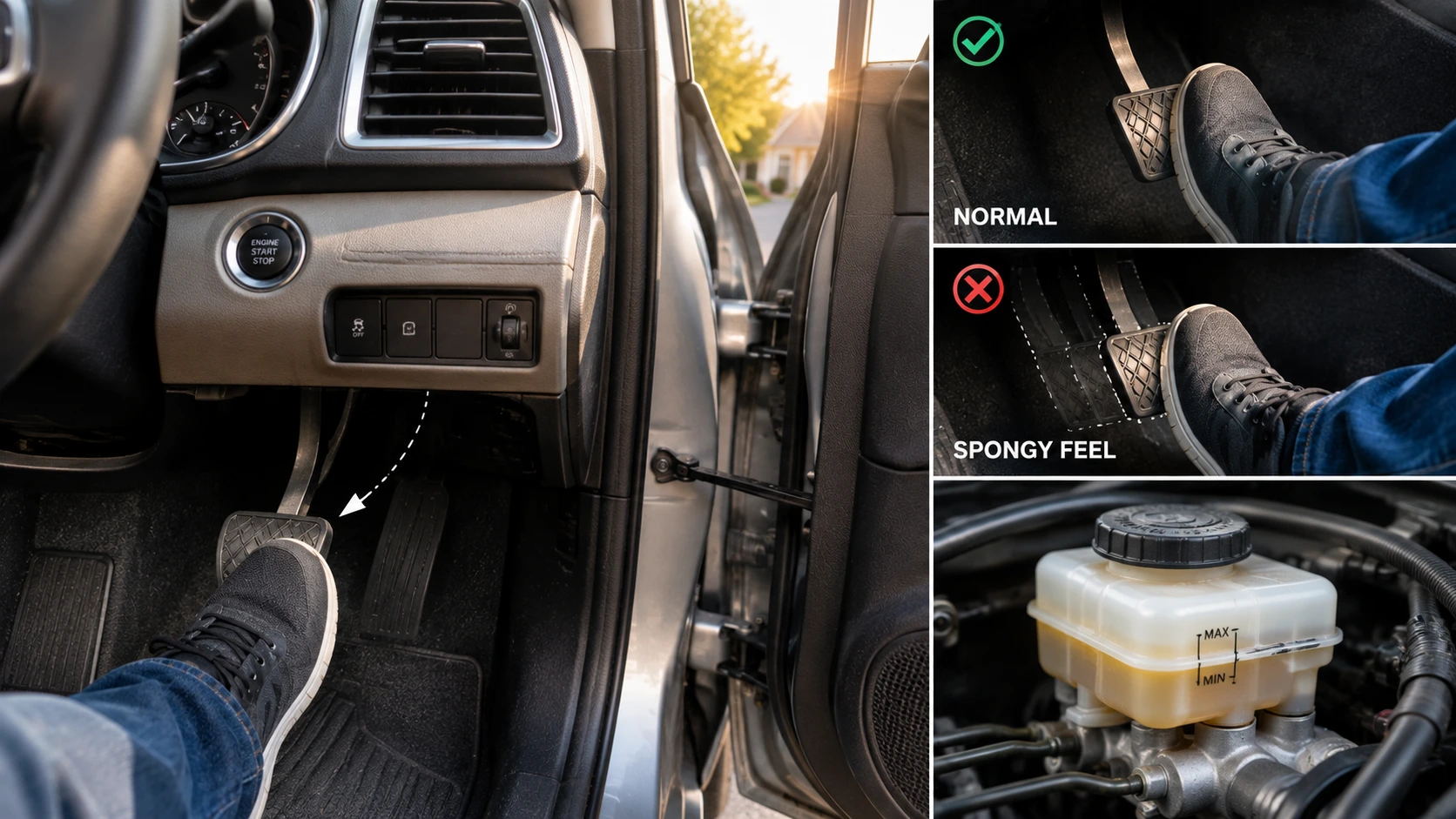
A correctly-functioning hydraulic brake system produces a pedal that begins building firm resistance relatively quickly from the top of its travel. The pedal doesn’t travel more than a third of its total range before braking force is clearly building. The feel is consistent across all temperatures and driving conditions.
Spongy Pedal Presentation
A spongy pedal travels noticeably further than normal before resistance builds. The first portion of pedal travel feels like compressing foam rather than hydraulic resistance. The driver has to press further and sometimes apply more foot pressure to achieve the same braking force. In severe cases, the pedal reaches the floor without full braking force being achieved — this is a brake emergency that requires immediate action.
The Critical Distinction — Pumping Firms the Pedal
A pedal that becomes firm when pumped several times rapidly indicates trapped air in the system or pad knockback — because pumping the pedal repeatedly closes the pad-disc gap and purges small air bubbles. A pedal that remains spongy even after repeated pumping indicates a more serious fault — typically a master cylinder that is bypassing fluid internally.
The Three Most Likely Causes in Dubai
This section covers the key details for this topic.
Brake Fluid Moisture Contamination
When brake pedal feels spongy in morning, brake fluid condition is always the first check — fluid in Dubai should be replaced every 18 months — more frequently than in moderate climates where two-year intervals are appropriate. Dubai’s humidity cycling — cool underground parking overnight, warm and humid daytime conditions in some seasons — accelerates moisture permeation into the brake fluid faster than factory replacement intervals assume. A moisture content above 3% is generally considered the replacement threshold for performance braking.
How to Test Brake Fluid Condition
A digital brake fluid tester — a probe that measures the boiling point of the fluid directly — gives an immediate, accurate reading of moisture content. This test takes under 60 seconds and immediately confirms whether fluid condition is contributing to the morning sponginess. Our car mechanic team runs this test on every spongy pedal complaint as the first diagnostic step.
The Safety Implication of High-Moisture Fluid
Brake fluid with high moisture content has a significantly reduced boiling point. Under heavy braking — emergency stops, descent braking, sustained braking in Dubai’s traffic — this fluid can reach its reduced boiling point and vapourise locally in the caliper. Vapour compresses; fluid doesn’t — and compressed vapour is what produces a suddenly soft pedal under heavy braking at the worst possible moment.
Disc Runout Causing Pad Knockback
Discs with lateral runout — common in Dubai from the heat cycling and stop-hold braking pattern that produces disc warping — push the caliper pistons back slightly with each rotation. After an overnight park, this piston retraction leaves a small gap between pads and disc. The morning spongy pedal is this gap being closed on the first application.
How This Is Distinct From a Fluid Problem
Pad knockback from disc runout produces a spongy pedal that firms immediately after one application — not after multiple applications. The gap is closed with the first brake application, and all subsequent applications are completely normal. This pattern is distinct from fluid moisture, which produces sponginess that may take several applications to resolve.
Master Cylinder Seal Wear
The master cylinder converts pedal force into hydraulic pressure. It has internal seals that prevent fluid from bypassing the piston — if these seals wear, fluid bypasses internally when pressure is applied, reducing the pressure reaching the calipers. A master cylinder with worn seals produces a pedal that sinks gradually when held under constant moderate pressure — the piston is moving forward as fluid bypasses, and the pedal follows.
The Sink Test for Master Cylinder Faults
A master cylinder bypass fault is confirmed by pressing the brake pedal with moderate steady force and holding it. A healthy system maintains pedal position under steady pressure. A master cylinder with internal bypass produces a gradual pedal sink — the pedal slowly travels further toward the floor under constant foot pressure without any increased braking force. This test distinguishes a master cylinder fault from every other cause of spongy pedal.
How Dubai Makes This More Common
Dubai’s conditions specifically accelerate the brake system degradation that causes brake pedal feels spongy in morning in ways that produce the morning spongy pedal fault earlier than factory service intervals assume.
Humidity Cycling Increases Fluid Moisture Absorption Rate
The daily cycle from cool, air-conditioned underground parking to warm outdoor conditions in Dubai’s coastal humidity creates a temperature and humidity cycling that drives atmospheric moisture into brake fluid faster than stable-condition climates. A brake fluid service interval appropriate for Dubai is 18 months rather than 24 months.
Stop-Hold Braking Pattern Accelerates Disc Warping
Dubai’s stop-and-hold braking pattern — hard braking followed by holding the pedal lightly while stationary — is the most effective way to create disc runout. Warped discs produce the pad knockback that creates morning spongy pedal. Both the fluid replacement interval and the disc wear pattern that produces pad knockback are Dubai-specific issues.
Heat Cycling Accelerates Caliper Seal Hardening
Caliper piston seals are the rubber rings that allow pistons to retract slightly when pressure is released. Dubai’s extreme heat hardens these seals faster than in cooler markets — reducing their ability to retract the piston consistently. A piston that doesn’t retract fully produces residual pad contact, and the complex interaction between pad knockback and insufficient retraction produces the spongy morning pedal. For any emergency on the road from a brake system failure, our roadside assistance covers Al Quoz and nearby Dubai areas.
How We Find the Exact Cause
Three tests distinguish the cause of brake pedal feels spongy in morning before any repair is recommended.
Brake Fluid Boiling Point Test
A digital tester confirms actual fluid boiling point and moisture content in under one minute. A reading above 3% moisture immediately identifies fluid replacement as required.
Pedal Behaviour Assessment — Pump Test and Sink Test
Multiple brake applications from a fresh pedal confirm whether firmness returns after pumping — and how many applications it takes. The sink test — steady moderate pressure held for 30 seconds — confirms or rules out master cylinder bypass as a contributing cause.
Disc Runout Measurement
A dial gauge measurement of each front disc confirms lateral runout and identifies whether pad knockback is the specific cause of the morning-first-application sponginess.
Getting It Fixed — The Right Repair for Each Cause
Each confirmed cause has a specific repair matched to it.
Brake Fluid Full Replacement
A complete brake fluid flush — not a top-up — removes all old, moisture-contaminated fluid and replaces it with fresh fluid to the correct specification. The system is bled starting from the caliper furthest from the master cylinder and working toward the closest to ensure all old fluid is removed. Our car service packages include brake fluid moisture testing at every major service visit.
Disc and Pad Replacement for Runout and Knockback
Where disc runout is confirmed causing pad knockback, disc and pad replacement on the affected axle is the repair. New discs without runout eliminate the piston retraction mechanism. The correct pad bedding-in procedure is followed to establish even pad-disc contact from the start.
Master Cylinder Replacement
Where the sink test confirms master cylinder bypass, the master cylinder is replaced with the correctly-specified unit for the vehicle. The brake fluid is replaced as part of the same service — a new master cylinder should not be filled with old, moisture-contaminated fluid. Post-replacement, the pedal sink test is repeated to confirm correct function.
What Happens If This Is Left
Morning spongy pedal is a warning that a brake system component is no longer at full performance.
Fluid Moisture Continues to Increase
Brake fluid that is not replaced continues to absorb moisture with every drive. The morning sponginess that is currently a nuisance becomes a dangerous vapour-lock risk under heavy sustained braking as moisture content increases toward and beyond safe limits.
Master Cylinder Fault Progresses
A master cylinder with beginning internal bypass typically gets worse rather than stabilising. A pedal that sinks a few millimetres in 30 seconds this month may reach the floor in 30 seconds within a year. The point at which a failed master cylinder produces inadequate braking under normal conditions is not predictable — and is not the moment to discover the fault. For exterior repairs alongside brake work, our car painting team handles colour-matched work in the same visit.
When Should You Stop Driving?
Spongy pedal urgency depends on severity and behaviour.
Morning Sponginess That Firms in One Application — Book This Week
This is the early-stage presentation. The vehicle is safe to drive with awareness — ensure the first brake application before full speed is a deliberate, moderate press rather than an emergency stop. Book within the week.
Pedal That Requires Multiple Pumps to Firm — Book Today
Multiple-pump requirement to achieve firm pedal indicates either significant moisture content in the fluid or air in the system. This should be assessed the same day.
Pedal Sinking to Floor or Not Building Adequate Force — Stop Driving
A pedal that sinks toward the floor or fails to build adequate braking force is an emergency — the vehicle should not be driven. This is a master cylinder or major seal failure scenario.
How Long the Repair Takes
This section covers the key details for this topic.
Brake Fluid Replacement
Complete brake fluid flush: typically one to two hours.
Disc and Pad Replacement
Front axle disc and pad replacement: one and a half to two and a half hours.
Master Cylinder Replacement
Master cylinder replacement and brake fluid flush: two to four hours depending on vehicle access.
What the Repair Costs in Dubai
This section covers the key details for this topic.
Brake Fluid Service
Complete brake fluid flush with correct-specification fluid: AED 250–500.
Disc and Pad Replacement
Front axle disc and pad replacement for pad knockback: AED 700–2,500 depending on vehicle.
Master Cylinder Replacement
AED 800–2,500 for the master cylinder unit. Labour for fitting and fluid flush adds AED 400–700 depending on access. A written estimate is provided after the diagnostic tests confirm the specific cause. Our mobile car mechanic covers Al Quoz and nearby Dubai areas for on-site brake fluid testing before driving in.
Preventing Morning Pedal Sponginess
Specific maintenance habits prevent the most common causes from developing.
18-Month Brake Fluid Replacement in Dubai
Replacing brake fluid every 18 months — rather than the standard 24-month interval — maintains moisture content below the threshold that produces morning sponginess and vapour-lock risk. This is a low-cost, high-value preventive measure for Dubai’s humidity cycling conditions.
Correct Braking Habits to Prevent Disc Warping
Releasing the brake pedal fully after stopping — rather than holding light pressure on a hot disc — allows discs to cool evenly and prevents the thermal warping that creates the runout causing pad knockback. This single habit change, consistently applied, significantly reduces the frequency of morning spongy pedal from this cause.
Annual Brake System Inspection Including Caliper Seals
Physical inspection of caliper piston seal condition, guide pin movement, and master cylinder function at every annual service catches developing faults before they produce morning sponginess or more serious brake performance issues. Our garage near me location in Al Quoz serves drivers across Business Bay, Jumeirah, Barsha, Satwa, Downtown, and the Sheikh Zayed Road corridor.
Why Rapid Rev Garage?
Brake pedal feels spongy in morning at Rapid Rev Garage follows a systematic diagnostic protocol. We distinguish between the three causes of morning spongy pedal through specific tests rather than assuming the most likely cause. A brake fluid boiling point test, a pedal pump and sink assessment, and a disc runout measurement together identify the specific cause in under 30 minutes — before any parts are ordered or any system is opened. The repair cost difference between a brake fluid service and a master cylinder replacement is significant — and getting the diagnosis right before starting the repair is what produces the correct outcome.
FAQ — Brake Pedal Feels Spongy in Morning
These are the questions most frequently asked about this fault at our workshop.
Is a spongy brake pedal in the morning dangerous?
Mild morning sponginess that firms in one or two applications is a warning rather than an immediate emergency — but it should be investigated within the week, not ignored. A pedal that requires multiple pumps or sinks under steady pressure is more urgent.
Why does pumping the brakes make the pedal firm?
Pumping closes the pad-disc gap created by pad knockback, and temporarily consolidates small air pockets. If the pedal only firms with pumping and doesn't stay firm under steady pressure, the master cylinder may be bypassing fluid internally.
Can I just add brake fluid to fix a spongy pedal?
No — adding fluid to a low reservoir addresses level but not condition or the underlying cause of the sponginess. If the reservoir is low, there is a leak somewhere in the system that must be found and sealed.
How do I know if my brake fluid needs replacing?
A digital boiling point tester gives an immediate, accurate reading. Fluid that is dark brown or black in colour and has been in the system for more than 18–24 months in Dubai's conditions warrants replacement regardless of the test result.
Is morning spongy pedal more common in Dubai than elsewhere?
Yes — Dubai's humidity cycling, high brake temperatures, and disc warping patterns from the stop-hold braking common here all accelerate the specific conditions that produce morning spongy pedal earlier than in any moderate climate.
Conclusion
A brake pedal feels spongy in morning in Dubai is a specific, diagnosable fault — caused by brake fluid moisture content, disc runout producing pad knockback, or early master cylinder seal wear. The morning-only pattern that resolves with a few applications is not a normal brake characteristic — it is a warning that one of these three conditions is present and needs addressing. Rapid Rev Garage in Al Quoz diagnoses the specific cause through a structured three-test sequence before any repair is recommended.
Rapid Rev Garage is in Al Quoz, serving drivers across nearby Dubai areas — Business Bay, Jumeirah, Downtown, Barsha, Satwa, and the Sheikh Zayed Road corridor. Book your appointment on WhatsApp or find us on Google Maps.
Rapid Rev Garage — Brake Pedal Feels Spongy in Morning | Al Quoz, Dubai