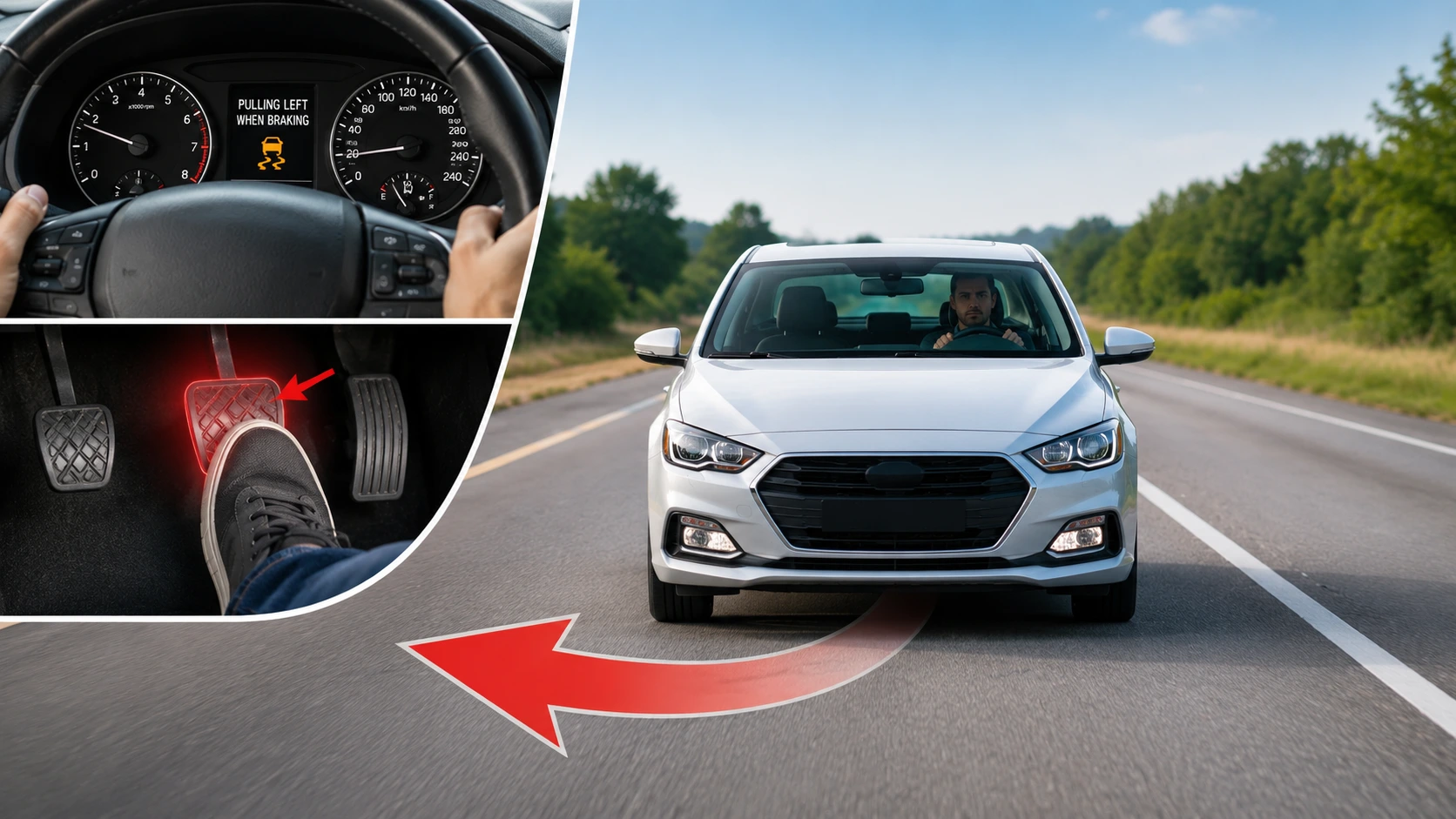
A car pulls left only while braking — steering that tracks straight in normal driving but drifts noticeably to the left the moment the brake pedal is applied — confirms this is a brake system fault, not a steering or alignment fault — the vehicle car pulls left only while braking pattern makes this clear. The distinction matters immediately: alignment and steering issues affect the car at all times, while braking pull is caused by unequal braking force between the left and right side of the same axle. One side is doing more work than the other, and the car follows the stronger side.
At Rapid Rev Garage in Al Quoz, car pulls left only while braking diagnosis follows a specific sequence that identifies the exact side and component producing the unequal force before any brake work begins.
Car Pulls Left Only While Braking — Quick Verdict
A car that pulls left only while braking has asymmetric braking force on the front axle — the right side is braking more effectively than the left, pulling the car toward the left. The most common causes are a seized or sticking left front brake caliper that isn’t fully releasing between stops, a stuck or corroded caliper piston that applies pressure inconsistently, a swollen or collapsed brake hose on one side that restricts fluid flow, or uneven pad and disc condition between sides from unequal wear. Confirming which side is generating less force — not which side the car is pulling toward — is the first diagnostic step.
Table of Contents
- Why Braking Pull Happens and Which Side Is Actually at Fault
- What You Notice When This Fault Is Present
- The Components That Produce Asymmetric Braking
- How Dubai Accelerates This Specific Fault
- How We Confirm the Exact Cause at Rapid Rev Garage
- The Right Fix — Matched to the Confirmed Cause
- What Happens If This Is Ignored
- Is It Safe to Keep Driving?
- How Long the Repair Takes
- What the Repair Costs in Dubai
- Preventing Brake Pull From Developing
- Why Rapid Rev Garage?
- FAQ
- Conclusion
Why Braking Pull Happens and Which Side Is Actually at Fault
The direction of pull in a car pulls left only while braking situation reveals which side is generating less braking force — not which side has the fault.
The Physics of Braking Pull
When the front brakes apply, both sides should generate equal clamping force on the disc. Equal force produces straight-line deceleration. Unequal force — one side generating more braking force than the other — produces a yaw moment that turns the car toward the side with more force.
A Car That Pulls Left Is Braking More on the Right
This is the counterintuitive element of brake pull diagnosis. A car that pulls left only while braking is doing so because the right front brake is generating more force than the left. The car yaws toward the higher-force side. The fault — whichever component is generating less force — is on the left front.
Why This Only Happens Under Braking
Normal driving doesn’t reveal this fault because the asymmetry only exists when brake pressure is applied. With no braking, both sides contribute nothing to lateral force and the car tracks straight. The moment brake pressure is applied, the asymmetry becomes a steering force.
What You Notice When This Fault Is Present
The specific presentation of car pulls left only while braking helps confirm this is a brake fault rather than an alignment or steering issue.
Pull That Appears Immediately With Brake Pressure
The pull appears the moment the brake pedal is pressed — not gradually as speed changes, not on a particular road surface, but consistently correlated with braking. Light braking produces a mild pull; harder braking produces a more pronounced pull. This direct correlation with brake application is the clearest indicator that the fault is in the brake system.
Straight Tracking During Normal Driving
The car tracks straight on a level road with no brake applied. If the car also pulls left during normal driving without braking, there is an additional issue — possibly an alignment or tyre fault — alongside the brake pull. A pure brake pull leaves normal driving unaffected.
Possible Heat or Smell From the Left Front Corner
If the left front caliper is seized in a partially-applied position — applying brake force even when the pedal is released — the left front corner will run significantly hotter than the right, and a burning smell from that corner may be detectable after a drive. This is an advanced stage of the fault and represents a caliper that is no longer releasing correctly between stops.
The Components That Produce Asymmetric Braking
Each of these components, when faulting on one side, produces the car pulls left only while braking pattern described above.
Seized or Sticking Brake Caliper
The front brake caliper has one or more pistons that press the brake pads against the disc when hydraulic pressure is applied. The caliper body slides on guide pins to ensure even pad contact across the disc face. When the caliper body can no longer slide freely — from corrosion, dust accumulation on the guide pins, or a seized slide pin — it applies uneven force across the pad, or fails to release fully after the pedal is released.
The Two Types of Caliper Sticking
A caliper that doesn’t apply enough pressure produces less braking force on that side — the opposite side brakes harder and the car pulls toward it. A caliper that doesn’t release fully after the pedal is released produces excessive friction on that side between stops — this wears the pad and disc on that corner faster, generates heat, and can actually produce a pull toward the sticky caliper side under light braking as the pre-loaded pad contacts the disc before the other side.
Why Dubai Dust Accelerates Guide Pin Seizure
Al Quoz industrial dust accumulates in the caliper guide pin bores faster than in clean-air environments. Guide pins that lose their protective grease from heat cycling and then accumulate dust seize in their bores over time — preventing the caliper body from sliding correctly.
Collapsed or Swollen Brake Hose
Each wheel has a flexible brake hose connecting the rigid metal brake line to the caliper — allowing for suspension movement. A hose that has deteriorated internally develops a partial blockage that acts as a one-way valve — brake fluid pressure can reach the caliper to apply the brakes, but the fluid can’t return freely when the pedal is released. The caliper remains partially applied after braking.
Why This Fault Looks Like Caliper Seizure
A collapsed brake hose produces the same symptoms as a caliper that isn’t releasing — heat from the affected corner, uneven pad and disc wear, and a pull toward that corner when the residual caliper pressure exceeds the other side. The two are distinguished by clamping the flexible hose for a moment and checking whether the caliper releases — if it releases when the hose is clamped, the hose is the fault, not the caliper.
Uneven Pad or Disc Condition
Brake pads on one side that are significantly more worn than the other, or a disc on one side that has developed uneven thickness, produces asymmetric braking force without any caliper fault. This is less immediately concerning than a seized caliper but still produces the braking pull and requires correction with matched pad and disc replacement on both sides of the axle.
Our car mechanic team measures pad thickness and disc runout at all four corners as part of every brake pull diagnosis.
How Dubai Accelerates This Specific Fault
Dubai’s driving conditions create the caliper and brake hose faults that cause car pulls left only while braking at lower mileages than the same vehicles experience in cooler markets.
Heat Cycling Hardens Caliper Seals
Brake caliper piston seals are rubber rings that maintain hydraulic pressure and allow the piston to retract slightly when pressure is released — producing the pad clearance that allows the disc to spin freely. In Dubai’s extreme braking heat combined with ambient temperatures, these rubber seals harden and lose their elastic recovery. A hardened seal doesn’t retract the piston effectively — the piston drags on the disc, generating heat, uneven wear, and eventually the braking pull the driver notices.
Dubai Speed Camera Zones Create Asymmetric Braking Loads
Hard braking for speed cameras in specific locations — Sheikh Zayed Road camera clusters, Al Khail Road speed reduction zones — applies brake force repeatedly in the same pattern. If the braking is consistently harder on one side from a technique or road camber issue at a specific location, it can accelerate wear asymmetry between sides.
Infrequent Car Washing Allows Dust Buildup in Guide Pin Bores
Al Quoz dust accumulating in guide pin bores over extended periods without cleaning or servicing produces gradual guide pin seizure. A vehicle that goes through 20,000+ km between brake system inspections in Dubai may develop significant guide pin seizure that is entirely preventable with lubrication at every service. For any brake-related breakdown, our roadside assistance covers Al Quoz and nearby Dubai areas.
How We Confirm the Exact Cause at Rapid Rev Garage
Car pulls left only while braking diagnosis follows a specific sequence to confirm which component on which side is at fault.
Road Test to Quantify the Pull
The diagnostic road test confirms the pull direction and its severity under progressive brake application. This is done on a straight, level section of road to eliminate camber effects from the observation.
Temperature Check After a Drive
Immediately after the road test, the temperature of each front wheel is measured — either with a contact thermometer or an infrared temperature gun. A significantly hotter left front wheel after normal driving confirms that the left front is dragging — either a sticking caliper, a collapsed hose keeping the pads loaded, or both.
Ramp Inspection — Pad Thickness, Disc Condition, Caliper Slide
With the vehicle raised, pad thickness is measured on all four corners, disc runout and thickness variation are checked, and caliper guide pin movement is assessed by attempting to slide the caliper body by hand. A caliper body that will not move on its guide pins is seized — confirming the caliper as the fault.
Brake Hose Clamping Test
Where the caliper is suspected of not releasing, the flexible brake hose is temporarily clamped and the piston retraction is checked. If the piston retracts with the hose clamped, the hose is confirmed as the fault source — restricting fluid return to the master cylinder.
The Right Fix — Matched to the Confirmed Cause
The repair addresses the confirmed component — not the assumed cause.
Caliper Service — Slide Pin Cleaning and Lubrication
Where guide pin seizure is the fault and the caliper itself is otherwise functional, the guide pins are removed, cleaned, inspected for corrosion damage, and lubricated with the correct high-temperature caliper grease. The caliper slide is confirmed free before any pad or disc work proceeds.
Caliper Replacement
Where the caliper piston seal is confirmed hardened, the piston is not retracting correctly, or corrosion has damaged the guide pin bores beyond recovery, the caliper is replaced. Both front calipers are replaced as a pair when one is confirmed worn — because a new caliper on one side with a borderline caliper on the other produces new asymmetry within months.
Brake Hose Replacement
A confirmed collapsed brake hose is replaced with the correctly-specified flexible hose for the vehicle. Both front hoses are typically replaced as a pair for the same reason as calipers — equal age, equal exposure, similar remaining life.
Pad and Disc Replacement
Uneven pad and disc condition is resolved by replacing both front disc and pad sets — identical specification on both sides to ensure matched friction coefficient and wear rate from the start. Our car service packages include a braking pull road test and corner temperature check at every brake service visit.
What Happens If This Is Ignored
A braking pull that is managed rather than repaired follows a specific and expensive progression.
Pad and Disc Wear Accelerates on the Affected Side
The side producing less force — or the side with a dragging caliper that’s partially applied — wears its pads and disc faster than the opposite side. The asymmetry that was mild initially becomes pronounced as the faster-wearing side’s components deteriorate further.
Caliper Seizure Progresses to Complete Loss of Braking on That Side
A caliper that is beginning to seize will eventually seize completely — providing no braking contribution from that corner. At this point, the braking pull becomes violent rather than noticeable, and the braking distance from the three-corner braking system is significantly increased.
Heat Damage to Disc and Wheel Bearing
A dragging caliper that is partially applied between stops generates sustained heat in the disc and hub. This heat damages the wheel bearing — the races and balls of the bearing are not designed for the temperature a continuously-applied brake generates. Wheel bearing replacement as a consequence of a deferred caliper repair is a significantly higher cost than the original caliper service.
Is It Safe to Keep Driving?
A braking pull is a safety fault that affects emergency stopping capability.
Short-Term Assessment
A mild pull during normal braking does not make the vehicle immediately uncontrollable, but it reduces the effectiveness of emergency stops and adds unpredictability at the moment of maximum braking. The fault should be assessed within the next two to three days.
Do Not Defer
This fault is not one to monitor over several weeks. The consequences of the fault worsening — from mild pull to violent pull or from asymmetric wear to complete caliper failure — all happen faster than most owners expect. For any exterior repairs alongside brake work, our car painting team handles colour-matched work in the same visit.
How Long the Repair Takes
This section covers the key details for this topic.
Guide Pin Service and Lubrication
Typically one to two hours including road test to confirm the pull is resolved.
Caliper and Hose Replacement With Pads and Discs
Two to three hours for front axle complete brake renewal including road test and bedding-in confirmation.
What the Repair Costs in Dubai
This section covers the key details for this topic.
Guide Pin Service
AED 300–600 per axle including lubrication and pad inspection.
Caliper Replacement
AED 800–2,000 per caliper depending on vehicle and whether OEM or equivalent is used. Both front calipers as a pair: AED 1,500–3,500.
Full Front Brake Renewal
AED 1,200–3,500 for discs, pads, and guide pin service — vehicle dependent. Written estimate provided after the diagnostic confirmation before any work begins. Our mobile car mechanic covers Al Quoz and nearby Dubai areas for on-site brake temperature assessment before deciding whether to drive in.
Preventing Brake Pull From Developing
Specific maintenance habits address the causes of braking pull before they develop.
Caliper Guide Pin Service at Every Brake Service
Cleaning and lubricating caliper guide pins at every pad and disc replacement prevents the guide pin seizure that is the most common cause of braking pull in Dubai. This adds minimal time to a brake service and prevents the caliper seizing that follows neglected guide pins.
Annual Brake Hose Inspection
Flexible brake hoses should be visually inspected at every service for cracking, swelling, and discolouration — and replaced at the first sign of deterioration rather than at complete failure. A hose that has collapsed internally shows no external symptom until the pull develops. Our garage near me location in Al Quoz serves drivers across Business Bay, Jumeirah, Barsha, Satwa, Downtown, and the Sheikh Zayed Road corridor.
Why Rapid Rev Garage?
Car pulls left only while braking at Rapid Rev Garage follows a systematic diagnostic protocol. We diagnose brake pull by identifying which side is underperforming rather than assuming the most common cause. The temperature test after a road test, the guide pin slide assessment, and the hose clamping test together identify the specific component before any parts are ordered. An owner who has been told they need a new caliper when the actual fault is a collapsed brake hose — or who has had caliper replacement that didn’t resolve the pull because the hose is the cause — benefits from the correct diagnostic sequence before any repair.
FAQ — Car Pulls Left Only While Braking
These are the questions most frequently asked about this fault.
If my car pulls left while braking, is the fault on the left side?
No — a pull to the left indicates the right side is braking harder. The fault is on the left side, where less braking force is being generated. The car yaws toward the side generating more force.
Can wheel alignment cause braking pull?
Poor alignment affects handling at all times — not specifically under braking. A pull that only appears during brake application and disappears when braking stops is a brake fault, not an alignment fault.
Why does the pull get worse with harder braking?
Harder braking amplifies the asymmetry between sides — both sides produce more force, but the ratio of difference between them remains the same or increases, making the pull more pronounced at higher brake pressures.
Can I adjust the braking to compensate by steering against the pull?
You can compensate, but compensating while driving normally means that in an emergency stop where both hands are managing the vehicle, the pull goes uncontrolled at exactly the worst moment. Address the fault rather than compensating for it.
How do I know if it's the caliper or the brake hose causing the pull?
A temperature check after a drive identifies whether the affected corner is dragging between stops. The brake hose clamping test distinguishes between caliper and hose as the cause of any dragging that is confirmed.
Conclusion
A car pulls left only while braking is a brake system fault — specifically, asymmetric braking force on the front axle — with a small number of identifiable causes. The diagnostic sequence — road test, corner temperature check, ramp inspection, and hose clamping test — confirms which component on which side is at fault before any repair is recommended. Rapid Rev Garage in Al Quoz follows this sequence on every braking pull complaint, producing an accurate repair recommendation rather than a replacement based on assumption.
Rapid Rev Garage is in Al Quoz, serving drivers across nearby Dubai areas — Business Bay, Jumeirah, Downtown, Barsha, Satwa, and the Sheikh Zayed Road corridor. Book your appointment on WhatsApp or find us on Google Maps.
Rapid Rev Garage — Car Pulls Left Only While Braking | Al Quoz, Dubai