The mechanic has just told you the engine has a vacuum leak, or a scan has shown a lean code such as P0171. The next question is the one most guides skip: why does my car have a vacuum leak in the first place? Unless that cause is dealt with, it can create another leak a few months later.
Vacuum leaks do not appear at random. Rubber hardens, gaskets shrink, plastic cracks and seals get pushed out of place, and each of these has a reason behind it. In Dubai, heat in the engine bay, long idling in traffic and constant vibration from speed bumps speed up every one of them.
This guide explains the root causes of engine vacuum leaks, why some cars get them more than others, how a workshop finds the exact cause and what the fix involves. If you want to check whether your car is showing the signs of a leak, the companion guide on the symptoms of an engine vacuum leak covers those in detail.
Why Does My Car Have a Vacuum Leak? Quick Answer
Aged rubber and failed seals are the usual answer when a driver asks, why does my car have a vacuum leak? Heat hardens vacuum hoses and intake boots until they crack, oil vapour softens hoses from the inside, intake manifold gaskets shrink with age, plastic intake parts crack around their fittings, and a blocked PCV system builds pressure that pushes seals out.
Other causes include a torn brake booster diaphragm, an EVAP purge valve stuck open, worn engine mounts that stretch hoses and clamps left loose after earlier work. A workshop confirms the cause with fuel trim readings and a smoke test, then replaces the failed part.
Table of Contents
- How Engine Vacuum Works and Why a Leak Matters
- Heat Hardens Rubber Hoses and Intake Boots
- Ozone and Age Crack Rubber at the Bends
- Oil Vapour Softens Hoses From the Inside
- A Blocked PCV System Pushes Seals and Gaskets Out
- Intake Manifold Gaskets Shrink and Leak
- Plastic Intake Parts Crack Around Their Fittings
- Worn Engine Mounts Stretch and Split Hoses
- Torn Brake Booster Diaphragms and Check Valves
- An EVAP Purge Valve Stuck Open
- Loose Clamps and Hoses After Earlier Repairs
- Why Dubai Driving Causes More Vacuum Leaks
- Which Cars Get Vacuum Leaks Most Often
- How to Tell If Your Car Has a Vacuum Leak
- How a Workshop Finds the Root Cause
- What Fixing Each Cause Involves
- Can a Vacuum Leak Fix Itself?
- Do Turbocharged Engines Get Vacuum Leaks?
- How to Stop Vacuum Leaks Coming Back
- FAQ
- Conclusion
How Engine Vacuum Works and Why a Leak Matters
A petrol engine creates suction in its intake manifold as the pistons move down. That suction, called vacuum, is strongest at idle when the throttle is nearly closed. It also powers the brake booster, draws gases through the PCV system and pulls fuel vapour from the EVAP system.
The engine computer, or ECU, measures incoming air with the mass airflow sensor and adds the right amount of fuel. Any opening after that sensor lets in air that was never measured. The mixture ends up with too much air, which is called running lean.
Because vacuum is highest at idle, even a small crack matters most when the car is stopped. That is why most vacuum leaks show up first as a rough idle at the lights, then later as hesitation and lean fault codes.
Heat Hardens Rubber Hoses and Intake Boots
Heat is the most common root cause. Gates, one of the largest hose makers, explains that engine heat leaves hoses with a hardened, cracked outer cover. Once rubber hardens, it can no longer flex with the engine, and vibration opens small splits.
Vacuum hoses sit close to the engine, so they see far higher temperatures than the outside air. Intake boots, the large rubber tubes between the airflow sensor and the throttle body, suffer the same way. Their folds crack first, often on the underside where they are hard to see.
On a summer afternoon when the air passes 45°C, an engine idling in traffic on Sheikh Zayed Road gets very little cooling airflow. Each of those heat cycles takes some flexibility out of the rubber, so a hose that lasts many years in a cool climate may crack much sooner in the UAE.
Ozone and Age Crack Rubber at the Bends
Rubber also breaks down with age and exposure to ozone in the air. Gates notes that ozone attacks the bonds in certain rubber compounds and leaves tiny parallel cracks in the hose cover, usually where the hose bends.
Bends are where vacuum hoses are most likely to fail, because the rubber is already stretched there. Small surface cracks grow deeper over time until air can pass through. Hoses near electrical parts that produce ozone, such as ignition coils, can age faster.
A hose that looks fine at a glance may show these fine cracks when it is bent gently in good light. That simple check at every service catches many leaks before they cause symptoms.
Oil Vapour Softens Hoses From the Inside
Some vacuum leaks start from inside the hose. Gates explains that oil reacts with hose compounds and weakens their bonds, leaving the hose soft, spongy or swollen until its layers start to separate.
The PCV hoses and any vacuum lines connected to the intake manifold carry oil mist from the crankcase. Over time, that mist soaks into rubber not designed to handle it. A soft hose collapses under vacuum or splits at the end where it slides onto a fitting.
Oil from a leaking valve cover gasket can also drip onto hoses below it. Fixing the oil leak protects the hoses as well as the engine, and the guide on symptoms of a bad PCV valve explains how a PCV fault speeds up this problem.
A Blocked PCV System Pushes Seals and Gaskets Out
A blocked or stuck PCV valve is one of the most overlooked causes of vacuum leaks. The PCV system uses engine vacuum to draw blow by gases out of the crankcase. When it blocks, pressure builds inside the engine instead.
Brake and Front End magazine explains that a failing PCV system can cause ruptured gaskets and seals, oil in the air cleaner and rough idle, and that building pressure can burn up the crankshaft seals. Pressure pushing on gaskets and hoses can force them out of place and create new leak paths.
A PCV valve stuck open causes the opposite problem. It acts as a vacuum leak itself, letting too much air into the intake. NAPA lists a rough or unusually high idle and a whistling or hissing sound among the signs of a PCV valve stuck open.
Intake Manifold Gaskets Shrink and Leak
The intake manifold gasket seals the joint between the manifold and the cylinder head. Many modern engines use rubber or silicone O ring style gaskets in place of the older paper or composite types. Rick’s Free Auto Repair Advice notes that rubber O ring gaskets are prone to shrinking.
As the gasket shrinks or hardens, it no longer fills the gap, and air leaks into one or more cylinders. These leaks are often worse when the engine is cold, because the metal and plastic parts have not yet expanded to close the gap.
A leaking intake gasket often causes a misfire on the cylinder nearest the leak, along with lean codes. Repair means removing the manifold, which an engine repair specialist can do in a few hours on most four cylinder engines.
Plastic Intake Parts Crack Around Their Fittings
Many modern engines use plastic intake manifolds, plastic hose fittings and plastic vacuum lines. Plastic is light and cheap to make, but repeated heat cycles make it brittle. Cracks usually start at mounting points, around bolt holes and where small hose fittings join the manifold.
A small plastic fitting can snap off when a mechanic moves a hose during an unrelated job, or simply crack after years of heat and vibration. Plastic vacuum lines also become brittle and break when bent.
Cracked plastic manifolds usually need replacing rather than repairing, because glues and sealants rarely hold under heat and vacuum. A smoke test shows whether the crack is in the manifold itself or in a fitting that can be replaced on its own.
Worn Engine Mounts Stretch and Split Hoses
Engine mounts hold the engine in place and absorb its vibration. When a mount wears out, the engine rocks further every time you pull away, brake or drive over a speed bump. Vacuum hoses and intake boots connected to the body or the air box get stretched with each movement.
Over months, that repeated stretching splits hoses at their ends and pulls intake boots partly off their clamps. A clunk when shifting into drive or reverse, or more vibration at idle, often points to a worn mount.
Replacing the leaking hose without fixing the mount means the new hose will split again. A good diagnosis checks the mounts whenever a hose or boot has torn rather than cracked.
Torn Brake Booster Diaphragms and Check Valves
The brake booster uses engine vacuum to make braking easier. Inside it, a rubber diaphragm separates two chambers. Rick’s Free Auto Repair Advice lists a torn brake booster diaphragm among the causes of lean codes, because the tear lets air pass straight into the intake.
The booster hose has a one way check valve that can also fail. A leak here often shows as a hiss from under the dashboard when you press the brake, a harder pedal and an idle that dips each time you brake. Because it affects braking, a brake system check should be done straight away.
Booster diaphragms age like any other rubber part, and heat speeds up the process. Replacing the booster fixes both the vacuum leak and the brake feel.
An EVAP Purge Valve Stuck Open
The EVAP system stores fuel vapour from the tank in a charcoal canister, then the purge valve lets that vapour into the intake to be burned. The purge valve should only open at certain times. If it sticks open, it lets air and vapour into the intake all the time, which acts like a vacuum leak.
A stuck purge valve often causes a rough idle, and some cars become hard to start just after refuelling, because the open valve draws extra vapour into the engine. EVAP fault codes may appear alongside lean codes.
Purge valves are electrically controlled and can be tested with a scan tool and a vacuum pump. On many cars, the valve is a small part mounted on the engine and is quick to replace.
Loose Clamps and Hoses After Earlier Repairs
Some vacuum leaks are caused by earlier work on the car. An intake boot that is not pushed fully onto the throttle body, a clamp left loose or a small vacuum hose knocked off during a repair can all let air in.
This often shows up straight after a service, especially after an air filter change, when the air box lid and intake boot are moved. If the idle turns rough within days of any engine bay work, ask the workshop to check every connection it touched.
Worm drive and spring clamps also lose tension as rubber hardens beneath them. A clamp that held tight when new may leave a small gap after a few years of heat cycles.
Why Dubai Driving Causes More Vacuum Leaks
Dubai combines several conditions that speed up rubber and plastic ageing. Stop and start traffic on Al Khail Road and Sheikh Zayed Road keeps engines idling for long periods with little cooling airflow and the AC compressor adding load.
Cars parked in underground car parks at places like Dubai Mall or office towers in Business Bay go from cool basements to hot roads several times a day. That constant expanding and shrinking loosens joints and cracks hard rubber.
Speed bumps every 200 to 400 metres on residential streets shake the engine on its mounts, which stresses hoses at their ends. Fine silica dust from Al Quoz industrial roads and construction sites works its way into loose joints and wears sealing surfaces.
Which Cars Get Vacuum Leaks Most Often
Age and mileage matter most. Cars older than about seven to ten years, or with high mileage, usually still have their original hoses, gaskets and boots, and those parts are reaching the end of their life in UAE conditions.
Engines with many small vacuum lines, such as older V6 and V8 engines, have more places to leak. Engines with plastic intake manifolds and plastic fittings are prone to cracks. Cars driven mainly on short trips also build more moisture and sludge in the crankcase, which strains the PCV system.
Cars that have had a lot of engine bay work are at higher risk of a hose left loose or damaged. A full service history helps a mechanic know which parts have already been replaced.
How to Tell If Your Car Has a Vacuum Leak
The common signs are a rough or high idle, a hissing sound from the engine, a check engine light with lean codes P0171 or P0174, hesitation when accelerating, stalling when you stop and a hard brake pedal. Samarins lists rough idle, hissing, lack of power and stalling when stopped among the signs of a lean engine.
Fuel use often rises too, because the ECU keeps adding fuel to correct the extra air. Some leaks only show when the engine is cold, which points to a shrinking gasket. The full guide on the symptoms of an engine vacuum leak explains each sign and what it means.
How a Workshop Finds the Root Cause
A proper diagnosis looks for the cause as well as the leak. The mechanic starts with an OBD2 scan to read stored codes, then watches live fuel trims with the engine warm. Samarins explains that short term fuel trim above plus 15 to 20 percent at idle that drops at higher rpm points to a vacuum leak.
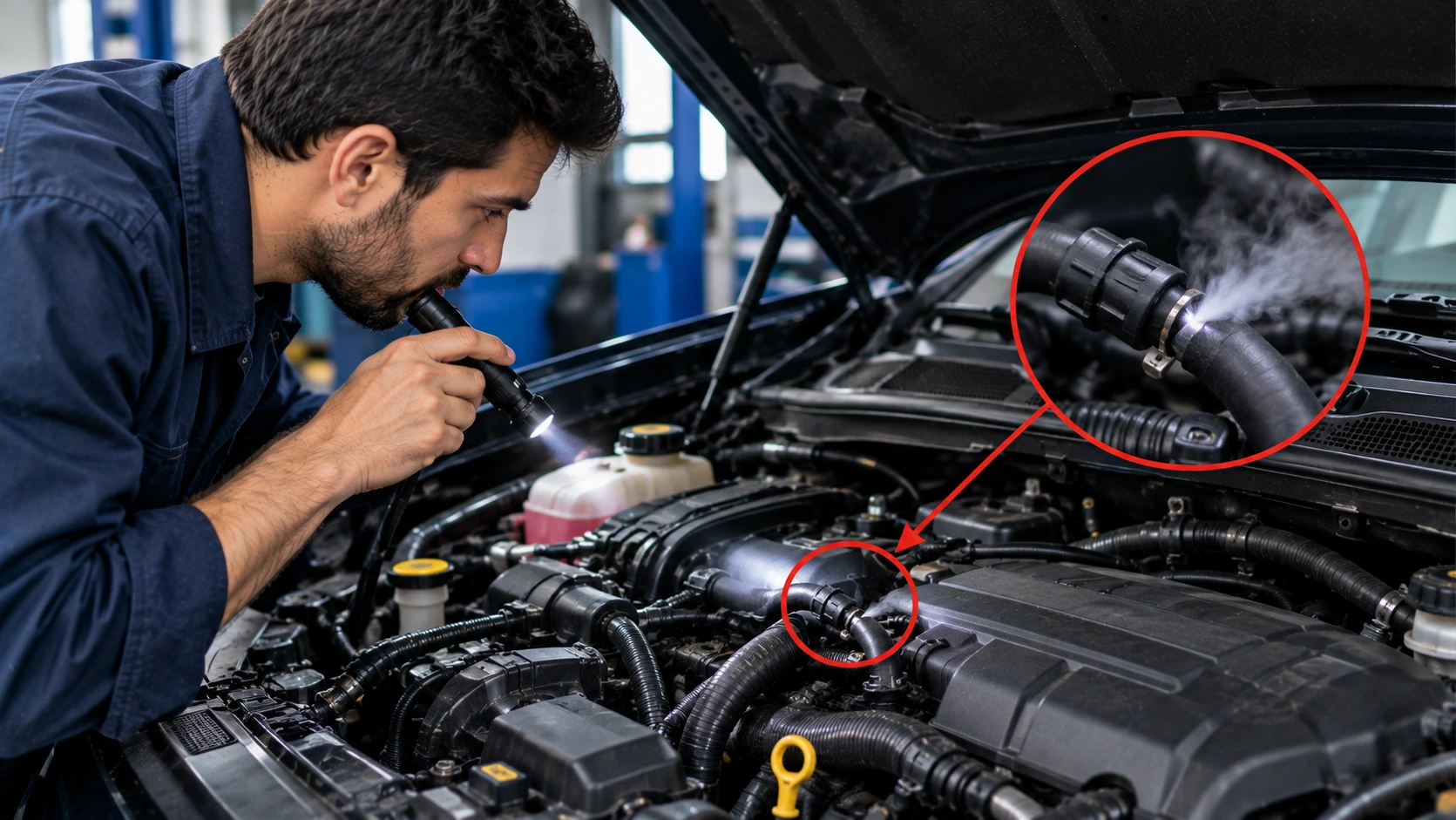
The next step is a smoke test. A machine fills the intake with harmless visible vapour at low pressure while the engine is off, and the smoke escapes from the exact spot that is leaking. Brake and Front End magazine advises using no more than 5 psi of pressure for this kind of test, so gaskets are not damaged.
Once the leak is found, the mechanic checks why it happened. That means looking at the PCV valve, the engine mounts, oil leaks onto hoses and the condition of nearby rubber. Book the test with an experienced car mechanic near you so both the leak and its cause are fixed in one visit.
What Fixing Each Cause Involves
The repair matches the cause. Hard or cracked vacuum hoses are replaced with new hose of the right type, and a split intake boot is replaced as a complete part. A soft, oil soaked hose needs replacing along with a check of the PCV valve or the oil leak that ruined it.
A blocked or stuck PCV valve is replaced, and its hoses are checked and cleared. A shrunk intake manifold gasket needs the manifold removed and a new gasket fitted. A cracked plastic manifold is usually replaced as a unit.
A torn brake booster diaphragm means a new booster. A stuck purge valve is replaced and tested. Worn engine mounts are replaced so the new hoses are not stretched again. After any repair, the mechanic clears the codes, confirms that fuel trims return close to zero and road tests the car.
Can a Vacuum Leak Fix Itself?
No. A crack in rubber or plastic does not close up on its own. Some leaks seem to come and go, which leads drivers to think the problem has gone away.
A shrinking intake gasket may leak when the engine is cold and seal once it warms up. A hose may only open its crack when the engine rocks under load. A purge valve may stick open only some of the time. In each case, the leak is still there and usually gets worse.
Ignoring a leak lets the engine run lean for longer, which can cause knock, misfires and extra heat in the catalytic converter. Fixing a hose early costs far less than replacing a damaged converter later.
Do Turbocharged Engines Get Vacuum Leaks?
Yes, and they can also get boost leaks. At idle and low load, a turbo engine’s intake runs under vacuum, so a cracked hose behaves like a normal vacuum leak. Under boost, the same intake runs under pressure, and a split hose or loose coupler blows air out instead.
A boost leak causes loss of power, a whooshing sound when accelerating and sometimes lean or underboost codes. Turbo engines have more hoses, couplers and intercooler pipes, so there are more places to leak.
Smoke testing works for both vacuum and boost leaks. For boost leaks, some workshops also pressure test the intake system with the engine off to find splits that only open under pressure.
How to Stop Vacuum Leaks Coming Back
Fixing the root cause is the best prevention. Replace the PCV valve if it is blocked, fix oil leaks that drip onto hoses and replace worn engine mounts. Ask for the hoses, intake boot and PCV system to be checked at every service once the car is more than five years old.
Use the right parts. Vacuum hose and fuel hose are made for different jobs, and a hose made for the wrong job fails early. Make sure clamps are tightened properly after any work on the intake or air filter.
If you test for leaks yourself by spraying carb cleaner, keep it well away from hot exhaust parts, and keep it off the bodywork. Solvents can dull or strip paint and leave damage that needs paint and panel repair. A regular car service in Dubai includes these hose and seal checks along with oil, filters and fluids.
When to Get Help Straight Away
If a vacuum leak makes the car stall in traffic or the brake pedal goes hard, do not keep driving. If it stalls on a highway, do not stop in a live lane. Stopping in the middle of the road because of a breakdown brings a AED 1,000 fine and six black points under Article 98 of the UAE Federal Traffic Law. Get to the hard shoulder and call roadside assistance.
If the car is parked and still drives safely, a mobile mechanic can read the codes and fuel trims at your home or office. For the smoke test and the repair, choose a car garage near you that confirms the cause before replacing parts.
FAQ
Here are the questions Dubai drivers most often ask about why vacuum leaks happen.
What is the most common vacuum leak cause?
Cracked or hardened rubber is the most common cause, especially vacuum hoses and the intake boot between the airflow sensor and the throttle body. Heat, age and oil vapour all break down rubber. A failed PCV valve and shrunk intake gaskets are also common.
Can a bad PCV valve cause vacuum leaks?
Yes. A PCV valve stuck open acts as a vacuum leak and can cause a rough or high idle. A blocked valve builds crankcase pressure that can push out seals and gaskets, creating new leak paths. Testing the PCV valve is part of any vacuum leak diagnosis.
Why does my car keep getting vacuum leaks?
Repeated leaks usually mean the root cause was not fixed. Common reasons are a blocked PCV system, oil dripping onto hoses, worn engine mounts stretching the hoses, or the wrong type of hose being fitted. Ask the workshop to check these after each repair.
Does heat cause vacuum leaks in cars?
Yes. Gates notes that engine heat hardens and cracks the outer cover of rubber hoses. In Dubai, long idling in traffic and high engine bay temperatures make hoses and intake boots crack sooner than in cooler climates.
How long do vacuum hoses usually last?
There is no fixed interval, because heat, oil exposure and engine movement decide their life. In UAE conditions, hoses on cars older than about seven to ten years are often hard and cracked. Have them inspected at every service once the car passes five years old.
Conclusion
A vacuum leak always has a cause. Heat, ozone and age harden rubber, oil vapour softens it, gaskets shrink, plastic cracks and a blocked PCV valve pushes seals out. Worn engine mounts, torn brake boosters, stuck purge valves and loose clamps after earlier work add to the list. Fixing the cause as well as the leak stops it coming back.
Rapid Rev Garage is a full workshop open 24 hours at Al Khail Gate, 12th Street, Al Quoz Industrial Area 2, serving passenger cars across Al Quoz, Business Bay, Jumeirah, Al Barsha, Satwa, Downtown and the Sheikh Zayed Road corridor. Visit https://rapidrevgarage.com, send your car model and symptoms on WhatsApp, or get directions on Google Maps.
Rapid Rev Garage | Car Have a Vacuum Leak | Al Quoz, Dubai