Your engine is using more oil between services, a new leak has appeared around the crankshaft seal, and the idle feels rough at the lights on Al Khail Road. Most drivers would never connect these problems to a small valve that costs little to replace. Yet the symptoms of a bad PCV valve often show up as oil leaks, oil burning and rough running long before anyone checks the valve itself.
The PCV valve controls how crankcase gases leave the engine. When it sticks open, the engine runs lean like it has a vacuum leak. When it sticks closed, pressure builds inside the engine and pushes oil out through seals and gaskets.
This guide explains what the PCV valve does, the signs it is failing, why Dubai conditions wear it out faster, how to test it and what replacement involves. It also covers engines where the valve is built into the valve cover, which changes the repair.
Symptoms of a Bad PCV Valve: Quick Answer
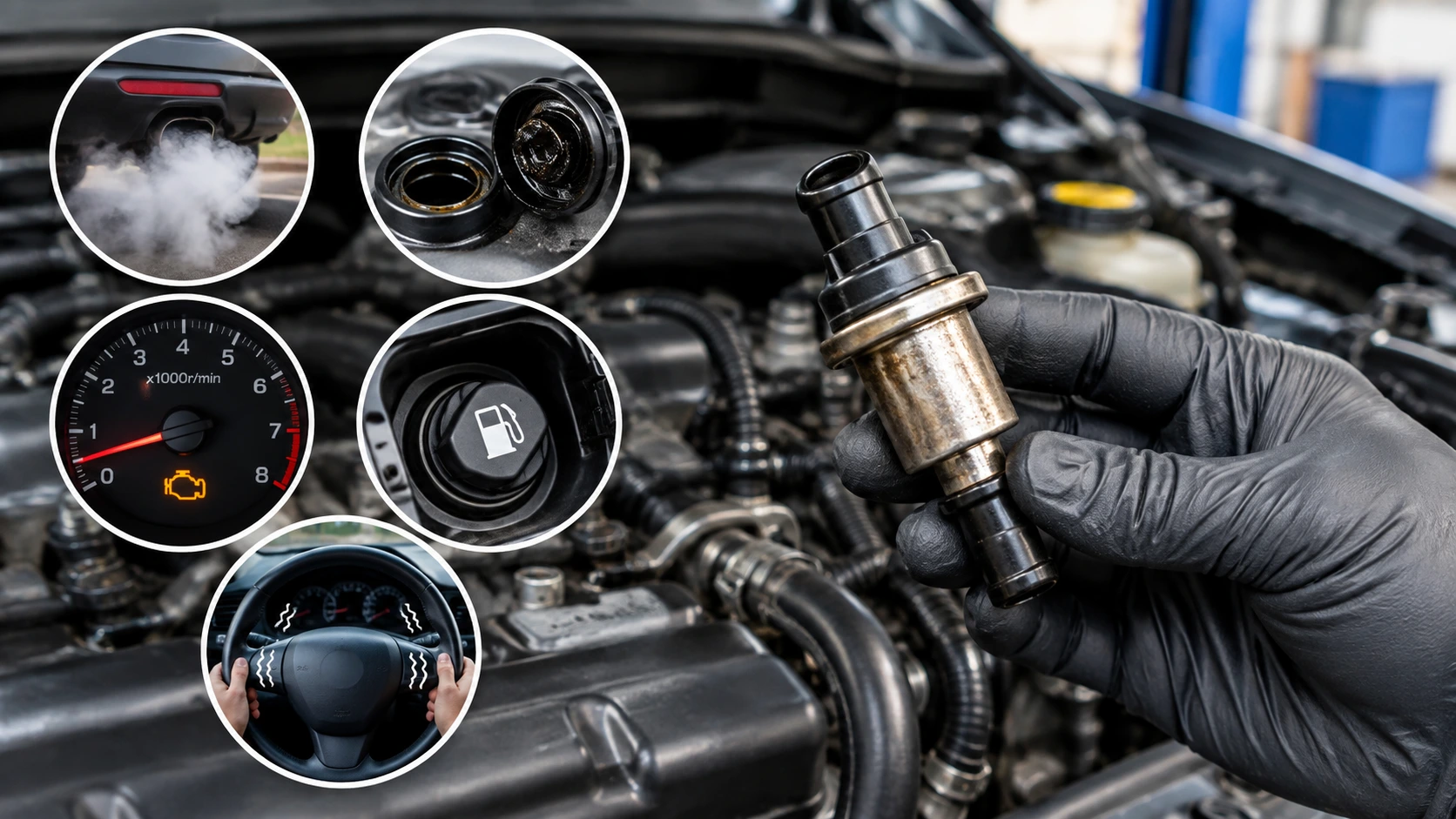
The main symptoms of a bad PCV valve are a rough or high idle, a whistling or hissing sound from the engine, oil leaks from seals and gaskets, higher oil use, blue smoke from the exhaust, oil in the air filter housing, sludge in the oil and a check engine light with lean codes.
A valve stuck open acts like a vacuum leak and causes rough idle and lean codes. A valve stuck closed builds crankcase pressure that pushes oil past seals and into the intake. A simple oil filler cap test, a vacuum reading and a smoke test confirm the fault.
Table of Contents
- What the PCV Valve Does in Your Engine
- Why PCV Valves Fail Faster in Dubai
- Stuck Open or Stuck Closed: Two Sets of Symptoms
- Rough or High Idle and Lean Fault Codes
- Whistling, Hissing or Howling From the Engine
- New Oil Leaks From Seals and Gaskets
- Higher Oil Use and Blue Exhaust Smoke
- Oil in the Air Filter Housing or Intake
- Sludge and Contaminated Engine Oil
- Fault Codes Linked to the PCV System
- Engines With the PCV Valve Built Into the Valve Cover
- How to Test a PCV Valve
- What PCV Valve Replacement Involves
- Can a Bad PCV Valve Damage Your Engine?
- How Often Should a PCV Valve Be Replaced?
- Is It Safe to Drive With a Bad PCV Valve?
- How to Keep the PCV System Healthy
- FAQ
- Conclusion
What the PCV Valve Does in Your Engine
PCV stands for positive crankcase ventilation. Every engine leaks a small amount of combustion gas past the piston rings into the crankcase, and these are called blow by gases. They carry moisture, unburned fuel and acids that would ruin the oil if left inside.
NAPA describes the PCV valve as a one way valve that routes these gases back into the engine’s intake, where they are burned along with the normal air and fuel mixture. Brake and Front End magazine explains that the system uses manifold vacuum to draw the vapours out of the crankcase.
The valve controls how much gas flows at different engine speeds. It keeps the crankcase under a slight vacuum, which helps keep oil inside the engine and stops seals from being pushed outward.
Why PCV Valves Fail Faster in Dubai
The PCV valve sits in the path of oil mist, moisture and carbon, so it slowly clogs with sludge and varnish. Several Dubai conditions speed this up.
Short trips are one cause. A car that only drives a few kilometres between home and an office in Business Bay may never fully warm up, so moisture and fuel collect in the crankcase. That mixture turns into sludge that blocks the valve and its hoses.
Heat is another. Long idling in stop and start traffic on Sheikh Zayed Road and high engine bay temperatures bake oil deposits onto the valve and harden its rubber parts. On a summer afternoon when the air passes 45°C, engine bay temperatures climb much higher. Old or overdue oil makes all of this worse, because it carries more sludge into the system.
Stuck Open or Stuck Closed: Two Sets of Symptoms
A PCV valve can fail in two ways, and each one causes different problems. Knowing which one you have helps explain the symptoms.
A valve stuck open lets too much air flow from the crankcase into the intake. That extra air was never measured by the airflow sensor, so the engine runs lean, much like a vacuum leak. NAPA lists a rough or unusually high idle and a whistling or hissing sound as signs of a stuck open valve.
A valve stuck closed stops gases leaving the crankcase. Pressure builds inside the engine and has to escape somewhere. NAPA notes that a valve stuck closed can cause higher oil use or an oil leak, because the pressure pushes oil past seals, gaskets and piston rings.
Rough or High Idle and Lean Fault Codes
A rough or high idle is one of the most common signs of a PCV valve stuck open. The engine shakes at idle, the rpm needle may sit higher than normal or wander up and down, and the car may stall when you slow to a stop.
Because a stuck open valve adds unmeasured air, the check engine light may come on with lean codes such as P0171 or P0174. Samarins lists a stuck open or defective PCV valve and a ripped PCV hose among the common sources of these codes.
The same symptoms can come from other vacuum leaks, a dirty airflow sensor or a dirty throttle body. The guide on the symptoms of an engine vacuum leak explains how to tell them apart.
Whistling, Hissing or Howling From the Engine
A whistle, hiss or howl from the top of the engine at idle often points to the PCV system. NAPA notes that a whistling or hissing sound can come from a cracked hose or a stuck open valve.
On many engines, especially European designs with the PCV valve built into the valve cover, a torn rubber diaphragm inside the valve makes a loud whistle or howl. The sound often changes when you remove the oil filler cap, because that changes the pressure inside the crankcase.
Never put your hands near the drive belts or the cooling fan while listening for the noise. The fan can start without warning even with the engine idling.
New Oil Leaks From Seals and Gaskets
New oil leaks are one of the most expensive symptoms of a blocked PCV valve. When gases cannot leave the crankcase, pressure pushes oil out through the weakest points.
Brake and Front End magazine lists ruptured gaskets and seals among the results of a failing PCV system. It explains that when the system builds pressure, it can burn up the crankshaft seals, because the seal lips no longer get proper lubrication. The valve cover gasket, the sump gasket and the front and rear crankshaft seals are the usual leak points.
Replacing those seals without fixing the PCV valve means they will leak again. An engine repair specialist should check the PCV system before replacing any crankshaft seal. Oil mist pushed out of breathers and seals can also coat the engine bay and the underside of the bonnet, and grime baked onto painted surfaces in the sun can stain them and lead to paint and panel repair.
Higher Oil Use and Blue Exhaust Smoke
An engine that needs more oil between services can have a PCV fault. NAPA lists increased oil use as a sign of a valve stuck closed, and notes that blue smoke from the exhaust can appear when oil enters the intake.
Crankcase pressure pushes oil mist into the intake, where it is burned with the fuel. Brake and Front End magazine also links a failing PCV system to oil use without visible smoke, fouled spark plugs and sticking oil rings.
Blue smoke is most visible on startup or when accelerating after idling. If you have to top up oil between services, check the PCV system before assuming the piston rings or valve stem seals are worn.
Oil in the Air Filter Housing or Intake
Oil in the air filter housing is a clear sign of crankcase pressure. When the PCV valve blocks, pressure pushes oil mist backwards through the fresh air breather hose into the air box. The air filter becomes oil soaked, and oil may pool at the bottom of the housing.
Brake and Front End magazine lists oil in the air cleaner among the symptoms of a failing PCV system. On turbo engines, more oil than usual in the intercooler pipes can also point to the PCV system.
An oil soaked filter restricts airflow and can contaminate the airflow sensor, which causes its own running problems. A filter change fixes the filter, but the PCV fault must be fixed too or the new filter will soak again.
Sludge and Contaminated Engine Oil
A blocked PCV system traps moisture and acids in the crankcase. Brake and Front End magazine explains that a malfunctioning PCV system will quickly contaminate the engine oil, and heavy sludge will begin to form, because blow by gases contain water and acids.
Sludge looks like a thick, dark or creamy deposit under the oil filler cap and on the dipstick. It blocks oil passages and the oil pump pickup, which can lower oil pressure. The guide on why oil pressure falls at idle covers that link in more detail.
Regular oil changes at the severe conditions interval in your service book reduce sludge. DubiCars lists change intervals of about 5,000 km for conventional oil and 10,000 to 15,000 km for full synthetic in UAE conditions.
Fault Codes Linked to the PCV System
A PCV fault can set several codes. The most common are lean codes P0171 and P0174, which mean the engine is getting more air than the ECU measured. A stuck open valve or a split PCV hose is a frequent cause.
Some engines monitor the PCV system directly. Code P052E is defined as a PCV regulator valve performance fault and is common on engines with the valve built into the valve cover, including many Volkswagen and Audi models. Misfire codes can also appear if the lean mixture affects one cylinder more than the others.
A code points to a circuit or system, not a part. Testing confirms whether the PCV valve or another leak is at fault before anything is replaced.
Engines With the PCV Valve Built Into the Valve Cover
On older engines, the PCV valve is a small part pushed into a rubber grommet on the valve cover, and replacing it takes minutes. Many modern engines are different. Brands such as Volkswagen, Audi, BMW and Mercedes Benz often build the PCV valve and its oil separator into the valve cover or a separate housing.
On these engines, the PCV valve usually fails through a torn rubber diaphragm. The fix is often a complete valve cover with the PCV built in, or a separate separator unit, rather than a single small valve. That makes the part and the labour more expensive than on older designs.
Some aftermarket repair kits replace just the diaphragm on certain valve covers. A mechanic can tell you whether your engine has a kit available or needs the full cover.
How to Test a PCV Valve
Several simple tests point to a PCV fault. NAPA describes a quick check: with the engine idling, remove the oil filler cap and hold a piece of paper over the opening. If the paper is gently pulled down, the system is working. If it is pushed away, crankcase pressure is too high and the valve may be blocked or stuck closed.
On engines with a removable valve, a mechanic can take it out and shake it. A working valve usually rattles, while a stuck one stays silent. A rattle alone does not prove it works properly, so it is only a first check.
Workshops use more accurate tests. Brake and Front End magazine notes that a normal system should read about 1 to 3 inches of vacuum at the crankcase at idle. A smoke test shows leaks in the PCV hoses, and a scan tool shows fuel trims and any PCV codes. Book these tests with an experienced car mechanic near you before replacing parts.
What PCV Valve Replacement Involves
On engines with a separate valve, the job means removing the old valve from its grommet, fitting a new one and replacing any hard or oil soaked hoses. It is one of the quickest jobs in the engine bay on many older cars.
On engines with the valve built into the valve cover, the cover comes off, a new cover or separator is fitted and a new gasket is used. This can take a few hours, depending on how many parts sit on top of the engine.
After replacement, the mechanic clears any codes, checks fuel trims and crankcase vacuum, and looks for oil leaks that the old valve may have caused. If seals were pushed out by pressure, they are replaced at the same time so the leak does not return.
Can a Bad PCV Valve Damage Your Engine?
Yes, if it is left for a long time. Brake and Front End magazine lists rapid or premature engine wear, plugged and sticking oil rings, ruptured gaskets and seals, fouled spark plugs and potential detonation among the results of a failing PCV system.
Sludge from a blocked system can starve the engine of oil by clogging the pickup screen and oil passages. Pressure can push out crankshaft seals, which may need the gearbox removed to replace the rear seal on some cars. A valve stuck open can make the engine run lean enough to knock.
Each of these costs far more than the valve itself. Testing the PCV system when you first notice rough idle, oil use or new leaks avoids much bigger repairs later.
How Often Should a PCV Valve Be Replaced?
There is no single interval for every car. Some manufacturers list a PCV inspection in their service schedule, while others only replace it when it fails. Check your owner’s manual for your engine.
In Dubai conditions, short trips, heat and long idling clog the valve sooner. A good rule is to have the PCV valve and hoses checked at every major service once the car passes five years or about 100,000 km. Replacing a cheap valve during a service is far easier than dealing with the leaks it can cause.
Is It Safe to Drive With a Bad PCV Valve?
For short distances, usually yes, but it should be fixed soon. A failing PCV valve rarely leaves you stranded straight away, but it keeps damaging seals, oil and spark plugs while you drive.
Some symptoms need faster action. Heavy blue smoke, oil pouring from a seal, a car that stalls in traffic or a flashing check engine light mean the car should be checked before you drive far. If the car stalls on a highway, get to the hard shoulder rather than stopping in a live lane, which brings a AED 1,000 fine and six black points under Article 98 of the UAE Federal Traffic Law. Then call roadside assistance.
If the car still drives normally, a mobile mechanic can do the oil cap test, check the hoses and read codes at your home or office.
How to Keep the PCV System Healthy
Fresh oil is the best protection for the PCV valve. Change the oil and filter at the severe conditions interval in your service book, because heat, dust and stop and start traffic count as severe in most manufacturer schedules.
Drive the car long enough to reach full temperature at least once or twice a week, which burns off moisture in the crankcase. Have the PCV valve and hoses checked at major services, and replace hoses that feel hard, soft or swollen.
A regular car service in Dubai covers oil, filters and a check of the PCV hoses and seals. If you already have oil leaks, rough idle or oil in the air box, choose a car garage near you that tests the PCV system before replacing seals.
FAQ
Here are the questions Dubai drivers most often ask about PCV valves.
What does a bad PCV valve do?
A valve stuck open lets extra air into the intake, causing rough or high idle and lean codes. A valve stuck closed builds crankcase pressure, which pushes oil past seals, raises oil use and can put oil in the air filter housing.
Can a bad PCV valve cause oil leaks?
Yes. A blocked PCV valve traps pressure inside the engine, and that pressure pushes oil out through gaskets and seals. Crankshaft seals and valve cover gaskets are common leak points. Fix the PCV valve before replacing the seals, or they will leak again.
How do I test my PCV valve?
With the engine idling, remove the oil filler cap and hold paper over it. If the paper is pulled down, the system works. If it is pushed away, pressure is too high. A workshop confirms with a vacuum reading and a smoke test.
Can a PCV valve cause rough idle?
Yes. A PCV valve stuck open, or a split PCV hose, lets unmeasured air into the intake, which makes the engine run lean. The idle becomes rough or high, and the check engine light may show lean codes such as P0171 or P0174.
Is a PCV valve expensive to replace?
On older engines with a separate valve, it is one of the cheapest and quickest repairs. On many European engines, the valve is built into the valve cover, so the whole cover or a separator unit is replaced, which costs more in parts and labour.
Conclusion
A bad PCV valve shows up as rough or high idle, whistling, new oil leaks, higher oil use, blue smoke, oil in the air box and sludge. A valve stuck open acts like a vacuum leak, while a valve stuck closed builds pressure that damages seals and oil. A simple oil cap test, a vacuum reading and a smoke test confirm the fault before any parts are changed.
Rapid Rev Garage is a full workshop open 24 hours at Al Khail Gate, 12th Street, Al Quoz Industrial Area 2, serving passenger cars across Al Quoz, Business Bay, Jumeirah, Al Barsha, Satwa, Downtown and the Sheikh Zayed Road corridor. Visit https://rapidrevgarage.com, send your car model and symptoms on WhatsApp, or get directions on Google Maps.
Rapid Rev Garage | Symptoms of a Bad PCV Valve | Al Quoz, Dubai