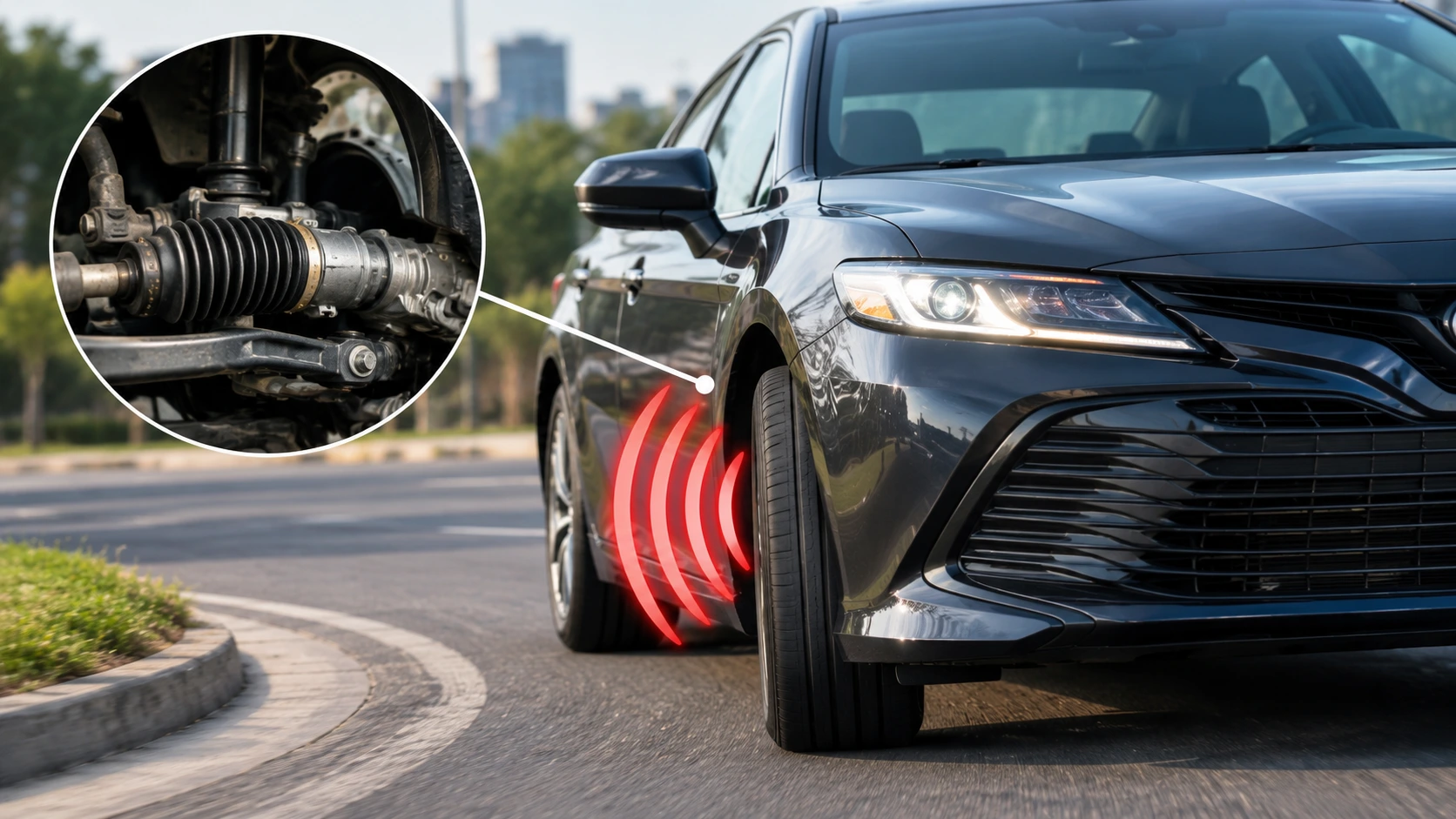
When a car make noise when turning — a click, clunk, groan, or grinding that appears specifically during steering input — is the suspension and steering system identifying a component under stress. The noise appears on turns because turning places specific components at their maximum load or maximum angle. At straight-ahead driving, the same fault is invisible.
In Dubai, car make noise when turning is amplified by two specific conditions: the city’s dense car park culture produces more full-lock turns per day than any other environment, and the heat and dust degrade the joints, seals, and bearings that produce noise when they fail.
At Rapid Rev Garage in Al Quoz, every car make noise when turning diagnosis starts with the noise character and turning condition — slow or fast, full lock or partial, with or without suspension travel — identifies the specific component before a single tool is used.
Car Make Noise When Turning — Quick Answer
A car makes noise when turning because one or more components in the steering and suspension system are failing under the load and angle of the turn. The most common causes are a worn CV joint producing a clicking at full-lock turns, a dry or worn ball joint or tie rod end producing a clunk on turn initiation, a power steering pump or rack producing a whine at full lock, a worn top mount bearing producing a grinding when the strut rotates with steering input, or a worn wheel bearing producing a hum that changes pitch when the steering is moved left or right. Each noise type — click, clunk, whine, grind, hum — points to a different component, and the turning speed and lock angle narrow the cause further.
Table of Contents
- How Turning Exposes Faults That Straight Driving Hides
- CV Joint Clicking at Full Lock — Front-Wheel-Drive Vehicles
- Ball Joint and Tie Rod Clunk on Turn Initiation
- Power Steering Whine or Groan at Full Lock
- Top Mount Bearing Grinding When the Strut Rotates
- Wheel Bearing Hum That Changes With Steering Angle
- Sway Bar Link Click During Cornering
- How Dubai’s Car Park Culture Produces More Turning Noise
- How We Diagnose Car Make Noise When Turning
- The Services That Fix Each Confirmed Cause
- What Does the Repair Cost in Dubai?
- Is It Safe to Keep Driving?
- Why Rapid Rev Garage?
- FAQ
- Conclusion
How Turning Exposes Faults That Straight Driving Hides
At straight-ahead driving, most steering and suspension components operate near the centre of their designed range. Load is distributed evenly. No component is near its travel limit.
When the car turns, several conditions change simultaneously. The steering components move to an angle. The suspension on the outside of the corner compresses. The inside corner extends. CV joints reach near-maximum angle. The power steering pump builds pressure.
A car make noise when turning because a component that handles the mid-range of operation silently is stressed at the extreme. A CV joint that rotates cleanly at straight-ahead clicks when it reaches full-lock angle. A ball joint that is silent on straight roads clunks when lateral load is applied during a turn. A bearing that hums quietly becomes audible when the load shifts with steering angle.
The turning condition — slow or fast, full lock or slight, smooth road or bumpy — is the diagnostic information. Our car mechanic team replicates the exact turning condition before any component is inspected.
CV Joint Clicking at Full Lock — Front-Wheel-Drive Vehicles
The CV (constant velocity) joint connects the driveshaft to the driven front wheel on front-wheel-drive vehicles. It allows the wheel to steer left and right while simultaneously receiving drive from the gearbox.
At full lock — the tightest possible turn — the CV joint operates at its maximum angle. A joint with worn or damaged ball bearings produces a distinctive clicking or clacking at this angle. The click repeats with every wheel rotation — it is rhythmic, following the wheel’s turning speed rather than the steering wheel’s movement.
The click is most obvious during slow car park manoeuvres with full lock applied. It disappears when the wheel is straightened. This on-off character with steering angle is the clearest identifier of CV joint noise.
A worn CV joint has typically also lost its grease — the rubber CV boot that retains the grease has cracked. A cracked boot is visible on a ramp inspection. Replacing the boot and repacking with grease at the boot-crack stage preserves the joint. A joint that has already lost its grease and worn its bearings requires full joint replacement.
Ball Joint and Tie Rod Clunk on Turn Initiation
Ball joints and tie rod ends are ball-and-socket joints. They allow steering movement while carrying suspension load. When the steering input begins — the wheel is turned from straight-ahead — these joints experience a sudden load change as the lateral force of the turn is applied.
A worn ball joint or tie rod end with play in its socket produces a clunk at this moment of load change. The clunk is the ball moving within the excess clearance in the socket before the joint takes up the load.
The clunk from a ball joint or tie rod end during turning is typically a single clunk at the initiation of the turn rather than a continuous noise during the turn. It may also clunk when the wheel hits a bump during a turn — the combined lateral and vertical load change at the worn joint produces the noise.
The ramp inspection — pry bar under the ball joint, push-pull test on the tie rod — confirms play beyond specification before any replacement is recommended. For any exterior repairs needed alongside joint work, our car painting team handles colour-matched repairs at the same visit.
Power Steering Whine or Groan at Full Lock
On hydraulic power steering vehicles, the rack’s internal valve blocks fluid flow at full lock. The power steering pump continues to run and builds pressure against this blocked valve.
A healthy pump with clean fluid handles this momentary pressure spike quietly. A pump with low or degraded fluid — or a pump with worn internal components — whines under this pressure.
The whine is specific to full lock — it disappears when the wheel is moved back from the extreme. It is most obvious during a stationary full-lock hold — the exact position used when manoeuvring in a tight car park space.
Power steering fluid degrades faster in Dubai’s heat than any manufacturer schedule assumes. A fluid check — colour, level, and smell — is the first investigation for any power steering whine during turning. Dark, burnt-smelling fluid that is replaced often resolves the whine entirely without any pump replacement.
Top Mount Bearing Grinding When the Strut Rotates
On MacPherson strut front suspension — used on most saloons and crossovers in Dubai — the entire front strut rotates with the steering. At the top of the strut, a bearing allows this rotation. The bearing carries the vehicle’s weight while rotating.
A top mount bearing that has worn or lost its grease produces a grinding or crunching sound specifically when the steering is turned. The sound is most obvious at slow speed — in a car park or during a U-turn — where the strut is rotating through its full range.
The grinding is sometimes felt through the steering wheel as a roughness or notchiness when turning. This combination — grinding sound and rough steering feel — confirms a top mount bearing fault before any ramp inspection.
Top mount bearing failure in Dubai is accelerated by heat cycling — the grease in the bearing evaporates faster at sustained high temperatures, leaving the bearing to run dry. For any breakdown from a steering fault on the road, our roadside assistance team covers Al Quoz and nearby Dubai areas.
Wheel Bearing Hum That Changes With Steering Angle
A wheel bearing that is failing produces a hum or rumble that increases with speed. Its distinguishing feature: the sound changes when the steering is moved left or right.
When the car turns left, the weight transfers to the right — loading the right bearing more. When the car turns right, the weight transfers left. A failing bearing on one side hums louder when that side is loaded and quieter when the weight shifts away from it.
This steering-angle sensitivity of the sound is the clearest identifier of a wheel bearing fault in the car make noise when turning presentation. The sound changes at partial steering angles — not just at full lock — which distinguishes it from CV joint noise (full lock only) and top mount noise (any rotation).
A wheel bearing fault is confirmed on the ramp by lifting the wheel and turning it by hand — a failing bearing feels rough or has audible roughness compared to a smooth, quiet healthy bearing. Our car service packages include a wheel bearing check at every major service for vehicles over 60,000 km.
Sway Bar Link Click During Cornering
The sway bar end links connect the sway bar to the suspension lower arm at each front corner. They have a ball joint at each end that allows the link to move as the suspension travels.
A worn sway bar end link produces a click or knock during cornering — specifically when the body rolls into the corner and loads the sway bar. The click occurs at the moment of roll initiation. It may also click when the wheel hits a bump during a turn, as the suspension movement loads the sway bar.
End link noise during cornering is distinguished from CV joint noise by its character. An end link click is a single click at the moment of load change — not a rhythmic click that follows wheel rotation. It also occurs at any steering angle — not only at full lock.
End links are inexpensive parts. Replacement resolves the click immediately.
How Dubai’s Car Park Culture Produces More Turning Noise
In Dubai, full-lock manoeuvring is an everyday requirement. Multi-storey car parks with tight bays, U-turns on residential streets, and exit manoeuvres from petrol stations all demand full or near-full lock turns at slow speed.
A Dubai driver performing two mall visits per day applies full lock 10–20 times per parking session — entering the bay, reversing out, manoeuvring around other vehicles. Over a year, this produces thousands of full-lock cycles that a highway-dominated driving environment never generates.
CV joints at full lock, top mount bearings rotating through their full range, and power steering pumps hitting maximum pressure — all of these components are stressed more by Dubai’s parking demands than by any other driving pattern. The car make noise when turning complaint is more common in Dubai than in any lower-parking-frequency market because the components that produce the noise are worn by exactly the manoeuvres Dubai requires most.
How We Diagnose Car Make Noise When Turning
Noise characterisation at multiple conditions. We test the noise at slow speed full lock, at highway-speed partial turns, at stationary full lock with the car in Park, and over bumps during turning. Each condition produces a different noise if a different component is involved.
Power steering fluid check first. A fluid level and condition check eliminates the simplest cause before any ramp work. Dark or low fluid is replaced and the car is tested before proceeding to component investigation.
CV boot inspection on the ramp. Both front CV boots are checked for cracks. A cracked boot confirms grease loss and likely CV joint wear.
Ball joint and tie rod pry test. Both front ball joints and tie rod ends are loaded with a pry bar. Any play beyond specification is flagged.
Wheel bearing rotation test. Both front wheels are spun by hand on the ramp. Roughness or audible noise from a bearing confirms bearing wear.
Top mount check. The top mount area is inspected and the strut is rotated manually at full lock to feel for grinding.
The Services That Fix Each Confirmed Cause
CV boot replacement. Boot replaced and grease repacked where the joint bearing is still intact. AED 300–600 per side. CV joint replacement where the bearing is worn. AED 500–1,200 per side.
Ball joint replacement. Worn ball joint replaced. Four-wheel alignment performed after replacement. AED 600–1,500 per joint.
Tie rod end replacement. Worn end replaced. Alignment confirmed. AED 400–900 per side.
Power steering fluid replacement. Degraded fluid flushed and replaced. AED 200–500.
Power steering pump replacement. Confirmed worn pump replaced. AED 600–1,800.
Top mount bearing replacement. Full top mount assembly replaced. AED 500–1,200 per corner.
Wheel bearing replacement. Damaged bearing replaced. AED 500–1,200 per corner.
Sway bar end link replacement. Both end links replaced as a pair. AED 400–900. Our mobile car mechanic covers Al Quoz and nearby Dubai areas for on-site noise characterisation before bringing the vehicle in. Our garage near me in Al Quoz serves drivers from Business Bay, Jumeirah, Barsha, Satwa, Downtown, and the Sheikh Zayed Road corridor.
What Does the Repair Cost in Dubai?
| Service | Cost Range |
| CV boot replacement | AED 300–600 per side |
| CV joint replacement | AED 500–1,200 per side |
| Ball joint replacement | AED 600–1,500 per joint |
| Tie rod end replacement | AED 400–900 per side |
| Power steering fluid replacement | AED 200–500 |
| Top mount bearing replacement | AED 500–1,200 per corner |
| Wheel bearing replacement | AED 500–1,200 per corner |
| Sway bar end link replacement | AED 400–900 |
All costs confirmed after noise characterisation and ramp inspection. Written quote before any work begins.
Is It Safe to Keep Driving?
CV joint clicking at full lock — book within two weeks. The joint will progress from clicking at full lock to clicking at any angle. Eventually it fails completely and the drive is lost to that wheel. Not immediately dangerous but worsening.
Ball joint clunk — book the same day. A ball joint with confirmed play has separation risk. Do not delay beyond the same day once ball joint play is confirmed.
Power steering whine — book within the week. Not a safety emergency but a deteriorating pump causes steering to become heavy without warning as it fails further.
Top mount grinding — book within the week. A seized bearing causes unpredictable steering feel in parking manoeuvres.
Wheel bearing hum — book within two weeks. A bearing that has started humming will worsen. Complete bearing failure at highway speed is a serious safety event.
Why Rapid Rev Garage?
Every car make noise when turning case has a component-specific answer — the noise type and turning condition identify it. A rhythmic click at full lock at slow speed is CV joint. A groan at full lock stationary is power steering. A clunk at turn initiation is ball joint or tie rod. A grinding that follows the steering wheel angle is top mount. A hum that changes at partial steering angles is wheel bearing.
We match the car make noise when turning character to the component, confirm it on the ramp, and repair specifically that component — not a list of probable parts.
FAQ — Car Make Noise When Turning
Here are the questions Dubai drivers ask us most about turning noises.
My car clicks when turning left but not right — what does that mean?
A single-direction click at full lock on a front-wheel-drive vehicle is almost always the outer CV joint on the side being driven at full lock during that turn. The left-turn click points to the left-front CV joint — it is the joint at the greatest angle during a left turn. Confirmed on the ramp by checking the left-front CV boot for cracks.
The noise only happens when I go over a bump while turning — what is that?
This combined condition — suspension travel during a turn — loads the ball joint in both the vertical and lateral directions simultaneously. A clunk that appears specifically when a bump is hit during a turn, rather than when turning on a smooth surface, points to a ball joint or sway bar end link rather than a CV joint or power steering issue.
Can low power steering fluid cause a clicking sound?
Low power steering fluid causes a whine or groan — not a click. A click during turning is a mechanical joint fault — CV joint, ball joint, or end link. These are distinct sounds with distinct causes.
I just had new CV boots fitted — why does my car still make a clicking noise when turning?
If the CV joint bearing was already worn before the boot was replaced, a new boot and fresh grease does not restore the bearing. The grease was protecting a worn joint only partially. Joint replacement alongside the boot replacement would have resolved it. The joint now needs to be replaced separately.
Does a car make noise when turning indicate urgent safety concern?
It depends on the specific cause. A CV joint click is a progressive fault — not immediately dangerous. A ball joint clunk is more urgent — ball joint separation at any speed is a safety risk. Whenever a new turning noise appears, have it assessed within the week. If the noise is accompanied by a change in steering feel or handling, treat it as same-day urgent.
Conclusion
A car make noise when turning in Dubai — clicking, clunking, whining, or grinding — comes from a specific component at the limit of its load or angle during the turn. CV joints, ball joints, tie rod ends, the power steering system, top mount bearings, wheel bearings, and sway bar links all produce distinct noise characters under distinct turning conditions.
Rapid Rev Garage in Al Quoz characterises the noise at every relevant turning condition, inspects the implicated component on the ramp, and repairs specifically what the tests confirm — before any other parts are touched.
Rapid Rev Garage is in Al Quoz, serving Business Bay, Jumeirah, Downtown, Barsha, Satwa, and the Sheikh Zayed Road corridor. Book your appointment on WhatsApp or find us on Google Maps.
Rapid Rev Garage — Car Make Noise When Turning | Al Quoz, Dubai