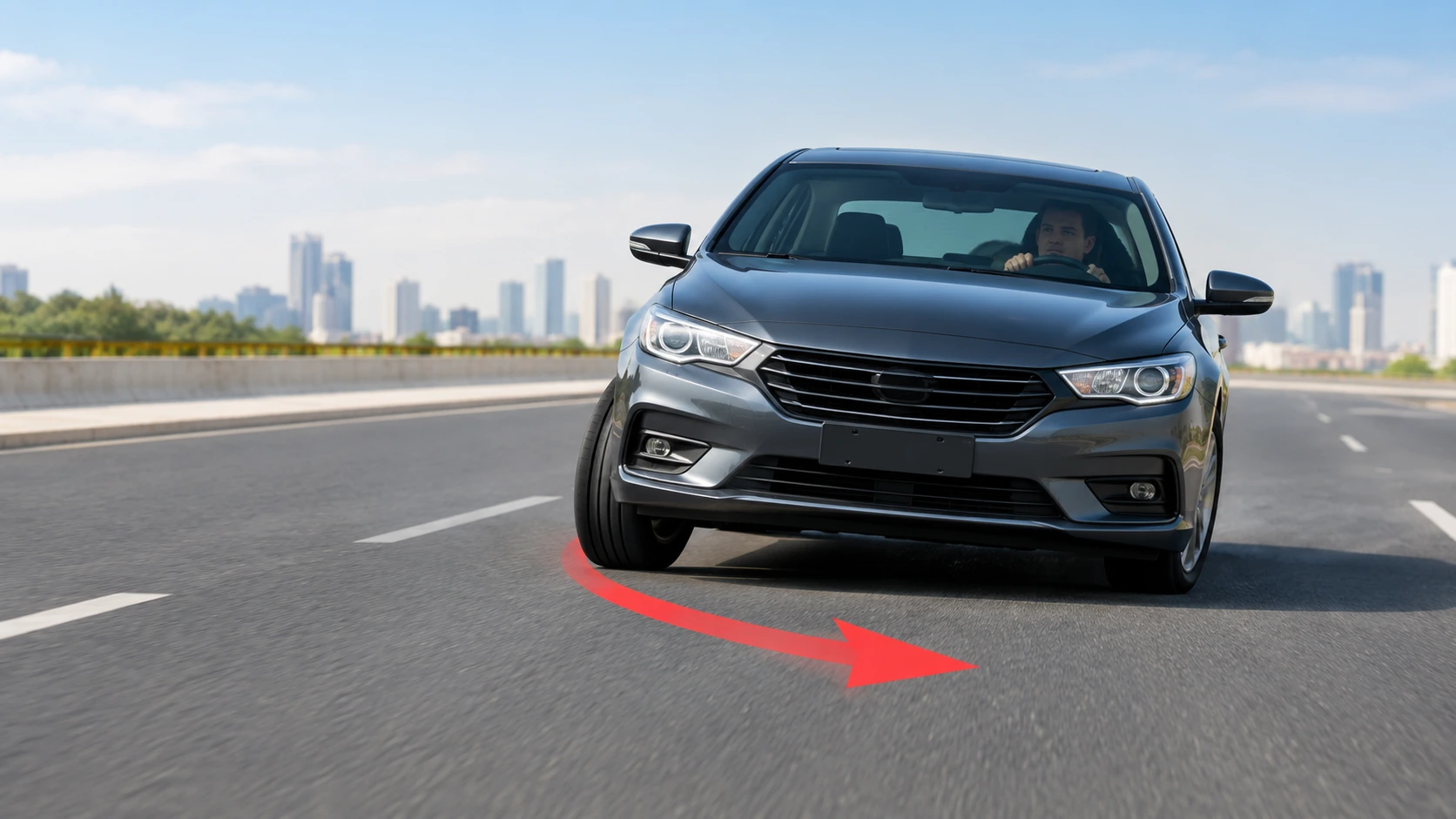
Car drift to one side — the vehicle that pulls left or right on a straight, level road without any steering input — is one of the most common handling complaints in Dubai. The driver should be able to let go of the steering wheel briefly on a flat road and the car should track straight. When it doesn’t, something is wrong with the geometry, the tyres, or the braking system.
In Dubai, the most frequent cause is wheel alignment disturbed by speed bumps, pothole strikes, or kerb contacts in car parks. But car drift to one side can also come from unequal tyre pressures, a dragging brake caliper, or suspension geometry that has shifted from component wear.
At Rapid Rev Garage in Al Quoz, every car drift to one side complaint is diagnosed with a road test on a level surface, a four-wheel alignment measurement, and a brake check — before any repair is recommended.
Car Drift to One Side — Quick Answer
A car drifts to one side because something is creating an unequal force on the left and right sides of the vehicle. The most common causes are incorrect wheel alignment — particularly toe or caster — where one side pulls harder than the other; unequal tyre pressures where the lower-pressure side has more rolling resistance; a dragging brake caliper on one side creating constant braking force; or worn suspension components — a collapsed spring, a worn control arm bushing — that have changed the geometry on one corner. In Dubai, speed bump impacts and pothole strikes disturb alignment regularly. A car drift to one side complaint that appeared after hitting a bump or kerb almost always traces to an alignment change.
Table of Contents
- How to Confirm Your Car Is Actually Drifting
- Wheel Alignment as the Primary Cause
- Unequal Tyre Pressure Between Left and Right
- Dragging Brake Caliper on One Side
- Worn Suspension Components Changing Corner Geometry
- Tyre Conicity — When the Tyre Itself Is the Cause
- Road Camber vs a True Drift Problem
- How Dubai’s Roads Disturb Alignment Regularly
- How We Diagnose Car Drift to One Side at Rapid Rev Garage
- The Services That Fix Each Confirmed Cause
- What Does the Repair Cost in Dubai?
- Why Rapid Rev Garage?
- FAQ
- Conclusion
How to Confirm Your Car Is Actually Drifting
Before diagnosing the cause, it helps to confirm that the drift is real — not road camber or driver habit.
The level road test. On a straight, flat road with no traffic, briefly release the steering wheel at 60 km/h. A car that drifts clearly to one side within two to three seconds has a genuine drift problem. A car that barely moves is likely road camber.
Swap the front tyres. Move the left front tyre to the right and vice versa, without changing their rotation direction. Drive the car again. If the drift reverses direction — the car now pulls the other way — the tyre is the cause (conicity). If the drift continues in the same direction, the cause is vehicle geometry or braking.
These two tests take under 20 minutes and provide clear diagnostic direction before any component is inspected. Our car mechanic team performs both before starting any alignment or brake work.
Wheel Alignment as the Primary Cause
Incorrect wheel alignment is the most common cause of car drift to one side in Dubai.
Toe Misalignment
Toe is the angle at which the front wheels point relative to the vehicle’s straight-ahead direction. Correct toe means both wheels point fractionally inward or outward by the same amount. When one wheel’s toe is different from the other — because an impact has shifted the tie rod — that wheel pulls toward its toe-out direction.
A toe error of 2–3mm on one side produces a noticeable pull at highway speed. It also wears the affected tyre’s inner or outer edge faster than the opposite tyre.
Caster Asymmetry
Caster is the tilt of the steering axis. Equal caster on both sides produces equal self-centring force — the car tracks straight without input. Unequal caster from a bent strut, a shifted subframe, or a cracked strut mount produces more self-centring force on one side. The car drifts toward the lower-caster side.
Caster asymmetry is the cause of drift that an alignment machine reveals most clearly — the numbers show the left and right caster angles are different even when toe is correct.
Unequal Tyre Pressure Between Left and Right
A tyre with lower pressure has a larger contact patch and higher rolling resistance than a correctly-inflated tyre. If the left front tyre is 5 PSI lower than the right, the left side resists rolling more. The car drifts left.
This cause is confirmed in two minutes with a tyre pressure gauge. It is frequently the first check to eliminate before any other investigation. In Dubai’s summer, pressure fluctuates more than in cooler climates — a tyre that was correctly inflated in the morning may read differently by afternoon. Always check cold pressure before attributing drift to a mechanical cause.
Our car service packages include a cold tyre pressure check at all four corners at every service visit.
Dragging Brake Caliper on One Side
A brake caliper that is partially seized — piston stuck slightly extended — maintains a light contact between the pad and disc at all times. This continuous friction creates a constant braking force on that corner. The car drifts toward the dragging side.
The distinguishing feature: a dragging caliper drift is accompanied by a burning smell from the affected wheel after a normal drive. The wheel is also noticeably hotter than the opposite side. In severe cases, the driver can see heat shimmer rising from the wheel.
A dragging caliper also produces a car drift to one side that worsens under braking — the already-braking caliper clamps harder when the pedal is pressed, increasing the imbalance.
In Dubai, caliper seizure is accelerated by the combination of brake dust from Al Quoz’s industrial environment and moisture from the inter-season humidity — both attack the caliper piston seals and slide pins from outside. For any roadside emergency from a seized caliper, our roadside assistance team covers Al Quoz and nearby Dubai areas.
Worn Suspension Components Changing Corner Geometry
Worn or collapsed suspension components can change the effective geometry of one corner — producing drift without any external impact having occurred.
Collapsed spring. A spring that has settled — lost height — lowers one corner of the vehicle. The lower corner has changed camber and caster angles. The car leans toward the lower corner and drifts in that direction.
Worn control arm bushing. A significantly worn bushing allows the control arm to move beyond its designed position. The wheel it supports no longer sits at the correct alignment angle under driving load. The drift appears progressively as the bushing continues to wear.
Worn front anti-roll bar bushing. An anti-roll bar bushing that has collapsed on one side allows the bar to sit lower on that corner. Under driving conditions, this changes the front corner’s effective geometry and can produce a pull.
A ramp inspection with physical loading tests on each component identifies worn components. A spring height measurement at each corner identifies a collapsed spring. Our car painting team handles any exterior repairs needed alongside suspension work at the same visit.
Tyre Conicity — When the Tyre Itself Is the Cause
Tyre conicity is a manufacturing characteristic where the tyre’s belt layers are not perfectly aligned. This asymmetry causes the tyre to generate a lateral force in one direction when it rolls — like a cone rolling in a circle.
A tyre with significant conicity causes the car to pull in one direction regardless of alignment. The alignment may be perfectly correct but the tyre’s internal structure is generating a lateral force that mimics drift.
Conicity is confirmed by the front-tyre swap test described earlier. If the car’s drift direction reverses after swapping the front tyres left-to-right, one of the tyres has conicity. The specific tyre is identified by moving each one individually to the rear and confirming the drift disappears.
Road Camber vs a True Drift Problem
Many roads — particularly UAE arterial roads — have a deliberate cross-slope (camber) that drains water toward the side. This camber causes a correctly-aligned car to drift slightly toward the lower side of the road.
This is not a fault. But it can be mistaken for one.
The road camber test: if the car drifts left on the road, drive the same stretch in the opposite direction. If the car now drifts right — consistently toward the road’s lower edge — the road is cambered and the car is correct. If the car drifts in the same direction regardless of which lane or direction is used, the cause is vehicle-side.
How Dubai’s Roads Disturb Alignment Regularly
Dubai’s combination of speed bumps, pothole edges at construction-adjacent roads, and dense car park kerbing produces a high frequency of alignment-disturbing impacts per vehicle per year.
Every speed bump crossing at above-recommended speed applies a longitudinal force to the front suspension that can shift the caster angle. Every pothole edge applies a lateral force that can shift toe. Every kerb contact in a car park applies a combined force that can shift both simultaneously.
A car drift to one side that appeared after a specific event — a hard bump, a kerb contact, a speed bump taken too fast — has a clear cause. A drift that has appeared gradually without any obvious trigger is typically component wear producing progressive geometry change.
How We Diagnose Car Drift to One Side at Rapid Rev Garage
Level road test. Confirmed on a flat, straight road before any component is investigated. Drift direction and severity documented.
Tyre pressure check. All four pressures confirmed cold against the door jamb specification. Any pressure discrepancy corrected and road tested before proceeding.
Thermal check of brake calipers. After a road test, both front wheel temperatures are measured. A significant temperature difference confirms a dragging caliper on the hotter side.
Four-wheel alignment measurement. All angles at all four corners compared against manufacturer specification. Toe, caster, and camber readings document any asymmetry between left and right.
Tyre swap test. Where alignment is confirmed correct but drift persists, the front tyres are swapped left-to-right. If drift direction changes, tyre conicity is confirmed.
Ramp suspension inspection. Springs, bushings, and control arms are inspected for wear and collapse where alignment cannot be fully corrected by adjustment.
The Services That Fix Each Confirmed Cause
Four-wheel alignment correction. Toe, caster, and camber corrected to manufacturer specification. AED 200–400. First and most common fix for car drift to one side.
Tyre pressure correction. Immediate. All four tyres corrected to the door jamb specification. AED 0–50.
Brake caliper service or replacement. Seized caliper rebuilt or replaced. Slide pins cleaned and lubricated. AED 400–1,800 per caliper depending on the vehicle.
Tyre replacement. A tyre confirmed with conicity replaced with a new unit. AED 250–800 per tyre.
Suspension component replacement. Collapsed spring, worn bushing, or damaged control arm replaced. Alignment confirmed after replacement. AED 400–2,500 depending on the component. Our mobile car mechanic covers Al Quoz and nearby Dubai areas for on-site initial drift assessment. Our garage near me in Al Quoz serves drivers from Business Bay, Jumeirah, Barsha, Satwa, Downtown, and the Sheikh Zayed Road corridor.
What Does the Repair Cost in Dubai?
| Service | Cost Range |
| Four-wheel alignment | AED 200–400 |
| Tyre pressure correction | AED 0–50 |
| Brake caliper service or replacement | AED 400–1,800 per caliper |
| Tyre replacement (conicity) | AED 250–800 per tyre |
| Suspension component replacement | AED 400–2,500 |
All costs confirmed after the level road test, pressure check, thermal check, and alignment measurement. Written quote before any work begins.
Why Rapid Rev Garage?
Car drift to one side has a specific cause in every case. We confirm the drift is real, check pressure first, test the brakes thermally, run the alignment measurement, and — if needed — perform the tyre swap test. This sequence identifies the cause before any component is replaced.
The most expensive fix in this list — caliper replacement — is only recommended after thermal confirmation. The cheapest fix — pressure correction — is always checked first. We don’t replace parts before the tests tell us which part to replace.
FAQ — Car Drift to One Side
Here are the questions Dubai drivers ask us most about car drift.
My car only drifts when I brake — is that still an alignment issue?
A drift specifically under braking points to the braking system — a dragging or uneven caliper — rather than alignment. Alignment drift is present all the time. Braking-specific drift means one side is applying more brake force than the other. Have the calipers and brake balance assessed.
I had an alignment done last month and the car is drifting again — why?
Two possible causes. Either a component is worn and cannot hold the alignment setting — the geometry shifts back out after the car is driven. Or a new impact since the alignment — a speed bump, a pothole, a kerb — has disturbed the angles again. Both are confirmed by a re-measurement.
Can an imbalanced wheel cause a car to drift?
Wheel imbalance causes a speed-specific vibration, not a consistent drift. A car that pulls to one side consistently at all speeds is not wheel balance. A car that vibrates at a specific speed range is balance. The two faults are distinct.
Does the car need to be on a specific type of road to test for drift?
A flat, straight road with no significant camber is needed for a clean test. Straight sections of residential roads away from traffic are useful. The test is invalid on a strongly-cambered road. If you're unsure whether your road has significant camber, drive the same stretch in both directions and compare.
Can a rear tyre cause a front drift?
Rear toe misalignment causes the rear of the car to push sideways — which the driver feels as a drift or wander at the front. This is called a dog-tracking or crabbing effect. The car doesn't necessarily feel like the front is pulling — it feels like the whole car is moving diagonally. A four-wheel alignment checks rear toe and identifies this cause.
Conclusion
Car drift to one side in Dubai is most commonly caused by wheel alignment disturbed by speed bumps and pothole impacts — but a dragging brake caliper, unequal tyre pressures, worn suspension components, and tyre conicity are all confirmed causes that require different repairs. The tyre pressure check and brake thermal check take under 10 minutes and eliminate the two simplest causes before the alignment machine is used.
Rapid Rev Garage in Al Quoz diagnoses every car drift to one side complaint with a level road test, pressure check, thermal brake check, four-wheel alignment, and tyre swap test where needed — confirming the exact cause before any repair is recommended.
Rapid Rev Garage is in Al Quoz, serving Business Bay, Jumeirah, Downtown, Barsha, Satwa, and the Sheikh Zayed Road corridor. Book your appointment on WhatsApp or find us on Google Maps.
Rapid Rev Garage — Car Drift to One Side | Al Quoz, Dubai