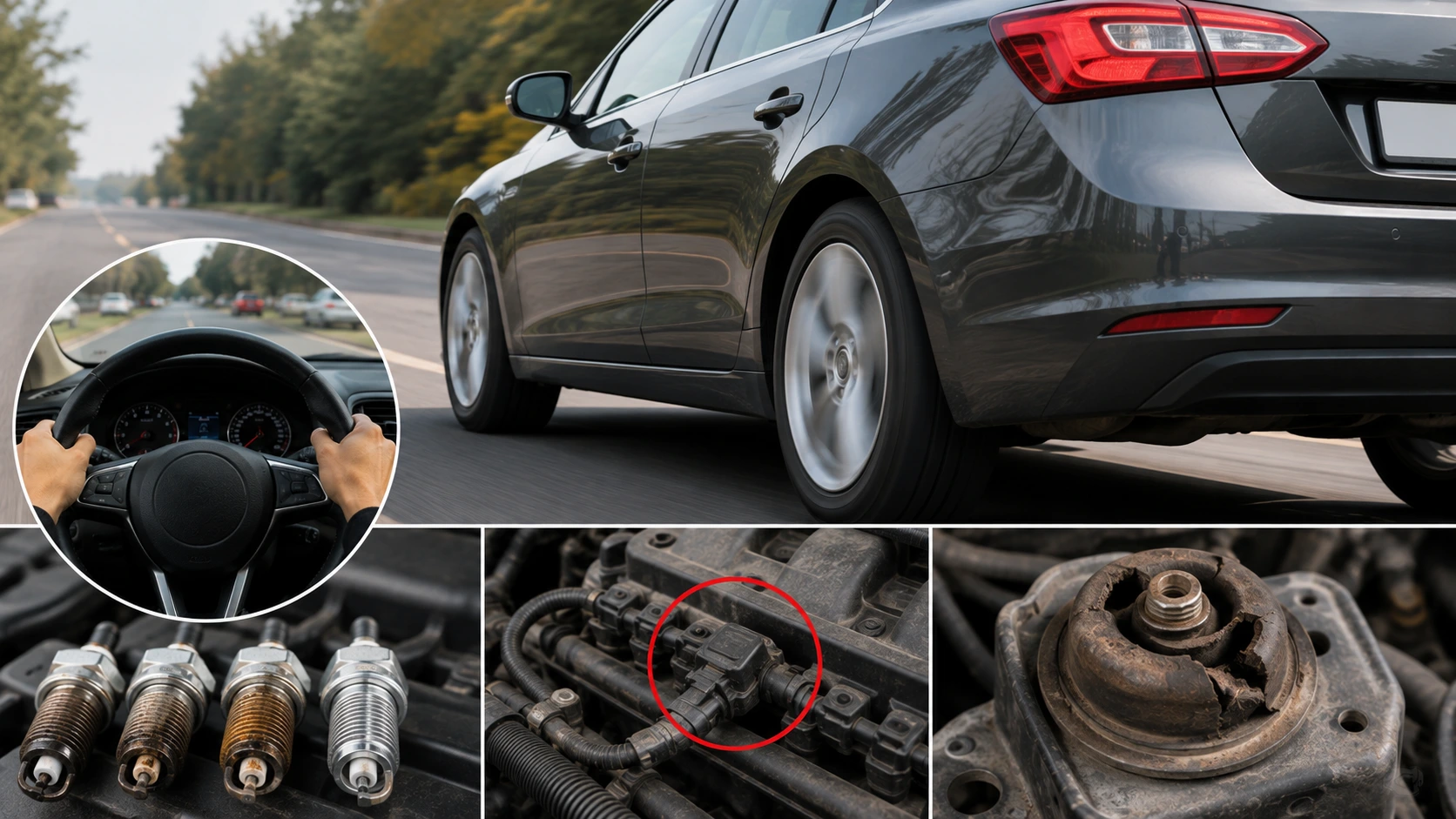
When a car shake during acceleration develops — a vibration or shuddering that appears specifically when the accelerator is pressed and fades at cruise or coast — the fault is in the components that transmit drive from the engine to the wheels, or in the engine’s ability to deliver smooth power under load. The acceleration-specific character is the most important diagnostic clue: it rules out causes that produce constant vibration at all times and directs the investigation toward the driveline components that are loaded specifically when drive is being applied.
At Rapid Rev Garage in Al Quoz, every car shake during acceleration complaint is diagnosed with a structured driveline assessment — engine mounts, driveshaft, CV joints, wheel balance, and ignition system — during a road test that specifically replicates the conditions that produce the shake.
Car Shake During Acceleration — Quick Verdict
A car shake during acceleration in Dubai is most commonly caused by a worn or failed engine mount allowing excessive powertrain movement under torque, a CV joint that has worn to the point where it produces vibration under drive load, a driveshaft that is out of balance or has a worn universal joint, engine misfires from worn spark plugs or failing ignition coils producing uneven power delivery, or a front tyre with a flat spot or severe imbalance that is amplified under acceleration load. In Dubai, engine mount failure from heat-degraded rubber is the most frequent cause, followed closely by CV joint wear from the high frequency of full-lock parking manoeuvres that Dubai’s car park culture produces. The diagnostic distinction between these causes requires a road test combined with physical inspection.
Table of Contents
- Why Acceleration Produces Shaking That Cruise Does Not
- Engine Mount Failure — The Primary Acceleration Shake Cause
- CV Joint and Driveshaft Faults Under Drive Load
- Engine Misfire as a Source of Acceleration Shaking
- Tyre and Wheel Faults Under Acceleration
- How Dubai’s Conditions Create Acceleration Shake Earlier
- How We Identify the Exact Cause at Rapid Rev Garage
- The Right Fix for Each Confirmed Cause
- What Happens If Acceleration Shaking Is Left Without Repair
- Is It Safe to Keep Driving?
- How Long the Repair Takes
- What the Repair Costs in Dubai
- Preventing Acceleration Shake in Dubai’s Conditions
- Why Rapid Rev Garage?
- FAQ
- Conclusion
Why Acceleration Produces Shaking That Cruise Does Not
The acceleration-specific character of a car shake during acceleration fault is diagnostically significant — it eliminates whole categories of possible causes immediately.
What Changes When the Accelerator Is Pressed
When the driver presses the accelerator, the engine produces torque that is transmitted through the transmission, driveshafts, CV joints, and wheels to the road. Each of these components is loaded specifically by the application of drive torque — and components with wear or failure that only produces movement under load are invisible at cruise where torque is minimal.
Why Coast and Cruise Don’t Reveal the Fault
At cruise with constant throttle, the driveline components carry a steady, moderate load that worn mounts, marginal CV joints, or imbalanced driveshafts can manage without producing noticeable vibration. Under hard acceleration, the sudden increase in torque and the directional reversal of torque loads on mount rubber, joint races, and universal joint needles exposes wear that the moderate cruise load conceals.
Engine Mount Failure — The Primary Acceleration Shake Cause
Engine and transmission mounts are the primary cause of car shake during acceleration — they are the components that absorb the engine’s torque reaction — preventing it from reaching the body and the driver. A failed mount allows the engine and gearbox assembly to rock under acceleration torque, producing the characteristic shudder that the driver feels through the seat and steering wheel.
How Failed Mounts Produce the Specific Shake Character
When the accelerator is pressed, the engine twists against its mounts in the direction opposite to crankshaft rotation. A mount with intact rubber isolates this twisting from the body. A mount whose rubber has hardened, cracked, or collapsed transmits the torque reaction to the body — producing a shudder that is precisely correlated with acceleration application and load. The shake is worst at heavy acceleration from low speed — when the torque spike is greatest — and reduces at maintained cruise speed.
The Clunk and Shake Combination
Many engine mount faults produce both a clunk and a shake — the clunk when the powertrain first moves against the failed mount under initial acceleration, followed by a vibration as the engine rocks in its mounts during sustained acceleration. Both symptoms from the same event confirm mount failure rather than a driveshaft or CV joint fault that produces smoother vibration without the initial clunk.
Why Dubai Destroys Mount Rubber Faster
Engine mount rubber in Dubai operates at sustained temperatures that accelerate its degradation through thermal oxidation and heat cycling. Every engine start followed by stop is a thermal cycle. Multiple daily starts in Dubai’s commuting pattern produce more thermal cycles per year than a vehicle with a single daily commute — and the sustained underbonnet heat between cycles keeps the rubber at elevated temperature for more hours per year than in any temperate market.
Our car mechanic team physically loads the engine in both drive directions from a stationary position — in gear with the brake applied and gentle throttle — while observing mount deflection from outside the vehicle. This test immediately identifies a failed mount before any lift inspection.
CV Joint and Driveshaft Faults Under Drive Load
Constant velocity joints allow drive to be transmitted to the front wheels through the full range of steering and suspension movement. When CV joints wear, they produce vibration specifically under the combination of drive load and operating angle.
How CV Joint Wear Produces Acceleration Shake
A worn CV joint that is transmitting drive torque at a steering or suspension angle develops a vibration from the uneven rolling of its ball bearings across worn race surfaces. Under acceleration load — when the highest torque is being transmitted through the joint — the vibration is most pronounced. At cruise with light throttle, the same joint may not produce noticeable vibration because the lower torque transmission doesn’t excite the worn contact surfaces as severely.
Front-Wheel-Drive vs Rear-Wheel-Drive Shake Patterns
On front-wheel-drive vehicles, acceleration shake from CV joint wear is typically felt through the steering wheel as well as the floor — because the shaking driveshaft is connected to the steering knuckle. On rear-wheel-drive vehicles, driveshaft imbalance or universal joint wear produces a shake primarily through the floor and seat — with less steering wheel involvement. This distinction helps identify whether the front or rear driveline is the source.
Universal Joint Wear on RWD Vehicles
Rear-wheel-drive vehicles — including the Toyota Land Cruiser, Ford F-150, Nissan Patrol, and most commercial pickups common in Dubai — use propeller shafts with universal joints rather than CV joints. A worn universal joint needle bearing produces a vibration specifically under acceleration that appears at low speed and may reduce at higher speed — a characteristic that helps distinguish it from a wheel balance issue that is typically speed-specific.
Engine Misfire as a Source of Acceleration Shaking
A misfiring cylinder produces uneven power delivery — the engine produces a power pulse from three, five, or seven cylinders rather than all four, six, or eight. Under acceleration, where full power is demanded, the missing cylinder contribution produces a rhythmic shake that is felt through the powertrain.
How Misfire Shake Differs From Mount or Driveshaft Shake
Misfire shake is typically faster and more rhythmic than mount or driveshaft shake — it pulses at the engine firing frequency rather than at the driveshaft rotation frequency. A misfire shake also typically produces a rough idle alongside the acceleration shake — because the misfiring cylinder is also affecting idle stability. A mount or driveshaft fault typically does not affect idle quality.
Why Dubai Accelerates Ignition Component Wear
Spark plugs and ignition coils degrade faster in Dubai’s heat cycling environment — the daily expansion and contraction from underground parking cool to peak underbonnet temperature accumulates insulation fatigue faster than in stable-temperature climates. A coil that is declining from heat cycling produces load-dependent misfire that first appears specifically under hard acceleration before it becomes a constant idle misfire. For any breakdown from a driveline failure, our roadside assistance covers Al Quoz and nearby Dubai areas.
Tyre and Wheel Faults Under Acceleration
Tyres and wheels with faults that create vibration can produce acceleration-specific shaking through the mechanism of torque steer and axle twist.
Tyre Flat Spots From Extended Stationary Parking
A vehicle parked stationary for several days in direct Dubai summer sun develops flat spots on the tyre contact area from the sustained heat deforming the contact patch area. This flat spot produces a rhythmic thumping on initial driving that is more pronounced under acceleration because the driven wheels are transmitting torque through the flat spot area. Tyre flat spots typically round out after several kilometres of driving at speed.
Wheel Imbalance Under Acceleration Load
A wheel that is marginally out of balance may not produce noticeable vibration at cruise — the imbalance is below the threshold of driver perception. Under acceleration, the additional traction force applied to the driven wheels can amplify the imbalance effect, producing a vibration under acceleration that reduces at steady cruise. This pattern is less common than mount or CV joint faults but is confirmed by wheel balancing and observing whether the shake resolves. Our car service packages include a four-corner bounce test and tyre condition check at every major service.
How Dubai’s Conditions Create Acceleration Shake Earlier
Dubai’s environment specifically accelerates the component wear that causes acceleration shaking.
Thermal Degradation of Mount Rubber
The underbonnet temperatures that Dubai vehicles experience — particularly for vehicles parked in direct sun — are significantly higher than any European test cycle. Rubber that is rated for sustained temperatures up to 120°C may experience sustained temperatures of 110–115°C in Dubai’s summer engine bays. Every degree closer to the material limit accelerates the thermal oxidation that hardens and cracks rubber mount material.
CV Joint Load From Parking Frequency
Dubai’s parking culture produces more full-lock CV joint loading per year than any other major city’s driving environment. A CV joint operating at full lock transmits drive at its maximum operating angle — the highest-wear condition. Accumulated over hundreds of daily parking manoeuvres, the race wear from these full-lock cycles shortens CV joint service life significantly compared to vehicles in markets with simpler parking environments.
How We Identify the Exact Cause at Rapid Rev Garage
The diagnostic sequence begins with a road test that specifically replicates the acceleration conditions that produce the shake.
Road Test Specifically Under Acceleration Conditions
The diagnostic road test focuses on hard acceleration from low speed, moderate acceleration at highway entry, and deceleration in gear — comparing the shake character at each condition. Mount failure produces shake at all acceleration conditions. CV joint wear produces shake most pronounced at full-throttle low-speed acceleration. Driveshaft imbalance produces vibration at specific speeds rather than at all acceleration conditions.
Stationary Drive Direction Load Test for Mounts
With the vehicle stationary, in gear, and brakes applied, gentle throttle is applied while a technician observes the powertrain from outside. Engine movement beyond the expected small rotation of a correctly-functioning mount system confirms mount failure.
Road Stethoscope for CV Joint and Driveshaft
A diagnostic road test with attention to steering feel during acceleration — lateral pull or steering wheel vibration under acceleration specifically confirms front axle CV joint involvement.
Diagnostic Scan for Misfire Codes
A full scan reads per-cylinder misfire counters — confirming or ruling out a cylinder that is contributing to the acceleration shake through combustion failure rather than mechanical driveline fault.
The Right Fix for Each Confirmed Cause
Each repair is matched to the specific cause confirmed by the road test and stationary load test.
Engine Mount Replacement
Failed engine and transmission mounts are replaced as appropriate. Where multiple mounts are confirmed worn — common on higher-mileage Dubai vehicles with similar service histories — all are replaced at the same visit to prevent sequential failures within months of each other.
CV Joint or Driveshaft Replacement
A worn CV joint is replaced with a correct-specification joint or complete driveshaft assembly. A worn rear universal joint is replaced with the correct-specification needle-bearing joint for the propeller shaft. Post-replacement, a road test confirms the acceleration shake has resolved.
Ignition System Service
Confirmed misfire cause: spark plugs and coils on the affected cylinders are replaced. On higher-mileage vehicles where multiple cylinders are approaching end of service life, a full spark plug set replacement prevents sequential recurrence within a short mileage. For exterior repairs alongside driveline work, our car painting team handles colour-matched work at the same visit.
Wheel Balancing and Tyre Inspection
Where tyre or wheel involvement is suspected from the specific shake character, four-corner wheel balancing confirms and resolves imbalance-related acceleration shake. A tyre inspection checks for flat spot damage or structural irregularity that balancing cannot correct.
What Happens If Acceleration Shaking Is Left Without Repair
Acceleration shaking that is driven through follows a predictable progression toward more expensive consequences.
Mount Failure Spreads to Adjacent Components
A failed engine mount that is allowing powertrain movement produces secondary contact with surrounding components — exhaust pipes, shift cables, brake lines — as the engine rocks beyond its designed travel. The secondary contact produces additional noise and can damage the surrounding components.
CV Joint Failure Produces Drive Loss
A CV joint fault causing a car shake during acceleration is in an advanced wear stage. The progression from shake to complete joint failure — where the joint cannot transmit drive at all — can happen within months of the first noticeable shake. A CV joint failure during a motorway merge or during a tight parking manoeuvre is both dangerous and expensive.
Is It Safe to Keep Driving?
The urgency depends on the severity of the shake and the conditions under which it appears.
Mild Shake Only Under Hard Acceleration — Book This Week
A car shake during acceleration that appears only at maximum throttle application with normal behaviour at all other conditions is driveable for careful short-term use with reduced throttle application.
Shake at Any Acceleration Level — Book Today
A shake that appears at moderate acceleration — not just maximum throttle — has progressed to a stage where the fault is significant. Book the same day or next morning.
How Long the Repair Takes
Repair time depends on the confirmed cause — wheel balancing is the fastest, mount or CV joint replacement takes several hours.
Mount Replacement
Two to four hours depending on the number of mounts and the engine access complexity.
CV Joint or Driveshaft
Two to four hours per side including road test confirmation.
Ignition Service
One to two hours for full spark plug set replacement with road test.
Wheel Balancing
45–60 minutes for four-corner balancing.
What the Repair Costs in Dubai
Cost depends on the confirmed cause from the road test and diagnostic scan.
Mount Replacement
Single mount: AED 500–1,200. Full set: AED 1,500–3,500 depending on vehicle.
CV Joint and Driveshaft
CV joint replacement: AED 700–2,000 per side. Propeller shaft universal joint: AED 500–1,500.
Ignition and Wheel Work
Full spark plug set: AED 400–1,200. Ignition coil: AED 400–1,200 per coil. Four-corner wheel balancing: AED 150–300. A written quote follows the road test and diagnostic confirmation. Our mobile car mechanic covers Al Quoz and nearby Dubai areas for on-site mount deflection and initial assessment.
Preventing Acceleration Shake in Dubai’s Conditions
Specific habits and scheduled checks prevent the most common causes of acceleration shaking in Dubai.
Mount Inspection at Every Major Service
A physical mount deflection check at every major service — applying leverage to the engine to test mount integrity — catches mounts developing failure before they produce the acceleration shake. Replacing a mount showing beginning rubber separation is significantly less expensive than replacing it at the shake stage when surrounding component damage may have accumulated.
Smooth Clutch and Throttle Application
Smooth acceleration from rest rather than snap-throttle application from standstill reduces the torque spike that loads mounts, CV joints, and driveshafts most severely. In Dubai’s stop-start traffic, this habit — applicable to both manual and automatic vehicles — meaningfully extends mount and CV joint service life. Our garage near me location in Al Quoz serves drivers from Business Bay, Jumeirah, Barsha, Satwa, Downtown, and the Sheikh Zayed Road corridor.
Why Rapid Rev Garage?
When a car shake during acceleration complaint arrives, the stationary load test for mounts, the road test for driveline characterisation, and the diagnostic scan for misfire together identify the specific cause before any component is recommended. Mount failure, CV joint wear, and ignition misfire all produce acceleration shake that is indistinguishable by symptom description alone — but the three diagnostic steps distinguish them definitively and direct the repair to the correct component.
FAQ — Car Shake During Acceleration
These are the questions most frequently asked about this fault at our Al Quoz workshop.
Why does my car shake when I accelerate but not when I brake or cruise?
Acceleration torque loads the engine mounts, CV joints, and driveshafts in a specific direction — these components carry drive torque only when the accelerator is pressed. Braking and cruising apply different, lower loads to these components, and worn mounts or joints that produce shake under acceleration may not produce noticeable vibration at these lower or differently-directed loads.
Can worn spark plugs cause my car to shake during acceleration?
Yes — worn spark plugs that produce intermittent or complete combustion failure on their cylinder deliver less power than a healthy cylinder. Under acceleration, where all cylinders are expected to contribute their full share, the missing contribution from a misfiring cylinder produces a rhythmic shudder that is felt through the powertrain.
Is acceleration shake from CV joints dangerous?
Yes — a CV joint producing shake is in an advanced stage of wear. The joint is transmitting drive under load on worn race surfaces that will eventually fail to transmit drive at all. Driving through an acceleration shake from a CV joint accelerates the progression to complete joint failure.
Does my tyre type affect acceleration shaking?
Tyre condition and balance directly affect smooth drive transmission. A tyre with flat spot damage or significant imbalance produces vibration that is amplified under the acceleration loads applied to the driven wheels. Correct tyre maintenance — correct pressure, regular rotation, and prompt replacement when wear is advanced — prevents tyre-related acceleration shake.
How do I tell if it's engine mounts or CV joints causing the shake?
Mount failure produces a clunk alongside the shake, and the shake occurs at all acceleration loads including gentle acceleration. CV joint wear produces a smoother vibration that is typically most pronounced at harder acceleration from low speed, and may also appear at full-lock slow-speed manoeuvres independently of straight-line acceleration.
Conclusion
A car shake during acceleration in Dubai is a driveline fault — most commonly engine mount failure, CV joint wear, or ignition system misfire — that is identified by the specific conditions under which the shake appears and confirmed by a road test combined with physical inspection and diagnostic scanning. Dubai’s heat degrades mount rubber and CV joint grease faster than any other major market, making these faults more common at lower mileages here than factory service intervals anticipate.
Rapid Rev Garage in Al Quoz diagnoses every acceleration shake through the stationary mount test, road test characterisation, and misfire scan before recommending any repair.
Rapid Rev Garage is in Al Quoz, serving drivers across nearby Dubai areas — Business Bay, Jumeirah, Downtown, Barsha, Satwa, and the Sheikh Zayed Road corridor. Book your appointment on WhatsApp or find us on Google Maps.
Rapid Rev Garage — Car Shake During Acceleration | Al Quoz, Dubai