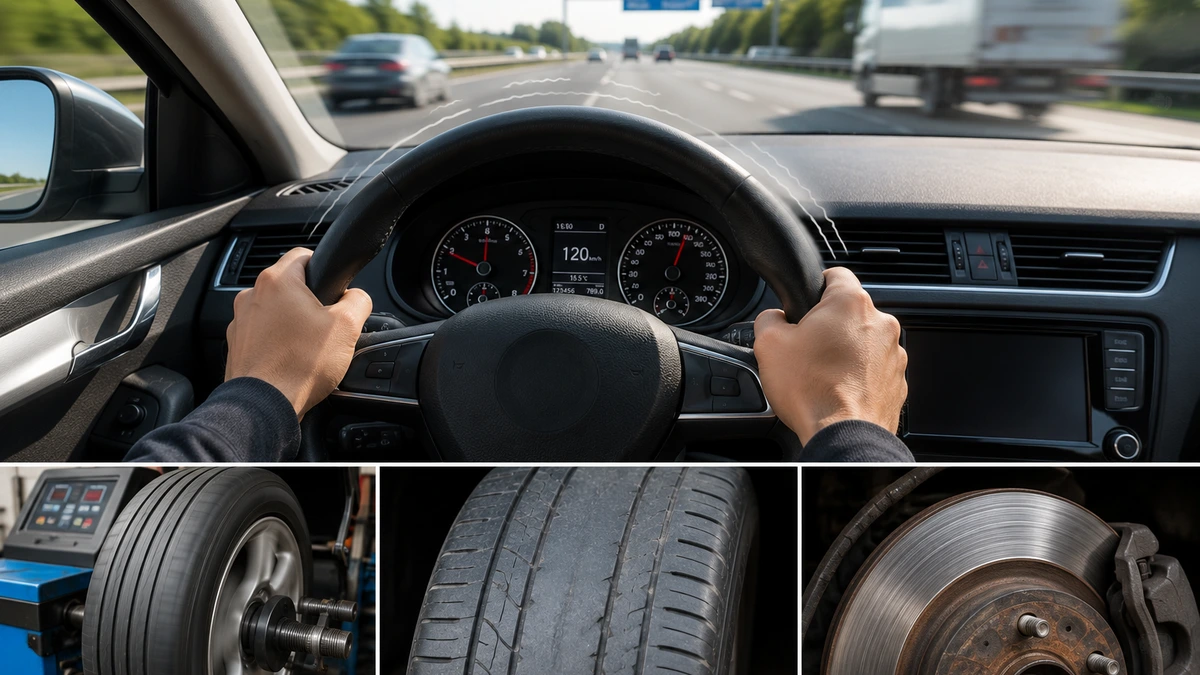
When a car vibrate at highway speed situation develops — a steering wheel buzz, seat vibration, or floor tremor that appears above a specific speed and may increase, decrease, or disappear as speed changes — the vehicle is communicating that something rotating at highway speeds is not balanced, not smooth, or not correctly aligned. This fault is both a comfort issue and a safety concern: highway-speed vibration increases driver fatigue, reduces steering precision, and in severe cases indicates component wear that will eventually produce control loss.
At Rapid Rev Garage in Al Quoz, every car vibrate at highway speed complaint is diagnosed with a road test at the specific speed that produces the vibration, combined with wheel balancing assessment, tyre inspection, and driveline physical checks — confirming the exact cause before any component is replaced.
Car Vibrate at Highway Speed — Quick Verdict
A car vibrate at highway speed fault in Dubai is most commonly caused by one of four faults: wheel and tyre imbalance — the most frequent cause, where the rotating mass of the wheel and tyre assembly is not uniformly distributed around its axis; tyre damage from speed bumps or pothole strikes that has produced an internal tyre structural fault; wheel damage producing runout that no balancing weight can correct; or a driveshaft or propeller shaft that has lost a balance weight or developed a universal joint fault. The speed-specific character — appearing at a defined speed and changing with speed — is the critical diagnostic marker. A vibration that appears at exactly 110–120 km/h on the Dubai-Abu Dhabi highway and reduces above and below this range is almost certainly a wheel balance resonance. One that progressively worsens with speed is more likely a tyre or driveshaft structural fault.
Table of Contents
- Speed-Specific Vibration — The Primary Diagnostic Tool
- Wheel and Tyre Imbalance — The Most Common Highway Vibration
- Tyre Structural Damage — The Dubai Speed Bump Factor
- Wheel Damage and Runout
- Driveshaft and Propeller Shaft Imbalance
- Steering and Suspension Wear at Highway Speed
- How Dubai’s Roads Create Highway Vibration Faults Specifically
- How We Confirm the Cause at Rapid Rev Garage
- The Right Fix for Each Confirmed Cause
- What Happens If Highway Vibration Is Left Without Repair
- Is It Safe to Drive?
- How Long the Repair Takes
- What the Repair Costs in Dubai
- Preventing Highway Speed Vibration in Dubai
- Why Rapid Rev Garage?
- FAQ
- Conclusion
Speed-Specific Vibration — The Primary Diagnostic Tool
The speed-vibration relationship is the most useful diagnostic information when a car vibrate at highway speed complaint is presented before any inspection begins.
Vibration That Appears at a Specific Speed and Reduces
A car vibrate at highway speed resonance pattern appears at a specific range — say, 100–120 km/h — and reduces or disappears above and below this range is a resonance-driven vibration. A specific component’s natural frequency is being excited at the speed that corresponds to the rotation rate that produces resonance. This pattern is classic for wheel imbalance — the imbalance weight excites the suspension’s natural frequency at the speed where the wheel’s rotation rate matches that frequency.
Vibration That Progressively Worsens With Speed
A vibration that begins at moderate speed and worsens progressively as speed increases — rather than appearing and disappearing at specific ranges — is from a component that is increasingly out of balance or misaligned at higher rotational speeds. This pattern is typical of tyres with internal structural faults (flat spots, separated belts) or driveshafts that have lost a balance weight — where the imbalance force grows with rotational speed.
Vibration Through Steering Wheel vs Floor vs Seat
Where the vibration is felt helps identify which axle is affected. Vibration felt primarily through the steering wheel is from the front wheels — front wheel imbalance, front tyre damage, or front wheel runout. Vibration felt primarily through the floor or seat — with minimal steering wheel involvement — is from the rear wheels or the propeller shaft on rear-wheel-drive vehicles. Both front and rear vibration together may indicate a driveshaft fault or multiple wheel balance issues simultaneously.
Wheel and Tyre Imbalance — The Most Common Highway Vibration
Wheel and tyre imbalance is the most frequent cause when a car vibrate at highway speed — and it is also the most directly correctable cause.
What Causes Imbalance
A new tyre-and-wheel assembly is never perfectly balanced from manufacture — small weight variations in the tyre construction and minor wheel weight distribution differences mean every assembly requires balancing weights to achieve uniform mass distribution. Over time, balance weights can be knocked off by kerb contact, car wash machinery, or road debris. Tyre wear also changes the weight distribution of the tyre — a tyre that was correctly balanced when new may develop imbalance as its tread wears unevenly.
How Imbalance Produces Speed-Specific Vibration
An imbalanced wheel assembly generates a centrifugal force as it rotates. At low speeds, this force is small and the suspension absorbs it without producing noticeable vibration. As speed increases, the centrifugal force grows with the square of rotational speed — and at a specific speed range, the force is large enough to excite the suspension’s resonant frequency. The driver notices a vibration at this specific speed range that may reduce at higher speeds when the suspension’s response to the excitation changes.
Why Dubai Road Kerbs Knock Balance Weights Off
Dubai’s road kerbing in residential areas, mall car parks, and roadside parking strips produces an unusually high frequency of wheel-kerb contact events. Each significant kerb contact has the potential to knock a balance weight off the wheel — immediately debalancing the wheel and creating a highway vibration that the driver will notice on the next highway drive. Our car mechanic team checks all four wheels for missing balance weights before any balancing run — confirming weight loss from kerb contact before correcting it.
Tyre Structural Damage — The Dubai Speed Bump Factor
Dubai’s speed bump density means every vehicle crosses dozens of speed bumps per day. A tyre that is impacted at high speed on a speed bump or pothole can develop internal structural damage — belt separation, cord damage, or deformation of the tyre carcass — that produces vibration at highway speed regardless of correct balance.
How Internal Tyre Damage Produces Vibration
A tyre with separated belts or a bulge in its sidewall rotates with an uneven radius — the damaged area produces a periodic impact with the road on every revolution. At highway speed, this periodic impact becomes a high-frequency vibration that no amount of wheel balancing can correct — because the vibration is from the tyre’s structural irregularity, not from weight distribution.
The Speed Bump Combination Hit
A particularly damaging event occurs when a vehicle crosses a speed bump at significantly above the recommended speed — or when a tyre impacts the vertical face of a speed bump directly. This high-energy impact can produce internal belt damage on the tyre that is not visible externally — the sidewall appears intact — but that causes progressive vibration at highway speed. Tyre sidewall inspection under load (on the vehicle, after driving) or on a tyre machine reveals the bulge or irregularity that confirms structural damage.
When Balance Cannot Fix Highway Vibration
Where four-corner wheel balancing has been performed correctly but the highway vibration persists, internal tyre structural damage is the first subsequent cause to investigate. A road force variation test — which measures the tyre’s force variation as it rolls under load — identifies structural irregularity that standard balancing cannot detect.
Wheel Damage and Runout
A wheel that has been bent from a pothole, kerb strike, or speed bump impact no longer rotates in a true plane — it wobbles slightly as it rotates. This runout produces a periodic load variation on the tyre contact patch that creates vibration at highway speed.
Lateral vs Radial Runout
Lateral runout — the wheel wobbling side to side as it rotates — produces a steering wobble and side-force variation that the driver feels primarily as steering instability. Radial runout — the wheel being out of round — produces a vertical force variation at each revolution that is felt primarily as a bounce or thump. Both are measured on a runout gauge during wheel removal.
Why Balancing Weights Cannot Correct Runout
Balancing addresses weight distribution — the forces produced by uneven mass. Runout is a geometric fault — the wheel is not round or not flat. Adding weights to an out-of-round wheel may reduce the vibration at one speed but will not correct the underlying geometric fault. A bent wheel requires straightening or replacement. For any breakdown from a severe tyre or wheel failure, our roadside assistance covers Al Quoz and nearby Dubai areas.
Driveshaft and Propeller Shaft Imbalance
On rear-wheel-drive and four-wheel-drive vehicles — which includes the Toyota Land Cruiser, Prado, Fortuner, Nissan Patrol, Ford Ranger, and most commercial pickups in Dubai — a propeller shaft that has lost a balance weight or developed a universal joint fault produces highway-speed vibration through the floor and seat specifically.
Lost Propeller Shaft Balance Weight
Propeller shaft balance weights are welded to the shaft — but corrosion, rust, or a direct impact can separate a weight. The resulting imbalance produces a vibration that increases with speed and is most prominent at highway cruise — because the shaft is rotating at high speed and the imbalance force is at its maximum.
Universal Joint Wear
A universal joint with worn needle bearings produces an irregular drive transmission that creates a vibration at a frequency determined by the shaft rotation speed. This vibration is most notable on smooth highway surfaces where there is no road noise to mask it — and it may also produce a clunk during acceleration transitions. Our car service packages include a propeller shaft balance weight and universal joint inspection at every major service for rear-wheel-drive vehicles.
Steering and Suspension Wear at Highway Speed
Worn suspension components can produce or amplify highway-speed vibration by reducing the suspension’s ability to control wheel movement.
Worn Wheel Hub Bearings
A wheel hub bearing with play allows the wheel to wobble slightly as it rotates — producing a vibration that increases with speed and is often accompanied by a humming or droning noise that changes pitch when the vehicle changes direction. A hub bearing vibration is typically continuous rather than speed-band-specific.
Loose or Worn Steering Components
Tie rod ends with play allow the wheel to respond to road surface irregularities with a vibration that is felt through the steering wheel at highway speed. This steering wheel shimmy is amplified at the speed ranges where the suspension’s natural frequencies are excited by the road input.
How Dubai’s Roads Create Highway Vibration Faults Specifically
Dubai’s road environment produces the tyre and wheel faults behind most car vibrate at highway speed complaints through specific mechanisms.
Speed Bump Impact Frequency
The density of speed bumps on Dubai’s residential, commercial, and school zone roads means the average Dubai vehicle crosses significantly more speed bumps per year than any vehicle in a speed-bump-free road environment. Each crossing at above-minimum speed applies a high-energy impact to the tyre sidewall and the wheel rim — accumulating the internal tyre damage and wheel bend risk that produces highway vibration.
Pothole Strikes in Commercial Areas
Al Quoz and other commercial areas have higher pothole density than residential Dubai — from the heavy vehicle traffic that stresses road surfaces. A pothole strike that damages a tyre or bends a wheel at 50 km/h in an Al Quoz industrial street produces a highway vibration that the driver first notices on the drive home up Sheikh Zayed Road.
Temperature Cycling Accelerates Tyre Casing Fatigue
The daily temperature cycling between cool underground parking and peak summer road temperatures accumulates thermal fatigue in tyre casing rubber faster than stable-temperature markets. This fatigue contributes to belt separation in older tyres at lower mileages than the same tyre would experience in a temperate climate. A tyre that would remain structurally sound for 60,000 km in a European climate may develop belt issues at 40,000–50,000 km in Dubai’s thermal cycling.
How We Confirm the Cause at Rapid Rev Garage
The diagnostic sequence starts with the road test at the specific speed that produces the vibration.
Speed-Specific Road Test First
The road test is conducted at the speed the driver reports as producing the vibration. The vibration character — resonance-band or progressive — is observed. Steering wheel vs floor vibration location is confirmed. This narrows the investigation to front or rear wheels, and to balance or structural fault, before any wheel is removed.
Four-Corner Wheel Balancing Run
All four wheels are balanced on a dynamic balancing machine. Missing weights are identified and replaced. Wheels are checked for runout on the machine.
Tyre Inspection Under and Off the Vehicle
Tyres are inspected for bulges, flat spots, and uneven wear patterns. Any tyre showing a sidewall bulge is marked for replacement regardless of balancing result — because structural damage cannot be corrected by balancing.
Propeller Shaft and Driveshaft Physical Inspection
For vehicles with rear-wheel or four-wheel drive, the propeller shaft is inspected for balance weights and universal joint condition. Any shaft with a missing weight or with play in its universal joints is assessed for reconditioning or replacement.
The Right Fix for Each Confirmed Cause
The repair is matched to the specific cause confirmed by the road test and inspection findings.
Four-Corner Wheel Balancing
Correctly performed dynamic balancing with the correct weight placement corrects imbalance vibration immediately — confirmed by a post-balancing road test at the speed that previously produced the vibration.
Tyre Replacement for Structural Damage
Any tyre with confirmed internal structural damage — belt separation, sidewall bulge, or severe flat spot — is replaced with the correct specification for the vehicle. Fitting a structurally compromised tyre that appears balanced is a safety risk at highway speeds.
Wheel Straightening or Replacement
A bent wheel with measurable runout is straightened if the bend is within the correctable range — or replaced with a correct-specification wheel where the bend is beyond straightening tolerance or has compromised the wheel’s structural integrity.
Propeller Shaft Rebalancing or Universal Joint Replacement
A propeller shaft with a missing balance weight is rebalanced at a specialist driveshaft workshop. A shaft with worn universal joints has the joints replaced with correct-specification needle-bearing units. Post-replacement, a highway road test confirms the floor vibration has resolved. For exterior repairs needed alongside wheel or driveline work, our car painting team handles colour-matched repairs at the same visit.
What Happens If Highway Vibration Is Left Without Repair
Highway vibration left without investigation produces specific and progressive consequences.
Imbalance Wear Damages Suspension Components
An imbalanced wheel assembly vibrating continuously at highway speed applies cyclic loads to the wheel hub bearing, the tie rod end, and the shock absorber — components designed for smooth loading, not for continuous vibration. Extended highway driving with an imbalanced wheel accelerates wear in these components beyond their normal service life.
Structural Tyre Damage Risks Sudden Failure
A tyre with internal structural damage that is producing highway vibration is at risk of sudden failure — a blowout or rapid deflation at highway speed. This is the most serious consequence of ignoring highway vibration from tyre structural damage. At 120 km/h on Emirates Road, a sudden tyre failure has severe safety implications.
Is It Safe to Drive?
The safety assessment depends on the confirmed or likely cause.
Imbalance Only — Driveable, Book This Week
A vibration from wheel imbalance with no suspected tyre or wheel damage is driveable for careful highway use. Book within the week.
Suspected Tyre Structural Damage — Do Not Drive at Highway Speed
A vibration accompanied by a visible sidewall bulge or a recently-sustained speed bump or pothole impact should not be driven at highway speed before the tyre is inspected. Drive carefully to the nearest workshop for tyre assessment.
How Long the Repair Takes
Repair time depends on the confirmed cause — balancing is the fastest, propeller shaft work takes several hours.
Four-Corner Balancing
45–60 minutes including road test confirmation.
Tyre Replacement
30–60 minutes per tyre including remounting, balancing, and torque confirmation.
Wheel Straightening or Replacement
One to three hours depending on the number of wheels and the access complexity.
Propeller Shaft Work
Two to four hours for universal joint replacement including road test confirmation.
What the Repair Costs in Dubai
Cost depends on the confirmed cause — balancing is the most affordable, wheel and driveshaft work costs more.
Balancing and Tyres
Four-corner wheel balancing: AED 150–300. Tyre replacement: AED 250–800 per tyre depending on brand and specification.
Wheel and Driveline Work
Wheel straightening: AED 150–400 per wheel. Wheel replacement: AED 400–1,500 per wheel depending on specification. Propeller shaft universal joint replacement: AED 500–1,500. Propeller shaft rebalancing: AED 300–600. A written quote follows the road test and inspection findings. Our mobile car mechanic covers Al Quoz and nearby Dubai areas for on-site tyre and wheel visual assessment.
Preventing Highway Speed Vibration in Dubai
Two habits prevent the most common causes of highway-speed vibration in Dubai’s road environment.
Speed Bump Approach Speed
The most effective prevention for both tyre structural damage and wheel bending is crossing speed bumps at the recommended approach speed — typically 10–15 km/h for the sharper profile bumps common in Dubai. A vehicle that consistently approaches speed bumps at appropriate speed eliminates the primary cause of internal tyre damage and wheel bending in Dubai’s road environment.
Regular Tyre Age and Condition Assessment
Tyre age assessment — confirming no tyre on the vehicle is more than five years old regardless of remaining tread — prevents the casing fatigue that contributes to belt separation and highway vibration. Our garage near me location in Al Quoz serves drivers from Business Bay, Jumeirah, Barsha, Satwa, Downtown, and the Sheikh Zayed Road corridor.
Why Rapid Rev Garage?
When a car vibrate at highway speed, the speed-specific road test — conducted at the exact speed that produces the vibration — is the diagnostic starting point. The vibration character at that speed tells us whether we are dealing with a balance resonance, a structural tyre fault, or a driveshaft imbalance. All three require different repairs, and the road test distinguishes them before any wheel is removed.
FAQ — Car Vibrate at Highway Speed
These are the questions most frequently asked about highway speed vibration at our Al Quoz workshop.
Why does my car vibrate at 100–120 km/h but feel smooth above and below this range?
This is a classic balance resonance pattern — the imbalanced wheel's rotation frequency matches the suspension's natural frequency at this specific speed range. Above and below this range, the resonance condition doesn't exist and the vibration reduces. Wheel balancing resolves this pattern in most cases.
Can a single tyre cause highway vibration?
Yes — a single imbalanced or structurally damaged front tyre produces steering wheel vibration at highway speed. A single rear tyre fault produces floor and seat vibration. Identifying which wheel is causing the vibration is part of the road test and inspection process.
Can alignment cause highway vibration?
Incorrect alignment causes handling issues — pulling to one side, poor return-to-center — but does not typically cause the speed-specific resonance vibration associated with balance or tyre structural damage. Alignment affects the angle at which tyres contact the road; balance affects the smoothness of wheel rotation.
How often should wheels be balanced in Dubai?
After every tyre rotation (every 10,000–15,000 km), after any significant kerb or pothole impact, and whenever highway vibration appears. Dubai's kerb contact frequency makes reactive balancing after specific events more relevant than a fixed interval.
My car was balanced recently but it still vibrates — what else could it be?
If balancing was performed correctly and the car vibrate at highway speed issue persists, the next possibilities are internal tyre structural damage (not correctable by balancing), wheel runout (a bent wheel), or a driveshaft balance or universal joint fault. The road force variation test distinguishes tyre structural fault from balance fault definitively.
Conclusion
A car vibrate at highway speed in Dubai has a specific cause — most commonly wheel imbalance, tyre structural damage from speed bump impacts, or driveshaft fault — identified by the speed-specific road test before any wheel is removed. The progressive versus resonance-band character of the vibration directs the diagnostic to the correct component category.
Rapid Rev Garage in Al Quoz confirms the vibration character, performs four-corner balancing, inspects tyres for structural integrity, and assesses the driveshaft before recommending any repair beyond balancing.
Rapid Rev Garage is in Al Quoz, serving drivers across nearby Dubai areas — Business Bay, Jumeirah, Downtown, Barsha, Satwa, and the Sheikh Zayed Road corridor. Book your appointment on WhatsApp or find us on Google Maps.
Rapid Rev Garage — Car Vibrate at Highway Speed | Al Quoz, Dubai