Dubai driving is hard on brakes. Stop-start traffic on Sheikh Zayed Road, high-speed deceleration from 120 km/h on the Abu Dhabi highway, and sustained heat that pushes brake components beyond what European service schedules account for — it all adds up. For Mercedes owners, getting Mercedes brake repair done right isn’t just about noise or warning lights. It’s about keeping a precision braking system working the way it was engineered to.
At Rapid Rev Garage, we handle Mercedes brake repair across all current models — C-Class, E-Class, GLC, GLE, S-Class, Vito, and Sprinter. Every job starts with a proper inspection. Nothing gets ordered until we know exactly what needs doing.
Mercedes Brake Repair in Dubai — What the Heat and Traffic Are Actually Doing
Most Mercedes owners in Dubai know the brakes need checking at some point. What’s less understood is how quickly Dubai conditions accelerate brake wear compared to factory service assumptions.
Brake pads on a Mercedes in moderate European conditions typically last 40,000–60,000 km. In Dubai, that range commonly shortens to 25,000–40,000 km depending on model and driving pattern. The GLE and S-Class are heavier vehicles — the braking force required to stop them repeatedly in Business Bay traffic is significantly higher than the same car on a German autobahn. Heat causes brake pads to glaze faster, reducing effectiveness even before they’re worn through. And fine dust particles from Al Quoz’s industrial surroundings embed in pad surfaces and accelerate rotor wear.
Mercedes brake repair that ignores these local factors — just swapping pads at whatever interval the service book says — isn’t proper servicing. It’s catching up after the damage is already done.
Warning Signs Your Brakes Need Attention Now
These symptoms point to a brake system that needs attention now, not at the next scheduled service:
Squealing or grinding — Squealing usually means pad wear is approaching the sensor. Grinding means metal-on-metal contact is already happening. Either way, continuing to drive causes rotor damage that makes the repair more expensive.
Vibration through the pedal — Usually warped rotors from heat cycling. Common on Dubai highway drivers who brake hard from speed regularly. The rotor gets hot, cools unevenly, and develops thickness variation that causes pedal pulsation.
Soft or spongy pedal — Brake fluid has absorbed moisture, or there’s air in the hydraulic circuit. DOT 4 fluid is hygroscopic — it pulls moisture from the air over time. In Dubai’s climate that process happens faster than the two-year replacement schedule accounts for.
Pulling to one side under braking — A seized caliper or uneven pad wear on one side. Left alone this causes uneven rotor wear and pulls the steering during braking — a handling issue, not just a brake issue.
Brake warning light — Mercedes brake pad wear sensors are model-specific and need replacing alongside the pads. A workshop that swaps pads without replacing the sensor leaves the warning system unreliable for the next wear cycle.
Our car mechanic team checks all of these at every service visit — physically measured pad thickness, rotor surface condition, caliper movement, and a full brake system diagnostic scan. Not just a visual look.
Mercedes Brake Repair — Pads, Rotors, and Calipers
Brake Pads
Mercedes uses electronic wear sensors on most models — a wire embedded in the pad that completes a circuit to the dashboard warning system when the friction material wears down. The correct pad specification matters. Using a generic aftermarket pad on a GLE or E-Class that doesn’t match the original friction coefficient changes the brake feel, increases stopping distance, and can damage rotors through incompatible compound hardness.
We use OEM-specification brake pads at Rapid Rev Garage for every Mercedes brake repair. Not because it’s a marketing point — because the braking system was calibrated around specific friction values, and changing that affects how the car actually stops.
Brake Rotors
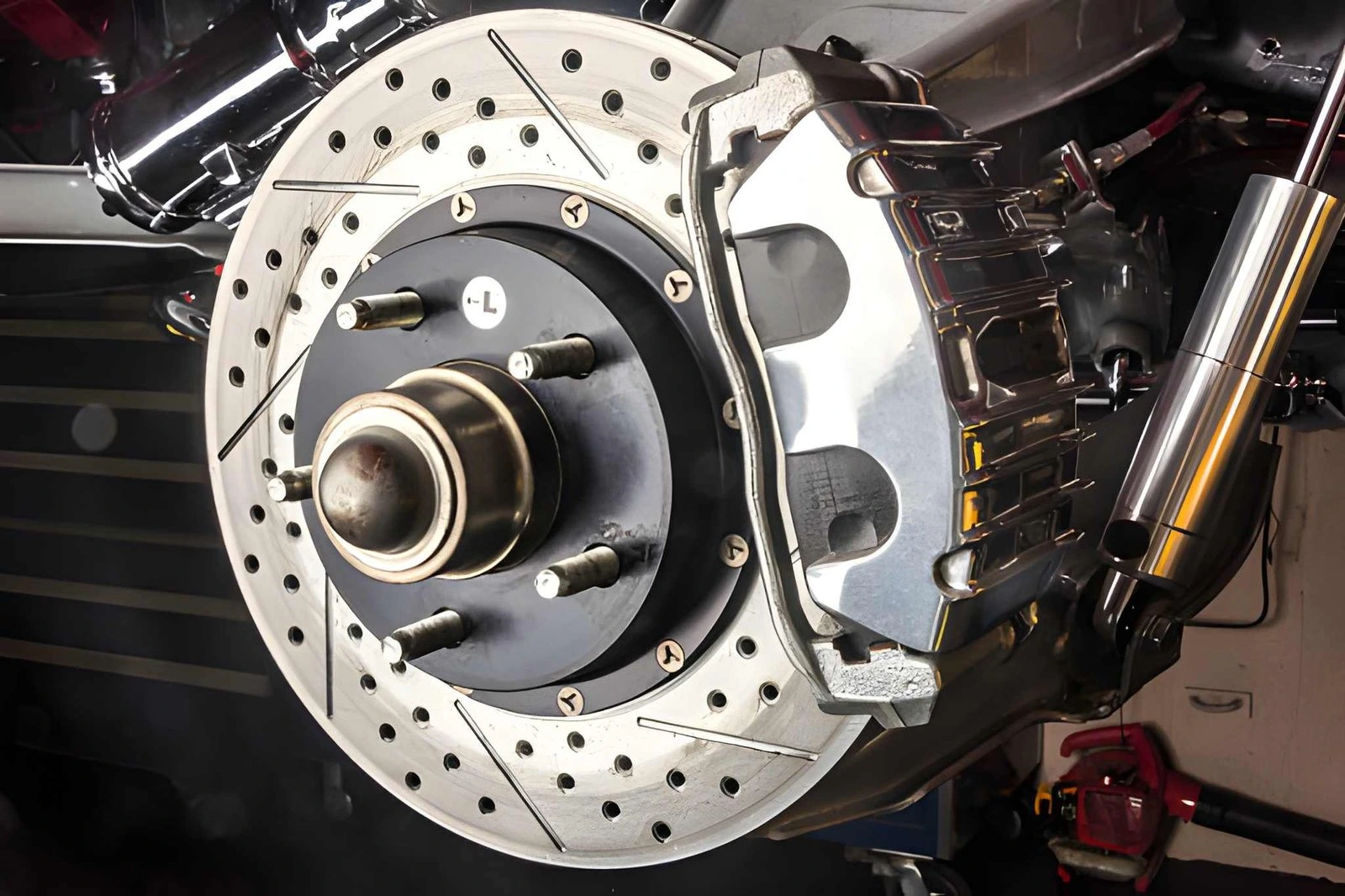
Rotors on a Mercedes aren’t just flat discs. GLC and GLE variants use internally vented cross-drilled or slotted rotors engineered to manage heat under load. When a rotor warps or develops deep scoring from running worn pads, resurfacing is sometimes possible — but only if there’s enough material thickness remaining. Below the minimum thickness, replacement is the only correct option.
A customer brought his E-Class in after feeling pedal vibration at highway speed. Another workshop had told him the pads were fine and the issue would “go away.” We measured rotor runout and found 0.18mm lateral variation on the front pair — well above the 0.05mm Mercedes tolerance. Both fronts replaced, new pads fitted at the same time. The vibration was gone on the test drive.
Brake Calipers
Caliper pistons seize. It happens on every brand, but in Dubai’s heat it happens faster on vehicles that sit in the sun daily. A seized front caliper drags the pad against the rotor permanently, causing rapid wear on one side, pulling under braking, and generating enough heat to damage the caliper beyond repair if it’s not caught. Our car service inspection process always includes a caliper piston check — we push back each piston and confirm it moves freely. If it doesn’t, that caliper gets rebuilt or replaced.
Brake Fluid — The Most Skipped Step in Any Brake Service
If there’s one component of Mercedes brake repair that gets skipped most often, it’s the brake fluid flush. It’s invisible, it doesn’t make noise when it degrades, and the car keeps braking normally until it doesn’t.
Fresh DOT 4 fluid has a wet boiling point around 155°C. Moisture-contaminated fluid — the kind that’s been in a Dubai car for three years — can have a wet boiling point below 120°C. Under hard braking from highway speed, brake temperatures regularly exceed that. Vapour forms in the brake lines. Vapour is compressible. The pedal goes soft. Stopping distances increase. This is brake fade, and it happens at the moment you most need the brakes to work.
Mercedes specifies brake fluid replacement every two years regardless of mileage. In Dubai’s humidity and heat, every 18 months is a smarter target. A full system bleed — all four corners — with fresh DOT 4 fluid is what’s needed. Not a top-up.
We include brake fluid condition testing as part of every full car service at Rapid Rev Garage. A moisture content reading above 3% means the fluid needs changing immediately.
ABS and Electronic Brake System Diagnostics
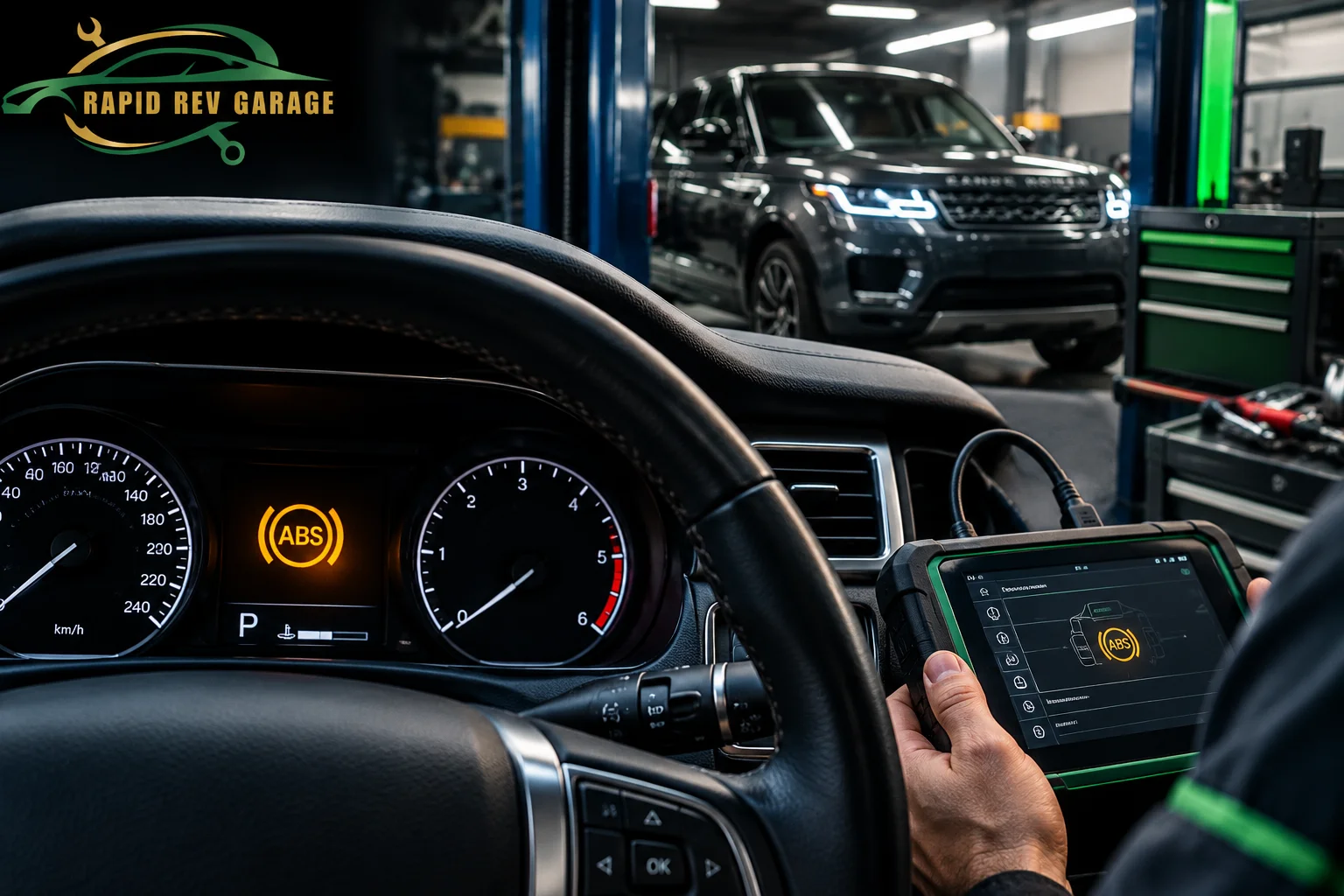
Modern Mercedes braking systems are more than pads and rotors. ABS, ESP, BAS (Brake Assist System), and PRE-SAFE braking all rely on wheel speed sensors, steering angle sensors, and brake pressure sensors communicating through the CAN bus. A fault in any one of these doesn’t just switch off a dashboard light — it can disable ABS, deactivate emergency braking assist, or cause the ESP to intervene incorrectly.
We run STAR-compatible diagnostic scans across all brake-related modules as part of every Mercedes brake repair at Rapid Rev Garage. Fault codes that haven’t triggered a warning light yet get caught and addressed before they affect system performance.
A Vito came in recently with an ABS warning that had been present for three weeks. The owner had been driving normally because “it stopped fine.” We found a failed rear left wheel speed sensor — ABS had been inactive the entire time. On dry roads in normal traffic it made no difference. On the wet road surface of a winter rain event while braking hard, it would have.
If you need help reaching us after a brake-related breakdown, our roadside assistance covers Al Quoz and nearby Dubai areas.
Choosing the Right Workshop for Mercedes Brake Repair in Dubai
A Mercedes brake repair at the wrong workshop costs more than the job itself. We see it regularly — customers who’ve had pads replaced at a general garage, come back six months later with rotor scoring, seized calipers, or a brake warning light that’s come on immediately because the wear sensor wasn’t replaced.
The difference at Rapid Rev Garage:
- STAR-compatible diagnostic equipment reads every brake module, not just the engine ECU
- OEM-specification pads and rotors for every Mercedes model variant
- Wear sensors replaced with every pad change as standard
- Full fluid condition test at every visit
- Caliper piston movement checked physically, not assumed
If you’re unsure whether your Mercedes needs brake attention or want someone to come to your location before the car is moved, our mobile car mechanic service covers the Al Quoz and nearby Dubai areas for on-site assessment.
Supporting Your Mercedes Beyond Brakes
While the car is with us for Mercedes brake repair, it makes sense to address anything else that’s due. Our garage near me location in Al Quoz is set up for full-service Mercedes work — engine oil, transmission, cooling system, electrical diagnostics, and car painting for any exterior damage. One visit, everything handled.
FAQ — Mercedes Brake Repair in Dubai
How often do Mercedes brakes need replacing in Dubai?
Brake pads typically last 25,000–40,000 km in Dubai conditions — shorter than European intervals due to heat, traffic, and heavier vehicles. Check at every service visit rather than waiting for the warning light.
Why is my Mercedes brake pedal soft or spongy?
Usually degraded brake fluid with high moisture content, or air in the hydraulic circuit. A full brake fluid flush resolves it in most cases. If the pedal stays spongy after a flush, a caliper or master cylinder fault needs investigating.
Can I just replace pads without changing rotors?
Only if rotors are within minimum thickness tolerance and show no scoring or warping. Fitting new pads on damaged rotors accelerates pad wear and doesn't restore full braking performance.
Does the brake wear sensor need replacing with the pads?
Yes, always. Mercedes wear sensors are single-use — once they've triggered or been removed, they don't give accurate readings. Reusing an old sensor leaves the warning system unreliable.
Why do my Mercedes brakes squeak after a wash or overnight parking?
A thin layer of surface rust forms on rotors when they're wet or haven't been used. It clears after the first few brake applications and is completely normal. Persistent squeaking after driving is a different issue — worn pads or glazed pad surfaces that need attention.
In Conclusion
Brakes are the single most safety-critical system on any car. On a Mercedes — with its weight, speed capability, and precision electronics — Mercedes brake repair done properly keeps the whole system working as engineered. Done halfway, it creates problems that show up at the worst possible moment.
Rapid Rev Garage is in Al Quoz and serves Mercedes owners across nearby Dubai areas — Business Bay, Jumeirah, Downtown, Satwa, and Sheikh Zayed Road corridor. Book your appointment on WhatsApp today and find us on Google Maps.
Rapid Rev Garage — Mercedes Brake Repair | Al Quoz, Dubai and Nearby Areas