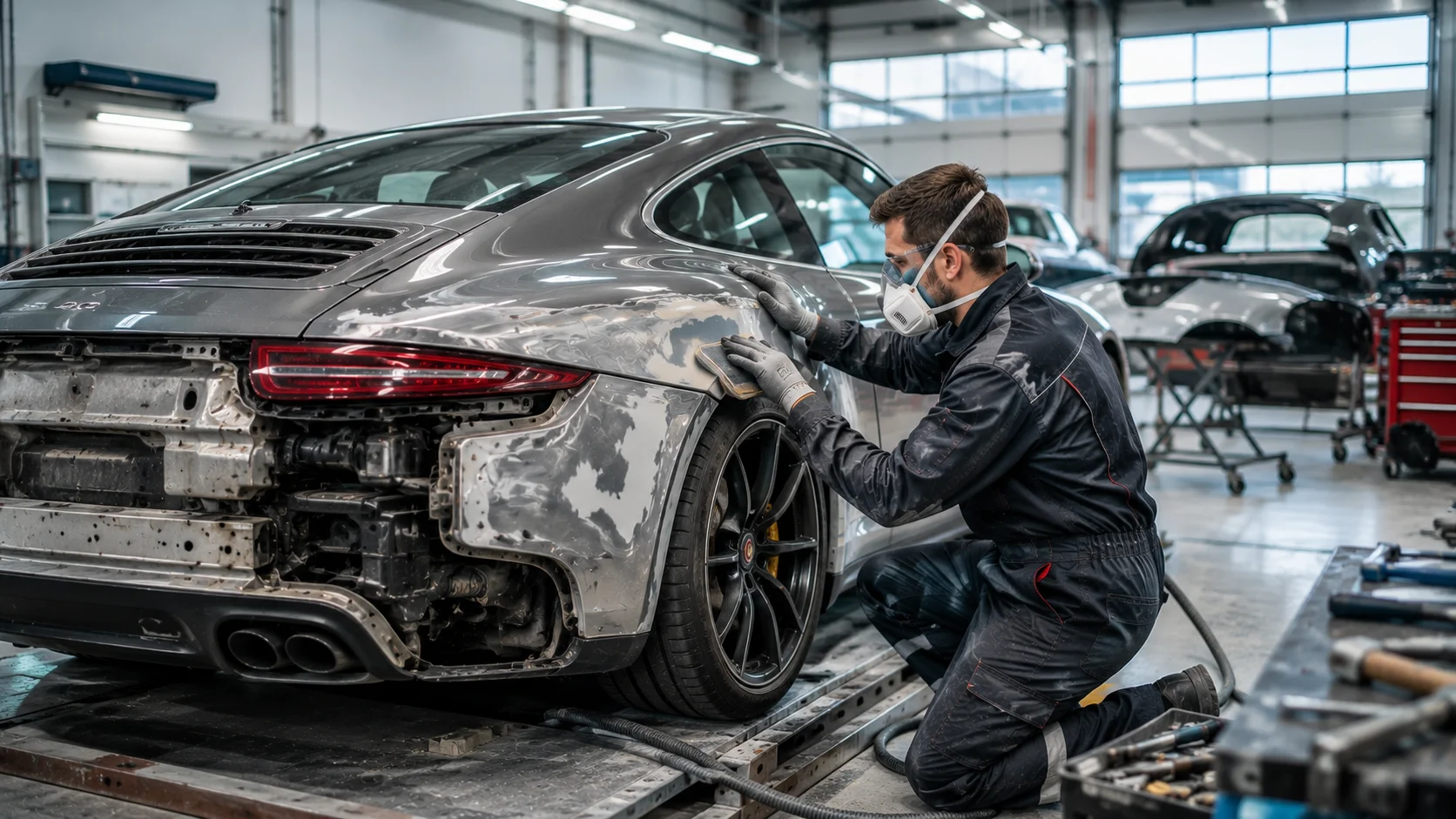
Porsche builds vehicles to tighter tolerances than most premium brands — and that precision extends to the bodywork. Panel gaps on a Porsche 911 are tighter and more consistent than on most competitors. The shut lines on a Cayenne are more uniform. The surface quality of a Panamera’s paint is applied in more layers with greater thickness consistency than standard production vehicles.
When a Porsche sustains body damage — a parking lot impact on the Cayenne’s front quarter, a stone chip cluster on the 911’s bonnet, a more significant collision on the Macan — the repair standard required to restore that precision is higher than for most other vehicles. A repair that would be acceptable on a standard saloon is visible on a Porsche precisely because the original standard was higher.
Porsche body repair in Dubai requires a workshop that understands the material composition of Porsche’s body structures, the specific paint systems used across the model range, and the preparation discipline that makes the difference between a repair that’s invisible and one that reveals itself in Dubai’s strong directional light.
Porsche Body Repair Dubai — Why Porsche Body Standards Are Different
Porsche’s body construction varies significantly across the model range — and understanding what’s under the skin matters for correct Porsche body repair assessment.
The 911 (992) uses an aluminium-intensive mixed-material body structure — a combination of high-strength steel, aluminium alloy, and in some areas carbon fibre reinforced plastic. The aluminium components require different handling from steel — aluminium doesn’t respond to steel repair techniques, and mixing steel repair tools with aluminium panels causes galvanic corrosion that develops under the paint surface over months.
The Cayenne and Macan use predominantly steel body structures with aluminium bonnet and door skins on certain specifications. The Panamera uses an aluminium-intensive body similar to the 911.
A Porsche body repair workshop needs to know which material is in the specific panel being repaired — and apply the correct preparation, adhesive bonding, and welding technique for that material rather than a generic approach.
A Porsche 911 came to Rapid Rev Garage after a workshop had attempted to repair the front aluminium bonnet using conventional steel repair technique — applying filler directly over the aluminium without the correct aluminium-specific primer and preparation sequence. The repair looked acceptable initially. Within six weeks in Dubai’s heat, a network of fine cracks had developed in the filler layer as the aluminium expanded at a different thermal rate from the filler compound. The bonnet had to be stripped and redone correctly.
Porsche Body Repair — Model-Specific Considerations
Each Porsche model in Dubai’s market has specific body construction and paint system characteristics that a proper Porsche body repair assessment must account for.
Porsche 911
The 911 is Porsche’s most iconic model and the one where body repair standards are most immediately visible — the car’s proportions are so precisely defined that any deviation from correct panel profiles or gaps shows distinctively.
Aluminium Panel Handling
The 911’s aluminium door skins, bonnet, and certain body panels require specific repair approach — using aluminium filler rather than standard polyester filler, aluminium-compatible etch primer before any topcoat application, and repair technique that accounts for aluminium’s different flex characteristics compared to steel.
A dent in an aluminium 911 door that’s being repaired with standard polyester filler and steel-substrate primer is being set up for adhesion failure. The thermal expansion mismatch between aluminium and steel-formulated filler in Dubai’s heat cycling environment causes separation within months.
Carbon Fibre Components on GT Variants
911 GT3, GT3 RS, GT4, and Turbo S models carry significant carbon fibre body components — bonnet, front and rear diffusers, wing elements, and side skirts depending on specification. Carbon fibre Porsche body repair requires specific assessment — carbon fibre that’s been impacted doesn’t always show external damage but may have internal delamination that compromises the structural integrity of the component.
A carbon fibre component that looks cosmetically acceptable after an impact should be assessed for internal delamination before it’s cleared for continued use. Tapping the surface and listening for the characteristic dull sound of delaminated areas — rather than the solid resonant sound of intact carbon fibre — is the manual assessment method. Ultrasonic testing provides more definitive assessment of internal damage.
911 Panel Gap Restoration
The 911’s door and engine lid panel gaps are tighter than most vehicles — typically 3–4 mm compared to the 5–6 mm common on standard saloons. Any structural repair affecting body geometry must restore these gaps to within 0.5 mm of factory specification.
A Porsche body repair on a 911 that restores cosmetic appearance but leaves panel gaps visibly wider or narrower than factory specification hasn’t restored the car to the standard Porsche built it to.
Porsche Cayenne
The Cayenne is the most common Porsche in Dubai’s market — a family SUV that sees high daily mileage and the inevitable minor parking damage that comes with urban Dubai use.
Steel and Aluminium Mixed Body Structure
The Cayenne’s body mixes steel structural components with aluminium bonnet and door skins on higher-specification variants. A Porsche body repair assessment on the Cayenne must identify which specific panel is being repaired and confirm the material before selecting the correct preparation approach.
The Cayenne’s bonnet on many variants is aluminium — the same preparation and filler specification requirements apply as on the 911 aluminium components. Using polyester filler over the Cayenne’s aluminium bonnet is the same thermal mismatch error that causes cracking.
Turbo and Turbo S Widebody Bodywork
The Cayenne Turbo and Turbo S use wider rear bodywork — wider rear wings and arch extensions — that distinguish the performance variants from standard models. Damage to these rear arch areas requires correct replacement parts specification to maintain the model’s visual identity, and paint matching that accounts for the additional surface area the wider rear bodywork creates.
Self-Levelling Air Suspension and Recovery
The Cayenne’s air suspension lowers to the bump stops when the ignition is switched off. Any recovery of a damaged Cayenne must account for this — a flatbed is the correct recovery method, loaded with the vehicle in Transport Mode where available. Wheel-lift recovery on a deflated Cayenne air suspension risks additional suspension component damage.
Porsche Macan
The Macan is Porsche’s compact SUV and the model that sees the most parking-related minor body damage in Dubai’s tight urban parking environments.
High-Strength Steel Construction
The Macan uses a predominantly high-strength steel body structure — the same material that requires specific welding technique and heat management during structural repairs. High-strength steel loses its tensile properties if overheated during welding — standard MIG welding technique that would be acceptable on mild steel creates heat-affected zones in high-strength steel that reduce the repaired area’s structural strength.
A Porsche body repair on the Macan’s structural components must use controlled-heat welding technique — either specific MIG settings for high-strength steel or resistance spot welding that limits heat spread.
Macan GTS and S Front Fascia Complexity
The Macan GTS and S front fascia — with integrated air intake sections, lower valance styling, and camera or parking sensor integration — is more complex than the standard Macan front. Damage to these front fascia components requires the correct parts specification to maintain the aerodynamic and sensor integration function, not just the cosmetic appearance.
Porsche Panamera
The Panamera is Porsche’s executive saloon — a large, technologically complex body with a distinctive fastback roofline that creates specific repair challenges.
Aluminium Body Structure
The Panamera uses an aluminium-intensive body structure — extensive aluminium content across the floor structure, A, B, and C pillars on certain variants, and body panels. The full range of aluminium-specific repair techniques applies across the Panamera body more comprehensively than on the Cayenne.
Structural repairs on the Panamera’s aluminium body sections require specific aluminium MIG or TIG welding technique — steel welding equipment damages aluminium and contamination between steel and aluminium repair areas causes galvanic corrosion.
Panamera Sport Turismo Roof
The Panamera Sport Turismo variant’s estate roof structure creates a large glass panel area that’s vulnerable to stone chip damage and to water ingress if roof seals are disturbed during any repair work near the roof structure.
Paint Systems — What Makes Porsche Paint Different
Porsche’s factory paint application is more thorough than standard production vehicles — and that higher standard makes paint matching and Porsche body repair colour work more exacting.
Paint Layer Count and Thickness
Porsche applies paint in more layers than most manufacturers — a primer layer, a colour base coat, and a clear coat system that builds to a greater total film thickness than standard production vehicles. This thickness is part of what gives Porsche paint its depth and lustre — and it means a paint repair must build to the same total film thickness to match the surrounding original panels correctly.
A repair that applies colour and clear coat at standard film thickness on a Porsche will appear slightly flatter than the surrounding original — the reduced depth of the paint system catches the eye in Dubai’s strong directional light.
Porsche Exclusive and Special Colours
A significant proportion of Porsches in Dubai’s market are specified in Porsche Exclusive or special-order colours — colours that exist in Porsche’s records but aren’t part of the standard production palette. Repairing these colours requires the paint code from Porsche’s records, correct mixing to that specific formulation, and potentially reference paint samples to account for any colour drift from the vehicle’s specific application batch.
A Porsche body repair on an Exclusive Manufaktur colour without access to the correct paint formulation produces a colour approximation that’s visible immediately against the original panels. The solution is obtaining the correct formulation through Porsche’s paint data system before any mixing begins.
Specialist Finishes
Porsche Chalk
Chalk — Porsche’s distinctive light matte grey — is among the most technically demanding colours for Porsche body repair. It uses a matte clear coat rather than standard gloss clear — and matte clear cannot be polished. Any attempt to blend a Chalk repair into adjacent panels using standard polishing technique creates localised gloss spots that are visible immediately against the surrounding matte finish.
Chalk repair requires matte clear coat application from the start, with a blend zone executed without polishing — relying on spray application technique rather than post-cure polishing to achieve the blend.
Miami Blue, Shark Blue, and Other Pearl Colours
Porsche’s pearl colours use a three-stage paint process — base coat, pearl mid-coat, and clear coat. Matching a pearl colour requires replicating all three stages correctly, with the pearl mid-coat applied at the correct density to match the depth and luminosity of the original.
A repair that matches the base colour but doesn’t apply the pearl mid-coat produces a colour that matches from one angle and differs from another — the pearl effect varies with viewing angle, and missing the mid-coat makes this variation visible against the original.
The Preparation Sequence for Correct Porsche Body Repair
Preparation quality determines everything in Porsche body repair — the surface that paint is applied to determines whether the repair holds correctly in Dubai’s conditions.
Material-Correct Substrate Preparation
Before any filler or primer is applied, the substrate must be correctly prepared for its specific material. Aluminium panels require aluminium-specific etch primer before any filler contact. Carbon fibre components require carbon fibre-compatible primer and bonding agents. Steel and high-strength steel panels require surface preparation appropriate to the specific steel grade.
Applying standard polyester filler directly over aluminium or carbon fibre without correct primer and material-specific products is one of the most common preparation errors in budget Porsche body repair work — and the failure it produces in Dubai’s heat cycling environment is predictable.
Profile Accuracy Under Dubai’s Directional Light
Dubai’s strong low-angle sunlight is more revealing of panel profile errors than the diffuse light of European climates. A panel that was straightened to approximately the right shape reveals itself under raking afternoon light as a subtle shape anomaly — a slight flatness or a ripple that wasn’t there on the original pressed panel.
Correct Porsche body repair profile work involves iterative filler application and sanding — building up, sanding back, assessing the surface under directional light, and repeating until the profile is correct before any primer is applied.
UV-Resistant Clear Coat
Dubai’s UV index is among the highest globally. A clear coat applied without adequate UV stabiliser chemistry degrades faster than the surrounding original panels — the repair shows fading at the panel edges within months as the clear coat loses its gloss retention faster than the UV-resistant original.
A proper Porsche body repair in Dubai uses UV-resistant clear coat as standard — not as a premium option.
ADAS Calibration After Porsche Body Repair
Modern Porsche vehicles carry Advanced Driver Assistance Systems — lane keeping, adaptive cruise, automatic emergency braking — that use cameras and sensors mounted in areas commonly affected by collision damage.
Any Porsche body repair that disturbs camera or sensor mounting positions requires recalibration of the affected ADAS systems before the vehicle is returned to service. A windshield replacement, a front bumper replacement affecting the radar sensor, or a repair near the camera mounting area behind the rear-view mirror all require PIWIS-based recalibration.
A Porsche body repair workshop that completes the collision repair without addressing ADAS recalibration returns a car that looks repaired but has driver assistance systems operating on incorrect reference data — a safety concern that isn’t visible to the owner until the system fails to respond correctly in a situation where it matters.
Realistic Porsche Body Repair Costs in Dubai
Approximate figures for common Porsche body repair work at a quality independent in Al Quoz:
- Minor dent removal — PDR, paint undamaged Quality independent: AED 400–800
- Single panel respray — standard colour Quality independent: AED 800–1,500 | Dealer-authorised bodyshop: AED 1,800–3,500
- Single panel respray — Porsche Exclusive or pearl colour Quality independent: AED 1,200–2,500 | Dealer-authorised bodyshop: AED 2,500–5,000
- Front bumper replacement and respray Quality independent: AED 2,000–4,000 | Dealer-authorised bodyshop: AED 4,500–9,000
- Structural collision repair — multiple panels Quality independent: AED 5,000–15,000+ | Dealer-authorised bodyshop: AED 12,000–35,000+
- ADAS recalibration after body repair Quality independent: AED 400–700 | Dealer: AED 900–1,400
Between Major Repairs — Maintaining Porsche Paint in Dubai
Porsche body repair visits address damage when it occurs. Between those visits, Dubai’s UV and dust environment requires active maintenance to preserve the paint condition.
Paint protection film on high-impact areas — the bonnet leading edge, front bumper, door edges — prevents the stone chip accumulation that Dubai’s highways produce. A clear film applied over these areas deflects the stone impacts that would otherwise require frequent micro-repairs.
Regular washing with proper technique — adequate water to float debris before any cloth contact, avoiding dry wiping that drags abrasive particles across the clear coat — prevents the swirl mark accumulation that builds progressively on vehicles washed incorrectly in Dubai’s dusty environment.
For owners needing mechanical assessment alongside body repairs, a qualified car mechanic handles any mechanical concerns from the same collision — suspension components affected by an impact, cooling system concerns from a front collision.
A complete car service alongside body repair ensures mechanical and cosmetic condition are addressed in the same visit. When collision damage requires recovery before the car can reach the workshop, proper roadside assistance ensures the Porsche — particularly air-suspended variants — is transported correctly using flatbed only. For owners in Al Quoz and surrounding areas looking for a garage near me with genuine Porsche body repair capability — material-correct preparation, colour formulation from the correct paint data source, UV-resistant clear coat, and ADAS recalibration where required — the difference from a general bodyshop shows immediately in how the repair holds in Dubai’s first summer.
FAQ
Why is Porsche body repair more complex than standard car repair?
Porsche uses mixed materials — aluminium, high-strength steel, carbon fibre — across different models and panels, each requiring material-specific preparation, primer, and repair technique. Standard steel repair approaches cause adhesion failure and corrosion on aluminium and carbon fibre components.
How do I know if my Porsche has aluminium or steel panels?
A workshop with Porsche-specific knowledge confirms the material from the vehicle's body specification — the same model can have different panel materials depending on the trim level and specification.
Does Porsche Chalk colour require special body repair technique?
Yes — Chalk uses matte clear coat that cannot be polished. Blending a Chalk repair into adjacent panels requires spray application technique rather than the post-cure polishing used on gloss finishes.
Is ADAS recalibration always needed after Porsche body repair?
After any repair that disturbs camera or sensor mounting positions — windshield replacement, front bumper work, repairs near rear-view mirror area — yes. PIWIS-based recalibration is required before the ADAS systems operate correctly.
Can a Porsche body repair be invisible on specialist colours?
Yes — with the correct paint formulation from Porsche's paint data system, correct layer count, and proper blend zone technique. An approximation on a specialist colour is visible immediately; a correctly formulated repair isn't.
Conclusion
Porsche body repair in Dubai demands material-correct preparation for aluminium and high-strength steel components, correct paint formulation from Porsche’s data system for specialist and Exclusive colours, UV-resistant clear coat as standard, and ADAS recalibration where required — all applied with the preparation discipline that Dubai’s strong directional light will test thoroughly. The difference between a repair that’s invisible and one that reveals itself is entirely in the process before the paint goes on.
Rapid Rev Garage in Al Quoz handles Porsche body repair across the full model range — 911, Cayenne, Macan, Panamera, and Taycan — with material-correct preparation, correct paint data system access, and ADAS recalibration capability. Book your appointment on WhatsApp or find the workshop on Google Maps.