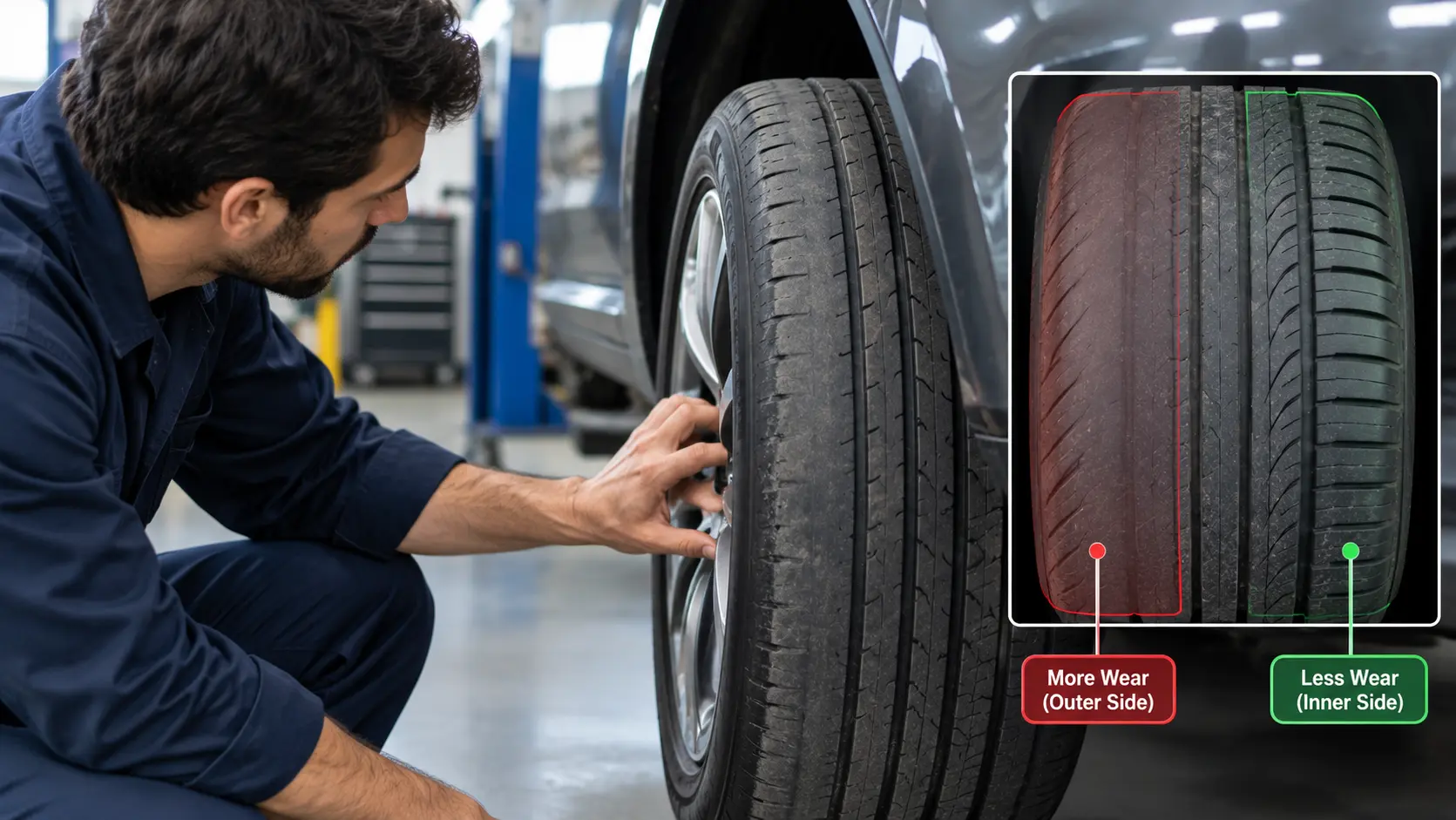
When tyre wearing unevenly develops — where one edge, centre, or patches wear significantly faster than the rest — is not a tyre quality problem. It is a diagnostic signal. The wear pattern tells a precise story about what is wrong with the vehicle’s alignment, suspension, or inflation.
In Dubai, tyre wearing unevenly is one of the most frequent tyre complaints — and one of the most preventable. The combination of heat that degrades rubber faster, speed bumps that disturb alignment, and high mileage from year-round daily driving accelerates uneven wear. A tyre wearing unevenly pattern at 15,000 km is a message that something needs fixing before the next set is fitted.
At Rapid Rev Garage in Al Quoz, every tyre wearing unevenly pattern is diagnosed and fix the root cause — so the replacement tyres wear correctly.
Tyre Wearing Unevenly — Quick Answer
Tyre wearing unevenly happens because the tyre’s contact patch is not loading evenly across its width. Each wear pattern points to a specific cause. Inner edge wear means excessive negative camber — the top of the tyre leans inward, overloading the inner edge. Outer edge wear means excessive positive camber or persistent underinflation. Centre wear means chronic overinflation — the tyre’s contact patch is arched, loading the centre more than the shoulders. Both-edges wear means chronic underinflation — the tyre is too flat, loading the shoulders more than the centre. Cupped or scalloped wear around the circumference means worn shock absorbers allowing the tyre to bounce and lose contact. Flat spots mean excessive braking or locking a wheel. Each pattern is a specific mechanical message. The fix addresses the cause, not the tyre.
Table of Contents
- How to Read a Tyre Wear Pattern
- Inner Edge Wear — Excessive Negative Camber
- Outer Edge Wear — Positive Camber or Persistent Underinflation
- Centre Wear — Chronic Overinflation
- Both-Edges Wear — Chronic Underinflation
- Cupped or Scalloped Wear — Worn Shock Absorbers
- Patchy or One-Sided Wear — Toe Misalignment
- Flat Spots — Emergency Braking or Locked Wheels
- How Dubai Accelerates Every Type of Uneven Wear
- How We Diagnose Tyre Wearing Unevenly
- The Services That Fix Each Confirmed Cause
- What Does the Repair Cost in Dubai?
- Why Rapid Rev Garage?
- FAQ
- Conclusion
How to Read a Tyre Wear Pattern
The wear pattern of a tyre wearing unevenly case is the clearest diagnostic tool available without removing any component. Understanding what each pattern means saves the driver from fitting a new set of tyres only to see them develop the same wear within 10,000 km.
Inspect the tread depth at three points across the width of each tyre: the inner shoulder, the centre, and the outer shoulder. Use a tread depth gauge — not just a visual estimate. A difference of 2mm or more between any two points on the same tyre confirms uneven wear.
Also inspect the tread around the full circumference — not just one point on the tread face. Cupping and flat spots are circumferential patterns that are invisible if only one part of the tyre is checked. Our car mechanic team measures tread depth at six points per tyre — inner, centre, and outer at two circumferential positions — before recommending any cause.
Inner Edge Wear — Excessive Negative Camber
Inner edge wear — the inner shoulder of the tyre significantly more worn than the centre or outer edge — is caused by excessive negative camber. The top of the tyre leans inward, shifting the tyre’s load onto the inner shoulder.
Causes of excessive negative camber: incorrect wheel alignment where camber is set or has drifted out of specification, worn control arm bushings that allow the arm to drop, worn ball joints that allow hub tilt, or sagged springs that lower ride height and increase camber beyond the design range.
The alignment measurement confirms whether the camber reading is outside specification. If it is out of range and cannot be corrected by alignment adjustment, a worn component — bushing, ball joint, or spring — is holding the geometry outside spec and must be fixed first.
Inner edge wear is the most common tyre wearing unevenly pattern in Dubai — inner edge wear on the front tyres from alignment disturbed by speed bump impacts and from bushings degraded by sustained heat.
Outer Edge Wear — Positive Camber or Persistent Underinflation
Outer edge wear — the outer shoulder significantly more worn than the centre — has two possible causes.
Excessive positive camber. The top of the tyre leans outward. This is uncommon on modern vehicles as a design feature but can develop from a collapsed suspension component or a spring that has broken and allowed the geometry to shift toward positive camber.
Persistent underinflation. An underinflated tyre bows outward at the sidewall. The contact patch is wider than designed and loads both shoulders more than the centre. This is identical to both-edges wear at moderate underinflation. At significant underinflation, the outer edge — which contacts the road more in turns — may wear faster.
Tyre pressure is the first check. If pressure is consistently correct and outer edge wear persists, camber measurement identifies any positive camber fault. Our car service packages include a tyre wear pattern check and inflation assessment at every major service.
Centre Wear — Chronic Overinflation
Centre wear — the centre of the tread significantly more worn than both shoulders — is the direct consequence of chronic overinflation.
An overinflated tyre is inflated beyond its designed pressure. The tyre becomes stiffer and more rounded in cross-section. The contact patch narrows — only the centre of the tread contacts the road under normal load. The shoulders lose contact. The centre carries the entire load and wears rapidly.
In Dubai, overinflation is sometimes the result of inflating tyres when hot — after a drive — rather than cold. A hot tyre reads 5–8 PSI higher than when cold. Inflating to the specified pressure when the tyre is already hot means the tyre is 5–8 PSI over when it cools down.
Always inflate to the door jamb specification with cold tyres — before the first drive of the day or after the car has been parked for at least two hours.
Both-Edges Wear — Chronic Underinflation
Both-edges wear — both inner and outer shoulders significantly more worn than the centre — is the classic underinflation pattern.
An underinflated tyre is too flat. The tyre deforms under the vehicle’s weight and the contact patch bulges at both edges — loading the shoulders more than the centre. The tyre runs hot from the increased flexing, and the rubber on both shoulders wears faster.
In Dubai, underinflation is common from two causes. The driver sets the pressure on a hot tyre and reads a higher figure — the tyre is underinflated cold. Or the tyre has a slow leak that is not noticeable in daily driving but consistently keeps the pressure below specification.
Both-edges wear is also harder on tyre structure than any other wear pattern — the excessive flexing stresses the sidewall cords. A tyre with significant both-edges wear may have compromised sidewall integrity even if the tread depth looks adequate. For any roadside tyre emergency, our roadside assistance team covers Al Quoz and nearby Dubai areas.
Cupped or Scalloped Wear — Worn Shock Absorbers
Cupped wear — rounded hollows or scalloped depressions that appear at intervals around the tyre circumference — is the wear pattern from worn shock absorbers.
A worn shock absorber allows the tyre to bounce after each road imperfection. Each bounce is a moment where the tyre loses contact with the road and then slams back down. The impact point on the tread wears more than the surrounding tread because of the increased contact force at the moment of impact. Repeated over thousands of road surface contacts, these impact points become visible as scalloped depressions.
Cupped wear appears on all tyres where the shock absorbers are worn — but is most visible on the rear tyres of rear-wheel-drive vehicles and on the front tyres of front-wheel-drive vehicles where the shock absorbers are most heavily loaded.
Confirming cupped wear confirms worn shock absorbers — the bounce test at each corner verifies the condition. Replacing the shock absorbers stops the cupping from developing on the new tyres. For any paint or body repairs needed alongside suspension work, our car painting team handles colour-matched repairs at the same visit.
Patchy or One-Sided Wear — Toe Misalignment
Toe misalignment produces a specific pattern that is different from camber-induced inner or outer edge wear. Toe wear is a feathered or sawtooth edge on one side of the tread blocks — the blocks are worn at an angle rather than straight across.
Running the hand across the tread blocks toward the car and then away from the car produces a distinct feeling — smooth in one direction, jagged in the other. This is the feathering that confirms toe misalignment.
Toe is the most common alignment angle to be disturbed by impacts in Dubai. A single sharp pothole strike at the front axle can shift the toe out of specification — producing tyre feathering within a few thousand kilometres.
Four-wheel alignment corrects toe immediately. Where the toe has been out of specification for a significant distance, feathering on the current tyres is permanent — but the new tyres will wear correctly after the alignment is set.
Flat Spots — Emergency Braking or Locked Wheels
A flat spot is a localised area of accelerated wear at one point on the tread circumference. It is produced by the tyre being dragged along the road surface while not rotating — either from a locked wheel under hard braking on a non-ABS vehicle, or from a parking brake applied while one wheel is still slightly moving.
A flat spot produces a thumping sensation at a specific speed — as the flat section of the tread contacts the road at each revolution. The thump is speed-dependent — it is a regular pattern at the speed where the flat-spot rotation matches a regular interval.
Mild flat spots can sometimes be partially corrected by normal driving over time — the high contact pressure around the spot gradually wears the rest of the tread to match. Severe flat spots require tyre replacement.
How Dubai Accelerates Every Type of Uneven Wear
Inner edge wear is accelerated by Dubai’s high speed bump density — each impact can shift alignment. The frequency of disturbance is higher than any European road environment.
Cupped wear is accelerated by the same speed bump density — more compression cycles per kilometre means shock absorbers complete their service life sooner.
Both-edges and centre wear are exacerbated by the difficulty of cold-check inflation in Dubai’s climate — tyres are often checked at operating temperature, producing a false reading.
All wear patterns are faster in Dubai because the rubber compound degrades faster in sustained heat and UV. A tyre that would last 40,000 km in a European climate may last 30,000–35,000 km in Dubai’s conditions even with correct inflation and alignment.
How We Diagnose Tyre Wearing Unevenly
Six-point tread depth measurement. Inner, centre, and outer at two circumferential positions on each tyre. The depth difference map identifies the pattern precisely.
Inflation check. All four tyres at cold pressure against the door jamb specification. Any underinflation or overinflation corrected.
Circumferential inspection. All four tyres run through a full rotation on the ramp to check for cupping, flat spots, and feathering.
Four-wheel alignment measurement. Camber, caster, and toe at all four corners. Out-of-specification readings and their relationship to the wear pattern documented.
Bounce test. Each corner assessed for shock absorber condition where cupped wear is present.
The Services That Fix Each Confirmed Cause
- Four-wheel alignment. Corrects toe and camber where within adjustment range. AED 200–400.
- Tyre pressure correction. Immediate. AED 0–50.
- Control arm bushing or ball joint replacement. Where camber is out of adjustment range. AED 500–1,500 per corner, including alignment.
- Shock absorber replacement. Where cupped wear is confirmed. AED 800–2,500 per axle.
- Tyre rotation. Redistributes wear and extends the life of the full set. AED 50–150. Our mobile car mechanic covers Al Quoz and nearby Dubai areas for on-site tyre wear and alignment assessment. Our garage near me in Al Quoz serves drivers from Business Bay, Jumeirah, Barsha, Satwa, Downtown, and the Sheikh Zayed Road corridor.
What Does the Repair Cost in Dubai?
| Service | Cost Range |
| Four-wheel alignment | AED 200–400 |
| Tyre pressure correction | AED 0–50 |
| Suspension component replacement | AED 500–2,500 per corner |
| Shock absorber replacement (per axle) | AED 800–2,500 |
| Tyre rotation | AED 50–150 |
All costs confirmed after tread depth mapping, pressure check, alignment measurement, and bounce test.
Why Rapid Rev Garage?
Every tyre wearing unevenly complaint is a symptom of a specific mechanical cause. Replacing the tyres without fixing the cause means the next set wears the same way. We read the wear pattern, identify the cause, fix it, and confirm the fix before fitting replacement tyres.
Every tyre wearing unevenly root cause must be fixed before replacement tyres are fitted — the new tyres wear on the inside within 10,000 km. Cupped wear without replacing the shock absorbers — the new tyres cup within 15,000 km. The wear pattern is the message. We fix what it is pointing at.
FAQ — Tyre Wearing Unevenly
Here are the questions Dubai drivers ask us most about uneven tyre wear.
Can I fix uneven tyre wear by rotating the tyres?
Rotation redistributes existing wear and extends the overall life of the set. It does not fix the cause of the uneven wear. If the cause — misalignment, wrong pressure, worn shocks — is not fixed, the rotated tyres will develop the same pattern in their new position. Fix the cause first, then rotate.
How do I check for uneven tyre wear myself?
Run your hand across the tread face toward and away from the car. Feathering feels like one direction is smooth and the other is rough. Use a coin or tread depth gauge at the inner, centre, and outer thirds of the tread. A difference of 2mm or more between any two points confirms uneven wear.
Does tyre rotation help with cupped wear?
Mild cupping can be partially addressed by rotating to a position where the tyre is less heavily loaded. But the shock absorbers that are causing the cupping must be replaced — otherwise the cupping continues at the new position. A tyre with significant cupping should be replaced alongside the shock absorbers.
How often should tyres be rotated in Dubai?
Every 8,000–10,000 km. Dubai's year-round driving and the speed bump density that accelerates front tyre wear make rotation intervals shorter than European recommendations. More frequent rotation keeps wear differences between axles manageable.
Why does only one tyre wear unevenly?
Single-tyre uneven wear points to a localised fault — an alignment issue at one specific corner, a shock absorber worn only on one side, or a slow leak keeping only that tyre underinflated. The alignment measurement and a slow leak test at the worn corner identify the specific cause.
Conclusion
Tyre wearing unevenly is a diagnostic message — each pattern identifies a specific cause in the alignment, inflation, or suspension system. Fitting new tyres without fixing the root cause guarantees the same pattern develops again within the first 10,000–15,000 km.
Rapid Rev Garage in Al Quoz confirms every tyre wearing unevenly cause, identifies the specific cause, fixes it, and confirms the fix before replacement tyres are fitted — so the next set lasts as it should.
Rapid Rev Garage is in Al Quoz, serving Business Bay, Jumeirah, Downtown, Barsha, Satwa, and the Sheikh Zayed Road corridor. Book your appointment on WhatsApp or find us on Google Maps.
Rapid Rev Garage — Tyre Wearing Unevenly | Al Quoz, Dubai