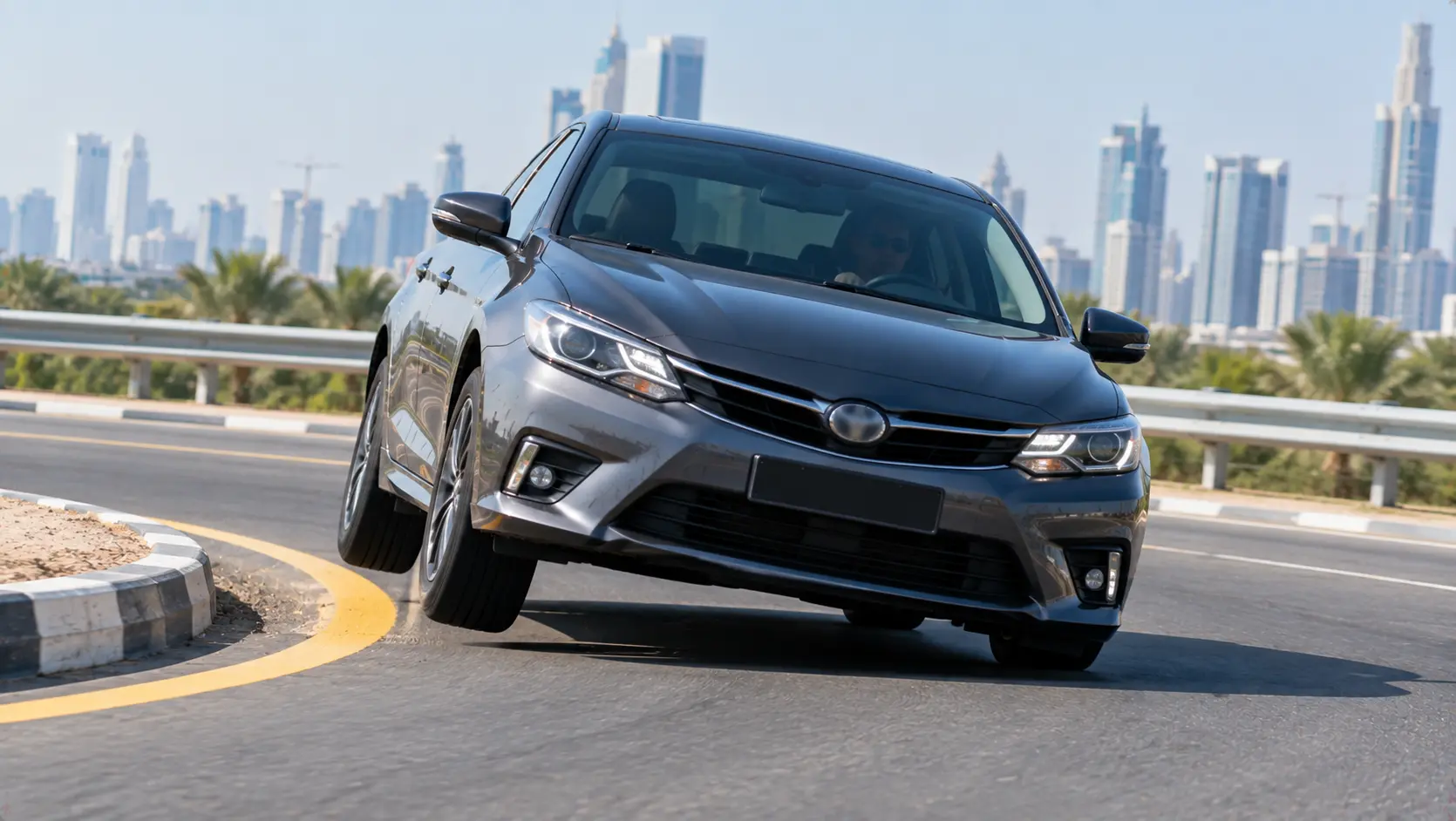
When a car lean while turning develops — the body rolling noticeably to the outside of every corner — is a suspension system that is no longer controlling body movement the way it was designed to. Some body roll in a corner is normal. Every car leans slightly into a turn because of the lateral G-force involved. But excessive roll — where the car tips significantly, the outside tyres feel overloaded, and passengers notice the lean — is a fault.
In Dubai, the car lean while turning complaint is triggered on every roundabout. Roundabouts, freeway ramps, and frequent U-turns all require cornering forces that expose a suspension system that has degraded. The driver noticing a car lean while turning that requires slowing at every roundabout has a suspension or anti-roll system that needs attention.
At Rapid Rev Garage in Al Quoz, every car lean while turning complaint is diagnosed with a loaded cornering road test and a full suspension inspection.
Car Lean While Turning — Quick Answer
A car leans excessively while turning because the suspension system’s resistance to body roll has been reduced. The components responsible for controlling body roll are the sway bar — also called the anti-roll bar — its bushings and end links, and the shock absorbers which control the rate of body roll. A worn sway bar bushing allows the bar to move in its mounting rather than transmitting the opposing force it should. A broken or disconnected sway bar end link disconnects one side of the bar from the suspension — the bar no longer functions as a roll resistance system. Worn shock absorbers allow the body to roll at a higher rate than the system was designed for. A broken or heavily sagged spring on one corner lowers that side of the car and increases its roll tendency. In Dubai, heat-degraded sway bar bushings and worn end links are the most frequent causes.
Table of Contents
- How the Sway Bar Resists Body Roll in Corners
- Worn Sway Bar Bushings Allowing Bar Movement
- Broken or Disconnected Sway Bar End Links
- Worn Shock Absorbers and Uncontrolled Roll Rate
- Broken or Sagged Spring Increasing Roll on One Side
- How Dubai’s Heat Degrades Anti-Roll Components
- How We Diagnose Excessive Car Lean While Turning
- The Services That Fix Each Confirmed Cause
- What Does the Repair Cost in Dubai?
- Is Excessive Body Roll Dangerous?
- Why Rapid Rev Garage?
- FAQ
- Conclusion
How the Sway Bar Resists Body Roll in Corners
When a vehicle turns, the centrifugal force loads the outside suspension and unloads the inside. The body wants to lean toward the outside of the corner.
The sway bar — a transverse steel bar connecting the left and right suspension — resists this. As the outside suspension compresses under cornering load, it pushes down on one end of the sway bar. The bar transmits this force across to the other end — lifting the inside suspension slightly. This opposing force resists the body roll.
The effectiveness of this system depends on every component being in good condition. The bar must be firmly mounted to the chassis through its bushings — any movement in the bushings reduces the force transmission. The end links that connect the bar to the suspension arms must be intact — a broken end link on one side means the bar transmits no force from that side.
When any component fails, the car lean while turning becomes noticeably worse — the sway bar system is no longer resisting the body roll it was designed to prevent. Our car mechanic team assesses the sway bar bushings, end links, and shock absorbers in sequence on every excessive body roll complaint.
Worn Sway Bar Bushings Allowing Bar Movement
The sway bar is held against the chassis at two points along its length by rubber-lined clamp bushings. These bushings must grip the bar firmly — the bar is fixed to the chassis through them, and all the roll resistance force is transmitted through these two mounting points.
When the bushings wear and the rubber compresses permanently, the bar can move within the bushing bore during cornering. Instead of transmitting the full roll resistance force to the chassis, some of the bar’s movement is absorbed by the bushing slack. The effective roll resistance is reduced.
Worn sway bar bushings in Dubai are extremely common. The rubber hardens and compresses from sustained heat and UV exposure. A bushing that was correctly gripping the bar at three years has compressed enough to allow movement at six years in Dubai’s outdoor conditions.
The symptom from worn bushings includes a clunking sound from the front of the car on roundabouts or sudden lane changes — the bar moving within the loose bushing. The car lean while turning from bushing wear is typically mild to moderate — the bar is still transmitting some force, just less than designed.
Sway bar bushing replacement is one of the most cost-effective suspension repairs — inexpensive parts, moderate labour, immediate improvement. Our car service packages include a sway bar bushing and end link inspection at every major service for vehicles over 60,000 km.
Broken or Disconnected Sway Bar End Links
The sway bar end links connect the ends of the sway bar to the lower control arm or strut body on each side. They are short rods with ball joints at each end that allow the suspension to travel independently while maintaining the sway bar connection.
A broken end link — from metal fatigue, corrosion, or a significant suspension impact — completely disconnects that side of the sway bar from the suspension. The bar on that side is no longer transmitting any roll resistance. The car lean while turning becomes significantly more pronounced because effectively half the sway bar system is absent.
A broken end link also produces a distinctive knocking or clanking sound specifically when cornering — the disconnected bar end moves freely and contacts adjacent components.
End links are inexpensive and quick to replace. They are always checked visually on a ramp inspection as part of any body roll investigation. End links are replaced in pairs — one on each side — to maintain equal roll resistance from both ends of the bar. For any roadside emergency from a suspension fault, our roadside assistance team covers Al Quoz and nearby Dubai areas.
Worn Shock Absorbers and Uncontrolled Roll Rate
The sway bar controls the magnitude of body roll — how far the car leans. The shock absorbers control the rate of body roll — how quickly the lean happens and how smoothly it progresses.
Worn shock absorbers allow the body to transition into the lean quickly and without control. The driver notices the car tips rapidly at the start of a corner rather than leaning progressively and settling. A sudden lane change at highway speed on worn shocks produces a lurching, unsettled feel as the body rolls rapidly toward one side and then back.
On vehicles where the shock absorbers are mounted within the coil spring — as on most modern vehicles — the shock absorber also provides part of the roll resistance directly. A significantly worn shock on one side produces an asymmetric roll — the car leans more toward the worn side in a given corner.
The bounce test confirms shock absorber wear at each corner. Where worn shocks are confirmed alongside sway bar bushing wear, both are addressed in the same visit — replacing one without the other produces only partial roll control improvement.
Broken or Sagged Spring Increasing Roll on One Side
A spring that has sagged — permanently settled lower than its designed length — lowers the ride height on that side of the car. The lower side has less suspension travel available before the bump stop is reached. It also changes the starting geometry of the sway bar — the bar is now offset from its designed position, which reduces its leverage.
An asymmetric spring sag — one side lower than the other — causes the car to lean more toward the lower side in corners that load that side of the car. A vehicle with a sagged left rear spring leans more in right-hand corners where the body load transfers to the left side.
Spring condition is confirmed by ride height measurement at all four corners. Where one corner is significantly lower than the others — beyond the manufacturer’s tolerance — spring replacement restores the correct ride height and sway bar geometry simultaneously. For any paint or body repairs needed alongside suspension work, our car painting team handles colour-matched repairs at the same visit.
How Dubai’s Heat Degrades Anti-Roll Components
Every rubber component in the anti-roll system — sway bar bushings, end link ball joint boots, shock absorber seals — degrades from heat and UV.
Dubai’s sustained underbonnet temperatures and the UV index that reaches extreme levels in summer cause rubber to harden and compress faster than any European service schedule anticipates. A sway bar bushing that would provide eight years of correct grip in a European climate may need replacement at four to five years in Dubai’s conditions.
This is why car lean while turning complaints cluster on Dubai vehicles in the four to seven year age range — the anti-roll rubber system has reached its heat-compressed end-of-life stage, and the roll resistance the system was providing is now significantly reduced.
How We Diagnose Excessive Car Lean While Turning
Cornering road test. The vehicle is driven through a series of roundabouts and lane changes at appropriate speed. Body roll is observed and compared against normal for the vehicle type. Asymmetric roll — worse in one direction than the other — points to a component fault on one specific side.
Ramp visual inspection of sway bar system. Both end links are visually inspected for cracks, separation, and ball joint play. Both sway bar bushings are checked for rubber compression and bar movement within the bore.
Bounce test at all four corners. Shock absorber condition assessed. Corners with multiple bounces confirmed as worn.
Ride height measurement. All four corners measured against specification. Low corners identify spring sag.
Component load test. With the vehicle on the ramp and a bar applied to the sway bar, any movement at the bushing mounting points under load is confirmed.
The Services That Fix Each Confirmed Cause
Sway bar bushing replacement. AED 200–500. Typically includes both sides in one visit.
Sway bar end link replacement. AED 300–700 per pair.
Shock absorber replacement. AED 800–2,500 per axle, in pairs.
Spring replacement. AED 600–2,000 per axle where sag is confirmed. Our mobile car mechanic covers Al Quoz and nearby Dubai areas for on-site lean and roll assessment. Our garage near me in Al Quoz serves drivers from Business Bay, Jumeirah, Barsha, Satwa, Downtown, and the Sheikh Zayed Road corridor.
What Does the Repair Cost in Dubai?
| Service | Cost Range |
| Sway bar bushing replacement | AED 200–500 |
| Sway bar end link replacement | AED 300–700 pair |
| Shock absorber replacement (per axle) | AED 800–2,500 |
| Spring replacement (per axle) | AED 600–2,000 |
All costs confirmed after the cornering road test, ramp inspection, and bounce test.
Is Excessive Body Roll Dangerous?
Mild car lean while turning on a family car is a comfort issue. Severe lean is a safety one. Severe body roll that causes the driver to slow significantly for roundabouts, or that produces a top-heavy, tipping sensation in lane changes, is a handling safety concern.
At the extreme, sufficient body roll can reduce tyre contact patch load on the inside front tyre to the point where steering effectiveness is reduced. In a sudden avoidance manoeuvre — the condition where the car’s handling matters most — severe body roll limits the driver’s ability to maintain control through the full manoeuvre.
Why Rapid Rev Garage?
A car lean while turning has a specific cause — and fixing only part of the system produces partial results. Replacing end links without replacing the worn bushings, or replacing the sway bar without addressing worn shock absorbers, improves the situation but does not restore the roll resistance the system was designed to provide.
We confirm every car lean while turning component fault and replace the full set in one visit, and road test the vehicle through the same corners before returning it.
FAQ — Car Lean While Turning
Here are the questions Dubai drivers ask us most about body roll in corners.
Is some body roll normal in every car?
Yes. Every car has some body roll in a corner — it is a natural response to the lateral G-force. The issue is excessive roll that is clearly more than the car was designed to produce. If a roundabout requires noticeably slowing down or if passengers comment on the lean, the roll is beyond normal.
Can tyre pressure affect body roll?
Underinflated tyres have a softer sidewall that flexes more under cornering load — contributing to the lean sensation. Check tyre pressure first. It is the quickest check and the cheapest fix. If pressures are correct and the lean persists, the investigation moves to the sway bar and shock absorbers.
Does a broken end link sound different from worn bushings?
Yes. A broken end link produces a knocking or clanking sound specifically during cornering — the disconnected bar end moving freely. Worn bushings produce a softer clunk or creak on the same manoeuvres but the sound is less distinct. A broken end link is also visible on a ramp inspection without any loading.
How often do sway bar bushings need replacing in Dubai?
Every four to six years in Dubai's outdoor parking conditions. The sustained heat compresses the rubber faster than in cooler climates. Replacing the bushings before they produce audible symptoms — as part of a scheduled suspension inspection — prevents the gradual roll increase that builds unnoticed until it is severe.
Will an alignment fix excessive body roll?
No. Wheel alignment affects straight-line tracking and tyre wear — it does not affect the sway bar system or shock absorber damping. Body roll is a suspension component issue, not an alignment issue. They are separate systems with separate inspection and repair procedures.
Conclusion
Every car lean while turning case traces to the anti-roll system losing its designed resistance it was designed for. Worn sway bar bushings, broken end links, worn shock absorbers, and sagged springs all reduce that resistance — and in Dubai’s heat, each of these components degrades faster than any European service interval assumes.
Rapid Rev Garage in Al Quoz resolves every car lean while turning complaint through a cornering road test and a full anti-roll system inspection — replacing the confirmed worn components in a single visit and road testing before returning the vehicle.
Rapid Rev Garage is in Al Quoz, serving Business Bay, Jumeirah, Downtown, Barsha, Satwa, and the Sheikh Zayed Road corridor. Book your appointment on WhatsApp or find us on Google Maps.
Rapid Rev Garage — Car Lean While Turning | Al Quoz, Dubai