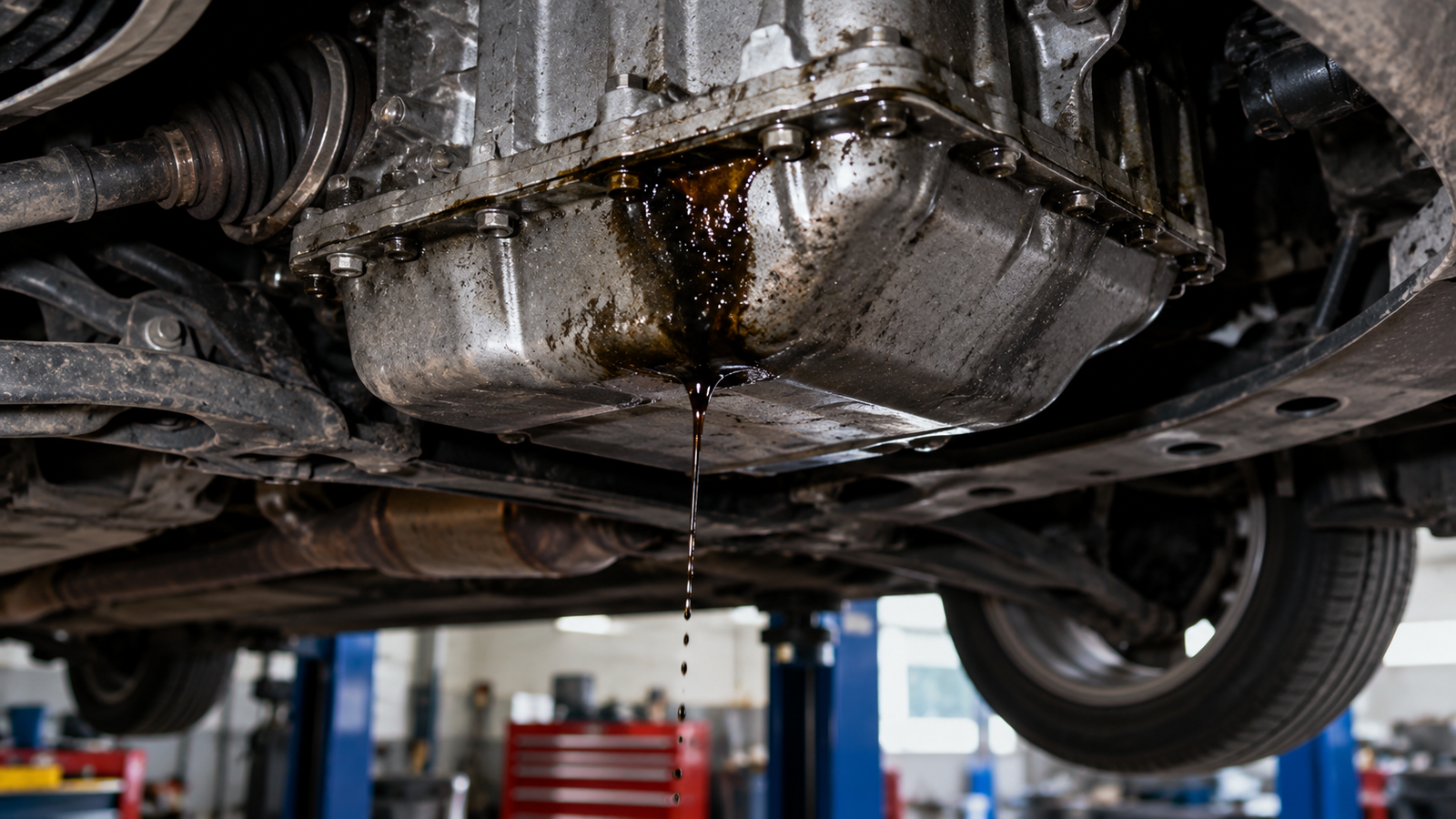
An engine oil leak is one of the most commonly discovered faults in Dubai — spotted as a small dark puddle under the car after overnight parking, noticed as a burning smell while driving, or flagged during a routine service inspection. The immediate question most drivers ask is whether they can continue driving, and the honest answer is that it depends entirely on how fast the oil is leaking, where it’s leaking from, and what the current oil level is.
Every engine oil leak situation we see at our Al Quoz workshop. At Rapid Rev Garage, our engine repair in Dubai team inspects every oil leak to assess its severity and source before advising on urgency.
Engine Oil Leak — Quick Verdict
A very slow oil leak — a small spot on the ground, oil level still correct, no burning smell — allows careful short-term driving with close monitoring of the oil level. A fast leak — a large puddle, oil level dropping noticeably between checks, or a burning smell from the engine bay — means stop driving and get the car to a workshop. Low oil pressure is the real risk, and an engine that loses oil pressure and keeps running can seize within minutes. Check the dipstick before every drive if an active oil leak is known, and do not drive if the level is below the minimum mark.
Engine oil serves four functions simultaneously — lubrication, cooling of internal components, cleaning by carrying debris to the filter, and sealing the small gaps between moving parts. When oil leaks from the engine, all four functions are progressively compromised as the level drops. The rate of oil loss determines how quickly the situation becomes dangerous, which is why the first assessment is always the leak rate rather than just the source.
In Dubai’s heat, oil leaks are more common and more urgent than in cooler markets. Heat cycling between underground parking temperatures and peak underbonnet heat accelerates the degradation of the rubber gaskets and seals that prevent oil from escaping — making engine oil leaks a regular finding at any Al Quoz workshop.
How to Assess the Severity of an Engine Oil Leak
Not all oil leaks are equal in urgency. This assessment determines whether the car can be driven to a workshop or needs recovery.
Check the Oil Level First
The dipstick is the most important piece of information. If the oil level is between the minimum and maximum marks, the leak is slow enough that the engine hasn’t yet lost meaningful volume. If the oil level is at or below the minimum mark, do not drive the car — add oil to bring it above the minimum and book a workshop visit for the same day.
Assess the Puddle Size
A small spot of oil — a few centimetres in diameter — under the car after overnight parking indicates a slow seep from a seal or gasket. A large puddle, multiple spots in a trail, or oil visible running down the engine block while the engine is running indicates a faster leak that requires immediate attention.
Check for a Burning Smell
Oil reaching the exhaust manifold, the turbocharger, or the catalytic converter produces a distinctive burning smell that’s sometimes accompanied by light smoke from the engine bay. This combination means the leak rate is significant enough that oil is reaching hot components — which is both a fire risk and an indication of faster-than-safe oil loss.
Our car mechanic team inspects every engine oil leak to identify the source, measure the approximate rate, and advise accurately on urgency.
Common Sources of Engine Oil Leaks
This section covers the key details you need to understand the point above.
Valve Cover Gasket
The valve cover sits on top of the cylinder head and is sealed by a rubber gasket around its perimeter. This is the most common engine oil leak location on most modern engines — the gasket degrades with heat cycling over time and begins to seep oil that runs down the side of the engine, drips onto the exhaust manifold, and produces the burning smell that often first alerts the owner.
Why Dubai Heat Accelerates Valve Cover Gasket Failure
The valve cover gasket is directly exposed to engine bay heat — one of the hottest environments in the vehicle. In Dubai, where underbonnet temperatures regularly exceed 100°C during summer driving, rubber gasket degradation happens measurably faster than the factory replacement interval assumes.
Oil Filter Housing Gasket
The oil filter housing on many European engines — BMW, Mercedes, Audi, Volkswagen Group — has a plastic housing with a rubber o-ring gasket that fails with age and heat exposure. An oil filter housing gasket leak often appears as oil around the front of the engine block that gets blown backward along the underside of the car.
Rear Main Seal
The rear main seal sits at the back of the engine where the crankshaft exits to connect to the transmission. A weeping rear main seal is common on higher-mileage engines and produces oil that appears at the joint between the engine and gearbox — visible from underneath the car on a lift but often misidentified as a gearbox leak.
Cam Seals and Front Crankshaft Seal
These seals surround the camshaft and crankshaft where they exit the engine at the front, often behind the timing cover. A failed cam or crankshaft seal can allow significant oil loss and is sometimes the first indication of a timing belt or chain cover that needs attention.
Turbocharger Oil Feed or Return Lines
Turbocharged engines have dedicated oil feed and return lines that lubricate and cool the turbocharger bearing. Cracked lines, loose fittings, or degraded hose sections on these lines produce oil leaks near the turbocharger that can result in oil burning from the hot turbine housing.
For immediate recovery if the leak has caused the engine to overheat or drop pressure, our roadside assistance covers Al Quoz and nearby Dubai areas.
Can You Drive? — The Specific Answers
This section covers the key details you need to understand the point above.
Yes, With Monitoring — Slow Leak, Correct Oil Level
A slow seep from a valve cover gasket or oil filter housing, with oil level correct and no burning smell, allows careful driving to a workshop within the next day or two — provided the oil level is checked before every drive.
No — Oil Level Below Minimum
Do not drive with the oil level below the minimum mark on the dipstick. Add oil to bring it above the minimum, and do not drive until the source of the loss is identified and repaired.
No — Burning Smell or Visible Smoke
Oil reaching hot components creates a fire risk and indicates the leak rate is high enough that continued driving risks oil pressure loss within a short drive.
No — Oil Puddle Growing Rapidly
An oil puddle that’s visibly forming while the car is stationary has a leak rate that means significant oil pressure loss can occur within minutes of driving.
Repair Process
This section covers the key details you need to understand the point above.
Gasket and Seal Replacement
The vast majority of oil leak repairs are gasket or seal replacements — valve cover gasket, oil filter housing o-ring, cam seal, rear main seal. These are primarily labour jobs where the cost is the time required to access the component and reseal it.
Turbo Line Replacement
Cracked or degraded turbocharger oil lines are replaced with new lines to specification. The turbocharger itself is inspected for bearing wear caused by any period of reduced oil supply.
Our car service packages include an oil leak inspection and oil level check at every scheduled visit — catching developing seeps before they become active leaks.
Risks of Ignoring an Engine Oil Leak
A small oil leak that’s ignored doesn’t stay small. Gasket material that’s seeping will continue to degrade, and the seep rate increases over time. The engine eventually reaches a state where oil pressure is insufficient for the lubrication demands of the moving parts — and bearing damage from low oil pressure can happen within minutes of the pressure dropping below the required threshold.
The financial comparison is straightforward — a valve cover gasket replacement costs a fraction of what a bearing failure from sustained low oil pressure costs to repair or replace.
Prevention Tips
Oil level checked monthly takes 60 seconds and is the single most effective prevention against the consequences of an oil leak. A dipstick that’s reading lower than the previous month’s check is early confirmation of an active leak worth investigating. For exterior repairs needed alongside engine work, our car painting team handles colour-matched repairs in the same visit.
Dubai-Specific Advice
Dubai’s heat is the primary driver of earlier oil seal and gasket failure compared to the same engines in moderate climates. Any oil leak discovered in spring — before summer temperatures peak — should be treated as a higher-priority repair than the same size leak discovered in October. An engine running with a borderline oil level in July’s stop-start traffic reaches low-pressure conditions faster than the same engine in December.
Why Rapid Rev Garage?
We inspect every oil leak under lift conditions before quoting any repair — because the visible oil trail on the outside of the engine doesn’t always indicate the source. Oil travels along engine surfaces and accumulates at lower points before dripping, which means the drip location and the leak source can be in very different places. Proper identification before repair prevents the scenario where a rear main seal is replaced when the actual leak was from a higher cam seal. Our mobile car mechanic covers Al Quoz and nearby Dubai areas for on-site oil level assessment if the car isn’t safe to drive in.
FAQ — Engine Oil Leak
These are the questions most commonly asked when an oil leak is discovered.
How long can I drive with an oil leak?
With a very slow leak and correct oil level — a few days with daily dipstick checks. With any level below minimum, burning smell, or rapidly growing puddle — not at all.
Is a small oil leak serious?
Even a small leak requires attention because it will worsen. The risk isn't the current rate but the rate it will become — and a leak caught early is always cheaper to repair than one that's been left to progress.
Can I just keep topping up the oil instead of repairing the leak?
In the very short term, while arranging repair — yes. As an ongoing strategy — no. The leak rate typically increases over time, and the consequences of a low oil pressure event from a missed top-up are severe.
What does oil on top of the engine usually mean?
Oil on top of the engine almost always comes from the valve cover gasket — the most common and most accessible oil leak source on modern engines.
How much does an oil leak repair cost in Dubai?
It depends on which seal or gasket is leaking. A valve cover gasket is a relatively straightforward repair. A rear main seal requires transmission removal to access and is significantly more labour-intensive.
Conclusion
An engine oil leak ranges from a minor inconvenience that allows careful short-term driving to an immediate stop-and-recover situation — and the difference is oil level, leak rate, and whether oil is reaching hot components. Check the dipstick, assess the puddle, check for burning smell, and use those three observations to determine urgency. Rapid Rev Garage in Al Quoz diagnoses every oil leak under lift conditions before quoting any repair.
Rapid Rev Garage is in Al Quoz, serving drivers across nearby Dubai areas. Find us through a garage near me search, book your appointment on WhatsApp, or find us on Google Maps.
Rapid Rev Garage — Engine Oil Leak | Al Quoz, Dubai