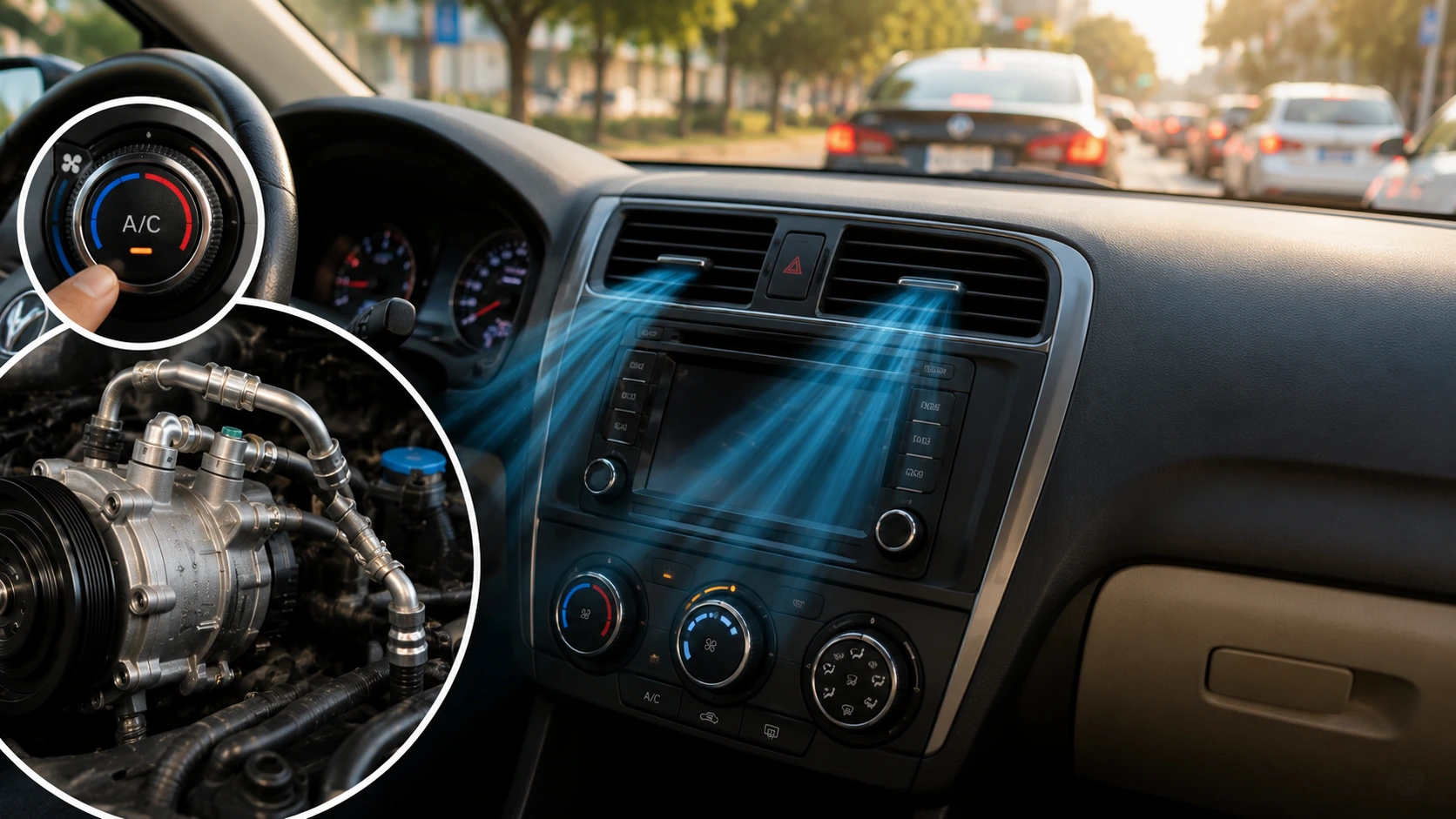
When a car AC take too long to cool situation develops — the cabin is still warm 10 or 15 minutes into a drive, passengers are uncomfortable on every journey start, and the system never quite reaches the cold air output it should produce — the AC system is working but not at full capacity. This underperformance is different from a sudden cooling failure: it is the system delivering 60–70% of its designed output rather than failing completely. In Dubai’s summer, where cabin temperatures in a parked vehicle can reach 70–80°C, an AC system taking too long to cool is not a minor inconvenience — it is a real health and comfort concern on every drive.
At Rapid Rev Garage in Al Quoz, our car AC repair team diagnoses every car AC take too long to cool complaint with a structured assessment — refrigerant pressure, condenser airflow, evaporator condition, and compressor output — before any repair is recommended.
Car AC Take Too Long to Cool — Quick Verdict
A car AC that takes too long to cool in Dubai is most commonly caused by one of five faults: a refrigerant charge below specification — the most frequent cause — reducing the system’s heat absorption capacity; a condenser blocked with dust reducing heat rejection and increasing system pressure; a cabin air filter so clogged that airflow across the evaporator is severely restricted; a compressor that is not producing full displacement output; or the cabin thermal load from a parked hot car being too high for the system to recover quickly from — which points toward pre-cooling habits and insulation rather than an AC fault at all. Each cause produces a different pressure signature and a different cooling recovery profile that distinguishes them accurately.
Table of Contents
- What Slow Cooling Actually Means — Underperformance vs Failure
- Refrigerant Charge — The Primary Slow Cooling Cause
- Condenser Restriction — Heat Rejection Failure
- Cabin Air Filter and Evaporator Airflow
- Compressor Output at Full Demand
- When the Problem Is Cabin Heat Load, Not the AC
- How Dubai’s Peak Cabin Temperatures Create the Worst Conditions
- How We Measure the Actual Cooling Performance at Rapid Rev Garage
- The Right Fix for Each Confirmed Cause
- What Happens If Slow Cooling Is Left Without Investigation
- Practical Tips While the Repair Is Arranged
- How Long the Repair Takes
- What the Repair Costs in Dubai
- Getting the Most From the AC System in Dubai
- Why Rapid Rev Garage?
- FAQ
- Conclusion
What Slow Cooling Actually Means — Underperformance vs Failure
Understanding the distinction in a car AC take too long to cool situation — between a system that is underperforming and one that has failed guides the diagnostic approach.
The Performance Benchmark
A correctly functioning car AC system in Dubai should reduce cabin temperature from peak parked temperature to a comfortable level within five to eight minutes of the vehicle moving at speed with the AC at maximum. After 10 minutes of operation, the air exiting the centre vents should typically be between 5–10°C above ambient on a correctly functioning system with a hot-soaked cabin.
What Slow Cooling Looks Like in Practice
A car AC take too long to cool situation produces vent air temperatures that are 15–20°C above ambient after 10 minutes, a cabin that remains uncomfortably warm for 20+ minutes into the drive, and a system that may eventually cool the cabin adequately — just much later than it should. The system is not failing completely; it is underperforming throughout.
Why This Is Still a Real Problem
In Dubai’s summer, 20 minutes of inadequate cooling is a meaningful health concern — particularly for children in rear seats, where rear vents deliver air that has been warmed slightly by the hot headliner before reaching passengers. An AC system that takes too long to cool is also working at elevated compressor load throughout the extended cooling period — reducing compressor service life per drive.
Refrigerant Charge — The Primary Slow Cooling Cause
A below-specification refrigerant charge remains the single most common cause when a car AC take too long to cool situation is reported in Dubai — and it is also the cause most often addressed incorrectly.
How Low Charge Reduces Cooling Rate
The AC system’s cooling capacity is directly proportional to the mass of refrigerant circulating through the evaporator per minute. A system with 15% below-specification refrigerant charge circulates 15% less refrigerant mass — absorbing 15% less heat from the cabin air per minute. The system still cools, but at a proportionally reduced rate. From a cabin at 75°C, reducing heat absorption by 15% means the cooling target takes proportionally longer to reach.
The Leak Must Be Found Before Any Recharge
This cannot be stated too many times in an AC context: adding refrigerant to a system without finding and sealing the leak produces a temporary improvement that lasts two to four weeks until the leak has removed the new charge as well. A pressure test held over time, followed by UV dye or electronic leak detection, identifies the specific leak point — O-ring seal, hose joint, condenser pin-hole, or evaporator seepage — before any refrigerant is added.
Common Leak Locations in Dubai’s Heat Cycling Environment
The O-ring seals at compressor port connections and condenser joints are the most frequent leak sources — thermal cycling between underground parking cool and peak operation temperatures hardens these rubber seals faster in Dubai than in any temperate market. A vehicle that was correctly charged two years ago may have developed a slow O-ring leak from this heat cycling and now presents with the slow cooling pattern from the resulting charge deficit.
Our car mechanic team performs a timed pressure decay test before any refrigerant is added to every system presenting with slow cooling — because a system that holds pressure is a system whose charge can be trusted once restored.
Condenser Restriction — Heat Rejection Failure
The condenser’s role is to reject the heat absorbed from the cabin air — discharging it to the outside atmosphere. When the condenser cannot reject heat efficiently, the refrigerant returns to the compressor still carrying heat it should have released, the system pressure rises above its designed range, and the evaporator’s cooling capacity is reduced.
Dust Blockage in Al Quoz Conditions
External condenser fin blockage from Al Quoz industrial dust is a common contributing cause of slow cooling in Dubai — particularly on vehicles that have not had their condensers cleaned in two or more years. A condenser with 30–40% fin blockage cannot reject heat at its design rate, raising the high-side system pressure and reducing cooling output throughout the drive.
Internal Scale From Degraded Coolant
On vehicles with combined condenser-radiator cooling systems — common on compact vehicles — degraded coolant can deposit scale inside the cooling side of the combined unit, reducing overall heat rejection capacity that indirectly affects AC performance.
How to Identify Condenser Restriction
An AC system with condenser restriction shows abnormally high high-side pressure combined with normal low-side pressure — the refrigerant is carrying heat it can’t reject rather than the charge being insufficient. This pressure pattern immediately distinguishes a condenser restriction from a refrigerant shortage, which produces lower pressures on both sides.
Cabin Air Filter and Evaporator Airflow
The rate at which the AC cools the cabin is directly limited by the volume of cabin air that passes across the evaporator per minute. A severely clogged cabin filter reduces this volume — and with it, the cooling rate.
How a Restricted Filter Slows Cooling
A cabin filter at 80% blockage passes perhaps 40–50% of the airflow that a clean filter allows. The evaporator is cold and functioning correctly — but it can only cool the air that reaches it. With restricted airflow, the heat removal rate from the cabin is proportionally reduced. The system will eventually cool the cabin, but it takes significantly longer to process the cabin air volume through the restricted filter.
The Evaporator Fouling Connection
A cabin filter that has been heavily loaded for an extended period may have allowed dust bypass onto the evaporator fins. An evaporator with dust and debris packed between its fins has reduced airflow through the fin gaps — reducing heat exchange efficiency independently of the cabin filter. Evaporator cleaning alongside filter replacement restores full airflow in cases where bypass has already occurred.
Compressor Output at Full Demand
A compressor that is not producing its rated displacement output reduces the refrigerant flow rate through the system — producing reduced cooling capacity across all driving conditions, not just in traffic.
Variable Displacement Control Valve Failure
Many modern compressors use a variable displacement control valve to adjust refrigerant flow rate to match cooling demand. A valve that is stuck at reduced displacement produces a system that feels slightly underperforming at all times — never quite cooling as quickly as it should. This is distinguished from a refrigerant shortage by pressure testing: the compressor with a control valve fault shows lower-than-normal high-side pressure despite adequate refrigerant charge, because it is not compressing refrigerant to its rated pressure.
Worn Compressor Pistons
A compressor whose piston sealing efficiency has degraded from wear produces lower compression ratio — the refrigerant is cycled through at lower pressure, reducing the system’s heat absorption capacity. This fault produces the same slow cooling symptom but with a different pressure pattern and is typically accompanied by compressor noise. Our car service packages include a full AC pressure check at every major service — catching below-specification pressures before slow cooling becomes the presenting symptom.
When the Problem Is Cabin Heat Load, Not the AC
Not every slow cooling situation represents an AC fault — some are a consequence of the thermal challenge the system faces in Dubai’s specific conditions.
The Pre-Parked Vehicle Cabin Temperature
A vehicle parked in direct Dubai summer sun for six hours reaches interior temperatures of 75–80°C at dashboard level and 60–65°C at seat level. The AC system is designed to cool against ambient outdoor temperatures, not against cabin temperatures that are 30–35°C above ambient. The time required to cool a severely heat-soaked cabin is significantly longer than the time to cool a cabin that has been parked in shade.
Pre-Cooling as the First Response
Before attributing slow cooling to an AC fault, the first response is to pre-cool the cabin by opening windows briefly after entering — allowing the super-heated air to exit before the AC is required to cool it. Running the AC for 30–60 seconds before closing the windows reduces the starting thermal load significantly. A vehicle whose slow cooling resolves with this pre-cooling habit has an adequate AC system facing an extreme thermal challenge — not a faulty AC system.
Sunshades and Window Tinting
A windscreen sunshade during parking and quality window tinting that reduces solar heat gain both reduce the peak cabin temperature the AC must recover from. A vehicle with quality tinting in Dubai reaches a lower peak parked temperature than an untinted vehicle — allowing the AC to cool the cabin faster on each drive start.
How Dubai’s Peak Cabin Temperatures Create the Worst Conditions
Dubai’s summer creates the most demanding conditions for AC cooling recovery of any major city.
75°C Starting Temperature vs 25°C Ambient — A 50°C Differential
The AC system must cool the cabin from 75°C to a comfortable 22–24°C — a 50°C temperature drop — against 45°C ambient air. This is one of the largest thermal differentials any production car AC system is regularly asked to manage. A system performing at 90% of specification completes this recovery in acceptable time. A system at 80% of specification takes noticeably longer — and the driver correctly perceives the difference.
Compressor Load at Maximum in Summer
With high ambient and high head pressure from the hot condenser environment, the AC compressor in Dubai’s summer operates at or near its maximum load rating from the moment the system starts cooling. There is no thermal headroom to compensate for marginal component performance. For any AC-related breakdown, our roadside assistance covers Al Quoz and nearby Dubai areas.
How We Measure the Actual Cooling Performance at Rapid Rev Garage
The diagnostic process measures actual cooling rate — not just whether the system produces cold air.
Vent Temperature and Cabin Temperature Rate Test
The AC is run at maximum with all windows closed on a standard hot day, and vent outlet temperature is measured at 2-minute intervals for 10 minutes. The rate of temperature drop — not just the final temperature — identifies whether the system is underperforming from the first minute or only over time.
System Pressure at Maximum Demand
High and low side pressures at maximum AC demand, with the engine at 1,500 RPM and the AC fan at maximum, are compared against specification for the ambient temperature. A system at correct pressures is performing correctly — the slow cooling has a different cause. A system with below-normal low-side pressure confirms refrigerant shortage. Above-normal high-side pressure confirms condenser restriction.
Cabin Filter and Evaporator Airflow Assessment
Cabin filter condition is confirmed before any other assessment. Airflow volume through the centre vents is compared against expected output for the blower speed setting — a system with correct cabin filter and good duct condition produces the expected airflow; a restricted system produces measurably lower airflow even with a new filter.
The Right Fix for Each Confirmed Cause
Each repair is matched to the specific cause confirmed by the cooling rate test and pressure assessment.
Refrigerant Leak Detection, Seal, and Correct Recharge
The specific leak is found and sealed. The system is evacuated completely and recharged to the manufacturer’s gram specification — not estimated by gauge reading. Post-recharge vent temperature is measured to confirm cooling rate improvement.
Condenser Cleaning
External fin blockage is cleared with a pressure wash from the rear face. System pressures are measured after cleaning to confirm high-side pressure reduction and cooling rate improvement.
Cabin Filter Replacement and Evaporator Assessment
Fresh cabin filter installed with housing cleaning. Where evaporator fin blockage is found from previous filter bypass, professional evaporator cleaning restores full airflow through the fin gaps. For exterior repairs needed alongside any AC service, our car painting team handles colour-matched work at the same visit.
Compressor Displacement Control Valve Replacement
Confirmed control valve fault is addressed with valve replacement — restoring full variable displacement operation without requiring complete compressor replacement.
What Happens If Slow Cooling Is Left Without Investigation
The consequences of accepting slow cooling rather than repairing the cause are specific and progressive.
Reduced Compressor Life Per Drive
A system taking too long to cool keeps the compressor at maximum load for an extended period per drive. Over months of this extended high-load operation, compressor bearing and piston wear accumulate faster than a system that reaches target temperature quickly and then reduces compressor load.
Worsening Charge Loss
A system with a slow refrigerant leak gets progressively worse without repair. What produces 20-minute cooling this month produces inadequate cooling throughout the drive next month as the charge continues depleting.
Practical Tips While the Repair Is Arranged
These habits reduce the cooling load immediately while the repair is being arranged.
Ventilate Before Closing Windows
Open all doors or windows for 30 seconds after entering the car — expelling the super-heated cabin air before the AC must cool it. This single habit reduces the AC’s starting thermal burden by 10–15°C immediately.
Park in Shade or With a Sunshade
Reducing peak cabin temperature through shaded parking or windscreen sunshades directly reduces the cooling time the AC needs on each drive start.
Use Fresh Air Mode Initially at Speed
When first driving away, fresh air mode draws cooler outside air into the cabin rather than recirculating the super-heated cabin air. Switch to recirculation once the cabin temperature has dropped to ambient — recirculation mode is more efficient for maintaining a cool cabin than for initial cooling from extreme heat.
How Long the Repair Takes
Repair time depends on the confirmed cause and the access required for the specific component.
Refrigerant Service
Leak detection, sealing, and recharge to specification: two to four hours depending on leak location.
Condenser Cleaning
30–60 minutes including post-cleaning pressure verification.
Filter and Evaporator Work
15–60 minutes for filter. Evaporator cleaning: one to two hours.
Compressor Control Valve
Two to three hours including system pressure confirmation after replacement. Our mobile car mechanic covers Al Quoz and nearby Dubai areas for on-site AC pressure and filter assessment.
What the Repair Costs in Dubai
Cost depends on the confirmed cause from the diagnostic assessment.
Cabin Filter and Condenser Work
Cabin filter replacement: AED 150–450. Condenser cleaning: AED 200–400.
Refrigerant Service
O-ring seal and refrigerant recharge (R-134a): AED 400–800. Evaporator pin-hole repair with refrigerant service: AED 800–2,000.
Compressor Work
Control valve replacement: AED 500–1,500. Compressor replacement where internal wear is confirmed: AED 1,500–4,500 depending on vehicle. A written quote is confirmed after the cooling rate test and pressure assessment identify the specific cause. Our garage near me location in Al Quoz serves drivers from Business Bay, Jumeirah, Barsha, Satwa, Downtown, and the Sheikh Zayed Road corridor.
Getting the Most From the AC System in Dubai
Specific habits maintain the AC system at full cooling capacity throughout Dubai’s demanding summer.
Annual AC Service Before Summer
A pre-summer AC service — pressure test, cabin filter replacement, condenser inspection, and vent temperature performance check — confirms the system is at full capacity before the peak demand period begins. A system confirmed at full specification entering April resolves any car AC take too long to cool concern before peak heat begins.
Cabin Filter at 6,000–8,000 km
The single maintenance habit with the most direct impact on cooling rate in Dubai is frequent cabin filter replacement. A clean filter maximises airflow across the evaporator — which is what actually cools the cabin air. This one habit directly reduces how often a car AC take too long to cool situation develops — maintaining cooling rate without any system repair.
Why Rapid Rev Garage?
We diagnose every car AC take too long to cool complaint by measuring the actual cooling rate — vent temperature at timed intervals — before attributing the slow cooling to any specific component. A system that cools correctly by the measurements but feels slow to the driver has a cabin heat load issue rather than an AC fault. A system that shows slow temperature drop in the measurements has a specific component fault that the pressure pattern identifies. Both distinctions prevent the wrong repair — and getting these diagnoses right is what a structured cooling rate assessment produces.
FAQ — Car AC Take Too Long to Cool
These are the questions most frequently asked about AC cooling performance at our Al Quoz workshop.
Is it normal for a car AC to take a long time to cool in Dubai summer?
Some delay from a severely heat-soaked cabin is normal — but a car AC take too long to cool situation lasting 20+ minutes always warrants investigation. A correctly functioning system should achieve comfortable cooling within 8–10 minutes of driving at speed. Significantly longer than this warrants investigation.
Can a dirty cabin filter make my AC take longer to cool?
Yes — a severely blocked filter restricts airflow across the evaporator, directly reducing how quickly it can cool cabin air. Cabin filter replacement is the first intervention when slow cooling is the complaint.
My AC was recharged but still cools slowly — what's wrong?
If the recharge did not find and seal the leak, the refrigerant has escaped again and the system is back to below-specification charge. Alternatively, the slow cooling may be from a condenser or airflow fault that a refrigerant recharge does not address.
Does window tinting help my AC cool faster?
Yes — quality window tinting reduces solar heat gain, lowering the peak cabin temperature the AC must recover from on each drive. A vehicle with 5% VLT tinting reaches a meaningfully lower peak parked temperature than an untinted vehicle.
Why does my AC cool well at first but then become less cold?
A system that cools well initially but then reduces performance may have a refrigerant charge that drops as the compressor runs at sustained load — indicating a slow internal leak that only becomes apparent after extended operation. It may also indicate a condenser that reaches heat saturation after extended operation without adequate fan output.
Conclusion
A car AC take too long to cool in Dubai has identifiable causes — below-specification refrigerant charge, condenser restriction, cabin filter blockage, or reduced compressor output — each of which produces a specific pressure signature that distinguishes it from the others. Dubai’s extreme cabin temperatures make the consequence of any AC underperformance more pronounced than in any other market. Rapid Rev Garage in Al Quoz diagnoses slow cooling through a timed vent temperature test and system pressure assessment — confirming the specific cause before any repair is recommended.
Rapid Rev Garage is in Al Quoz, serving drivers across nearby Dubai areas — Business Bay, Jumeirah, Downtown, Barsha, Satwa, and the Sheikh Zayed Road corridor. Book your appointment on WhatsApp or find us on Google Maps.
Rapid Rev Garage — Car AC Take Too Long to Cool | Al Quoz, Dubai