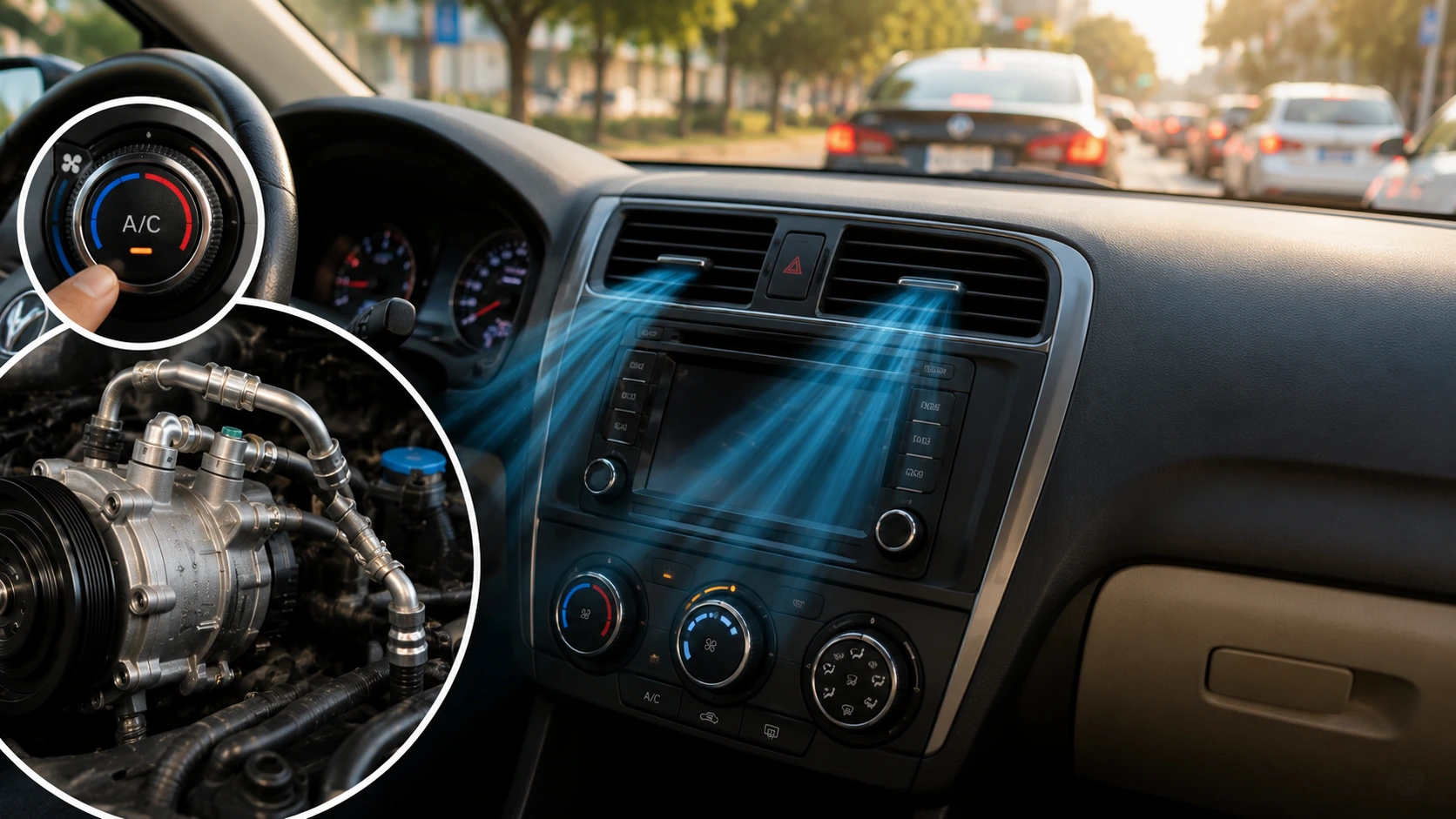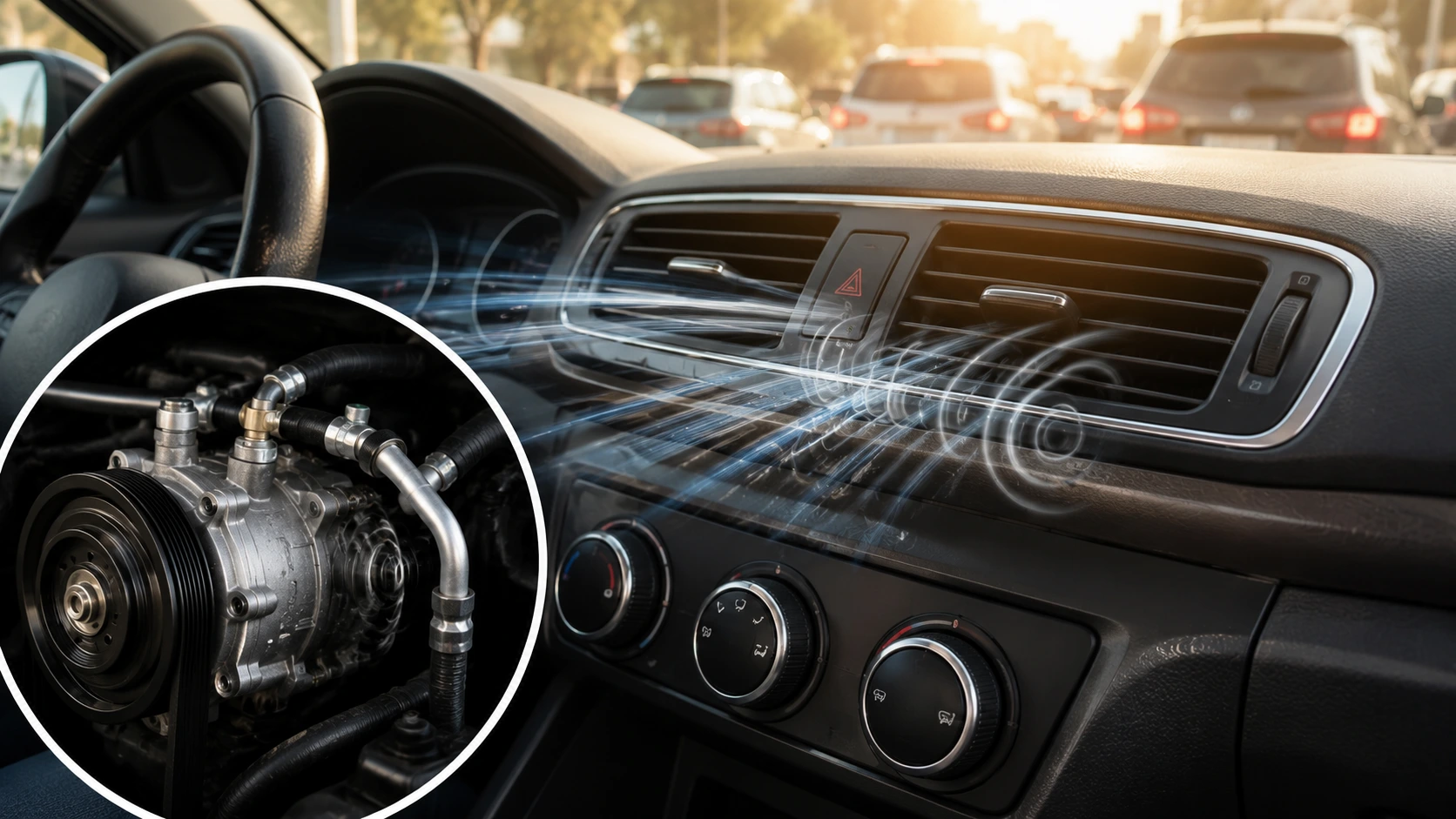
When a car AC making a whistling noise appears — that high-pitched whine, hiss, or whistle that appears when the AC is running — is almost always an airflow fault rather than a refrigerant or mechanical fault. The whistling is the sound of air being forced through a restriction it shouldn’t be encountering, or through a gap it shouldn’t be entering. In most cases, this fault is less urgent than a compressor noise — but it points to a specific component that, if left unaddressed, can worsen into a more significant blockage or develop into a secondary fault.
At Rapid Rev Garage in Al Quoz, our car AC repair team diagnoses every car AC making a whistling noise complaint through a systematic airflow assessment — identifying whether the restriction is in the cabin filter housing, the blend door mechanism, the evaporator, or the refrigerant circuit itself.
Car AC Making a Whistling Noise — Quick Verdict
A car AC making a whistling noise is most commonly caused by a severely clogged cabin air filter creating turbulent airflow as air is forced through the restricted media — the most common and most immediately fixable cause. Other frequent causes include a blend door that is partially obstructed or misaligned producing a whistle as airflow passes the door edge, a refrigerant system with a partial restriction at the expansion valve producing a hissing whistle from refrigerant forced through a narrowed passage, a recirculation flap that is not seating correctly and allowing air to whistle through its gap, or a cabin air intake that is drawing air past a loose seal. In Dubai’s dust environment, cabin filter clogging is the dominant cause — and filter replacement resolves it immediately.
Table of Contents
- Reading the Whistle — When It Appears and What It Sounds Like
- Cabin Air Filter — The Most Common Whistling Cause
- Blend Door and Recirculation Flap Issues
- Expansion Valve Restriction — The Refrigerant Whistle
- Cabin Air Intake Seal Gaps
- How Dubai’s Dust Accelerates This Fault
- How We Locate the Exact Source at Rapid Rev Garage
- The Right Fix for Each Confirmed Source
- What Happens If AC Whistling Is Left Without Attention
- Is It Urgent?
- How Long the Repair Takes
- What the Repair Costs in Dubai
- Preventing AC Whistling in Dubai’s Conditions
- Why Rapid Rev Garage?
- FAQ
- Conclusion
Reading the Whistle — When It Appears and What It Sounds Like
The character of a car AC making a whistling noise — pitch, timing, and conditions provide the primary diagnostic information before any panel is removed.
Whistle That Gets Louder as Fan Speed Increases
A whistle that increases in pitch and volume as the AC blower speed is turned up is almost certainly an airflow restriction in the cabin filter or duct system. Higher fan speed means more air being forced through the same restriction — and the whistle intensifies proportionally. This is the clearest indicator of a cabin filter or duct obstruction.
Whistle That Is Constant Regardless of Fan Speed
A whistle that maintains constant pitch and volume regardless of the blower setting is not from an airflow restriction — it is from the refrigerant circuit. A partial refrigerant restriction at the expansion valve or a damaged refrigerant hose produces a constant hissing whistle from the refrigerant flow rather than from the airflow.
Whistle That Changes When Vent Position Is Changed
A whistle that appears on specific vent positions but not others — present on face vents but not footwell, or present only on defrost — points toward a blend door or duct distribution fault specific to the duct path that is being used in that position.
Whistle That Appears When Switching From Recirculation to Fresh Air
A whistle specifically at the moment of switching between recirculation and fresh air mode — or that only appears in one mode — points toward the recirculation flap. The flap is not seating correctly in one of its positions, allowing air to whistle through the gap between the flap and its seat.
Cabin Air Filter — The Most Common Whistling Cause
A severely clogged cabin air filter is responsible for the majority of these complaints — making the car AC making a whistling noise complaint the most preventable AC noise in Dubai — and it is also the most immediately fixable cause.
How Clogging Produces a Whistle
The AC blower draws cabin air through the cabin filter media. A clean filter allows unrestricted flow — the air passes through the media without any turbulence or pressure differential that produces noise. A filter that is 60–80% blocked forces the same volume of air through a much smaller effective filter area. The air turbulence at the restriction boundary produces the high-pitched whistle that the driver hears — exactly like blowing through a partially obstructed straw.
Why Dubai Clogs Filters Faster Than Any Other Market
Dubai’s cabin air filter replacement interval should be 6,000–8,000 km rather than the factory 15,000–20,000 km. Fine desert dust and Al Quoz industrial particulate load the filter at a rate that European factory schedules never anticipated. A cabin filter at 15,000 km in Dubai may have more than double the blockage of the same filter at 15,000 km in Germany. The whistling typically begins at 70–80% blockage — well before the filter would be replaced on a factory schedule.
The Bypass Risk at Extreme Clogging
A cabin filter that is 85–90% blocked produces enough differential pressure across the filter housing that the filter media can partially collapse or pull away from its seating frame. This creates a bypass gap at the filter edge — unfiltered dusty air enters the HVAC system alongside the whistling. The evaporator then accumulates dust directly, contributing to the musty smell fault described in a previous blog. Our car mechanic team checks cabin filter condition as the first step on every AC whistling diagnosis.
Blend Door and Recirculation Flap Issues
The HVAC system contains several plastic flaps that control airflow direction and temperature mixing — the temperature blend door, mode selection flaps, and the recirculation flap. A flap that is cracked, warped from heat, or operating with a worn servo produces a whistle as airflow passes the misaligned edge.
Blend Door Whistling
The temperature blend door controls the ratio of cool air to heated air reaching the cabin. A blend door that has warped slightly from heat cycling in Dubai’s extreme cabin temperatures — the dashboard area can reach 80°C+ in direct summer sun — may no longer seal fully against its frame in one temperature position. Air passing through the narrow gap between the warped door and its frame produces a whistle at specific temperature settings but not others.
How to Identify Blend Door Whistling
If the whistle changes character or disappears when the temperature control is adjusted from maximum cool to maximum heat (or vice versa), the blend door is the source. The whistle appears at the temperature setting where the door has the gap, and stops when the door is moved to a position where it sits against its stop rather than partially against its frame.
Recirculation Flap Seal
The recirculation flap switches the HVAC system between drawing air from inside the cabin and drawing fresh air from outside. A flap that is not seating correctly — from a worn foam seal around its perimeter or a warped plastic flap — allows air to whistle through the gap between the flap and its housing in one or both positions. The whistle typically appears specifically in one mode — either fresh air or recirculation — confirming which position the flap is failing to seal in.
Expansion Valve Restriction — The Refrigerant Whistle
The expansion valve is the precision orifice through which liquid refrigerant expands from high pressure to low pressure, producing the cooling effect at the evaporator. A partially blocked expansion valve — from refrigerant contamination, moisture crystallisation, or debris from a failing compressor — forces refrigerant through a narrowed passage and produces a distinctive hissing or whistling from the refrigerant flow itself.
How to Distinguish Refrigerant Whistle From Airflow Whistle
A refrigerant whistle has a different character from an airflow whistle — it is more consistent in pitch and does not change with blower fan speed. The refrigerant flows regardless of the blower setting, so the whistle remains constant when the fan speed is changed. An airflow whistle intensifies with fan speed. This distinction is confirmed by changing the fan speed while observing whether the whistle changes — a constant whistle is refrigerant, a variable whistle is airflow.
The Accompanying AC Performance Drop
An expansion valve restriction typically produces reduced AC cooling performance alongside the whistle — the restricted refrigerant flow through the evaporator reduces its heat absorption capacity. A whistle with no cooling reduction is almost certainly airflow; a whistle with reduced cooling points toward the refrigerant circuit.
Cabin Air Intake Seal Gaps
The fresh air intake at the base of the windscreen — through which outside air enters the HVAC system in fresh air mode — has rubber seals around its grille and ducting that can develop gaps from UV degradation and heat cycling.
How Intake Seal Gaps Whistle
Air drawn into the HVAC system through a gap rather than the designed intake opening produces a whistle as it is accelerated through the narrow seal gap by the blower’s suction. The whistle is present only in fresh air mode — because recirculation mode closes the intake flap and the gap no longer allows airflow. This fresh-air-mode-only characteristic immediately identifies the intake seal as the source. For any breakdown needing assistance while investigating AC issues, our roadside assistance covers Al Quoz and nearby Dubai areas.
How Dubai’s Dust Accelerates This Fault
Dubai’s dust environment explains why a car AC making a whistling noise from cabin filter clogging is significantly more common here than in any other market.
Filter Loading Rate Is Four to Five Times European Rate
The combination of fine desert dust during harmattan-like wind events, Al Quoz industrial particulate from nearby manufacturing and logistics operations, and construction site dust from Dubai’s continuous development produces a cabin filter loading rate that is genuinely four to five times the loading rate a European vehicle experiences in equivalent driving. A filter that whistle-clogs at 12,000 km in Frankfurt reaches the same blockage at 3,000 km in Al Quoz.
Heat Warps Blend Doors Faster
The cabin temperatures that Dubai vehicles experience in direct summer sun — 70–80°C at dashboard level — accelerate the warping of plastic blend door components faster than in any temperate climate. A blend door that is manufactured flat and correctly gapped will develop a slight warp from repeated extreme heating cycles, eventually producing the gap that allows airflow to whistle past its edge.
UV Degrades Intake Seals Faster
The rubber seals around the fresh air intake are exposed to direct UV from the windscreen area. Dubai’s UV intensity degrades rubber seals faster than European conditions — a seal that would remain intact for ten years in Germany may develop cracking and gaps after five to six years in Dubai. Our car service packages include cabin filter inspection and HVAC inlet seal assessment at every major service.
How We Locate the Exact Source at Rapid Rev Garage
The diagnostic sequence moves from the most common and cheapest cause to the more involved investigation only when simpler causes are ruled out.
Cabin Filter Inspection First — Always
The cabin filter is removed and inspected before any other investigation. A filter that is significantly clogged is replaced immediately, and the AC is run for 10 minutes to confirm whether the whistle has resolved. If it has — the diagnosis is complete. If the whistle continues after a fresh filter is installed, the investigation moves to the blend doors and refrigerant circuit.
Fan Speed Change Test
If the whistle is present after a filter replacement, the fan speed is changed while observing whether the whistle pitch changes. Speed-variable whistle is airflow — pointing to duct or blend door. Speed-constant whistle is refrigerant — pointing to the expansion valve.
Mode and Temperature Selection Test
The mode selector (face, feet, defrost) and the temperature dial are changed systematically while observing the whistle. A whistle that changes or disappears at a specific mode or temperature setting identifies the specific blend door or flap responsible.
Refrigerant Circuit Pressure Assessment
Where the whistle is confirmed as refrigerant-circuit by the speed-constant test, system pressures are measured to confirm whether an expansion valve restriction is producing the whistle alongside a cooling performance reduction.
The Right Fix for Each Confirmed Source
The repair is matched to the specific source confirmed by the fan-speed test and mode selection test.
Cabin Filter Replacement
A fresh cabin filter of correct specification — standard filtration or activated carbon depending on the vehicle platform — resolves the majority of AC whistling cases immediately. The filter housing is cleaned of accumulated dust before the new filter is installed.
Blend Door Lubrication or Replacement
A blend door with a minor warp that is not fully seated is assessed for whether lubrication of its pivot and a slight seal adjustment resolves the whistle. Where the door has warped beyond adjustment or its foam seal has deteriorated, replacement is the correct repair.
Recirculation Flap Seal Replacement
The foam seal around the recirculation flap perimeter is replaced where it has compressed or separated from the flap edge. Fresh foam tape of the correct thickness restores the air seal that prevents the whistling. For exterior repairs needed alongside AC work, our car painting team handles colour-matched repairs at the same visit.
Expansion Valve Replacement
A confirmed refrigerant-circuit whistle from a restricted expansion valve requires expansion valve replacement. The AC system is opened, the old valve removed, and a new valve of correct specification installed. The system is evacuated, leak-tested, and recharged to the correct refrigerant weight.
Fresh Air Intake Seal Replacement
Degraded or cracked fresh air intake seals are replaced with fresh sealing material — either the manufacturer’s replacement seal or a correctly-specified aftermarket equivalent. The whistle in fresh air mode is confirmed resolved before the repair is signed off.
What Happens If AC Whistling Is Left Without Attention
In most cases, a whistling AC is not an emergency — but specific causes have consequences if left unaddressed.
Clogged Filter Leads to Evaporator Mould
A cabin filter that is allowed to become severely clogged — to the point of bypass — deposits dust directly onto the evaporator surface. This dust provides the substrate for the mould growth that produces the musty smell described in the musty AC blog. A filter replacement that prevents bypass prevents the mould establishment that follows.
Expansion Valve Restriction Reduces Cooling and Stresses Compressor
An expansion valve with a partial restriction that is producing a refrigerant whistle and reduced cooling places the compressor under increased load — the compressor works against an elevated back pressure from the restricted circuit. Over months of this elevated load, the compressor’s service life is reduced.
Is It Urgent?
The urgency depends on which component is producing the whistle and whether it is affecting cooling performance.
Cabin Filter Whistle — Not Urgent, But Fix This Week
A cabin filter causing the whistle is not a safety concern — but a severely blocked filter is one bypass event away from evaporator contamination. Replace within the week.
Blend Door Whistle — Not Urgent, Monitor
A blend door whistle does not affect cooling performance significantly. Book at the next service unless the whistle is significantly disruptive.
Refrigerant Whistle — Book This Week
A refrigerant circuit whistle from an expansion valve restriction is reducing cooling performance alongside the noise. This affects Dubai summer comfort meaningfully and should be addressed within the week.
How Long the Repair Takes
Repair time ranges from under 30 minutes for a cabin filter to several hours for expansion valve work.
Cabin Filter Replacement
15–30 minutes.
Blend Door and Flap Work
60–180 minutes depending on whether the blend door requires dashboard access or is reachable through a service panel.
Expansion Valve Replacement
Two to three hours including system evacuation, replacement, recharge, and performance confirmation.
What the Repair Costs in Dubai
Cost depends on the confirmed source — filter and seal work costs far less than expansion valve replacement.
Filter and Seal Work
Cabin filter replacement: AED 150–450. Recirculation flap foam seal replacement: AED 200–500. Fresh air intake seal: AED 150–350.
Blend Door and Expansion Valve
Blend door foam tape or replacement: AED 300–1,200 depending on access complexity. Expansion valve replacement with refrigerant service: AED 600–1,800 depending on vehicle. A written quote is provided after the diagnostic sequence confirms the specific source. Our mobile car mechanic covers Al Quoz and nearby Dubai areas for an on-site cabin filter check and fan speed whistle test.
Preventing AC Whistling in Dubai’s Conditions
Specific habits prevent the dominant cause of AC whistling in Dubai — cabin filter clogging.
Cabin Filter at Dubai-Appropriate Intervals
6,000–8,000 km or every 4–6 months for vehicles driven in Dubai’s dust conditions. This single habit prevents the majority of AC whistling complaints — and the evaporator mould that filter bypass enables.
Annual HVAC Seal and Flap Inspection
An annual inspection of blend door seal condition, recirculation flap seal integrity, and fresh air intake seal condition catches developing gaps before they reach the whistling threshold. Our garage near me location in Al Quoz serves drivers from Business Bay, Jumeirah, Barsha, Satwa, Downtown, and the Sheikh Zayed Road corridor.
Why Rapid Rev Garage?
When a car AC making a whistling noise complaint arrives, the fan-speed-change test distinguishes a car AC making a whistling noise from airflow versus refrigerant sources before any disassembly is attempted. An airflow whistle from a clogged cabin filter resolves in 20 minutes. A refrigerant whistle from an expansion valve restriction requires a full refrigerant service. Treating them the same — or guessing without testing — produces the wrong repair. We identify the source type first, then the specific component.
FAQ — Car AC Making a Whistling Noise
These are the questions most frequently asked about AC whistling at our Al Quoz workshop.
Why does my AC whistle louder when I increase the fan speed?
A whistle that intensifies with fan speed is an airflow restriction — most commonly a clogged cabin air filter. The higher the fan speed, the more air is forced through the restriction, and the louder the whistle. Cabin filter replacement resolves this immediately.
My AC whistles only when I switch to fresh air mode — what is it?
A fresh-air-mode-specific whistle is almost always the fresh air intake seal or the recirculation flap seal. The whistle appears in fresh air mode because the flap opens and either allows air through its gap, or because the intake seal gap is only active when air is drawn through the intake.
Can a whistling AC still cool the car properly?
It depends on the cause. A cabin filter whistle does not significantly reduce cooling performance. A refrigerant restriction whistle reduces cooling alongside the noise — the restriction reduces refrigerant flow through the evaporator.
Is a refrigerant hissing sound dangerous?
A refrigerant hiss is not immediately dangerous — refrigerant at AC pressures is not toxic at the concentrations that can escape through a normal system. However, a hissing refrigerant circuit has a restriction that is reducing cooling performance and stressing the compressor. It should be investigated within the week.
How often should I replace my cabin air filter in Dubai?
Every 6,000–8,000 km or every 4–6 months for Dubai city driving — significantly more frequently than European factory schedules suggest. The whistling that develops from a clogged filter is the most common and most preventable AC noise complaint at our workshop.
Conclusion
A car AC making a whistling noise in Dubai almost always comes from one of four sources — a clogged cabin filter, a misaligned blend door or recirculation flap, a refrigerant expansion valve restriction, or an intake seal gap. The fan-speed-change test distinguishes the first two categories from the second two immediately. Cabin filter replacement resolves the most common cause in under 30 minutes. Rapid Rev Garage in Al Quoz diagnoses every AC whistling complaint by source type first — airflow or refrigerant — before identifying the specific component.
Rapid Rev Garage is in Al Quoz, serving drivers across nearby Dubai areas — Business Bay, Jumeirah, Downtown, Barsha, Satwa, and the Sheikh Zayed Road corridor. Book your appointment on WhatsApp or find us on Google Maps.
Rapid Rev Garage — Car AC Making a Whistling Noise | Al Quoz, Dubai