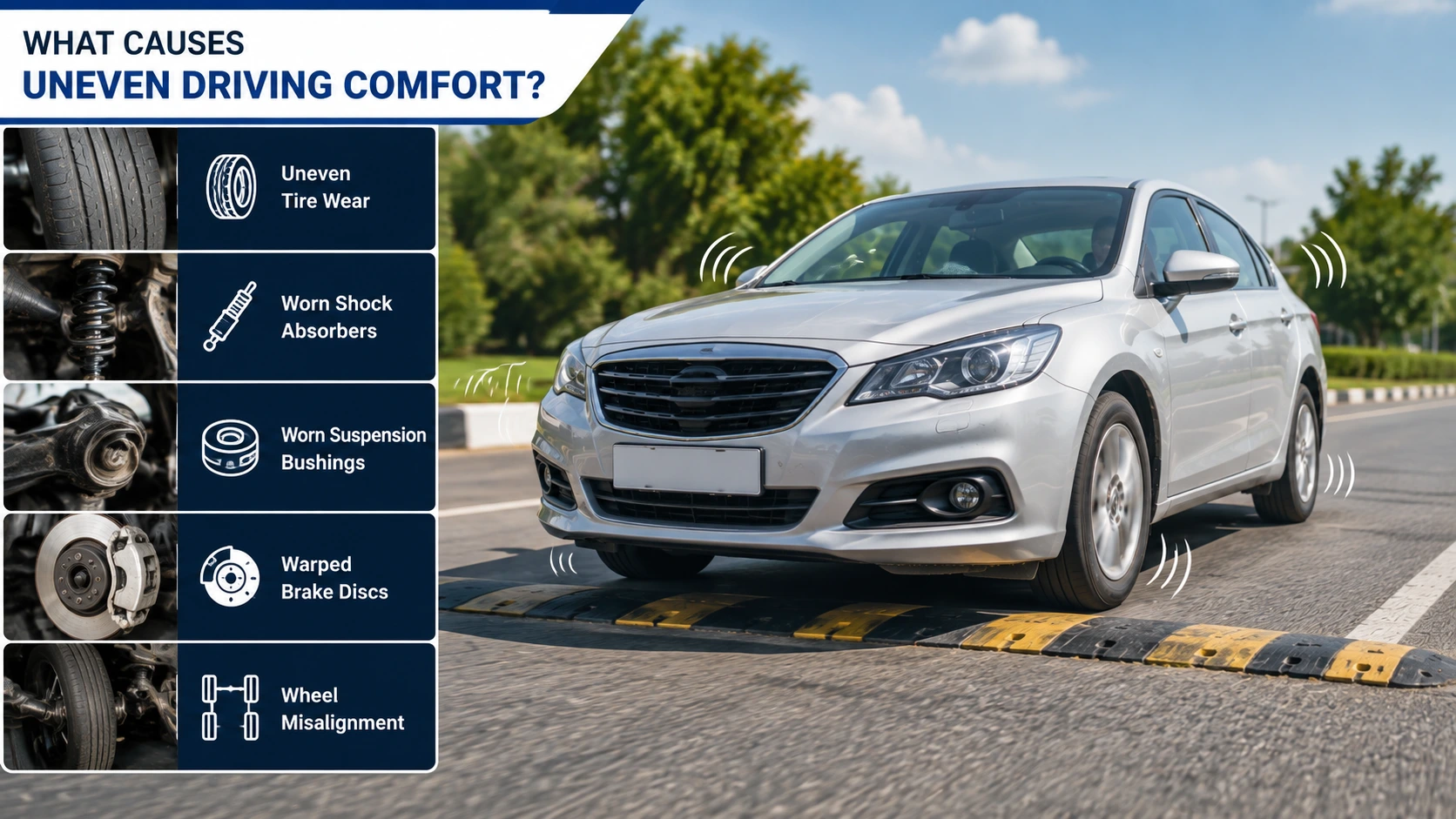
What causes uneven driving comfort in a car — what causes uneven driving comfort is a question with a deliberately wide range of answers — because What causes uneven driving comfort is not a single fault but a category of symptoms that point toward different systems depending on where the discomfort originates, what conditions produce it, and which part of the vehicle the driver notices it through. A car that rides harshly over small bumps, vibrates at specific speeds, pulls to one side on smooth road, or produces irregular noise on one side but not the other is experiencing uneven driving comfort — and each of these patterns points to a different fault.
At Rapid Rev Garage in Al Quoz, every what causes uneven driving comfort case is diagnosed uneven comfort complaints by first establishing exactly what type of unevenness is present — then following the specific diagnostic path for that type.
What Causes Uneven Driving Comfort — Quick Verdict
Uneven driving comfort in Dubai is most commonly caused by one of four fault categories: tyre condition and pressure inconsistency between corners producing different ride character at each wheel, worn or unequally degraded suspension components — shock absorbers, springs, or bushings — producing different damping response between sides, wheel alignment or balance faults producing vibration or pull at specific speeds, or road contact irregularities from a damaged wheel or tyre causing inconsistent surface feedback. In Dubai, heat accelerates suspension component degradation and tyre wear, while the high density of speed breakers produces asymmetric suspension wear when one side of the vehicle consistently takes harder impacts.
Table of Contents
- Defining the Unevenness — What Type Is Present?
- Tyre-Related Causes of Uneven Comfort
- Suspension Component Causes — When One Side Feels Different
- Alignment and Balance Faults That Create Directional Discomfort
- Road Noise and Structural Sources of Unevenness
- Why Dubai’s Conditions Produce Asymmetric Wear
- How We Map the Fault at Rapid Rev Garage
- The Right Fix — Matched to the Confirmed Cause
- What Happens If Uneven Comfort Is Left Without Repair
- Is It Safe to Keep Driving?
- How Long the Repair Takes
- What the Repair Costs in Dubai
- Keeping Driving Comfort Even Across All Four Corners
- Why Rapid Rev Garage?
- FAQ
- Conclusion
Defining the Unevenness — What Type Is Present?
The character of the unevenness is the first diagnostic filter — establishing which type is present eliminates entire fault categories before any physical inspection begins.
Side-to-Side Unevenness
The car feels different on the driver’s side from the passenger’s side — the ride is harsher on one side, one corner bounces more, or the driver notices impact noise from one side more than the other. Side-to-side unevenness points toward a single-corner component fault — one shock absorber more worn than the other, one tyre in worse condition, or one wheel with a balance fault.
Front-to-Rear Unevenness
The front of the car rides differently from the rear — the front absorbs impacts more harshly, or the rear continues bouncing after bumps while the front settles. Front-to-rear unevenness points toward an axle-level fault — the rear shock absorbers have worn further than the fronts, or the rear tyres are in different condition from the fronts.
Speed-Dependent Unevenness
The discomfort only appears at specific speeds — a vibration between 80–100 km/h, a pull that appears at highway speed but not at city speed, a shudder under braking from high speed. Speed-dependent unevenness almost always traces to wheel balance, tyre condition, or a brake disc that is affecting the suspension’s response at specific rotation frequencies.
Condition-Dependent Unevenness
The discomfort only appears under specific conditions — braking, accelerating, turning, or crossing a specific road surface. Condition-dependent unevenness traces to the components that are loaded under that specific condition — brakes under braking, suspension geometry under cornering, drivetrain under acceleration.
Tyre-Related Causes of Uneven Comfort
Tyres are the vehicle’s only contact with the road — they are also the first place to check when investigating what causes uneven driving comfort — any inconsistency in their condition, pressure, or geometry is immediately felt through the ride.
Uneven Tyre Pressure Between Corners
A tyre that is 5–8 PSI below specification feels noticeably different under the corresponding corner than correctly-inflated tyres at the other corners. The underinflated corner is softer but also more prone to lateral instability. In Dubai’s heat, tyre pressure fluctuates more significantly between hot and cold conditions than in moderate climates — a tyre that is correctly inflated after being driven may read significantly different when cold the next morning.
The Speed Camera Zone Effect in Dubai
Many Dubai drivers inflate their tyres to a specific pressure when they check — but the heat of the road surface and sustained driving raises pressure significantly. Some drivers compensate by deliberately under-inflating, which produces the uneven comfort pattern when the tyres are at different pressures at different corners.
Uneven Tyre Wear Across an Axle
A tyre that has worn more on one side of its tread than the other — from persistent misalignment — has a different contact patch shape than its pair on the opposite side of the axle. Different contact patch shapes produce different ride characteristics at each corner of the axle, contributing to the side-to-side unevenness the driver notices.
Tyre Cupping or Scalloping
Uneven wear around the circumference of the tyre — a pattern called cupping or scalloping — produces a rhythmic bumping or thudding at every revolution of the tyre. This is a direct consequence of driving on failed shock absorbers, which allowed the tyre to bounce on and off the road surface and wear its contact patches unevenly.
The Circular Cause-and-Effect
Worn shock absorbers cause tyre cupping. Cupped tyres produce uneven driving comfort. The cupped tyres cannot be fixed by replacing the shocks alone — the tyre must be replaced alongside the shock absorber for the comfort to genuinely improve. Our car mechanic team assesses tyre wear pattern alongside suspension condition at every comfort complaint visit.
Tyre Flat Spot From Extended Stationary Parking
A vehicle parked stationary for an extended period — multiple days in underground parking — develops a temporary flat spot on the contact area of each tyre. The flat spot produces a rhythmic thudding on initial driving that typically rounds out within a few kilometres of driving. In Dubai, where vehicles may sit unused in underground parking for days during travel, this is a regular cause of temporary uneven comfort that resolves on its own.
Suspension Component Causes — When One Side Feels Different
When investigating what causes uneven driving comfort and the cause is structural rather than tyre-related, the cause is almost always in the suspension components.
Unequally Worn Shock Absorbers Between Sides
Shock absorbers on the same axle wear at different rates when the driving conditions apply different loads to each side. A vehicle that consistently parks against a kerb on one side, or consistently carries more weight on one side from passenger patterns, or crosses speed breakers at a slight angle — all of these produce asymmetric wear between the left and right shock absorbers. The side that has worn further provides less damping, producing a noticeable difference in ride character between the two sides.
Broken or Weakened Spring on One Corner
A spring that has cracked or lost its rated stiffness on one corner causes the vehicle to sit lower on that corner and produces a noticeably different ride on that side — harder over small bumps and with reduced suspension travel before the bump stop is reached. A visual ride height check at all four corners — measuring the distance from wheel arch to ground — identifies a corner that is lower than specification.
Degraded Bushings on One Side
Suspension bushings that have deteriorated more on one side than the other — from unequal heat exposure, or from a specific impact that partially dislodged a bushing — produce a different suspension compliance on each side. The side with degraded bushings allows more suspension movement for the same input, producing a looser, more imprecise feel on that side. For any breakdown caused by a suspension fault, our roadside assistance covers Al Quoz and nearby Dubai areas.
Alignment and Balance Faults That Create Directional Discomfort
When what causes uneven driving comfort turns out to be speed-dependent or directional rather than corner-specific, alignment and balance are the primary candidates.
Wheel Out of Balance — Speed-Specific Vibration
An out-of-balance wheel produces a vibration that appears at a specific speed range — typically 80–110 km/h — and disappears below and above that range. The vibration is felt through the steering wheel for a front wheel imbalance, or through the seat and floor for a rear wheel imbalance. This speed-specific character distinguishes a balance fault from a suspension fault, which produces discomfort at all speeds.
Toe or Caster Alignment Fault — Pull and Wander
A vehicle with incorrect toe alignment on one side pulls toward the side with more toe-in, or wanders unpredictably if toe is mismatched between left and right. The driver perceives this as having to hold the steering actively to maintain a straight line — a form of uneven comfort where straight-line driving requires constant input.
Wheel Runout or Damaged Wheel
A wheel that is bent — from a kerb strike or a pothole impact — produces a rhythmic vibration at every speed rather than the speed-specific vibration of a balance fault. The vibration frequency increases linearly with speed rather than appearing and disappearing at a specific range.
Road Noise and Structural Sources of Unevenness
Some uneven driving comfort comes from road noise transmission differences between sides rather than from suspension or tyre mechanical faults.
Degraded Wheel Arch Liner or Underbody Insulation
Road noise enters the cabin through the wheel arches. A wheel arch liner that has partially detached on one side transmits significantly more road noise on that side than the intact liner on the other — producing a perceived unevenness in driving comfort that has no suspension component at all.
Failed Door or Window Seal on One Side
Wind noise from a failed door seal on one side produces an uneven comfort perception at highway speed — the driver hears more noise from one side without any mechanical fault being present. This is distinguished from suspension and tyre noise by the fact that the noise is air-based rather than road-transmitted.
Why Dubai’s Conditions Produce Asymmetric Wear
Dubai’s specific conditions create asymmetric component wear in ways that European driving rarely produces.
Speed Breaker Crossing Angles
Many Dubai drivers approach speed breakers at a slight angle rather than squarely — taking one side of the vehicle over the breaker before the other, particularly at compound entry speed breakers with diagonal approach angles. This applies the full compression load to one side of the suspension before the other on every crossing, accumulating asymmetric wear between left and right shock absorbers over thousands of crossings.
Kerb and Pothole Impacts Are One-Sided
Kerb strikes and pothole impacts — which are common on Dubai’s commercial streets, particularly in Al Quoz’s industrial area — almost always affect one side of the vehicle. A single significant kerb impact on the passenger side may partially displace a bushing, crack a spring, or cause wheel runout that produces uneven comfort indefinitely after the event.
Roadway Camber on Dubai’s Streets
Dubai’s road surfaces in some areas have significant cross-fall — the road tilts from the centre to the gutter edge for drainage. A vehicle driven consistently on heavily cambered roads places more weight on the downhill side, which accelerates suspension wear asymmetrically. Our car service packages include a four-corner suspension assessment and tyre condition check at every major service.
How We Map the Fault at Rapid Rev Garage
Diagnosing what causes uneven driving comfort requires a systematic approach that identifies the fault category before any component is investigated.
Driver Interview and Symptom Mapping
The diagnostic process starts with understanding exactly how the driver experiences the unevenness — which side, which speed, which conditions, when it started, whether any impact preceded it. This symptom map identifies the fault category immediately in most cases.
Four-Corner Tyre Pressure and Visual Inspection
Tyre pressure at all four corners is confirmed with a gauge — not by looking. Tyre wear pattern at all four corners is assessed visually. Ride height is measured at all four corners and compared against specification. These three checks identify tyre, spring, and gross suspension fault simultaneously in under 10 minutes.
Road Test Over Known Surfaces
A road test covering speed breakers, smooth road, and highway speed confirms the specific conditions that produce the unevenness and identifies which corner or end is producing the different response. The road test at highway speed specifically assesses whether the vibration is speed-dependent — confirming or ruling out wheel balance as a contributing cause.
Ramp Inspection — Suspension, Bushings, Wheel Runout
With the vehicle raised, shock absorber bounce test at each corner, bushing condition assessment, wheel runout check, and brake disc condition assessment are completed. The ramp inspection finds the specific component that the road test and four-corner check have already pointed toward. For any exterior repairs alongside suspension work, our car painting team handles colour-matched work at the same visit.
The Right Fix — Matched to the Confirmed Cause
Each confirmed cause has a specific repair that addresses the actual fault.
Tyre Pressure Correction and Rotation
Correct pressure is set at all four corners to the vehicle specification — not a generic figure. Where tyre wear is uneven across an axle, rotation to an axle where wear is more even is assessed. Where the wear pattern is severe, replacement is recommended alongside the rotation.
Wheel Balancing
Out-of-balance wheels are rebalanced on a dynamic wheel balancer. On vehicles where the vibration is speed-specific and appears after tyre replacement or rotation, road force balancing identifies tyre uniformity faults that standard balancing cannot correct.
Shock Absorber Replacement in Pairs
Where one shock absorber has worn further than the other on the same axle, both are replaced — because the remaining shock is at a similar mileage and will fail shortly, and because matched damping on both sides is required for even comfort across the axle.
Alignment Correction
A four-wheel alignment restores correct toe, camber, and caster to specification. Post-alignment, a straight-line road test confirms the pull is resolved.
Bushing and Spring Replacement
Confirmed faulty bushings and springs are replaced with correctly-specified units. Every suspension geometry repair is followed by a four-wheel alignment to confirm the new components are sitting at the correct angles.
What Happens If Uneven Comfort Is Left Without Repair
Asymmetric suspension or tyre faults that are left without repair produce progressively worse consequences.
Tyre Wear Accelerates on the Affected Corner
Any suspension component fault that changes the geometry or damping on one corner accelerates tyre wear on that corner compared to the others. The irregular wear pattern that results makes the tyres less safe and more expensive to replace — because they wear out of synchrony with their pairs.
Secondary Component Damage
A worn shock absorber on one corner places greater impact loads on the wheel bearing and ball joint on that corner — because the uncontrolled impacts that the shock no longer damps are absorbed by the next component in the load path. Premature wheel bearing failure on the corner with the worst shock absorber is a common secondary consequence of deferred suspension repair.
Is It Safe to Keep Driving?
Safety depends on the specific fault producing the unevenness.
Tyre and Balance Faults — Driveable, Prioritise This Week
Uneven tyre pressure or a balance fault is safe for careful driving in the short term but should be corrected within the week to prevent tyre wear and progressive comfort deterioration.
Failed Shock Absorber — Limit Driving, Book Today
A significantly deteriorated shock absorber on one corner that is producing continuous bouncing or severe side-to-side difference in ride character should be assessed the same day. The handling asymmetry in an emergency manoeuvre is the safety concern.
How Long the Repair Takes
Repair time depends on the confirmed fault category and which components require replacement.
Tyre Pressure and Wheel Balancing
Tyre pressure correction: 15 minutes. Four-wheel balancing: 45–60 minutes.
Alignment Correction
Four-wheel alignment: 60–90 minutes.
Shock Absorber Replacement and Alignment
Front axle pair including alignment: three to four hours. Rear axle pair: two to three hours.
What the Repair Costs in Dubai
Cost is determined by the confirmed cause identified during the four-corner diagnostic assessment.
Tyre and Balance Work
Wheel balancing per axle: AED 150–300. Tyre replacement per corner: AED 250–1,200 depending on tyre size and specification.
Alignment
Four-wheel alignment: AED 250–500.
Suspension Work
Front strut pair with alignment: AED 1,200–3,500 depending on vehicle. Rear shock pair: AED 700–2,500. Control arm bushing replacement: AED 600–1,500 per arm. A written quote follows the four-corner diagnostic assessment. Our mobile car mechanic covers Al Quoz and nearby Dubai areas for on-site tyre and bounce assessment before driving in for repair.
Keeping Driving Comfort Even Across All Four Corners
Specific habits prevent the asymmetric wear that produces the most common uneven comfort faults in Dubai.
Monthly Tyre Pressure Check
Tyre pressure checked with a gauge monthly — not visually — maintains even inflation across all four corners. In Dubai’s heat, checking pressure when the tyre is cold gives the most accurate reading for setting the correct specification.
Tyre Rotation at Every Service
Regular tyre rotation — every 8,000–10,000 km — distributes the wear that naturally accumulates faster on driven axles, maintaining more consistent tyre condition across all four corners. Our garage near me location in Al Quoz serves drivers from Business Bay, Jumeirah, Barsha, Satwa, Downtown, and the Sheikh Zayed Road corridor.
Why Rapid Rev Garage?
We diagnose what causes uneven driving comfort by mapping the fault category before recommending any component replacement — because replacing shock absorbers on a vehicle whose uneven comfort is from a balance fault, or replacing tyres on a vehicle whose unevenness is from a bushing fault, produces a repair that doesn’t resolve the symptom. The four-corner assessment — tyre pressure, ride height, bounce test, ramp inspection — identifies the specific failing component in most cases within 45 minutes.
FAQ — What Causes Uneven Driving Comfort
These are the most frequently asked questions about this fault.
Why does my car feel rougher on the driver's side than the passenger's side?
Asymmetric suspension wear — most commonly one shock absorber that has worn further than the other — produces different damping on each side. Driver-side components typically wear slightly faster from the driver's weight being consistently present.
Can tyre pressure alone cause uneven driving comfort?
Yes — a tyre 8–10 PSI below specification feels noticeably softer and less stable than the correctly-inflated tyres on the other corners. A consistent pressure difference between corners is one of the most common and most easily corrected causes of uneven comfort.
Why does my car vibrate at 90 km/h but not at 70 or 110?
Speed-specific vibration at a defined speed range is wheel balance. A slightly heavier spot on the wheel creates a centrifugal force that resonates at a specific rotation frequency corresponding to a specific vehicle speed. Balancing resolves this completely.
Does uneven driving comfort mean I need new suspension?
Not necessarily — the cause may be tyres, alignment, or wheel balance rather than suspension components. A four-corner assessment identifies the specific cause before any suspension work is recommended.
Can a single speed breaker impact cause uneven comfort immediately after?
Yes — a significant impact on one corner can displace a bushing, cause wheel runout from a bent wheel, or produce a spring crack that changes ride character immediately. An assessment after any significant impact is worthwhile.
Conclusion
What causes uneven driving comfort in Dubai comes down to a specific fault category — tyre inconsistency, asymmetric suspension wear, alignment or balance fault, or road noise transmission — each of which is identifiable through a structured four-corner assessment and road test. Dubai’s speed breaker density, heat, and one-sided impact history accelerate the asymmetric wear that produces the unevenness. Rapid Rev Garage in Al Quoz maps the fault category first and confirms the specific component before recommending any repair.
Rapid Rev Garage is in Al Quoz, serving drivers across nearby Dubai areas — Business Bay, Jumeirah, Downtown, Barsha, Satwa, and the Sheikh Zayed Road corridor. Book your appointment on WhatsApp or find us on Google Maps.
Rapid Rev Garage — What Causes Uneven Driving Comfort | Al Quoz, Dubai