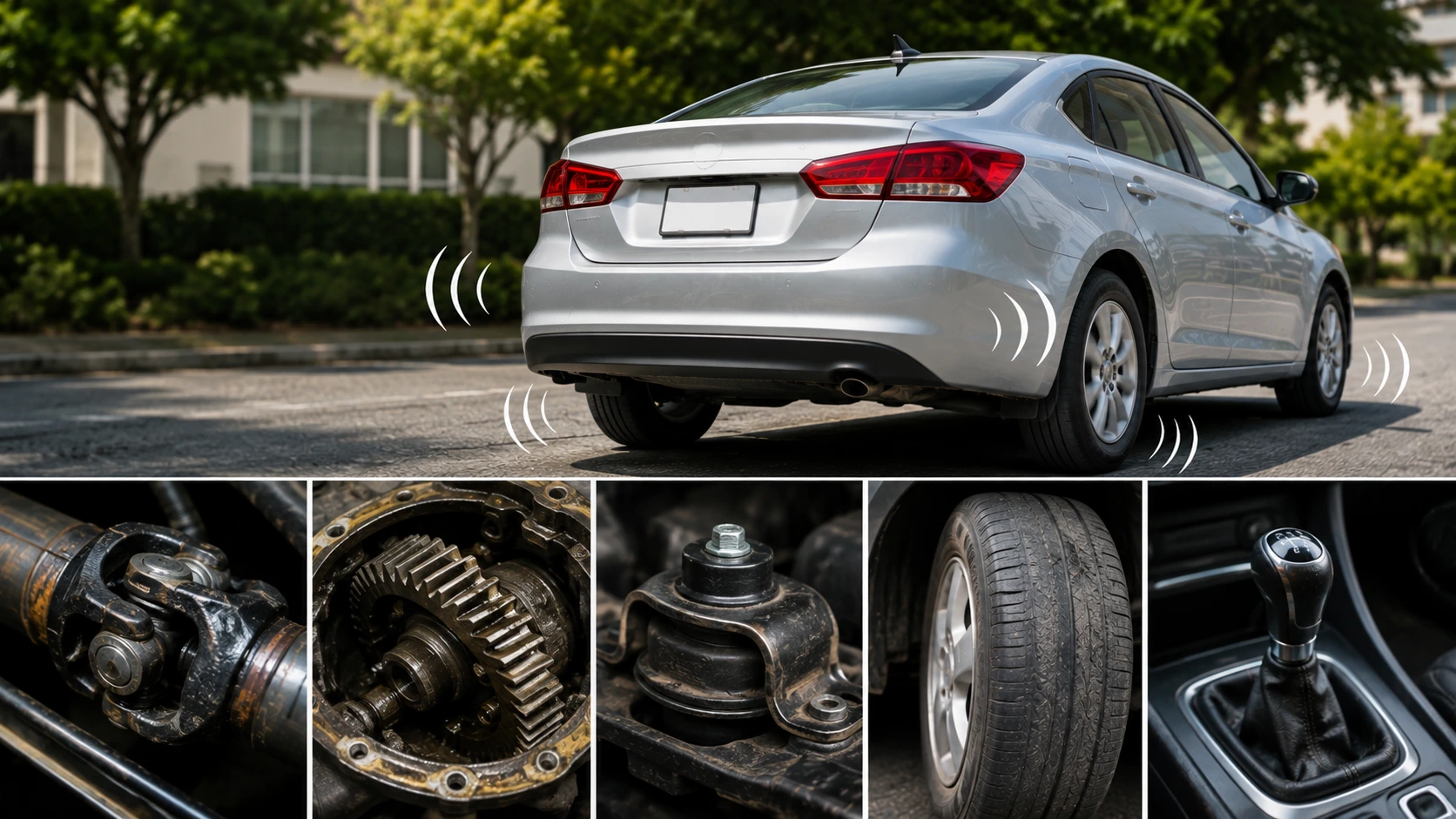
A vehicle vibrates only in reverse gear — the shuddering, shaking, or vibration that appears the moment reverse is selected and disappears when drive is engaged — — a vehicle vibrates only in reverse gear pattern is specific and diagnostically useful. The fact that it only occurs in reverse tells you immediately that the fault is related to how the vehicle handles reverse torque direction, which components are loaded differently in reverse compared to forward gears, and which parts of the drivetrain are stressed specifically by backward movement. This pattern This is why a vehicle vibrates only in reverse gear complaint is one of the easier faults to direct toward the correct component.
At Rapid Rev Garage in Al Quoz, vehicle vibrates only in reverse gear cases are diagnosed by understanding which components behave differently in reverse and testing each one systematically.
Vehicle Vibrates Only in Reverse Gear — Quick Verdict
A vehicle that vibrates only in reverse gear is most commonly caused by a failed or collapsing engine mount or transmission mount that allows excessive powertrain movement when torque is applied in the reverse direction, a CV joint or driveshaft that has developed a fault that only manifests at the specific angle and rotation direction of reverse, a torque converter shudder on automatic transmissions that is most pronounced at the low-speed, high-load condition of reverse engagement, or loose exhaust or drivetrain components that resonate specifically when the drivetrain rotates in reverse. The reverse-only character is the key — it rules out faults that would produce vibration in all gears and directs the diagnosis toward components loaded asymmetrically by reverse torque.
Table of Contents
- Why Reverse Gear Loads the Drivetrain Differently
- What the Vibration Character Reveals Before Inspection
- Engine and Transmission Mounts — The Most Common Cause
- Driveshaft and CV Joint Faults in Reverse
- Torque Converter and Automatic Transmission Causes
- Exhaust and Underbody Component Resonance
- How Dubai’s Conditions Accelerate These Faults
- How We Confirm the Exact Cause at Rapid Rev Garage
- The Right Fix for Each Confirmed Fault
- What Happens If This Is Left
- Is It Safe to Drive?
- How Long the Repair Takes
- What the Repair Costs in Dubai
- Preventing Reverse Vibration From Developing
- Why Rapid Rev Garage?
- FAQ
- Conclusion
Why Reverse Gear Loads the Drivetrain Differently
Understanding why a vehicle vibrates only in reverse gear pattern occurs requires understanding why reverse is mechanically unique explains why it produces vibration that forward gears don’t.
Torque Direction Reverses Under the Powertrain
When the engine drives the vehicle forward, torque is applied to the engine mounts, transmission mounts, and driveshafts in a specific direction — the engine twists clockwise against its mounts under acceleration. In reverse, the driven direction of the drivetrain reverses, and the torque reaction through the mounts occurs in the opposite direction. A mount that has collapsed enough to allow movement in the reverse-torque direction but still provides resistance in the forward-torque direction produces vibration only in reverse.
CV Joints and Driveshafts Operate at Different Angles
In reverse, the front wheels point in the direction of travel — typically slightly turned for the parking or manoeuvring conditions where reverse is most used. The constant velocity joints that allow drive to the steering wheels operate at a greater angle in reverse parking manoeuvres than in straight-line forward driving. A CV joint with developing wear may only produce vibration at these larger angles — which occur almost exclusively in reverse manoeuvres.
Reverse Engagement Creates a Unique Hydraulic Load on Automatics
On automatic transmissions, reverse uses a specific clutch pack and hydraulic circuit that is different from any forward gear. The engagement event and the sustained torque transmission in reverse load the torque converter and transmission internals differently from drive. A torque converter with developing shudder is often most noticeable in reverse at low speeds.
What the Vibration Character Reveals Before Inspection
The specific feel of the vibration when a vehicle vibrates only in reverse gear helps identify the component before any physical inspection.
Vibration Immediately on Engagement
A vibration that appears the moment reverse is selected — before the car has moved — points toward the engine mounts or transmission mounts. The powertrain jolts against a failed mount the instant torque is applied, and the movement produces a vibration or clunk that appears immediately.
Vibration While Moving in Reverse
A vibration that appears specifically while the car is moving in reverse — particularly during slow reversing manoeuvres with the wheel turned — points toward a CV joint or driveshaft fault. The movement of the driveshaft at the specific angle of the reversing manoeuvre is the triggering condition.
Vibration Only at the Moment of Engagement, Then Smooth
A shudder specifically at the moment of engagement that then resolves as the car reaches a steady reverse speed points toward a torque converter shudder or a transmission clutch pack engagement issue — the clutch pack or converter slipping briefly on engagement and then locking.
Vibration Accompanied by a Specific Sound
A vibration accompanied by a metallic clunk points toward a mount fault. A vibration accompanied by a knocking or clicking from under the vehicle points toward a CV joint or driveshaft. A vibration with a grinding sensation from the transmission area points toward internal transmission engagement wear.
Engine and Transmission Mounts — The Most Common Cause
Failed engine or transmission mounts are the most frequent cause of a vehicle vibrates only in reverse gear complaint of reverse-only vibration, and the cause that produces the clearest connection between the reverse-torque mechanism and the symptom.
How a Failed Mount Produces Reverse-Only Vibration
Engine mounts use rubber or hydraulic isolation to absorb the engine’s torque reaction without transmitting it to the body. When the rubber has hardened from heat, cracked from age, or the hydraulic fluid has leaked from the mount’s internal cavity, the isolation fails. In forward gears at normal driving speeds, the engine’s inertia and the relatively gradual torque application may mask the mount failure. In reverse, the low speed and immediate torque application during engagement loads the failed mount directly and immediately, producing the vibration before vehicle speed has developed enough to mask it.
The Bounce Test for Mount Condition
A mount’s condition can be assessed by applying load to the engine in both directions while the vehicle is stationary — in gear with the foot on the brake, gently applying throttle. A mount that is failing allows visible engine movement that exceeds the normal small rotation of a healthy mount. With the vehicle on a ramp, a lever applied to the engine and transmission tests deflection against specification.
Front Mounts vs Rear Transmission Mount
The front engine mounts primarily resist the vertical and lateral loads of the engine’s weight. The rear transmission mount or gearbox mount is what principally resists the engine’s torque reaction. A rear transmission mount failure specifically produces the reverse-only vibration pattern because it is the mount that is most directly loaded when reverse torque is applied. Our car mechanic team tests both engine and transmission mount deflection before recommending any mount replacement.
Driveshaft and CV Joint Faults in Reverse
CV joints — constant velocity joints — allow the driveshaft to transmit drive to the front wheels regardless of the steering angle. They are designed to operate through a range of angles, but their wear characteristics change with operating angle.
CV Joint Wear and the Reverse Angle Factor
A CV joint with beginning wear may operate without noticeable vibration at the small angles used in straight-line forward driving. During reverse parking manoeuvres where the steering wheel is turned significantly, the CV joint operates at a larger angle — and a worn joint at a large angle produces the vibration the driver notices. This is the specific mechanism that makes CV joint vibration appear in reverse parking and not in forward straight-line driving.
The Clicking Test for CV Joint Condition
The classic test for CV joint wear is turning the steering to full lock and driving in a slow circle. A clicking or vibration specifically at full-lock slow speed confirms CV joint wear. In reverse, this same condition is replicated during typical Dubai parking manoeuvres — which is exactly when the vibration appears.
Driveshaft Imbalance or Wear in Reverse
On rear-wheel-drive vehicles, the propeller shaft or driveshaft that connects the gearbox to the rear differential can develop a vibration that is directional — appearing in reverse but not in forward because the rotation direction is reversed. A centre bearing on the driveshaft that is worn or misaligned produces a vibration at specific rotation directions and speeds. For any breakdown from a driveshaft failure, our roadside assistance covers Al Quoz and nearby Dubai areas.
Torque Converter and Automatic Transmission Causes
On automatic transmissions, the torque converter and the reverse clutch pack are specific components that can produce reverse-only vibration.
Torque Converter Shudder in Reverse
Torque converter shudder occurs when the converter’s lock-up clutch engagement becomes inconsistent — slipping and gripping rapidly rather than locking cleanly. This shudder is most noticeable at low speeds with high torque demand — exactly the conditions of reverse engagement in a parking manoeuvre. The shudder feels like a vibration or judder during the first few seconds of reverse movement.
The ATF Connection
Torque converter shudder is often exacerbated by degraded automatic transmission fluid. Fresh ATF restores the friction modifier properties that allow the lock-up clutch to engage smoothly. A torque converter shudder that resolves or improves significantly after an ATF drain and refill confirms fluid condition as a contributing cause.
Reverse Clutch Pack Engagement Roughness
The reverse clutch pack on an automatic transmission engages hydraulically when reverse is selected. A clutch pack with worn friction material, or a hydraulic circuit with pressure delivery inconsistency, produces a rough engagement that the driver feels as a vibration or judder at the moment reverse is selected. Our car service packages include transmission fluid condition checks at every major service — because ATF condition is directly connected to clutch engagement smoothness.
Exhaust and Underbody Component Resonance
Less commonly, reverse-only vibration comes from components under the vehicle that resonate specifically when the drivetrain rotates in reverse.
Loose Heat Shield Resonance at Reverse RPM
A loose exhaust heat shield may vibrate at a specific frequency that corresponds to the engine RPM and exhaust pulse pattern in reverse. In forward gears, the engine operates at different RPM ranges that don’t excite the shield’s resonant frequency. In reverse at idle-adjacent RPM during slow manoeuvring, the resonance is triggered and produces the vibration.
Exhaust Mount Contact With Reverse Drivetrain Movement
An exhaust system that is hanging lower than designed — from a broken mount — may make contact with the vehicle floor or underbody specifically when the drivetrain moves in the reverse-torque direction. The contact produces a vibration that is only present in reverse.
How Dubai’s Conditions Accelerate These Faults
Dubai’s specific conditions create the component wear that produces vehicle vibrates only in reverse gear faults at lower mileages than in temperate markets.
Heat Destroys Mount Rubber and Hydraulic Fluid
Engine mount rubber compounds harden and crack faster in Dubai’s sustained heat. Hydraulic mount fluid leaks more readily through seals that have hardened from heat cycling. Transmission mount rubber loses its isolation effectiveness faster. All three mount failure mechanisms are accelerated by the sustained underbonnet temperatures of Dubai stop-start driving.
Parking Frequency Means More Reverse Manoeuvres
Dubai’s mall-dominated parking culture means the average vehicle selects reverse dozens of times per day. Each reverse selection is a torque reversal event for the mounts and a full-angle loading event for the CV joints. The accumulated cycle count on a Dubai city-driven vehicle is significantly higher than on any suburban vehicle doing driveway reversals.
Short Trips at Maximum Load Stress Mounts
Short trips from parking to parking — characteristic of Dubai’s urban layout — mean the vehicle spends a high proportion of its driving time in the acceleration and deceleration phases where mounts are most heavily loaded. A mount designed for the sustained cruise loads of highway driving is more quickly fatigued by the repeated peak-load cycles of urban stop-start driving.
How We Confirm the Exact Cause at Rapid Rev Garage
Reverse-only vibration diagnosis requires testing in the conditions that produce the fault.
Reverse Driving Test to Characterise the Vibration
The diagnostic process starts with a reverse manoeuvre test — straight reverse, reverse with wheel turned, and reverse from a stationary position — to confirm the exact conditions that produce the vibration and identify whether it is movement-dependent or engagement-dependent.
Mount Deflection Test Under Load
The vehicle is held stationary with the brake applied and reverse selected, and gentle throttle is applied while observing engine and transmission mount deflection from outside the vehicle. Excessive visible movement of the powertrain under this reverse-torque load immediately identifies a failed mount.
CV Joint Full-Lock Assessment
A full-lock slow circle in reverse confirms or rules out CV joint contribution — a joint that produces vibration or clicking at full lock in reverse has wear that the angle exposes.
ATF Condition and Torque Converter Assessment
On automatic transmissions, ATF condition is checked and a diagnostic scan reads torque converter slip data and transmission fault codes. A transmission scan that shows torque converter slip counts in reverse confirms the torque converter as the cause.
The Right Fix for Each Confirmed Fault
Each fault has a specific repair matched to the confirmed cause.
Mount Replacement
Failed engine or transmission mounts are replaced with correctly-specified units. Where the transmission mount is confirmed as the primary cause — as is most common in reverse-only vibration — the engine mounts are also assessed for condition, as they are typically of similar age and exposure.
CV Joint or Driveshaft Replacement
A worn CV joint is replaced with a correct-specification joint or complete driveshaft assembly. Post-replacement, the full-lock reverse test is repeated to confirm the vibration is resolved.
ATF Service and Torque Converter Assessment
A complete ATF drain and refill with correct-specification fluid — combined with a torque converter shudder additive where the platform supports this — resolves torque converter shudder from fluid degradation. Where the converter itself is mechanically worn, replacement is the correct repair. For any exterior repairs alongside drivetrain work, our car painting team handles colour-matched repairs at the same visit.
Heat Shield and Exhaust Mount Repair
A loose heat shield is re-secured or replaced. A broken exhaust mount is replaced to restore correct exhaust clearance from underbody components.
What Happens If This Is Left
A reverse-only vibration fault that is left without repair follows a predictable escalation.
Mount Failure Spreads to Adjacent Components
A failed transmission mount that is allowing powertrain movement in reverse continues to deflect further as the rubber deteriorates. The excessive movement eventually contacts surrounding components — shift cables, exhaust pipes, brake lines — causing secondary damage that complicates the repair.
CV Joint Wear Progresses to Failure
A CV joint that is producing vibration at large angles in reverse is in the early stages of mechanical failure. Continued driving at full-lock angles accelerates the wear until the joint fails during a manoeuvre — producing a complete loss of drive to that wheel at a moment that is typically inconvenient and potentially unsafe.
Is It Safe to Drive?
Reverse-only vibration is generally safe for forward driving — the fault only manifests in reverse — but warrants prompt investigation for specific reasons.
Mount Failure Has Forward-Gear Consequences
A mount that has failed enough to produce reverse vibration will progressively fail to the point where forward-gear driving is also affected — and eventually to the point where drivetrain movement causes secondary contact damage.
Book Within the Week
A vehicle vibrates only in reverse gear from any of the confirmed causes should be diagnosed within the week. The fault is not an immediate stop-and-recover emergency for most presentations, but it should not be deferred for months. Our mobile car mechanic covers Al Quoz and nearby Dubai areas for on-site mount deflection assessment before driving in.
How Long the Repair Takes
Repair duration depends on which component the diagnostic confirms has failed.
Mount Replacement
Transmission mount replacement: two to three hours. Full engine and transmission mount set: three to five hours.
CV Joint Replacement
CV joint or driveshaft replacement: two to four hours per side including road test confirmation.
ATF Service
ATF drain and refill: two to three hours including post-service reverse manoeuvre test.
What the Repair Costs in Dubai
All costs are confirmed after the diagnostic assessment and before any work begins.
Mount Replacement
Single transmission mount: AED 500–1,200 parts and labour. Full mount set: AED 1,500–3,500 depending on vehicle platform.
CV Joint or Driveshaft
AED 700–2,500 per side depending on whether the joint or complete shaft is replaced and the vehicle platform.
ATF Service
AED 400–900 depending on ATF specification and vehicle sump capacity. Torque converter replacement where confirmed faulty: AED 1,500–4,500 depending on vehicle. A written quote is provided after the diagnostic assessment. Our garage near me location in Al Quoz serves drivers from Business Bay, Jumeirah, Barsha, Satwa, Downtown, and the Sheikh Zayed Road corridor.
Preventing Reverse Vibration From Developing
Specific maintenance habits prevent the most common causes of reverse-only vibration in Dubai.
ATF Service at Dubai-Appropriate Intervals
Automatic transmission fluid replaced every 60,000–80,000 km in Dubai’s heat — rather than the factory “lifetime fill” guidance — maintains the friction modifier properties that prevent torque converter shudder and smooth reverse clutch engagement.
Mount Inspection at Every Major Service
A visual and physical mount deflection check at every major service catches mounts that are beginning to fail before they produce the reverse vibration that confirms failure. A mount showing beginning rubber separation is identified and replaced before the vibration appears.
Why Rapid Rev Garage?
We diagnose vehicle vibrates only in reverse gear by testing specifically in reverse — mount deflection under reverse torque load, CV joint assessment at full lock in reverse, ATF condition assessment, and torque converter data from a diagnostic scan. The reverse-specific test conditions are what distinguish a mount fault from a CV joint fault from a converter fault — because all three can produce vibration that the driver experiences as “only in reverse” but through completely different mechanisms.
FAQ — Vehicle Vibrates Only in Reverse Gear
These are the questions most frequently asked about this fault at our workshop.
Why does my car only vibrate in reverse and not in drive?
Reverse applies torque to the drivetrain in the opposite direction from forward gears. Components that have failed in a way that only allows excessive movement in the reverse-torque direction — particularly mounts — produce vibration in reverse without affecting forward gears.
Can a CV joint cause vibration only in reverse?
Yes — a CV joint with wear operates at larger angles during reverse parking manoeuvres than in straight-line forward driving. A joint that is only worn enough to produce vibration at these larger angles produces the reverse-only vibration pattern.
Is reverse-only vibration always a transmission problem?
No — the most common cause is engine or transmission mounts, not the transmission itself. CV joints and exhaust components are also common causes that have nothing to do with the transmission internally.
My car vibrates in reverse but shifts smoothly — is that a transmission fault?
Smooth shifting that accompanies reverse-only vibration points away from the transmission itself and toward mounts or CV joints — because an internal transmission fault usually also affects shift quality in forward gears.
How urgent is it to repair reverse-only vibration?
It should be diagnosed within the week. It is not an immediate stop-driving emergency for most presentations, but deferred repair allows the underlying fault to progress to secondary damage that is more expensive to address.
Conclusion
A vehicle vibrates only in reverse gear is a diagnostically specific complaint — the reverse-only pattern immediately identifies the fault category and narrows the component list to mounts, CV joints, torque converter, or resonating underbody components. Dubai’s conditions accelerate all four causes through heat-related mount degradation, high reverse-manoeuvre frequency from parking culture, and oil degradation from sustained heat. Rapid Rev Garage in Al Quoz diagnoses every reverse-only vibration complaint by testing specifically in reverse and under the exact conditions that produce the fault.
Rapid Rev Garage is in Al Quoz, serving drivers across nearby Dubai areas — Business Bay, Jumeirah, Downtown, Barsha, Satwa, and the Sheikh Zayed Road corridor. Book your appointment on WhatsApp or find us on Google Maps.
Rapid Rev Garage — Vehicle Vibrates Only in Reverse Gear | Al Quoz, Dubai