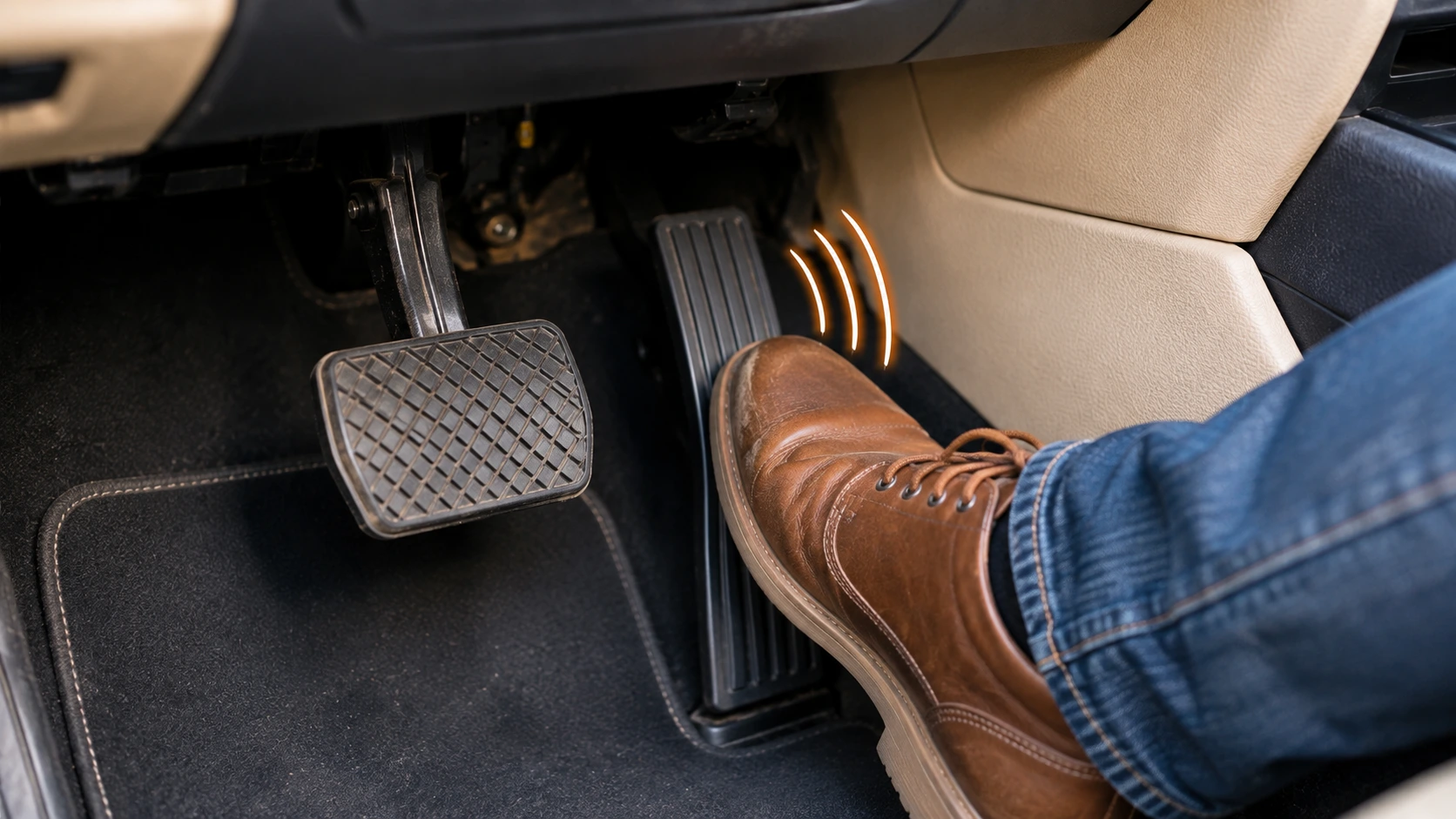
When an accelerator feels stiff and requires noticeably more effort to depress than before, returning slowly after releasing, or feeling resistant through part of its travel — the pedal is communicating that something in the throttle control circuit has developed increased friction, reduced flexibility, or a mechanical obstruction. This is not a fault to adapt to. An accelerator feels stiff situation makes precise speed control more difficult and can mask the progression toward a more serious throttle fault if left without investigation.
At Rapid Rev Garage in Al Quoz, stiff accelerator pedal complaints are diagnosed with a structured physical and electronic assessment — covering the pedal mechanism, throttle cable or electronic sensor, throttle body, and any environmental obstruction — before any component is recommended for replacement.
Car’s Accelerator Feels Stiff — Quick Verdict
An accelerator that feels stiff is most commonly caused by a throttle cable that has developed internal friction from corrosion, kinking, or contamination — on vehicles with cable-operated throttle systems. On modern vehicles with electronic throttle control, a stiff pedal is more likely from a throttle pedal position sensor that has developed internal friction, a throttle body that has accumulated carbon deposits restricting plate movement, or a physical obstruction — floor mat displacement, debris under the pedal — that is mechanically limiting pedal travel.
In Dubai’s heat and dust, cable systems corrode faster than in cooler markets and throttle bodies accumulate carbon faster from stop-start driving. Electronic throttle faults require diagnostic scanning to distinguish a sensor fault from a control module issue.
Table of Contents
- What a Stiff Accelerator Is Telling You
- Understanding Throttle Control — Cable vs Electronic Systems
- Physical Obstructions — The First Check Before Any Diagnosis
- Throttle Cable Faults on Cable-Operated Systems
- Electronic Throttle Pedal and Sensor Faults
- Throttle Body Restriction Causing Pedal Resistance
- Return Spring and Pedal Mechanism Faults
- How Dubai’s Heat and Dust Create Stiff Throttle Faults
- How We Confirm the Exact Cause at Rapid Rev Garage
- The Correct Fix for Each Confirmed Cause
- What Happens If a Stiff Accelerator Is Left Without Repair
- Is It Safe to Drive?
- How Long the Repair Takes
- What the Repair Costs in Dubai
- Keeping the Throttle System Smooth in Dubai
- Why Rapid Rev Garage?
- FAQ
- Conclusion
What a Stiff Accelerator Is Telling You
When the accelerator feels stiff, comparing it against correct pedal behaviour is the first diagnostic step — a correctly functioning accelerator pedal has a consistent, progressive resistance through its full travel — light and smooth from the rest position through to full throttle, with a return spring that brings it back to the rest position immediately and completely when the driver’s foot is removed.
Normal vs Abnormal Pedal Resistance
The pedal’s resistance profile is engineered — it should feel the same throughout its travel range without any stiff spots, sticky points, or positions where more force is suddenly required. A stiff spot at a specific pedal position — say, requiring extra effort to push past 30% travel — indicates a friction point at the corresponding position in the throttle cable, sensor, or throttle body.
Why Slow Return Is as Concerning as Stiff Depression
An accelerator that returns slowly after the driver’s foot is removed is as diagnostically significant as one that is hard to push down. Slow return means the return spring is insufficient to overcome the friction in the system — which is the same friction that made pressing it down harder. A pedal that doesn’t return fully to the rest position is a fault that must be addressed immediately.
Understanding Throttle Control — Cable vs Electronic Systems
The type of throttle control system determines which components are most likely causing the accelerator feels stiff complaint determines which components are the most likely causes.
Cable-Operated Throttle Systems
Older vehicles and some current basic models use a physical cable that connects the accelerator pedal to the throttle body. Pressing the pedal pulls the cable, which directly opens the throttle plate. The cable runs through a conduit from the pedal to the throttle body — usually passing through the firewall and across the engine bay. Any friction increase in the cable, conduit, or throttle body produces a directly-felt stiff pedal.
Electronic Throttle Control Systems
Modern vehicles use an electronic throttle — the pedal connects to a position sensor rather than a cable. The sensor sends a signal to the engine management system, which activates an electric motor in the throttle body to open the throttle plate to the commanded position. A stiff pedal on an electronic system is from friction in the pedal mechanism itself, a failing pedal position sensor, or a throttle body motor that requires more current than normal to move.
Physical Obstructions — The First Check Before Any Diagnosis
Before investigating why the accelerator feels stiff through mechanical or electronic means, physical obstruction must be ruled out — because it is the cause that takes 30 seconds to check and requires no tools to resolve.
Floor Mat Displacement
A floor mat that has slid forward under the accelerator pedal is the single most common cause of sudden accelerator stiffness — and the most dangerous, because a mat that traps the pedal partially depressed prevents the pedal from returning fully to the rest position. This is a direct cause of unintended acceleration events.
The Dubai Mat Factor
Dubai’s climate means most vehicle owners use rubberised floor mats that provide more coverage than factory mats — protecting the carpet from sand and dust. These larger, heavier mats are more prone to displacement. Any sudden accelerator stiffness should begin with a floor mat check before the vehicle is driven further.
Debris Under the Pedal
A foreign object — a stone, a pen, a bottle cap — lodged under the accelerator pedal can physically limit its travel or create friction against the pedal arm. In Al Quoz’s commercial environment, small debris on the floor of workshop-visiting vehicles is a real source of this fault. Our car mechanic team confirms pedal clearance visually before any further diagnosis proceeds.
Throttle Cable Faults on Cable-Operated Systems
On vehicles with cable throttle systems, the cable and its conduit are the primary cause of an accelerator feels stiff complaint.
Internal Cable Corrosion
The throttle cable runs inside a conduit that protects it from the environment. When moisture enters the conduit — from a damaged conduit end or a failing firewall grommet — the cable inner wire corrodes. Corroded cable wire increases friction against the conduit inner surface, producing increased pedal effort and sometimes a sticky feel at specific pedal positions where corrosion is localised.
Why Dubai Heat Accelerates Conduit Degradation
The rubber ends and grommets that seal the throttle cable conduit harden and crack in Dubai’s sustained heat, allowing moisture ingress during the brief but significant humidity periods Dubai experiences. A conduit end that was sealed when the vehicle was new may be freely allowing moisture after five years of Dubai heat cycling.
Cable Kinking From Previous Work
A throttle cable that was removed and incorrectly reinstalled during a previous engine service may have developed a kink at the point of reinstallation. A kinked cable has increased friction at the kink that produces a stiff spot at a specific throttle position. This cause appears suddenly after a service rather than gradually over time.
Throttle Body Pivot Friction
The cable end connects to a lever at the throttle body. A lever pivot that has corroded or lost its lubrication produces friction that is felt through the cable back to the pedal. The friction is at the throttle body end, but the stiffness is felt at the pedal.
Electronic Throttle Pedal and Sensor Faults
On electronic throttle systems, the pedal itself contains a position sensor — and the pedal mechanism has its own mechanical return and pivot components.
Pedal Position Sensor Friction
The pedal position sensor translates mechanical pedal position into an electrical signal. When the sensor’s internal mechanism develops friction — from wear, contamination, or a fault in its return spring — the sensor resists smooth movement and produces the stiff, notchy feel the driver notices.
How This Shows on a Diagnostic Scan
A pedal position sensor with internal friction produces an irregular output voltage curve when the pedal is slowly depressed and released with the ignition on and a scan tool reading live data. A healthy sensor produces a smooth, linear voltage change. A faulty sensor produces a voltage curve that jumps or sticks at specific pedal positions — confirming the sensor as the stiffness source.
Throttle Body Motor Resistance
In an electronic throttle system, the throttle body contains an electric motor that receives commands from the engine management system and opens the throttle plate. A motor with beginning failure draws more current and produces more resistance to movement. The driver perceives this as stiffness because the pedal sensor commands a position that the motor struggles to achieve — and the control system compensates in ways that can alter pedal feel.
Throttle Body Restriction Causing Pedal Resistance
Carbon accumulation on the throttle plate and bore is a cause of accelerator feels stiff symptoms that applies to both cable and electronic throttle systems.
How Carbon Buildup Creates Stiffness
A throttle plate coated in carbon deposits on its edges and face requires more force to move through the carbon-restricted bore than a clean plate in a clean bore. On cable systems, this carbon friction is felt directly through the cable to the pedal. On electronic systems, the throttle body motor’s increased effort to move the carbon-restricted plate changes the control loop behaviour — sometimes producing an altered pedal feel as the system compensates.
Why Dubai Stop-Start Driving Creates More Carbon
The stop-start driving pattern that dominates Dubai urban commuting never sustains the combustion temperatures that burn off carbon deposits from the throttle bore naturally. Carbon accumulation on throttle bodies in Dubai occurs faster than in any highway-dominated driving environment. Our car service packages include throttle body carbon assessment at every major service for vehicles with stop-start urban driving histories.
Return Spring and Pedal Mechanism Faults
The accelerator pedal’s return is managed by a spring that pulls the pedal back to the rest position when the driver’s foot is removed. A spring that has weakened or a pedal pivot that has stiffened produces the slow-return symptom.
Weakened Return Spring
A return spring that has fatigued produces a pedal that travels normally when pressed but returns more slowly than it should. The pedal may not return fully to the rest position under its own spring force — requiring the driver to lift their foot to physically raise the pedal. This is not safe under any circumstances and must be addressed immediately.
Stiff Pedal Pivot
The pedal arm pivots on a pin through a bracket. A pivot that has corroded or accumulated debris produces friction that resists both the pressing and return movement of the pedal — contributing to stiffness in both directions. In Dubai’s occasional humidity combined with dust, this pivot accumulates contamination faster than in stable dry climates. For any breakdown caused by a stuck or stiff accelerator that makes the vehicle unsafe to drive, our roadside assistance covers Al Quoz and nearby Dubai areas.
How Dubai’s Heat and Dust Create Stiff Throttle Faults
Dubai’s environment specifically produces throttle stiffness through two dominant mechanisms.
Heat Degrades Cable Conduit and Sensor Seals Faster
Throttle cable conduit rubber, pedal position sensor seals, and throttle body gaskets all degrade from sustained heat faster than in any temperate market. The degradation allows moisture and dust ingress that produces the corrosion and contamination creating friction. A vehicle that spends its days in peak Dubai summer heat accumulates this degradation significantly faster than a vehicle in a moderate climate.
Dust Contamination of Throttle Components
Al Quoz industrial dust enters engine bays, cable conduit ends, and pedal mechanism housings faster than residential-area dust levels allow. Fine particulate dust in a throttle cable conduit, on a pedal sensor track, or in a throttle body bore creates the abrasive friction that progressively increases pedal effort. Air filter condition directly affects throttle body cleanliness — a restricted air filter increases the velocity at which any bypass dust reaches the throttle body.
How We Confirm the Exact Cause at Rapid Rev Garage
The diagnostic sequence moves from the fastest physical checks to electronic assessment only when mechanical causes are ruled out.
Physical Check First
Floor mat position and pedal clearance are confirmed before any other investigation. Pedal return to rest position under its own spring force is tested with the engine off.
Live Data Pedal Sensor Assessment
On electronic throttle vehicles, live pedal position sensor voltage is observed during slow, full-range pedal movement with the ignition on. A smooth, linear output confirms the sensor. An irregular output confirms sensor friction.
Throttle Body Physical Inspection
The throttle plate and bore are inspected for carbon accumulation. On cable systems, the cable condition is assessed — conduit end integrity, cable routing, and throttle body lever pivot lubrication. The cable is moved through its full range while feeling for stiff spots or resistance variations.
Scan for Throttle System Fault Codes
A full diagnostic scan reads any throttle system fault codes — throttle body position errors, pedal sensor range faults, throttle motor current faults — that confirm electronic cause before any mechanical work is undertaken.
The Correct Fix for Each Confirmed Cause
The repair is matched to the specific cause confirmed by the diagnostic sequence.
Floor Mat Repositioning or Replacement
A displaced floor mat is repositioned to its correct location with all retention clips engaged. A mat that is too large for the driver’s footwell is replaced with the correct size for the vehicle. This fix costs nothing but prevents a serious safety risk.
Cable Lubrication or Replacement
A stiff throttle cable is first lubricated with penetrating cable lubricant injected into the conduit end — this resolves friction from minor corrosion and debris without cable replacement. Where the cable has significant internal corrosion or a kink, replacement with the correct cable for the vehicle is the repair. Post-replacement, cable routing is confirmed to avoid sharp bends.
Throttle Body Cleaning
Professional throttle body cleaning removes carbon deposits from the plate and bore — restoring smooth plate movement and reducing pedal effort on cable systems or normalising throttle body motor current on electronic systems. Post-cleaning, a throttle body adaptation reset is performed through the scan tool. For any exterior work needed alongside throttle or engine servicing, our car painting team handles colour-matched repairs at the same visit.
Pedal Position Sensor Replacement
A confirmed faulty pedal position sensor is replaced with the correctly-specified unit for the vehicle. Post-replacement, a scan tool is used to confirm the new sensor’s output voltage range and linearity before road testing.
Return Spring Replacement
A weakened or broken return spring is replaced immediately. This is a safety-critical repair that should not be deferred for any reason once the spring failure is confirmed.
What Happens If a Stiff Accelerator Is Left Without Repair
A stiff accelerator that is driven through rather than repaired follows a predictable and dangerous progression.
Progressive Stiffness Leading to Throttle Sticking
A throttle cable that is corroding internally gets stiffer with every kilometre driven. A carbon-fouled throttle body accumulates more carbon with every start. A stiff pedal this week is a stuck pedal at risk next month — and a throttle that is mechanically stuck open is a severe safety emergency.
Imprecise Speed Control Creates Safety Risk
An accelerator that is noticeably stiffer than normal requires more conscious foot effort to modulate precisely. The subtle speed control that driving in dense Dubai traffic requires — small throttle adjustments in stop-start patterns — is compromised by a pedal that requires significant effort at each input.
Is It Safe to Drive?
The urgency depends on the severity and the suspected cause.
Confirmed Floor Mat Obstruction — Fix Before Driving
A floor mat that is obstructing the pedal must be repositioned before the vehicle is driven. This is a non-negotiable safety correction.
Confirmed Slow Return — Fix Today
A pedal that returns slowly or incompletely after the foot is removed has a return spring or pivot fault. Do not drive until this is assessed — a pedal that doesn’t return is an uncontrolled throttle event waiting to happen.
Stiff But Returning Correctly — Book This Week
A pedal that is stiffer than before but returns correctly under spring force is safe for careful driving for a few days. The fault should not be deferred for months.
How Long the Repair Takes
Repair time varies from minutes for physical checks to a few hours for cable or sensor replacement.
Physical Checks and Floor Mat
15 minutes including road test confirmation.
Throttle Body Cleaning and Adaptation Reset
90 minutes to two hours including road test after cleaning.
Cable Lubrication or Replacement
One to two hours for lubrication. Two to three hours for full cable replacement depending on routing complexity.
Pedal Sensor Replacement
One to two hours including scan tool output confirmation.
What the Repair Costs in Dubai
Cost depends on the confirmed cause — physical fixes cost less than electronic component replacement.
Simple Fixes
Floor mat repositioning: no charge beyond inspection. Cable lubrication: AED 150–300 including road test.
Component Repairs
Throttle body cleaning: AED 350–700. Throttle cable replacement: AED 400–1,000 depending on vehicle and cable routing. Pedal position sensor replacement: AED 500–1,500 depending on vehicle platform and sensor specification.
Return Spring and Pivot Work
Return spring replacement: AED 200–500. Pivot cleaning and lubrication: AED 150–300. A written quote follows the diagnostic confirmation. Our mobile car mechanic covers Al Quoz and nearby Dubai areas for on-site pedal and throttle assessment.
Keeping the Throttle System Smooth in Dubai
Specific habits prevent the most common causes of throttle stiffness in Dubai.
Floor Mat Retention Check at Every Entry
A 10-second check of floor mat position every time the driver enters the vehicle — ensuring the mat retention clips are engaged — prevents the most dangerous cause of accelerator stiffness from ever occurring.
Throttle Body Cleaning as Scheduled Maintenance
Including throttle body carbon inspection and cleaning at every major service prevents the carbon accumulation that produces stiffness before it reaches the symptom threshold. Our garage near me location in Al Quoz serves drivers from Business Bay, Jumeirah, Barsha, Satwa, Downtown, and the Sheikh Zayed Road corridor.
Why Rapid Rev Garage?
When an accelerator feels stiff, the starting point is always the physical check — floor mat, pedal clearance, pedal return — before any electronic or mechanical investigation. A stiff accelerator from a displaced floor mat requires no tools to fix and no cost. A stiff accelerator from a corroded cable requires cable replacement. A stiff accelerator from an electronic sensor fault requires a specific sensor replacement. Treating all three the same way produces the wrong intervention in two out of three cases. Our diagnostic sequence identifies the correct cause before any work begins.
FAQ — Accelerator Feels Stiff
These are the questions most frequently asked about this fault at our workshop.
Can a stiff accelerator cause an accident?
Yes — a floor mat obstructing the pedal is a known cause of unintended acceleration. A return spring that fails to return the pedal means the throttle stays open when the driver's foot is removed. Both are safety-critical situations that require immediate attention.
Why did my accelerator suddenly get stiffer after a service?
A throttle cable that was disturbed, kinked, or incorrectly reinstalled during a service produces immediate post-service stiffness. The timing of the fault after a service is the strongest indicator of a service-introduced cause.
Can I lubricate a stiff throttle cable myself?
Penetrating cable lubricant sprayed into the conduit from the pedal end is a DIY-accessible preliminary intervention. If the stiffness is significant or the cable shows signs of corrosion, replacement rather than lubrication is the correct repair and should be done by a workshop.
Does an electronic throttle car have a cable I can check?
No — on electronic throttle vehicles, there is no cable between the pedal and the throttle body. The pedal connects only to a sensor. Stiffness on an electronic throttle vehicle is in the pedal mechanism or sensor, not a cable.
How do I know if my accelerator is returning fully?
With the engine off and the vehicle stationary, press the accelerator fully to the floor and release. The pedal should spring back immediately and completely to the rest position against the stop. Any hesitation, partial return, or slow return indicates a return spring or pivot fault.
Conclusion
An accelerator feels stiff in Dubai from specific, identifiable causes — floor mat obstruction, cable corrosion, throttle body carbon accumulation, electronic sensor friction, or return spring failure — each of which has a direct repair that restores correct throttle feel. When an accelerator feels stiff, the investigation begins with the fastest physical checks and progresses to electronic assessment only when mechanical causes are ruled out. Rapid Rev Garage in Al Quoz diagnoses every stiff accelerator complaint through this sequence — resolving the most common causes in under an hour.
Rapid Rev Garage is in Al Quoz, serving drivers across nearby Dubai areas — Business Bay, Jumeirah, Downtown, Barsha, Satwa, and the Sheikh Zayed Road corridor. Book your appointment on WhatsApp or find us on Google Maps.
Rapid Rev Garage — Accelerator Feels Stiff | Al Quoz, Dubai