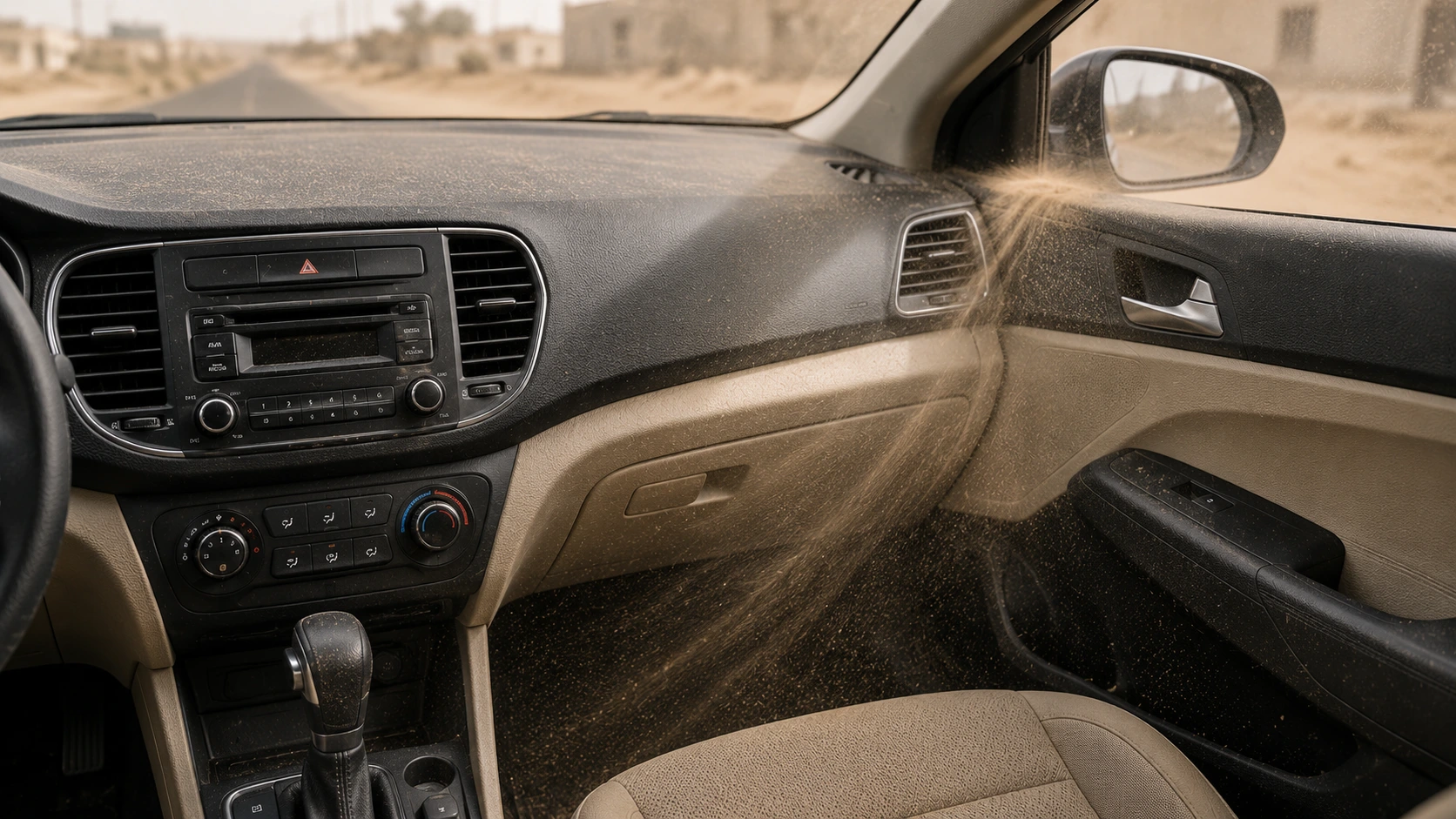
Dust entering cabin excessively is one of the most complained-about vehicle issues in Dubai — and one of the most directly connected to the specific environment here. Dubai’s combination of fine desert dust, industrial particulate from commercial areas like Al Quoz, and the HVAC system running near-continuously creates both the source material and the delivery mechanism for dust inside the cabin. A vehicle with dust entering cabin excessively accumulates visible dust on the dashboard within days of cleaning is not simply parked in a dusty area — it has a specific entry point that is allowing dust to bypass the systems designed to stop it.
At Rapid Rev Garage in Al Quoz, dust entering cabin excessively complaints are diagnosed by identifying every possible entry route — air handling system, seals, and structural gaps — and confirming which is active.
Dust Entering Cabin Excessively — Quick Verdict
Dust entering the cabin excessively in Dubai comes from one or more of four entry routes: a clogged or bypassed cabin air filter that is no longer capturing dust before it enters the HVAC distribution system, failed door or window seals that allow dusty air to enter directly during driving, the HVAC fresh air intake drawing dusty air from outside when operating in fresh air mode, or physical gaps in the firewall, floor grommet, or body panel joints that allow road dust to migrate into the cabin. In Dubai’s environment, the cabin air filter is almost always the starting point — a severely clogged filter can collapse and allow unfiltered air to bypass it entirely. But a filter that’s been freshly replaced and dust continues accumulating indicates a seal or structural entry point that the filter cannot address.
Table of Contents
- Why Dubai Produces So Much More Cabin Dust Than Other Markets
- How the Cabin’s Dust Barrier System Is Supposed to Work
- When the Cabin Air Filter Is the Primary Cause
- Door and Window Seal Failure as an Entry Route
- HVAC Fresh Air Intake and Recirculation Faults
- Structural Entry Points — Grommets, Firewall, and Floor Gaps
- How to Distinguish Between Entry Routes
- How We Map Every Dust Entry Point at Rapid Rev Garage
- The Right Fix for Each Confirmed Entry Route
- What Happens If Excessive Dust Entry Is Left Without Repair
- Is Excessive Cabin Dust a Health Concern?
- How Long the Repair Takes
- What the Repair Costs in Dubai
- Keeping the Cabin as Dust-Free as Possible in Dubai
- Why Rapid Rev Garage?
- FAQ
- Conclusion
Why Dubai Produces So Much More Cabin Dust Than Other Markets
The quantity and character of dust that causes dust entering cabin excessively in Dubai is genuinely different from temperate markets — which is why factory maintenance schedules for cabin air filters are consistently inadequate for this market.
Fine Desert Particulate Penetrates Everything
Desert dust — particularly the fine PM2.5 and PM10 particles that Dubai’s environment generates — is physically smaller than dust in many other environments. Smaller particles penetrate gaps that larger particles would not — including partially degraded seals, compressed foam strip joints, and HVAC system gaps that were adequate for European dust levels but are insufficient for Dubai’s fine particulate.
Al Quoz Industrial Dust Is an Amplifier
For vehicles driven regularly in Al Quoz — or parked near its industrial streets — the particulate load is higher than in residential Dubai. Industrial processes in the area produce a mixed dust that includes mineral, carbon, and metallic particles. This mix is heavier in total particulate concentration per cubic metre of air than residential or desert dust alone.
The HVAC System Runs Nearly Continuously
In a temperate market, a vehicle’s HVAC fan runs for a portion of each journey. In Dubai, the AC fan runs at significant speed from the moment the car starts to the moment it stops, from April through October. This continuous operation means more air — and therefore more dust — passes through the cabin air filter, the duct system, and any gaps in the HVAC circuit per day than in any market with seasonal AC use.
How the Cabin’s Dust Barrier System Is Supposed to Work
Understanding the intended dust prevention system identifies immediately why each failure mode allows dust to enter.
The Cabin Air Filter’s Role
All air entering the HVAC system — whether from the fresh air intake or recirculation — passes through the cabin air filter before it reaches the fan and duct distribution system. The filter captures particles above its rated pore size. A clean, correctly-seated filter in good condition prevents virtually all dust from the HVAC circuit reaching the cabin.
The Body Seal System
The door seals, window seals, and firewall seals create a pressure barrier between the outside environment and the cabin. When the HVAC system creates slight positive pressure inside the cabin — which it does when the fresh air intake is open — this pressure differential pushes outward, further preventing dust from entering through any small gaps.
When Both Systems Work Together
A functioning cabin filter and intact body seals together produce a cabin that accumulates minimal dust even in Dubai’s environment. When either system is compromised — a clogged filter, a failed seal, a blocked recirculation flap — the dust barrier is broken and accumulation accelerates.
When the Cabin Air Filter Is the Primary Cause
The cabin air filter is the most frequently responsible component for dust entering cabin excessively in Dubai for excessive cabin dust in Dubai — and the most easily addressed.
How a Clogged Filter Causes More Dust Entry
A cabin air filter that is severely clogged from Dubai’s particulate load does not simply stop filtering — it begins to restrict airflow significantly. As restriction increases, the HVAC fan must work harder to pull air through the clogged media. At severe restriction, the differential pressure across the filter is high enough to collapse or bypass the filter media — allowing unfiltered dusty air to reach the distribution system directly.
What Severe Clogging Looks Like
A Dubai cabin filter that has exceeded its service life is dark grey to black across its face, may have visible surface debris, and when removed allows visible light through only a few areas of the filter media. A filter in this condition has effectively stopped filtering — it is a dust collection device that is no longer preventing dust from passing through.
The Replacement Interval in Dubai
Factory cabin filter replacement intervals — typically every 15,000–20,000 km or once per year — are based on moderate European dust conditions. In Dubai’s environment, particularly for vehicles driven in commercial areas, every 8,000–10,000 km or every 6 months is the appropriate interval. Vehicles regularly driven in Al Quoz may need replacement even more frequently. Our car mechanic team inspects cabin filter condition at every service visit — not just when replacement is due by mileage.
Filter Fit and Bypass Gaps
A correctly functioning cabin filter must seal completely against its housing — any gap between the filter and the housing walls allows dusty air to bypass the filter media entirely. A filter of incorrect dimensions, a housing with a damaged seal surface, or a filter that has been incorrectly reinstalled after the last replacement all produce bypass gaps that allow unfiltered air to enter.
Door and Window Seal Failure as an Entry Route
Door and window rubber seals are the primary physical barrier that prevents dust entering cabin excessively through the body structure preventing outside air — and the dust it carries — from entering the cabin during driving.
How Seal Failure Produces Cabin Dust
A door seal that has hardened, cracked, or lost its compression against the door frame no longer creates the complete barrier it was designed to provide. Dusty outside air is forced through the gap by the pressure difference between outside (higher pressure at speed) and inside (slightly lower pressure if the HVAC is in recirculation mode). The continuous flow through this gap carries dust into the cabin directly — bypassing the cabin filter entirely because it is entering through the body rather than the HVAC system.
Dubai UV and Heat Accelerate Seal Failure
Door and window seals are rubber or EPDM — materials that harden and become brittle under sustained UV exposure and heat. In Dubai’s sun intensity and temperature, seal material degrades measurably faster than in any European market. A seal that provided full compression contact when the vehicle was two years old may be leaving a gap by five years on a vehicle parked in direct sun.
Which Seals Fail First
The seals most exposed to direct sun — the door seal on the roof line and the upper window seal — typically harden before the lower seals that are shaded by the door structure. A dusty vehicle where the dust accumulates particularly on the upper portions of the dashboard and seats has a roof-line or upper seal failure as the most likely route. Our car service packages include a door and window seal condition inspection at every major service.
HVAC Fresh Air Intake and Recirculation Faults
The HVAC system’s mode selection — fresh air versus recirculation — has a direct effect on how much outside dust enters the cabin.
Fresh Air Mode in Dubai
When the HVAC is in fresh air mode, outside air is drawn through the intake grille at the base of the windscreen and through the cabin filter before entering the cabin. In Dubai’s dusty environment, fresh air mode continuously challenges the cabin filter with high-particulate air. A filter past its service life in fresh air mode in Dubai produces rapid cabin dust accumulation.
Stuck-Open Fresh Air Flap
The flap that controls whether the HVAC draws from fresh air or recirculation is controlled by a servo motor. A flap that is stuck in the fresh air position — from a faulty servo, a mechanical failure, or a vacuum fault — keeps the system drawing dusty outside air even when recirculation is selected. This produces continued dust entry even after a fresh cabin filter is installed, which is a confusing pattern that points toward the flap rather than the filter.
Recirculation in Dusty Conditions
Operating in recirculation mode in severely dusty conditions prevents outside dust from entering through the HVAC intake. However, recirculation mode also prevents the removal of CO2 from the cabin — long-term recirculation in a closed cabin impairs air quality in a different way. The correct practice in Dubai’s peak dust conditions is to use a correctly-serviced cabin filter in fresh air mode rather than avoiding fresh air entirely.
Structural Entry Points — Grommets, Firewall, and Floor Gaps
Some cases of dust entering cabin excessively trace to physical gaps in the body structure in the body structure rather than through the HVAC system or door seals.
Firewall Grommets and Penetrations
The firewall — the metal panel separating the engine bay from the cabin — has penetrations for wiring harnesses, cable conduits, and HVAC hoses. These penetrations are sealed with rubber grommets. A grommet that has hardened and pulled out of its seat, or cracked from engine bay heat, creates a direct opening between the dusty engine bay and the cabin.
Why This Is More Common in Dubai
Engine bay temperatures in Dubai’s summer — particularly in the firewall area that sits between the hot engine and the hot ambient air — are sustained at levels that harden firewall grommets faster than in any moderate climate. A grommet that was flexible and well-seated when the vehicle was new may have partially retracted from its seat by six years of Dubai heat exposure.
Floor Pan Penetrations and Drain Grommets
The floor pan has drain holes and cable penetrations that are sealed with rubber plugs. In older vehicles or those that have had underbody work, these can be missing or unseated — allowing road dust to enter from below, particularly when driving through dusty Al Quoz industrial streets where disturbed road dust is at its highest concentration. For any breakdown needed while investigating dust entry, our roadside assistance covers Al Quoz and nearby Dubai areas.
How to Distinguish Between Entry Routes
The location and pattern of accumulation when dust entering cabin excessively identifies which entry route is active.
Dust From the HVAC Vents
Dust accumulating primarily on surfaces directly in line with the HVAC vents — the dashboard directly below the centre vents, the areas around the A/C outlet grilles — is entering through the HVAC system. This points to a cabin filter that is clogged, bypassed, or incorrectly seated.
Dust at the Door Edges and Window Sills
Dust accumulating primarily at the door edges, window sill areas, and along the floor near the door thresholds is entering through door or window seal failure. The dust trail follows the air path through the seal gap.
Dust on the Floor Near the Pedals
Dust accumulating specifically on the floor in the pedal area or near the centre console base points toward a firewall grommet or floor penetration entry point — road dust entering through the engine bay or floor penetration rather than through the door or HVAC system.
How We Map Every Dust Entry Point at Rapid Rev Garage
The diagnostic sequence identifies every active dust entry route in a single visit.
Cabin Filter Inspection and Replacement First
The cabin filter is inspected and replaced if in any doubt — because a fresh, correctly-fitted filter eliminates the HVAC entry route completely and allows any remaining dust accumulation after replacement to be attributed to a seal or structural entry point.
Smoke or UV Dye Test for Seal Gaps
A smoke test — introducing visible smoke outside the vehicle and observing whether it enters through door seals, window seals, or other gaps — identifies seal failure entry points precisely. UV dye applied around suspect areas and observed under UV light after a drive identifies the specific gap that is allowing dust ingress.
Grommet and Floor Penetration Visual Inspection
The firewall area is inspected with a torch for grommets that have pulled out of their seats or cracked. Floor pan drain grommets and cable penetrations are confirmed present and correctly seated. For exterior repairs needed alongside sealing or body work, our car painting team handles colour-matched work at the same visit.
The Right Fix for Each Confirmed Entry Route
Each confirmed entry route has a specific repair that closes that specific path — all confirmed routes are addressed at the same visit.
Cabin Filter Replacement With Correct Fit Confirmation
A fresh cabin filter of the correct specification for the vehicle is installed, with the housing seal surfaces cleaned and the filter seated to confirm no bypass gap around its edges. An activated carbon filter variant — where available for the vehicle — provides additional odour and particulate filtration appropriate for Dubai’s urban air quality.
Door and Window Seal Replacement
Degraded door and window seals are replaced with the correct specification for the vehicle. Seal replacement restores the full compression contact against the door frame and window channel that prevents dusty air from entering during driving.
Firewall Grommet Reseating or Replacement
A grommet that has pulled out of its firewall seat is cleaned, re-inspected for crack damage, and reseated with the correct sealant where the grommet has lost its natural retention. A cracked grommet is replaced.
HVAC Recirculation Flap Repair
A stuck recirculation flap servo is replaced or the flap mechanism is freed and confirmed to operate correctly through its full range of motion. Post-repair, the mode selection is confirmed to produce the correct flap position in both fresh air and recirculation settings. Our mobile car mechanic covers Al Quoz and nearby Dubai areas for on-site cabin filter and seal assessment before bringing the vehicle in.
What Happens If Excessive Dust Entry Is Left Without Repair
Excessive dust entry that is accepted and driven through produces specific and progressive consequences.
Progressive HVAC System Contamination
Dust that bypasses the cabin filter accumulates inside the HVAC duct system, on the evaporator fins, and in the blower motor housing. A dust-caked evaporator has reduced heat exchange efficiency — reducing AC cooling performance. A blower motor housing packed with dust introduces particles to the bearing that accelerate motor wear. What starts as visible dashboard dust eventually produces reduced AC performance and a prematurely failed blower motor.
Electrical Component Contamination
Interior electrical components — switches, sensors, modules behind the dashboard — accumulate dust that can eventually cause contact resistance faults. Fine metallic dust from industrial areas is particularly problematic for electrical contacts.
Is Excessive Cabin Dust a Health Concern?
In Dubai’s environment — where the dust contains desert minerals, industrial particulate, and occasional construction debris — sustained dust inhalation in an enclosed cabin is a genuine health concern.
Fine Particulate and Respiratory Health
PM2.5 particles — those small enough to penetrate deeply into the respiratory system — are present in Dubai’s air at elevated concentrations during dust events and in industrial areas. A cabin with a clogged or bypassed filter provides no protection against this particulate. A correctly maintained cabin air filter — particularly an activated carbon filter — provides meaningful protection.
Allergy and Asthma Triggers
Dust mite allergens, pollen, and industrial particulate are all captured by a functioning cabin filter. A bypassed or failed filter delivers these allergens directly to cabin occupants. For family vehicles with children or occupants with respiratory conditions, cabin filter maintenance is a health matter rather than simply a comfort one.
How Long the Repair Takes
Repair time depends on which entry routes are confirmed and how many require attention.
Cabin Filter Replacement
15–30 minutes including housing inspection and bypass gap confirmation.
Seal Replacement
One to two hours per door seal. Window seals: 30–60 minutes per window.
Firewall Grommet Work
30–60 minutes per grommet area including inspection and resealing.
HVAC Flap Repair
One to three hours depending on the flap mechanism access and whether servo replacement is required.
What the Repair Costs in Dubai
Cost depends on which entry routes are confirmed active and the specific repair each requires.
Cabin Filter Work
Cabin filter replacement: AED 150–450 depending on the filter specification and vehicle. Activated carbon filter variants where available typically cost more than standard filters but provide superior dust and odour capture.
Seal and Structural Work
Door seal replacement per door: AED 400–1,000. Window seal replacement: AED 250–600 per window. Firewall grommet reseating: AED 150–400. HVAC recirculation flap servo replacement: AED 400–1,200 depending on vehicle. A written quote follows the diagnostic assessment confirming the active entry route. Our garage near me location in Al Quoz serves drivers from Business Bay, Jumeirah, Barsha, Satwa, Downtown, and the Sheikh Zayed Road corridor.
Keeping the Cabin as Dust-Free as Possible in Dubai
Specific habits maintain the cabin’s dust barrier in Dubai’s demanding environment.
Cabin Filter at 8,000 km or 6 Months in Dubai
The standard factory replacement interval for cabin filters is not appropriate for Dubai’s conditions. An 8,000–10,000 km or six-month interval — whichever comes first — maintains filter effectiveness and prevents the bypass risk of severe clogging.
Use Recirculation Mode During Peak Dust
During visible dust conditions — sandstorms, construction activity nearby, or driving through Al Quoz’s industrial streets — selecting recirculation mode prevents the HVAC intake from actively drawing dusty air into the cabin. This preserves filter life and reduces immediate cabin dust accumulation during the worst conditions.
Annual Seal Inspection Before Summer
A door and window seal inspection before the summer season — when thermal expansion and UV exposure are at their peak — identifies seals approaching end of life before they fail and allow dust ingress through the summer months.
Why Rapid Rev Garage?
We approach dust entering cabin excessively by identifying which of the four entry routes is active before recommending any repair — because a new cabin filter does not prevent dust entering through a failed door seal, and door seal replacement does not address a bypassed cabin filter. The filter replacement, smoke test, and structural inspection together identify every active entry route in a single diagnostic visit. All confirmed routes are addressed at the same time to restore the complete dust barrier.
FAQ — Dust Entering Cabin Excessively
These are the questions most frequently asked about this fault at our Al Quoz workshop.
Why does my car collect dust so fast even with the windows closed?
Dust is entering through the HVAC system — most likely through a clogged cabin filter that has been bypassed, or through the HVAC fresh air intake drawing dusty outside air when in fresh air mode. A cabin filter replacement is the first intervention.
How often should I replace the cabin air filter in Dubai?
Every 8,000–10,000 km or six months — significantly more frequently than European factory schedules suggest. Vehicles driven regularly in Al Quoz or other dusty commercial areas may need replacement even more frequently.
Can dust inside the car damage anything?
Yes — dust on the evaporator reduces AC cooling efficiency, dust in electrical contacts creates resistance faults, and sustained fine particulate in the cabin has health implications. Preventing dust entry is both a comfort and a mechanical maintenance issue.
Why does my cabin smell dusty even after replacing the filter?
Dust that accumulated inside the HVAC ducts and on the evaporator before the filter was replaced remains in the system after the filter change. Professional HVAC evaporator cleaning and duct treatment removes existing accumulation and eliminates the dusty smell.
Do window tints help reduce cabin dust?
Window tinting reduces UV exposure and solar heat gain — which slows seal degradation. It does not directly reduce dust entry from the HVAC system, but reducing seal degradation extends the time before seal gaps allow additional dust entry.
Conclusion
Dust entering cabin excessively in Dubai has a specific entry route in every case — cabin filter bypass, failed door or window seals, HVAC flap fault, or structural gaps — and each route has a direct repair. The pattern of dust accumulation inside the cabin identifies which route is active. Rapid Rev Garage in Al Quoz identifies every active dust entry route through filter inspection, seal assessment, and structural check before recommending any repair — ensuring the complete dust barrier is restored rather than one entry point while others remain open.
Rapid Rev Garage is in Al Quoz, serving drivers across nearby Dubai areas — Business Bay, Jumeirah, Downtown, Barsha, Satwa, and the Sheikh Zayed Road corridor. Book your appointment on WhatsApp or find us on Google Maps.
Rapid Rev Garage — Dust Entering Cabin Excessively | Al Quoz, Dubai