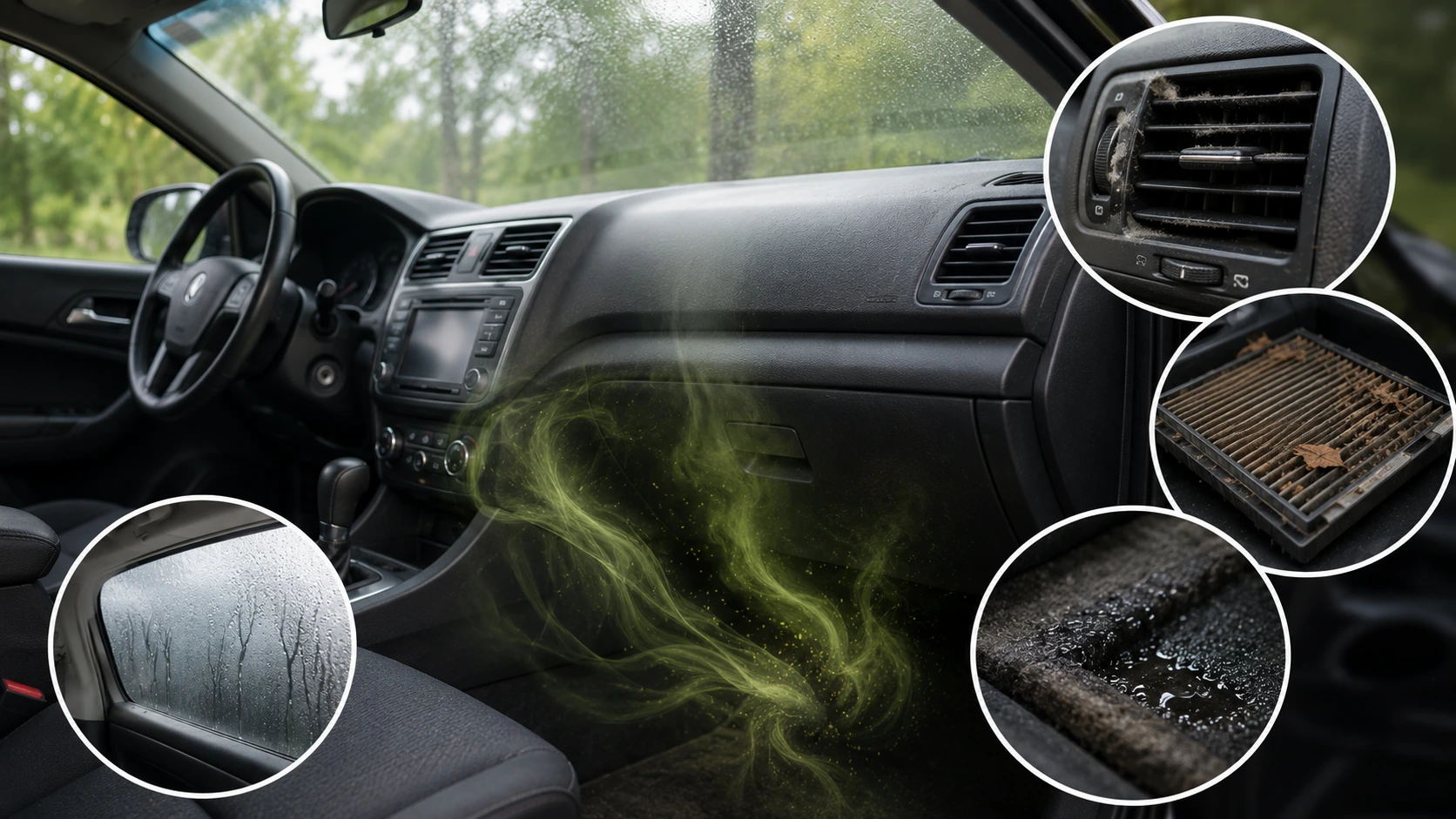
A musty smell inside the vehicle when the AC is switched on — particularly noticeable in the first few minutes before the cabin has fully cooled — is one of the most common complaints from Dubai drivers. The smell is distinctive: a damp, earthy, slightly mouldy odour that typically appears when the AC blower first pushes air through the system. In Dubai’s environment, where the AC runs near-continuously and the high humidity of certain seasons creates ideal conditions for microbial growth on the evaporator, this smell is not merely unpleasant — it can be a source of airborne allergens and respiratory irritants that affect everyone in the cabin.
At Rapid Rev Garage in Al Quoz, musty AC smell complaints are diagnosed and treated at the source — not masked with deodoriser sprays that address the symptom without eliminating the cause.
Musty Smell Inside the Vehicle — Quick Verdict
A musty smell inside the vehicle when the AC is on is almost always caused by mould, mildew, or bacteria growing on the surface of the evaporator coil and in the evaporator housing. The evaporator’s cold surface causes moisture from cabin air to condense on it — and if this condensate doesn’t drain correctly, or if the system sits with moisture present when switched off, microbial growth establishes on the wet evaporator surface. A severely clogged cabin air filter that has absorbed moisture compounds the problem.
In Dubai, the high humidity of the winter and inter-season periods, combined with a year-round AC system that is frequently switched from maximum cooling to off in cool underground parking, creates ideal evaporator mould conditions. The smell is the mould’s odour being carried into the cabin by the air stream at startup.
Table of Contents
- Why the Evaporator Is Where Mould Grows
- Why Dubai Creates This Problem More Than Most Markets
- The Smell Pattern — What It Tells You Before Inspection
- The Primary Cause — Evaporator Mould and Bacteria
- Secondary Contributors — Cabin Filter and Drain Faults
- How We Locate and Treat Every Source at Rapid Rev Garage
- The Right Treatment for Each Confirmed Cause
- What Happens If the Musty Smell Is Left Untreated
- Is the Smell a Health Concern?
- How Long the Treatment Takes
- What the Treatment Costs in Dubai
- Preventing the Musty Smell From Returning
- Why Rapid Rev Garage?
- FAQ
- Conclusion
Why the Evaporator Is Where Mould Grows
The evaporator is the component that produces cool air inside the cabin. Understanding why it is the primary location for mould growth explains why this smell is so specific to AC operation.
The Condensation Mechanism
The evaporator coil is cold — it operates below the dew point of cabin air during cooling. This causes moisture from the cabin air to condense on the evaporator’s surface in the same way a cold glass collects moisture in a humid room. This condensation is normal and expected — it is designed to drain through the AC condensate drain tube to outside the vehicle.
The Window When Mould Establishes
Mould and bacteria require moisture and a surface to grow on. The evaporator provides both — its metal surface and the debris that accumulates on it from unfiltered air provide the substrate, and the condensation provides the moisture. When the AC is switched off, the evaporator gradually warms and the remaining surface moisture doesn’t drain — it stays as a thin film on the evaporator surface. In the hours between switching off and switching on again, microbial growth occurs. Each cooling cycle adds more condensation and more time for growth.
Why the Smell Is Worst at Startup
The established mould on the evaporator surface produces volatile organic compounds — the molecules responsible for the musty smell. When the blower motor first pushes air across the evaporator surface, it carries these compounds directly into the cabin. After a few minutes of operation, the airflow across the evaporator partially dries the surface and reduces the intensity of the smell — which is why the worst of the musty smell inside the vehicle appears in the first two to five minutes of AC operation.
Why Dubai Creates This Problem More Than Most Markets
Several aspects of Dubai’s climate and driving patterns specifically accelerate evaporator mould development.
High Humidity in Winter and Inter-Season
Dubai’s image as a purely dry desert climate is incomplete — the winter and inter-season months (October through March) can produce significant humidity, particularly near the coast. High cabin humidity during these months provides abundant moisture for evaporator mould to develop at a faster rate than in the same vehicle during the dry summer months.
Daily Underground Parking Temperature Cycling
Dubai vehicles cycle between warm, relatively humid outdoor air and cool, air-conditioned underground parking multiple times per day. Each time the vehicle enters underground parking with its residual cabin heat and humidity, the AC evaporator — still slightly warm from the drive — begins to cool in the damp air, creating condensation on its surface before the system has fully dried out from the previous cycle.
AC System Left in Recirculation Mode
Many Dubai drivers use recirculation mode to maximise AC cooling efficiency and protect against outside heat. Recirculation continuously recirculates the same cabin air — which becomes progressively more humid from the occupants’ breath and perspiration. Higher humidity in the recirculated air means more condensation on the evaporator surface per minute of operation, accelerating mould establishment.
Short Trips Mean Less Evaporator Drying Time
On short trips — a 10-minute drive from home to the mall — the evaporator runs cold and wet for the entire trip and never has the extended operation that would partially dry its surface. The switch-off at the destination leaves the evaporator in its maximum-moisture state. In a Dubai week of multiple short trips, the evaporator is rarely given the sustained dry-out time that a long highway drive would provide.
The Smell Pattern — What It Tells You Before Inspection
The specific pattern of when and how strongly the musty smell inside the vehicle appears identifies how advanced the mould growth is and which components are contributing.
Strong Smell Only at Startup, Fading After 5 Minutes
Early-stage evaporator mould — the most manageable condition. The mould is primarily on the evaporator surface and its smell is concentrated at startup when the blower first blows across the undisturbed mould colony. Evaporator cleaning resolves this quickly.
Persistent Smell Throughout the Drive
Moderate-to-advanced evaporator mould, combined with contamination of the evaporator housing, drain pan, and potentially the ductwork. The smell doesn’t fade because the mould colony is large enough that the airflow does not reduce the odour output significantly. More involved treatment is required.
Smell That Returns Within Days of Treatment
A musty smell inside the vehicle that returns quickly after deodoriser treatment — without professional evaporator cleaning — is confirming that a spray applied to the outside of the evaporator has not reached the established mould colony on the inner coil surfaces and the drain pan. Surface treatment of an established mould colony is temporary. The mould requires physical cleaning or professional biocide application that reaches the evaporator’s full surface area.
Smell Accompanied by Reduced Airflow
A musty smell combined with reduced airflow through the vents indicates the cabin air filter is severely clogged and has absorbed moisture — contributing its own organic material and moisture retention to the smell, and restricting airflow across the evaporator. Both the filter and the evaporator require treatment simultaneously.
The Primary Cause — Evaporator Mould and Bacteria
Mould and bacteria are the specific microorganisms responsible for the characteristic musty smell inside the vehicle. The evaporator surface and housing are their habitat.
What Grows on the Evaporator in Dubai
The specific species that establish on evaporator surfaces are mould species that thrive on cellulose and organic debris — dust, pollen, and dead skin cells that accumulate on the evaporator despite the cabin filter. In Dubai’s conditions, Aspergillus, Penicillium, and Cladosporium species are the most commonly identified — the same species that produce the damp smell associated with buildings that have water damage.
How Carbon Dust Compounds the Problem in Al Quoz
In Al Quoz’s industrial environment, the dust that accumulates on the evaporator surface contains carbon and metallic particles from nearby industrial activity. This industrial dust provides additional surface area and organic substrate for mould growth compared to the residential-area dust that settles on evaporators in non-industrial locations. Our car mechanic team assesses evaporator contamination during every musty smell inside the vehicle diagnostic visit to confirm whether the growth is on the surface only or has penetrated into the housing and drain pan.
Secondary Contributors — Cabin Filter and Drain Faults
While the evaporator is the primary mould location, two secondary components significantly amplify the problem.
Cabin Air Filter Moisture and Organic Loading
A cabin air filter that has become loaded with dust and debris — particularly one that has been exposed to moisture — retains that organic material in a compressed, damp state. Moisture absorbed into the filter media from humidity or condensation creates a secondary mould site that the blower distributes into the cabin alongside the evaporator mould smell. Replacing the cabin filter is always part of a complete musty smell treatment — because leaving an old, organically-loaded filter while cleaning the evaporator produces continued smell from the surviving filter mould.
Blocked AC Condensate Drain
A blocked AC condensate drain — as covered in the Water Dripping Inside the Cabin blog — prevents condensation from draining from the evaporator housing. Standing water in the drain pan is an ideal mould growth environment. A drain that is cleaned as part of musty smell treatment prevents re-establishment of the mould colony at the drain pan — which is the highest-moisture area of the evaporator housing. Our car service packages include evaporator drain flow testing at every major service.
How We Locate and Treat Every Source at Rapid Rev Garage
The diagnostic process confirms the extent of contamination and all active sources before any treatment is applied.
Initial Assessment — Smell Strength and Pattern
The diagnostic process starts with an assessment of the smell’s character and timing — startup-only versus persistent, presence of reduced airflow, any other AC system symptoms. This identifies the severity and the likely extent of contamination before any components are accessed.
Cabin Filter Inspection and Replacement
The cabin filter is removed and inspected for moisture evidence, discolouration from organic loading, and any visible mould growth on the filter media. The filter is replaced regardless of condition as part of any musty smell treatment — a filter with established mould cannot be cleaned effectively.
Evaporator Housing Access and Drain Check
The condensate drain is tested for flow — confirming it is clear before any evaporator treatment. A blocked drain is cleared before the evaporator is treated, ensuring post-treatment condensation can drain correctly.
Evaporator Treatment — Professional Grade
Professional evaporator treatment uses a foaming biocide that is introduced to the evaporator through the air intake or evaporator access point. The foam expands to reach the full coil surface area — including the internal passages between coil fins — and the drain pan, carrying the biocide to every surface the mould has established on. This is the treatment that addresses the root cause rather than masking the smell. For any breakdown while arranging AC treatment, our roadside assistance covers Al Quoz and nearby Dubai areas.
The Right Treatment for Each Confirmed Cause
Every confirmed cause is addressed in the same visit — treating only the evaporator while leaving a contaminated filter produces continued smell.
Cabin Filter Replacement — Always Required
A fresh cabin filter is fitted as part of every musty smell treatment — because a contaminated old filter will contribute continued smell even after the evaporator is treated. An activated carbon filter provides superior odour capture and filtration compared to a standard filter.
Professional Evaporator Foam Treatment
A professional biocide foam treatment is the only intervention that reliably reaches the full evaporator surface and drain pan. Consumer spray products introduced through the air vents reach the duct surfaces but rarely penetrate the evaporator coil fins where the mould is established. The foam treatment, applied by accessing the evaporator more directly, reaches the full contamination area.
Duct System Treatment
Where the smell is persistent through the full drive rather than only at startup — indicating contamination has spread into the ductwork — a duct treatment with long-range biocide spray addresses the distribution system surfaces beyond the evaporator itself.
Drain Pan Cleaning
Where the drain pan has standing water from a previously blocked drain, the pan is physically cleaned after the drain is confirmed clear. Standing water residue in the drain pan provides a re-establishment point for mould if not removed. For exterior repairs needed alongside any HVAC work, our car painting team handles colour-matched work at the same visit.
What Happens If the Musty Smell Is Left Untreated
A musty smell that is tolerated rather than treated produces specific and progressive consequences.
Mould Colony Grows and Becomes Harder to Treat
An early-stage evaporator mould colony — startup smell only, fading after a few minutes — can be treated effectively with a professional foam application. A colony that has been left for months or years penetrates more deeply into the evaporator housing and drain pan, requires more aggressive treatment, and may not be fully resolved without evaporator removal for physical cleaning.
Air Quality Deterioration
An established evaporator mould colony continuously produces mould spores and volatile compounds that circulate through the cabin with every AC cycle. The cabin air quality deteriorates progressively as the colony grows and as the spore count in the ductwork increases. Children and occupants with respiratory sensitivity are disproportionately affected.
Is the Smell a Health Concern?
In Dubai’s environment — where the AC runs nearly continuously and the cabin is a semi-enclosed space — the musty smell inside the vehicle is a genuine health concern rather than simply an unpleasant experience.
Mould Spores and Respiratory Effects
The mould species that commonly establish on evaporators — Aspergillus and Cladosporium — produce spores that can trigger allergic responses, asthma exacerbation, and respiratory irritation in sensitive individuals. In a sealed, air-conditioned cabin where occupants breathe recirculated air, the exposure to these spores is higher than in an environment with more air exchange.
Children in the Rear Seats
Children sitting close to the rear vents — which deliver air directly from the duct system across the contaminated evaporator — receive the highest concentration of mould-contaminated air in the cabin. Dubai families using large SUVs and MPVs for daily school runs should prioritise evaporator treatment as a health matter rather than waiting until the smell becomes severe.
How Long the Treatment Takes
Treatment time depends on the extent of contamination and the number of components requiring attention.
Cabin Filter Replacement Only
15–30 minutes including housing inspection.
Foam Treatment With Filter Replacement
60–90 minutes including drain confirmation, foam application, 20-minute dwell time, blower purge, and post-treatment smell assessment.
Comprehensive Treatment Including Duct System
Two to three hours for cases with persistent smell including cabin filter, drain cleaning, foam treatment, and duct treatment.
What the Treatment Costs in Dubai
Cost depends on the confirmed contamination extent and which treatment components are required.
Cabin Filter Replacement
AED 150–450 depending on filter specification and vehicle. Activated carbon filter variants are at the higher end but provide superior odour and particle capture.
Professional Evaporator Foam Treatment
AED 300–600 including foam biocide, drain check, and post-treatment assessment.
Complete Treatment Package
Cabin filter, evaporator foam, and duct treatment: AED 500–1,000 depending on system size and the extent of contamination. A written quote is provided after the initial smell pattern assessment. Our mobile car mechanic covers Al Quoz and nearby Dubai areas for on-site initial assessment before bringing the vehicle in for treatment.
Preventing the Musty Smell From Returning
Specific habits prevent evaporator mould from re-establishing after treatment.
The Two-Minute Pre-Shutdown Habit
The single most effective prevention for musty smell inside the vehicle in Dubai requires no maintenance cost at all. Two to three minutes before parking, switch the AC to fan-only mode — blower running, compressor off. This runs warm air across the evaporator surface, beginning the drying process before the vehicle is switched off. A partially-dried evaporator has significantly less moisture available for mould growth during the parked period.
Cabin Filter at Dubai-Appropriate Intervals
An 8,000–10,000 km or six-month replacement interval for the cabin filter maintains low organic loading on the filter media — preventing the filter from becoming a secondary mould site.
Annual Pre-Summer Evaporator Treatment
A professional evaporator foam treatment once per year — before the peak summer period when AC use is at maximum — resets the evaporator surface to a clean state before the most intensive AC use period begins. Our garage near me location in Al Quoz serves drivers from Business Bay, Jumeirah, Barsha, Satwa, Downtown, and the Sheikh Zayed Road corridor.
Why Rapid Rev Garage?
We treat the musty smell inside the vehicle at the source rather than masking it. A deodoriser spray introduced through the air vents temporarily suppresses the smell by covering the mould odour with a fragrance — the mould colony continues to grow and the smell returns within days to weeks. The professional foam treatment that reaches the full evaporator coil surface and drain pan eliminates the mould colony rather than covering it. Combined with cabin filter replacement and drain confirmation, this approach produces a lasting resolution rather than a temporary improvement.
FAQ — Musty Smell Inside the Vehicle
These are the questions most frequently asked about this fault at our Al Quoz workshop.
Why does the smell only come when the AC first starts?
The blower's initial airflow across the undisturbed mould colony produces the peak odour output. After a few minutes, the airflow partially dries the evaporator surface and reduces — but doesn't eliminate — the smell. Advanced mould growth produces persistent smell throughout the drive because the colony is too large to be reduced by airflow alone.
Can I use a supermarket AC spray to fix this myself?
Consumer AC sprays introduced through the air vents reach the duct surfaces but rarely penetrate the evaporator coil fins where the mould is actually established. They provide temporary odour suppression — not mould elimination. The smell returns within days to weeks.
Is the musty smell dangerous to breathe?
In a sealed cabin with established evaporator mould, the continuous exposure to mould spores and volatile compounds is a genuine health concern — particularly for children and occupants with respiratory conditions. It should be treated rather than tolerated.
My car was just cleaned inside — why is there still a musty smell?
Interior cleaning addresses cabin surfaces but has no effect on the evaporator inside the HVAC system. The smell source is the evaporator — an area no interior detail can access. Only direct evaporator treatment eliminates the cause.
How long does the evaporator treatment last?
A professional foam treatment typically provides six to twelve months of odour-free operation — depending on how the vehicle is used, the cabin filter condition, and whether the pre-shutdown fan-dry habit is adopted. Annual preventive treatment at our Al Quoz workshop maintains the system in optimal condition.
Conclusion
The musty smell inside the vehicle when the AC is on in Dubai traces almost entirely to mould and bacteria established on the evaporator surface and drain pan — a consequence of Dubai’s humidity cycling, frequent AC switching, and short-trip driving pattern that leaves evaporator moisture available for microbial growth. Professional evaporator foam treatment, cabin filter replacement, and drain confirmation eliminate the cause. Rapid Rev Garage in Al Quoz addresses musty AC smell at the source — treating the evaporator directly rather than masking the odour.
Rapid Rev Garage is in Al Quoz, serving drivers across nearby Dubai areas — Business Bay, Jumeirah, Downtown, Barsha, Satwa, and the Sheikh Zayed Road corridor. Book your appointment on WhatsApp or find us on Google Maps.
Rapid Rev Garage — Musty Smell Inside the Vehicle | Al Quoz, Dubai