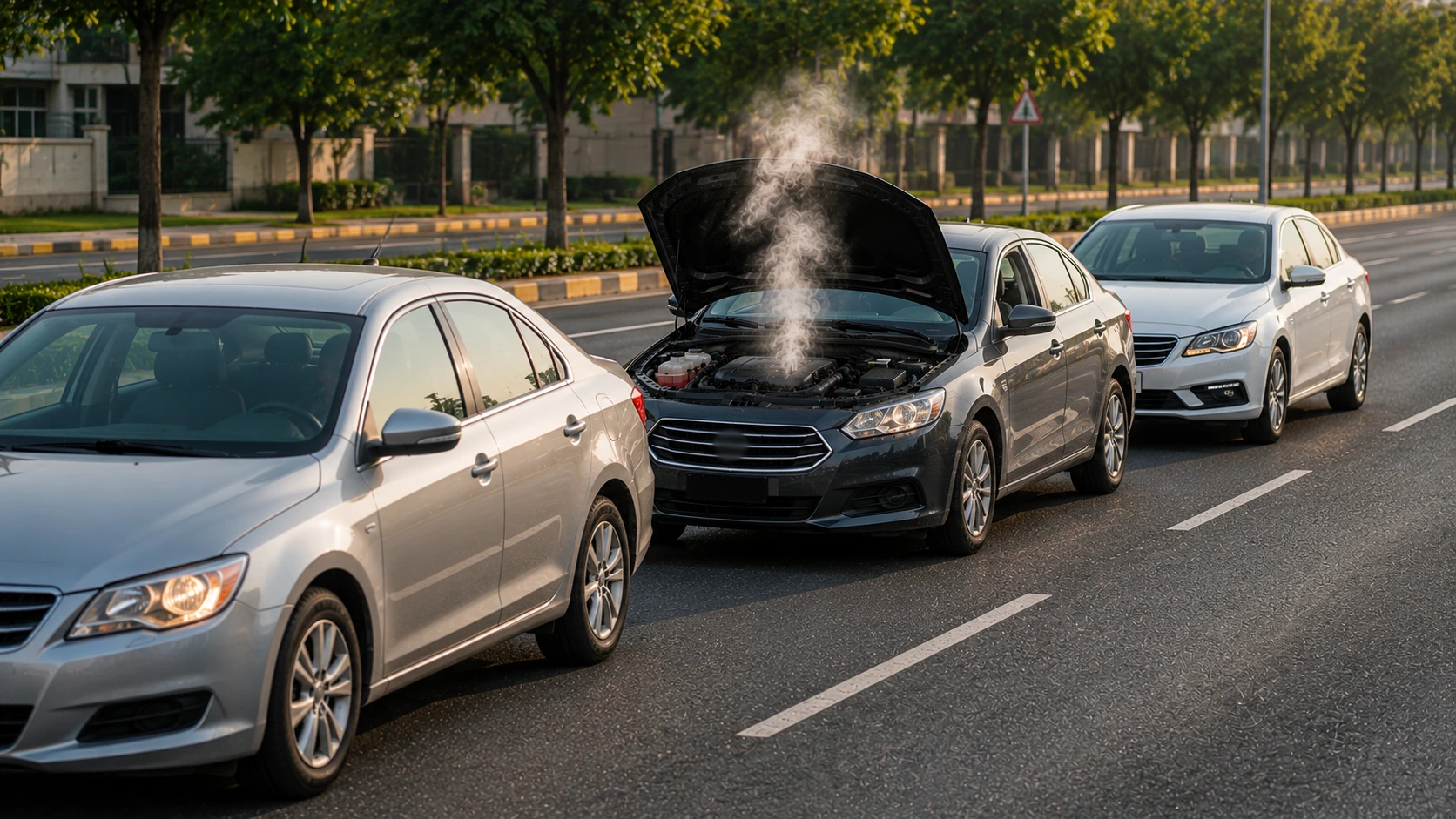
Engine overheating in traffic is signalled by the temperature gauge climbing above its normal position specifically during slow, stationary, or stop-start driving while remaining normal at speed — is one of the most specific fault patterns the cooling system produces, and one of the most urgent. In Dubai’s summer, where ambient temperatures reduce the cooling system’s thermal margin and traffic on Al Khail Road, Sheikh Zayed Road, and the Business Bay interchanges can be stationary for extended periods, an overheating fault that appears in traffic must be treated as the emergency it is. The consequences of driving through an overheating event — head gasket failure, warped cylinder head, cracked block — are among the most expensive engine repairs possible.
At Rapid Rev Garage in Al Quoz, engine overheating in traffic cases are diagnosed by understanding which cooling system components are only essential when the vehicle is stationary — and why they are failing.
Engine Overheating in Traffic — Quick Verdict
Engine overheating in traffic in Dubai is almost always caused by one of four faults: an electric cooling fan that has failed or is running at reduced speed — removing the airflow across the radiator that moving air provides when the car is in motion; a thermostat stuck partially or fully closed that prevents adequate coolant circulation to the radiator; a coolant level that is low from a leak or internal consumption — leaving insufficient coolant volume to absorb heat during stationary periods; or a radiator that is blocked with Al Quoz dust or internal scale — reducing its heat rejection capacity to the point where it fails at stationary low-airflow conditions.
Engine overheating in traffic specifically is the critical diagnostic clue — at speed, natural airflow compensates for many of these faults. At idle in traffic, nothing compensates.
Table of Contents
- Why Traffic Exposes Cooling System Weakness
- Reading the Temperature Gauge — What Each Pattern Means
- Cooling Fan Failure — The Primary Traffic Overheating Cause
- Thermostat Faults and Restricted Coolant Flow
- Low Coolant Level and Its Consequences
- Blocked or Restricted Radiator
- Head Gasket Failure — The Consequence and the Cause
- Why Dubai’s Conditions Make Traffic Overheating More Frequent
- How We Confirm the Exact Fault at Rapid Rev Garage
- The Right Fix for Each Confirmed Cause
- What to Do When the Temperature Gauge Climbs in Traffic
- Is It Safe to Keep Driving in Traffic?
- How Long the Repair Takes
- What the Repair Costs in Dubai
- Preventing Engine Overheating in Dubai Traffic
- Why Rapid Rev Garage?
- FAQ
- Conclusion
Why Traffic Exposes Cooling System Weakness
The traffic-specific pattern of engine overheating in traffic is the single most important diagnostic information — it tells you exactly which components the cooling system is depending on and which ones are failing.
What Changes When the Vehicle Stops in Traffic
When a vehicle is moving — even at 40 km/h — forward motion forces air through the front grille across the radiator and condenser at a rate that provides substantial cooling. This natural airflow supplements or even replaces the electric cooling fan’s function. When the vehicle stops in traffic, natural airflow drops to zero. The radiator now depends entirely on the electric fan to maintain airflow. Any weakness in the fan’s performance — from a failing motor, a seized bearing, a faulty relay, or a broken blade — is immediately apparent in stationary conditions.
What the Speed-Dependent Pattern Rules Out
A vehicle that overheats only in traffic but runs correctly at highway speed has a cooling system that is adequate at speed but insufficient at idle. This immediately rules out causes that would produce overheating at all speeds — a completely failed water pump, a massively depleted coolant level, or a fully seized thermostat. The fault is specifically in the components that provide stationary cooling: the fan, the radiator’s heat rejection capacity, and the thermostat’s ability to allow full coolant flow to the radiator.
Reading the Temperature Gauge — What Each Pattern Means
The temperature gauge’s behaviour in traffic is the most informative preliminary observation before any diagnostic tool is connected.
Gauge Rises in Traffic, Falls Immediately When Moving
This is the classic cooling fan failure pattern. The moment the vehicle begins moving and natural airflow returns, the temperature drops. The moment it stops again, the temperature begins climbing. This oscillating pattern — up in traffic, down at speed — confirms the fan is the primary cause. The cooling system is adequate at speed but depends on a fan that isn’t delivering.
Gauge Rises Progressively and Doesn’t Fall When Moving
A temperature gauge that climbs continuously regardless of whether the vehicle is moving or stationary indicates a more serious cooling system failure — inadequate coolant volume, a severely restricted radiator, or a head gasket that is introducing combustion gases into the coolant. The cooling system is failing even with natural airflow assistance.
Gauge Rises Slowly From the Start of Every Drive
A temperature gauge that runs slightly higher than its normal position from the beginning of every drive — and climbs further in traffic — points toward a thermostat that is not opening fully. The thermostat is restricting coolant flow to the radiator, and in traffic, where the fan’s limited capacity is already being tested, the reduced coolant flow compounds the heat rejection problem.
Cooling Fan Failure — The Primary Traffic Overheating Cause
The electric cooling fan is the component that provides airflow across the radiator when the vehicle isn’t moving. It is the first component to assess in any traffic-specific overheating complaint.
How a Failing Fan Produces Traffic-Specific Overheating
A fan motor that is running at reduced speed — from a worn motor winding, a failing relay, or a temperature switch that isn’t activating correctly — provides less airflow than a correctly-functioning fan. At normal driving speeds, this reduced airflow is supplemented by natural airflow and the overheating doesn’t develop. In stationary traffic, the reduced fan airflow is all that’s available — and it isn’t enough to reject the heat the engine is producing.
The Fan Speed Assessment
A correctly-functioning cooling fan at full operation produces a clearly audible and strong airflow through the radiator. A fan that is running but audibly slower than normal, or that activates late (not running when the temperature gauge is rising), is providing insufficient cooling capacity for stationary conditions.
The Fan Relay and Temperature Switch
The fan relay controls power to the fan motor. A relay that has developed high resistance — not the welded-closed relay from the previous blog that keeps the fan running continuously, but a relay that is providing reduced voltage — produces a fan that runs but at below-rated speed. The temperature switch that commands the relay to activate may activate at too high a temperature — allowing the engine temperature to rise further before the fan is called. Our car mechanic team tests fan output speed and activation temperature before any cooling system assessment is complete.
Thermostat Faults and Restricted Coolant Flow
The thermostat is the valve that controls when hot coolant flows from the engine to the radiator. A thermostat fault affects traffic-specific overheating in a specific way.
Thermostat Stuck Partially Closed
A thermostat that opens too late — activating coolant flow to the radiator at 105°C rather than the designed 90°C — allows the engine to reach higher temperatures before the cooling cycle begins. In traffic, where heat accumulates quickly and the fan is the only active cooling mechanism, this delayed thermostat opening means the engine reaches a dangerous temperature before the cooling cycle can bring it down.
Thermostat That Opens Intermittently
A thermostat with degraded spring material may open and close inconsistently at its design temperature — sometimes allowing full coolant flow, sometimes restricting it. This intermittent operation produces an oscillating temperature gauge that is independent of vehicle speed — it rises when the thermostat restricts flow and falls when it opens. This is distinct from the speed-dependent pattern of a fan fault and helps identify the thermostat as the cause.
Low Coolant Level and Its Consequences
Coolant volume is the thermal buffer that absorbs heat from the engine and carries it to the radiator. Insufficient coolant volume reduces this buffer — and the consequences are most severe in traffic where heat accumulates fastest.
Why Low Coolant Is Worst in Traffic
At highway speed, a partially-depleted coolant system may still reject heat adequately — the high airflow rate across the radiator removes heat faster than the reduced coolant volume absorbs it. In stationary traffic, the lower fan-driven airflow can no longer compensate for the reduced coolant volume. The smaller thermal buffer reaches its temperature limit faster, and overheating occurs.
What Causes Coolant Loss in Dubai
External leaks — from a radiator hose, a water pump seal, or a radiator core — are the most obvious cause. Internal coolant loss through a failing head gasket — where coolant enters the combustion chamber and exits as white exhaust smoke — is less visually obvious but produces progressive coolant depletion that eventually produces the traffic overheating pattern. Our car service packages include coolant level measurement and pressure testing at every major service to catch developing leaks before they deplete the coolant volume to the overheating threshold.
Blocked or Restricted Radiator
The radiator’s heat rejection capacity depends on clean fins with adequate airflow. In Dubai’s environment, radiator restriction from two sources is particularly common.
Dust Accumulation on External Fins
Al Quoz industrial dust accumulates between radiator fins at a rate that significantly exceeds residential-area dust loading. A radiator with 30–40% of its fin area blocked by compacted dust rejects substantially less heat per unit of airflow — and in stationary traffic where airflow rate is already limited, the reduced heat rejection capacity is what tips the system into overheating. External fin cleaning restores heat rejection capacity without any component replacement.
Internal Scale Buildup From Degraded Coolant
Coolant past its effective service life becomes acidic and produces internal corrosion products that deposit as scale inside the radiator’s coolant passages. Scale insulates the coolant from the aluminium walls, reducing the rate at which heat passes from the coolant to the fin structure. A scale-fouled radiator may look externally clean while rejecting significantly less heat than a clean radiator — and the performance deficit appears most clearly in the high-demand stationary traffic condition.
For any breakdown from traffic overheating, our roadside assistance covers Al Quoz and nearby Dubai areas.
Head Gasket Failure — The Consequence and the Cause
Head gasket failure deserves specific mention in any discussion of engine overheating in traffic because it exists in both directions — it is both a consequence of overheating and a cause of it.
Overheating Causes Head Gasket Failure
A cooling system fault that produces repeated or sustained overheating events eventually damages the head gasket — the seal between the cylinder head and the engine block. The head gasket is designed to seal under the engine’s normal operating thermal stresses. Beyond those stresses, the gasket material and the fire ring that seals the combustion chamber begin to fail.
A Failing Head Gasket Then Causes Overheating
A head gasket that has begun to fail allows combustion gases to enter the coolant passages. These combustion gases — which are at much higher pressure than the cooling system — push coolant out of the system, produce air pockets in the coolant that reduce heat transfer efficiency, and contaminate the coolant with combustion products. The combined effect is a cooling system that overheats progressively — with visible white exhaust smoke, coolant that smells of exhaust, and a coolant reservoir that shows bubbling when the engine is running.
Why Dubai’s Conditions Make Traffic Overheating More Frequent
Dubai’s environment reduces the cooling system’s thermal margin through several compounding mechanisms.
Reduced Thermal Margin From High Ambient Temperature
In a moderate climate, the cooling system operates with substantial thermal margin — the difference between the engine’s normal operating temperature and the ambient air temperature the radiator rejects heat into is large, giving the system capacity to handle hot days and traffic without overheating. In Dubai’s summer, ambient temperatures of 45°C+ reduce this margin dramatically. A cooling system that was adequate in winter may overheat in summer traffic because the reduced margin eliminates the buffer that previously compensated for minor system deficiencies.
Dust-Loaded Radiators and Fan Filters
Dubai’s dust accumulation on radiator fins is significantly higher in Al Quoz than in any residential environment — and most vehicles from this area have never had their radiator fins cleaned. A vehicle that has been driven in Al Quoz for two or more years has accumulated enough fin blockage to meaningfully reduce its heat rejection capacity.
Fan Motor Degradation From Heat
As covered in the cooling fan blog — Dubai’s sustained underbonnet heat accelerates fan motor bearing wear and winding degradation. Fan motors approaching end of life may run at full speed in winter but fail to maintain full speed when underbonnet temperatures are highest in summer — exactly when the vehicle most needs maximum fan performance.
How We Confirm the Exact Fault at Rapid Rev Garage
The diagnostic sequence starts with the temperature gauge pattern — the fastest and most informative observation.
Temperature Gauge Pattern Assessment During Road Test
The road test confirms whether the engine overheating in traffic is speed-dependent (fan fault) or progressive regardless of speed (coolant, thermostat, or head gasket). This single observation narrows the investigation immediately.
Fan Speed and Activation Test
Fan output is assessed at operating temperature with the vehicle stationary — confirming the fan activates at the correct temperature and delivers the correct airflow rate. A fan that is running but slowly is identified by this test.
Coolant Level, Pressure Test, and Combustion Gas Check
Coolant level is confirmed. The system is pressure-tested to identify any external leak. Combustion gases in the coolant are checked with a block test — a colour-change fluid that identifies combustion gas presence in the coolant reservoir, confirming head gasket involvement.
Radiator External and Thermostat Function Assessment
Radiator fin blockage is visually assessed. Thermostat function is confirmed by monitoring the upper hose temperature at the coolant thermostat’s expected opening temperature — if the hose doesn’t warm at the correct temperature, the thermostat is opening late or not at all.
The Right Fix for Each Confirmed Cause
Each repair is matched to the specific component the diagnostic sequence confirms has failed.
Cooling Fan Repair or Replacement
Fan relay, temperature switch, or motor replacement — matched to the specific failure confirmed by the fan speed and activation test.
Thermostat Replacement
Thermostat replaced with the correct opening-temperature unit for the engine. Coolant system refilled and pressure-tested after replacement.
Coolant Level Restoration and Leak Repair
The specific leak point is identified and repaired — hose replacement, water pump seal, or radiator repair. Coolant refilled to the correct concentration with fresh coolant after the leak is sealed.
Radiator Cleaning or Replacement
External fin cleaning restores heat rejection capacity without component replacement for externally-blocked radiators. Internal scale-fouled radiators are assessed for cleaning versus replacement based on the severity of the internal restriction.
Head Gasket Replacement
Where combustion gas in the coolant confirms head gasket failure, the repair involves cylinder head removal, gasket replacement, head resurfacing, coolant system pressure testing, and a complete coolant refill. For exterior repairs needed alongside engine work, our car painting team handles colour-matched work at the same visit.
What to Do When the Temperature Gauge Climbs in Traffic
This is the most important section in this blog — because the driver’s response when overheating begins determines whether the engine survives intact or suffers permanent damage.
Step One — Do Not Ignore It
A temperature gauge that is climbing above its normal position in traffic is not self-correcting. It is telling you the cooling system cannot manage the heat it is generating. Do not wait to see if it comes back down.
Step Two — Turn Off the AC and Turn On the Heater
Switch off the air conditioning and switch the cabin heater to maximum heat. The heater core is part of the cooling circuit — running maximum heat uses the heater as an additional heat exchanger, removing some heat from the coolant. This buys time.
Step Three — Move If Possible
If traffic allows, move the vehicle at any speed — even 20 km/h. This restores natural airflow across the radiator and typically causes the temperature to drop. If you can safely leave the traffic lane and pull over, do so.
Step Four — Stop the Engine Before the Red Zone
If the temperature gauge approaches the red zone and pulling over is not immediately possible, stopping the engine is better than allowing it to reach the temperature where head gasket damage occurs. A hot engine restart after 10–15 minutes of cooling is better than a seized engine that drove through the red zone.
Is It Safe to Keep Driving in Traffic?
The action required depends entirely on where the temperature gauge is reading at the moment of assessment.
Temperature Gauge at Normal Position — Continue
If the gauge is reading at its normal position in traffic, the cooling system is managing correctly. Continue driving.
Gauge Rising Above Normal — Act Immediately
Apply the steps above — heater on, AC off, move if possible. Do not continue driving with a rising temperature gauge hoping it will resolve.
Gauge Approaching Red Zone — Stop Engine
Stop the engine before the gauge reaches the red zone. An overheated engine that is stopped before head gasket temperature is reached can often be repaired relatively affordably. An engine that drives through the red zone frequently requires head gasket replacement, head resurfacing, or worse.
How Long the Repair Takes
Repair time depends on the confirmed cause — fan relay replacement is the fastest, head gasket replacement the most involved.
Fan and Thermostat Work
Fan relay or motor replacement: one to three hours. Thermostat replacement: one to three hours.
Coolant System Repair
Coolant refill and leak repair: one to four hours depending on the leak location.
Radiator Cleaning or Replacement
External cleaning: 30–60 minutes. Radiator replacement: two to four hours.
Head Gasket Replacement
Three to five days including head removal, resurfacing, gasket replacement, assembly, pressure testing, and road test.
What the Repair Costs in Dubai
Cost is determined by the confirmed cause from the diagnostic assessment.
Fan, Thermostat, and Coolant Work
Fan relay: AED 150–400. Fan motor or assembly: AED 400–1,200. Thermostat replacement: AED 400–1,200. Coolant refill with hose repair: AED 300–800.
Radiator and Head Gasket
Radiator replacement: AED 800–2,500 depending on vehicle. Head gasket replacement: AED 2,500–7,000+ depending on vehicle and head condition. A written quote is confirmed after the full diagnostic assessment. Our mobile car mechanic covers Al Quoz and nearby Dubai areas for on-site temperature and fan assessment.
Preventing Engine Overheating in Dubai Traffic
Specific maintenance habits prevent the most common causes of traffic overheating in Dubai.
Coolant Replacement Every Two Years
Two-year coolant replacement maintains inhibitor effectiveness, prevents internal scale, and ensures the coolant concentration is correct for Dubai’s temperature range.
Annual Fan Output Test Before Summer
A fan speed and activation test before the summer driving season identifies a fan approaching end of life before the peak demand period confirms the failure through an overheating event. Our garage near me location in Al Quoz serves drivers from Business Bay, Jumeirah, Barsha, Satwa, Downtown, and the Sheikh Zayed Road corridor.
Why Rapid Rev Garage?
We diagnose this fault by starting with the traffic-specific pattern of engine overheating in traffic — confirming it is speed-dependent before any component is tested. A speed-dependent overheating fault points to the fan and stationary-cooling components first, not to the water pump or head gasket that produce speed-independent overheating. This distinction determines the entire diagnostic direction and prevents the expensive head gasket investigation on a vehicle whose actual fault is a failing fan relay.
FAQ — Engine Overheating in Traffic
These are the questions most frequently asked about this fault.
Why does my car only overheat in traffic and not on the highway?
At highway speed, natural airflow through the grille provides substantial radiator cooling — supplementing or replacing the cooling fan's function. In traffic, natural airflow drops to zero and the cooling fan carries the full burden. Any weakness in fan performance, radiator capacity, or coolant volume that was masked at speed becomes apparent in stationary conditions.
Is it safe to turn off the AC when overheating in traffic?
Yes — switching off the AC removes the condenser heat load from the cooling system and also removes the compressor drive load from the engine. Both effects reduce the thermal load the cooling system must manage.
Can low coolant cause overheating only in traffic?
Yes — in traffic, the combination of reduced airflow and stationary heat accumulation exposes a low coolant volume more rapidly than at highway speed. A vehicle with borderline coolant level may not overheat on the highway but overheats consistently in stop-start traffic.
How long can I run the heater to buy time before finding somewhere to stop?
Running maximum heater output when the temperature gauge is rising can reduce the climb rate — sometimes preventing the gauge from reaching the red zone for the minutes needed to reach a safe stopping place. It is a buying-time measure, not a fix — stop as soon as safely possible.
Conclusion
Engine overheating in traffic in Dubai is a specific, diagnosable cooling system fault — almost always a failing cooling fan, a thermostat fault, low coolant, or a blocked radiator — that the traffic-specific pattern immediately identifies. The traffic-specific character is the most important diagnostic clue: it tells you the cooling system works at speed and fails only when stationary, which narrows the investigation immediately. Rapid Rev Garage in Al Quoz diagnoses every traffic overheating complaint with this pattern-first approach — confirming the speed-dependent character before testing any component.
Rapid Rev Garage is in Al Quoz, serving drivers across nearby Dubai areas — Business Bay, Jumeirah, Downtown, Barsha, Satwa, and the Sheikh Zayed Road corridor. Book your appointment on WhatsApp or find us on Google Maps.
Rapid Rev Garage — Engine Overheating in Traffic | Al Quoz, Dubai