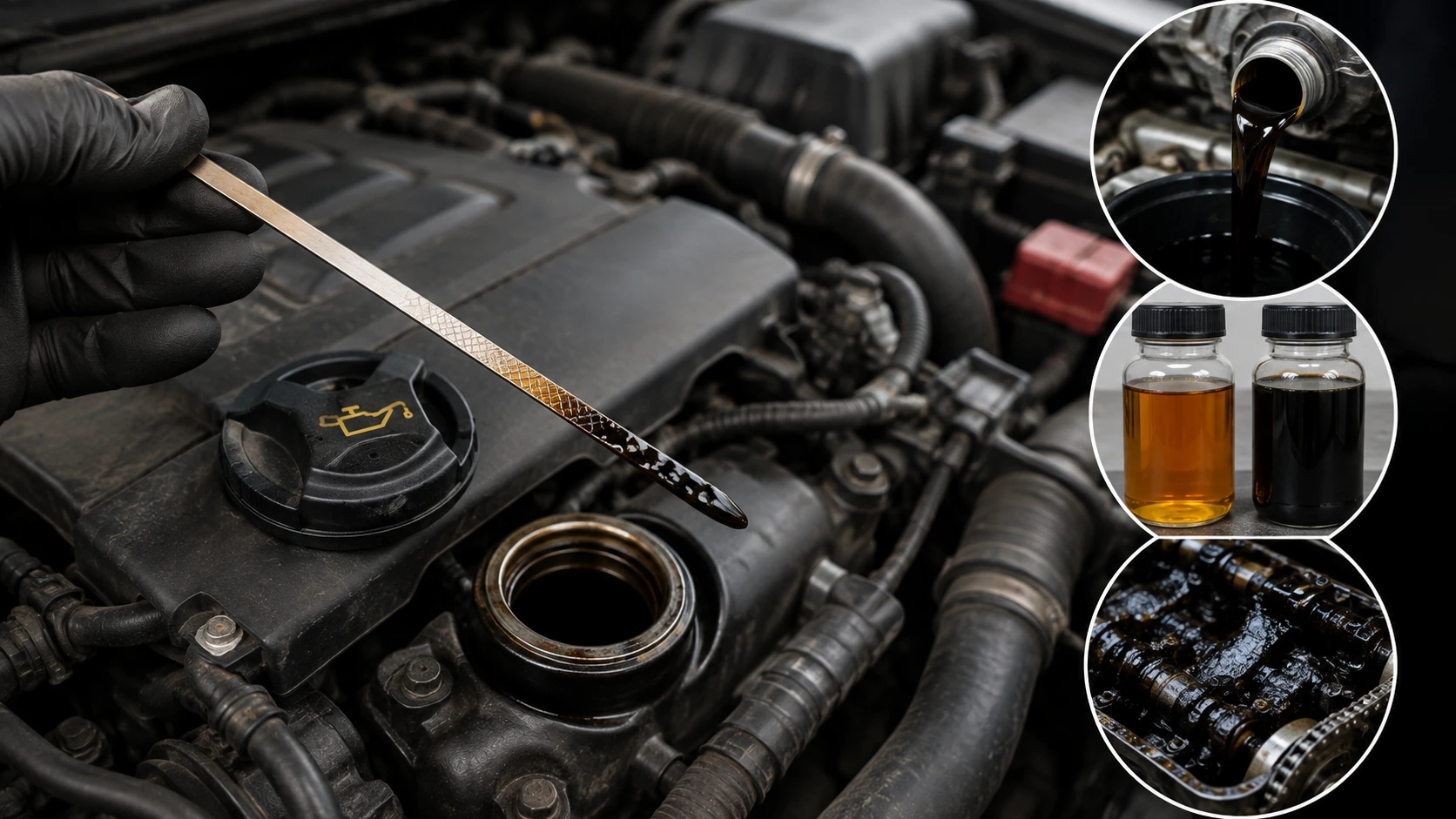
When engine oil turning black occurs rapidly after a fresh oil change it is one of the most consistently misunderstood vehicle observations in Dubai. Drivers who check their oil and find it dark or black just weeks after a service sometimes assume the workshop used incorrect oil, or that something is seriously wrong. In most cases, neither is true — but the rate at which the oil is darkening does contain useful diagnostic information about the engine’s operating conditions and whether anything needs attention.
At Rapid Rev Garage in Al Quoz, engine oil turning black rapidly is assessed in context — distinguishing normal darkening from contamination that indicates a specific fault requiring attention.
Engine Oil Turning Black — Quick Verdict
Engine oil turning black in Dubai is almost always normal — black oil is not the same as bad oil, and modern engine oils are designed to absorb and suspend combustion byproducts that darken the oil’s colour. Oil that turns dark quickly is doing exactly what it’s supposed to do — keeping contaminants in suspension rather than allowing them to deposit on engine surfaces. The rate of darkening does increase in Dubai’s stop-start heat conditions compared to highway driving. However, oil that turns black within days rather than weeks, that smells of fuel or combustion gases, that has a metallic feel, or that appears gritty or frothy is communicating a specific fault that requires investigation beyond a simple colour observation.
Table of Contents
- Why Black Oil Is Usually Normal — The Detergent Explanation
- What Normal Oil Darkening Looks Like in Dubai’s Conditions
- When Black Oil Indicates a Real Problem
- Combustion Blowby — The Primary Accelerated Darkening Cause
- Fuel Contamination in the Oil
- EGR Valve Soot Entry Into the Oil Circuit
- Coolant Contamination — The Serious Indicator
- How Dubai’s Stop-Start Heat Changes the Darkening Rate
- How We Assess Oil Condition at Rapid Rev Garage
- The Right Service Response for Each Finding
- What Happens If Contaminated Oil Is Left Without Action
- How Often to Change Oil in Dubai’s Conditions
- Why Rapid Rev Garage?
- FAQ
- Conclusion
Why Black Oil Is Usually Normal — The Detergent Explanation
The most important thing to understand when engine oil turning black quickly is that colour alone is not a reliable indicator of oil condition. This is a misconception that causes unnecessary concern.
What Modern Engine Oil Is Designed to Do
Modern engine oil contains detergent and dispersant additives specifically designed to prevent varnish and carbon deposits from forming on engine surfaces. These additives work by grabbing combustion byproduct particles — soot, carbon particles, combustion residue — and keeping them suspended in the oil rather than allowing them to settle and form deposits on pistons, rings, and oil passages. This suspension is what makes the oil dark.
Dark Oil Is Doing Its Job
An oil that turns dark quickly is successfully capturing combustion byproducts and holding them in suspension — exactly as it was designed to do. An oil that stays light amber after thousands of kilometres of use in a combustion environment may actually be doing a poorer job of capturing these byproducts — they may be settling on engine surfaces instead of being held in the oil. Clean-looking old oil is not necessarily better than dark-looking old oil.
What Colour Cannot Tell You
Oil colour cannot tell you the oil’s remaining additive life, its viscosity at operating temperature, its acid neutralisation capacity, or whether its anti-wear additives are still effective. Only an oil analysis test — measuring the oil’s actual remaining additive content and contamination levels — provides this information. Visual colour assessment, while useful for identifying serious contamination, should not be the sole basis for oil change decisions.
What Normal Oil Darkening Looks Like in Dubai’s Conditions
Understanding the normal range of darkening in Dubai’s specific conditions prevents unnecessary alarm when the oil is checked between services.
Darkening Within the First 500–1,000 km After an Oil Change
Fresh engine oil is typically amber to light golden in colour. In Dubai’s stop-start heat conditions, this oil will darken noticeably — often to a medium brown — within the first 500–1,000 km. This rapid initial darkening reflects the first combustion byproducts being captured by the fresh detergent package. It is entirely normal and does not indicate any fault.
Dark Brown to Black by 4,000–5,000 km
By the middle of the oil’s service life, the oil will typically be dark brown to black. Again, this is normal — the detergents have captured several thousand kilometres worth of combustion byproducts and are holding them in suspension as intended.
What Changes the Normal Darkening Rate
Stop-start driving darkens oil faster than highway driving — because stop-start conditions produce more combustion byproduct entry into the crankcase per kilometre than sustained cruise. Dubai’s stop-start pattern therefore produces faster darkening than the same engine doing highway driving. This is a driving-condition effect, not a fault.
When Black Oil Indicates a Real Problem
Colour alone is not the indicator — but specific characteristics of the oil alongside its colour identify when engine oil turning black is communicating a genuine fault.
Oil That Turns Jet Black Within a Few Days
Oil that turns from fresh amber to jet black within three to five days — rather than weeks — is darkening at a rate that exceeds what normal combustion byproduct capture produces. This very rapid darkening indicates either excessive combustion blowby — combustion gases passing the piston rings into the crankcase at an abnormal rate — or EGR soot that is entering the oil circuit through a specific fault.
Oil With a Fuel Smell
Petrol in the engine oil produces a distinctly fuel-scented oil that is often thinner than it should be. Running a clean rag across the dipstick and smelling it immediately — before the fuel volatilises — confirms fuel contamination. Fuel in oil comes from injector faults that cause fuel to wash the cylinder walls, or from cold-start enrichment strategies on short trips that don’t fully vaporise the fuel.
Oil With a Gritty or Metallic Feel
Rubbing oil between thumb and forefinger reveals texture. A gritty feel indicates metallic particles in the oil from bearing, ring, or cylinder wall wear. A metallic sheen visible on the dipstick confirms this. This is not oil that is simply dark — it is oil that is carrying wear debris that indicates internal engine damage.
Frothy or Milky Appearance
Oil that appears frothy, has a milky discolouration, or has foam around the dipstick or oil filler cap has coolant contamination. Coolant and oil don’t mix — when they are forced together by a head gasket breach, the result is the characteristic coffee-coloured froth that is one of the clearest indicators of a serious engine fault.
Combustion Blowby — The Primary Accelerated Darkening Cause
Blowby is the passage of combustion gases past the piston rings into the crankcase. A controlled, minimal amount of blowby is normal — the PCV (positive crankcase ventilation) system recirculates these gases back into the intake. Excessive blowby indicates worn piston rings or cylinder walls.
How Blowby Accelerates Oil Darkening
Combustion gases are rich in soot, unburned fuel particles, and acidic compounds. When these gases bypass worn rings at an excessive rate, they enter the crankcase and contaminate the oil directly — darkening it faster than normal combustion byproduct suspension would. The oil’s detergent package has to work harder and depletes faster under excessive blowby conditions.
The Symptoms That Accompany Excessive Blowby
An engine with significant blowby typically produces blue-grey exhaust smoke under acceleration as oil is drawn through the worn ring gaps into the combustion chamber from below. The PCV system — which manages crankcase pressure — may produce excess pressure that pushes oil mist from the oil filler cap opening or produces oil leaks at weakened gasket points. Our car mechanic team checks for blowby indicators — PCV system pressure, exhaust smoke pattern, and oil consumption rate — when rapid oil darkening is reported.
Why Ring Wear Is Accelerated in Dubai
Oil that is extended past its effective service life in Dubai’s heat degrades the thin oil film that protects ring surfaces from metal contact during the millions of compression strokes they perform per year. Rings that wear faster than designed from degraded oil produce more blowby that then darkens the replacement oil faster — a cycle that reinforces itself if oil change intervals are not appropriate for Dubai’s conditions.
Fuel Contamination in the Oil
Fuel contaminating the engine oil is a specific fault that produces faster oil darkening alongside the fuel smell and reduced oil viscosity.
How Fuel Gets Into the Oil
Short-trip driving where the engine never fully warms up is the primary cause in Dubai — fuel injected during cold-start enrichment doesn’t fully combust or evaporate from the cylinder walls, and some washes past the rings into the crankcase. A fuel injector that is leaking — dripping fuel into the cylinder after the engine is switched off — is a more severe cause that produces fuel contamination even on properly-warmed engines.
Why Dubai Short Trips Are the Primary Context
A Dubai vehicle that makes multiple 5–10 km trips daily — home to school, school to mall, mall to home — may never complete a full thermal warm-up cycle on any of these trips. The cold-start enrichment fuel that washes cylinder walls never has time to fully vaporise. Accumulated over hundreds of these short trips, the fuel contamination of the oil builds to a level where the viscosity is measurably reduced.
EGR Valve Soot Entry Into the Oil Circuit
Diesel engines with exhaust gas recirculation (EGR) systems, and some petrol engines, recirculate exhaust gases into the intake to reduce combustion temperatures and NOx emissions. A faulting EGR valve can allow soot-laden exhaust gases to contaminate the oil circuit.
The EGR Oil Contamination Pattern
An EGR valve that is stuck open, or an EGR cooler that has developed an internal leak, can introduce exhaust soot directly into the intake air or into the coolant circuit that then contacts oil. The resulting oil contamination produces rapid jet-black darkening from soot entry rather than from normal combustion byproduct suspension. A diagnostic scan that reads EGR valve position data confirms whether the valve is operating correctly. For any breakdown while investigating an engine oil fault, our roadside assistance covers Al Quoz and nearby Dubai areas.
Coolant Contamination — The Serious Indicator
Coolant in the engine oil is a fault that must be treated as urgent regardless of the oil’s colour — because coolant contamination of oil is almost always the result of a head gasket failure or an internal cooling system crack.
How to Identify Coolant Contamination
The milky, frothy appearance of severely contaminated oil is the most obvious sign. In early stages — before the contamination is extensive — the oil may appear slightly lighter than normal with a subtle beige tint around the dipstick or filler cap. A coolant level that is dropping without any external leak, combined with oil that is darkening faster than normal, is the early-stage combination that should prompt investigation.
Why This Is Never Normal
Coolant in oil has no normal context — unlike darkening from combustion byproducts, coolant contamination always indicates a specific fault. It must be investigated and addressed before the contaminated oil causes bearing damage from the oil’s destroyed lubrication properties. Our car service packages include an oil condition visual check and coolant level check at every service — catching early-stage contamination signs before they progress.
How Dubai’s Stop-Start Heat Changes the Darkening Rate
Dubai’s conditions produce oil that darkens faster than European factory service intervals assume — and this is a normal consequence of local driving conditions rather than a fault.
Why Stop-Start Darkens Oil Faster
Each cold start introduces slightly more combustion byproducts into the crankcase than a warm engine start — the cold combustion is less efficient and produces more soot. Multiple cold starts per day in Dubai’s multi-trip driving pattern accumulate more byproducts per week than a single daily commute with one cold start. The oil’s detergent package captures all of these byproducts and darkens accordingly faster.
The Colour Change Does Not Mean Early Change Required
Rapid darkening from stop-start driving does not by itself indicate the oil needs to be changed earlier than the service interval requires. The oil’s effective service life is determined by its additive package’s remaining capacity — not its colour. However, in Dubai’s conditions, changing oil at 8,000 km rather than factory maximums accounts for the additional thermal and combustion stress the additive package faces.
How We Assess Oil Condition at Rapid Rev Garage
Oil condition is assessed as a combination of multiple indicators — not colour alone.
Visual Assessment — Colour, Sheen, Texture
The dipstick oil is assessed for colour intensity, any metallic sheen, gritty texture between fingers, and any smell indicators — fuel, coolant, or burning.
Filler Cap Check for Froth
The underside of the oil filler cap is examined for any white or beige froth — the earliest visible sign of coolant contamination.
Oil Consumption Rate Comparison
The rate of oil level drop between services is compared against the normal consumption specification for the engine. Consumption significantly above specification is the primary indicator of blowby from worn rings.
PCV System Pressure Check
Crankcase pressure is assessed — excessive pressure from the breather indicates blowby that is overwhelming the PCV system’s capacity to recirculate gases.
The Right Service Response for Each Finding
The service response is matched to the specific indicator confirmed during the oil assessment.
Normal Dark Oil at Service — Change, Monitor Interval
Dark oil at the service interval in Dubai’s conditions is normal. Change at 8,000 km intervals for stop-start city drivers. No additional action required.
Fuel-Contaminated Oil — Change and Investigate Injection System
Drain the fuel-contaminated oil, change the oil filter, and refill with fresh oil. Investigate the injector fault or change the short-trip driving pattern. A longer warm-up drive occasionally — even 20–30 minutes on a weekend — helps burn off accumulated fuel from the oil.
Blowby-Accelerated Darkening — Change and Compression Test
An oil change followed by a compression and leak-down test confirms the extent of ring wear that is causing the blowby. The test result determines whether repair is immediately required or whether the wear is being managed with appropriate service intervals.
Coolant Contamination — Head Gasket Investigation
When engine oil turning black is accompanied by a milky appearance, immediate head gasket assessment is triggered — pressure test, combustion gas test in the coolant, and cylinder compression check. The head gasket repair scope is determined by these tests. For exterior repairs needed alongside engine work, our car painting team handles colour-matched work at the same visit.
What Happens If Contaminated Oil Is Left Without Action
Contaminated oil that is left in service produces specific and progressive consequences for the engine.
Fuel Contamination Reduces Bearing Protection
Oil diluted with fuel has reduced viscosity — it is thinner than specified and provides a thinner oil film at bearing surfaces. Running an engine with fuel-contaminated oil accelerates bearing wear at a rate far beyond what the same engine experiences on correct oil.
Coolant Contamination Destroys Bearings Rapidly
Coolant in oil is an acid-water-glycol mixture that destroys bearing material directly. Bearings running in coolant-contaminated oil can fail within hundreds of kilometres of the contamination beginning. The bearing failure that results from running coolant-contaminated oil is a significantly more expensive repair than the head gasket that produced the contamination.
How Often to Change Oil in Dubai’s Conditions
The factory oil change interval is calibrated for the manufacturer’s target market — typically European driving conditions. Dubai’s conditions justify a shorter interval for most vehicles.
8,000 km for Stop-Start City Drivers
A Dubai driver doing multiple short daily trips in Al Quoz or Business Bay traffic accumulates oil stress — thermal degradation, combustion byproduct loading, and potential fuel contamination — faster per kilometre than any highway driver. The 8,000 km interval maintains oil quality within the window where its protective additive package is still effective.
12,000 km for Predominantly Highway Drivers
Our mobile car mechanic covers Al Quoz and nearby Dubai areas for on-site oil condition assessment.
A Dubai driver doing regular long highway runs — Abu Dhabi commuters, Al Ain weekend drivers — accumulates oil stress more slowly and can extend to the 12,000 km end of the reasonable range with the correct specification oil. Our garage near me location in Al Quoz serves drivers from Business Bay, Jumeirah, Barsha, Satwa, Downtown, and the Sheikh Zayed Road corridor.
Why Rapid Rev Garage?
Engine oil turning black rapidly is most often normal — but the additional indicators that accompany the colour change are what determine whether anything needs attention. We assess oil condition as a combination of colour, sheen, texture, smell, consumption rate, and filler cap condition — not as a single colour observation. An oil that is black but otherwise clean indicates normal operation. An oil that is black and gritty, milky, or fuel-scented indicates a specific fault that the oil’s appearance is communicating. We distinguish between the two on every oil assessment and communicate the finding clearly before recommending any additional investigation.
FAQ — Engine Oil Turning Black
These are the questions most frequently asked about engine oil turning black at our Al Quoz workshop.
Is black engine oil always a problem?
Black engine oil is usually a sign of normal operation — the oil has been doing its job of capturing combustion byproducts. Black oil with a gritty texture, a fuel smell, or a milky appearance indicates a specific problem that requires investigation beyond a colour observation.
Why does my oil turn black so fast in Dubai?
Dubai's stop-start driving pattern produces multiple cold starts per day — each one delivering slightly more combustion soot to the oil than a warm start. The cumulative effect of multiple daily cold starts and sustained high operating temperatures darkens oil faster than highway driving in a cooler climate. This is a normal consequence of local conditions.
Should I change my oil more often because it goes black fast?
Not solely because it darkens quickly — because colour doesn't indicate additive depletion. However, Dubai's conditions do justify changing at 8,000 km for stop-start city drivers rather than at factory maximums, because the thermal and combustion stress is higher here regardless of what colour the oil turns.
What does milky oil mean?
Milky, beige, or frothy oil indicates coolant has entered the oil circuit — almost always from a head gasket breach or an internal cooling system crack. This is a serious finding that requires immediate investigation.
Can fuel get into my engine oil in Dubai?
Yes — primarily through short-trip driving where cold-start fuel enrichment adds fuel to the cylinders that doesn't fully vaporise before the engine is switched off. Multiple short daily trips without a longer warm-up drive accumulate fuel contamination in the oil over time.
Conclusion
Engine oil turning black rapidly in Dubai is almost always normal — the oil is capturing combustion byproducts as designed, and stop-start driving in heat produces this darkening faster than European driving conditions. The concern is not colour but the additional indicators: gritty texture indicates wear debris, fuel smell indicates injection or short-trip contamination, milky appearance indicates coolant intrusion. Rapid Rev Garage in Al Quoz assesses oil condition as a complete picture — colour, texture, smell, consumption, and filler cap condition — before any additional investigation is recommended.
Rapid Rev Garage is in Al Quoz, serving drivers across nearby Dubai areas — Business Bay, Jumeirah, Downtown, Barsha, Satwa, and the Sheikh Zayed Road corridor. Book your appointment on WhatsApp or find us on Google Maps.
Rapid Rev Garage — Engine Oil Turning Black | Al Quoz, Dubai