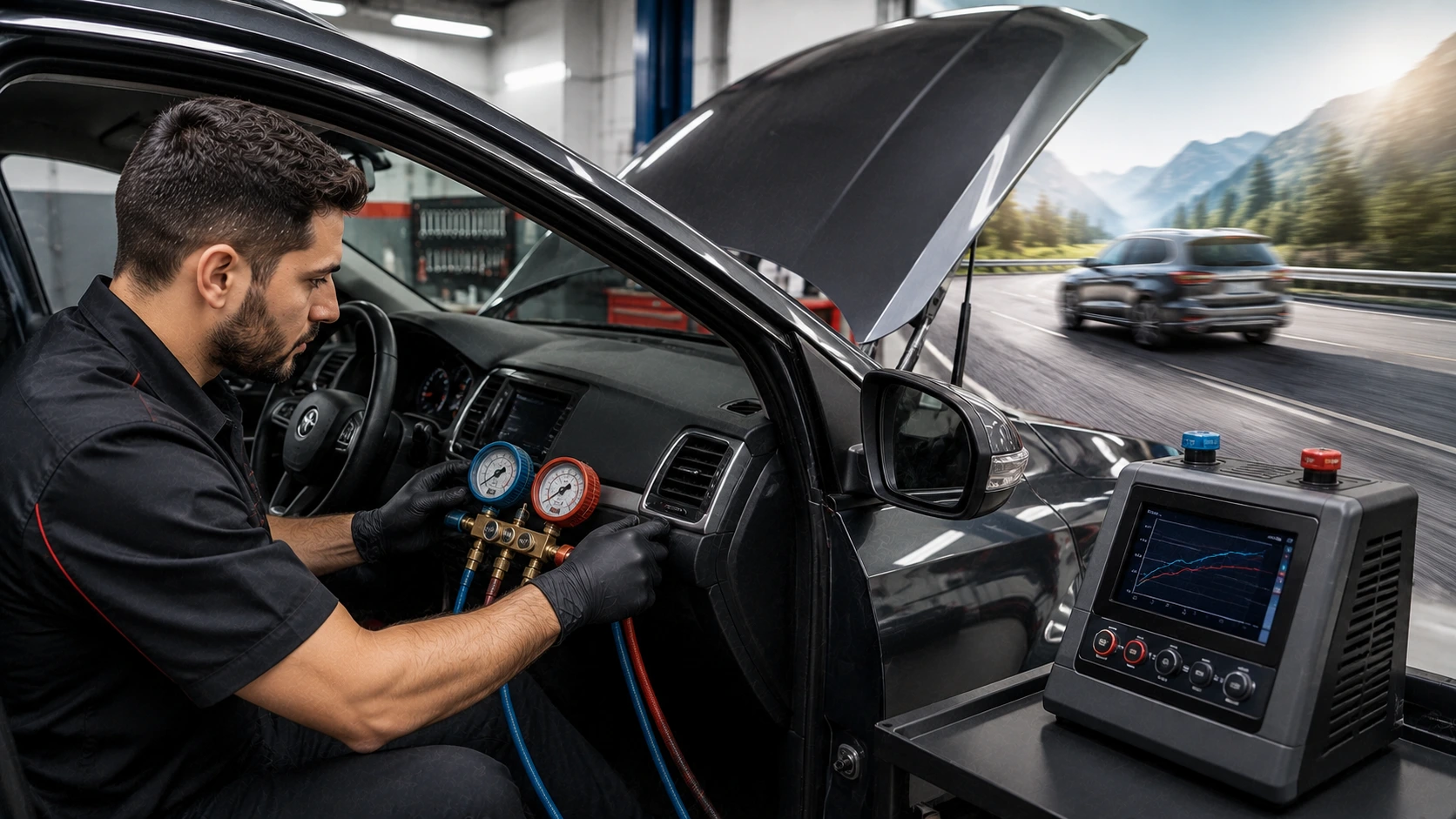
When a car ac cooling only while driving pattern develops — cold and effective at speed but blowing warm or barely cool air the moment the vehicle slows or stops — is one of the most common AC complaints from Dubai drivers during summer. The pattern is highly specific: the moment the car moves, cooling returns. The moment it stops, cooling fades. This is not a coincidence — it is the AC system communicating exactly which component is failing and under exactly what condition.
At Rapid Rev Garage in Al Quoz, our car AC repair team diagnoses every car ac cooling only while driving complaint by testing condenser fan output, system pressure at idle, and condenser airflow before any part is recommended for replacement. Dubai’s stop-start driving means this symptom appears on every journey — and identifying the correct cause the first time prevents returning with the same complaint after the wrong part has been replaced.
Car AC Cooling Only While Driving — Quick Verdict
When a car ac cooling only while driving situation is confirmed, the cause is almost always the condenser cooling fan — a motor that has weakened, a relay that is supplying reduced voltage, or a temperature switch that activates the fan too late to maintain cooling during stationary periods. At speed, natural airflow through the front grille provides adequate condenser cooling even without the electric fan. At a standstill, the fan is the only airflow source — and any weakness in it is immediately exposed. Secondary causes include low refrigerant that cannot maintain adequate pressure at idle compressor speeds, and condenser fins blocked with Al Quoz industrial dust reducing heat rejection at exactly the condition where airflow is most limited.
Table of Contents
- Why Driving Speed Is the Diagnostic Key
- The Condenser Fan — Why It Fails and How It Shows
- Low Refrigerant and Its Idle-Specific Effect
- Blocked Condenser Fins in Dubai’s Dust Environment
- Compressor Speed and Variable Displacement at Idle
- How Dubai’s Summer Removes Every Thermal Margin
- How We Confirm the Exact Fault at Rapid Rev Garage
- The Right Fix for Each Confirmed Cause
- What Happens If This Is Left Without Repair
- Is It Safe to Keep Using the AC in Traffic?
- How Long the Repair Takes
- What the Repair Costs in Dubai
- Preventing Speed-Dependent AC Failure in Dubai
- Why Rapid Rev Garage?
- FAQ
- Conclusion
Why Driving Speed Is the Diagnostic Key
The most important diagnostic information for a car ac cooling only while driving fault is already in the symptom description — the AC works while driving and fails while stopped.
What Moving Speed Provides That a Standstill Does Not
When a vehicle moves at 60 km/h or above, air is forced through the front grille and across the condenser at a rate that provides substantial cooling capacity. This natural airflow supplements or replaces the electric fan’s function — even a fan running at 50% of its rated output is invisible to the driver at speed because natural airflow compensates. The moment the car stops, natural airflow drops to zero. The electric fan is now the only source of condenser airflow, and any weakness in its output is immediately apparent as rising system pressure and falling cooling performance.
What the Speed-Dependent Pattern Rules Out
This pattern immediately rules out causes that would produce cooling failure at all speeds — a failed compressor, a severely depleted refrigerant charge, a blocked expansion valve. All of these would produce inadequate cooling regardless of vehicle speed. The speed-specific character means the fault is in the stationary-cooling components: the fan, the condenser’s heat rejection capacity, or the refrigerant charge level as it interacts with idle compressor speed.
The Condenser Fan — Why It Fails and How It Shows
The electric condenser cooling fan is the component most directly responsible for the car AC cooling only while driving pattern.
A Partially Failed Fan — The Most Common Cause
A fan motor running at reduced speed — from worn brush contacts, a degraded winding, or a relay supplying below-rated voltage — delivers less airflow across the condenser than a fully functioning motor. This reduced airflow is adequate at low ambient temperatures but wholly insufficient against Dubai’s peak summer heat. The repeatability of the pattern — cooling returns every time the car moves, fails every time it stops — is the strongest indicator that the fan is the specific cause.
Why the Pattern Is So Consistent
The fan’s output determines the ceiling of stationary AC performance. If the fan can reject 70% of the required heat at its reduced speed, the system maintains adequate cooling in mild ambient conditions — and fails precisely in peak Dubai summer heat when the baseline condenser temperature is already high. The pattern’s consistency across every stop in every journey confirms the fan as the primary cause rather than a refrigerant issue, which would produce more variable results.
Fan Relay Voltage and Temperature Switch Timing
A relay providing reduced voltage produces a fan that appears to run but delivers below-rated airflow. A temperature switch that activates the fan too late — at 105°C coolant temperature rather than 90°C — allows system pressure to rise before the fan is called in, during which time the car AC cooling only while driving symptom appears even though the fan itself is healthy. Our car mechanic team tests fan activation temperature and measured airflow output as the first physical checks on every speed-dependent cooling complaint.
Low Refrigerant and Its Idle-Specific Effect
A refrigerant charge below specification reduces the system’s heat-carrying capacity — and this reduction becomes most apparent at idle.
Why Idle Amplifies Low Charge
The AC compressor rotates at engine speed. At idle, the compressor turns more slowly, circulating less refrigerant per minute than at highway engine speed. A system with full refrigerant charge maintains adequate cooling at both idle and highway compressor speeds. A system with 15–20% below-specification charge produces adequate cooling at highway speed — where the compressor is running faster and compensating — and insufficient cooling at idle when the reduced charge is circulated at the lowest rate. This creates the driving-speed-dependent pattern.
The Leak Must Be Found Before Any Recharge
Adding refrigerant without finding and sealing the leak produces a temporary improvement that disappears within weeks as the charge drops again. A pressure decay test held over time, followed by UV dye or electronic leak detection, identifies the exact leak point before any refrigerant is added to the system.
Blocked Condenser Fins in Dubai’s Dust Environment
A condenser with externally blocked fins cannot reject heat at its rated capacity — and this limitation is most severe precisely when airflow is most limited: at a standstill.
The Compounding Effect at Standstill
At speed, sufficient airflow passes through even a partially-blocked condenser to maintain adequate heat rejection. At a standstill, the limited fan-driven airflow must pass through the same blocked fin area — and the reduced effective fin area means less heat rejection per unit of airflow. The result is a condenser that raises system pressure above the optimal range during stationary operation, directly reducing cooling performance.
Al Quoz Dust Loading Rate
Vehicles driven in Al Quoz and other Dubai industrial zones accumulate external condenser fin blockage at a rate several times higher than residential-area vehicles. A condenser on a vehicle that has not been cleaned in two or more years of Al Quoz driving may have 30–40% of its fin area blocked. For any emergency from AC failure in peak Dubai heat, our roadside assistance covers Al Quoz and nearby Dubai areas.
Compressor Speed and Variable Displacement at Idle
On vehicles with variable displacement compressors — the majority of modern AC-equipped vehicles — the compressor adjusts its displacement to match cooling demand. A failing displacement control valve may not increase compressor output at idle when natural airflow is absent and maximum compression is needed.
How This Differs From a Fan Fault
A compressor control valve fault produces a system where the high-side pressure at idle is lower than at elevated RPM — the compressor is not working harder at idle as it should be when natural airflow disappears. A fan fault produces normal or high high-side pressure at idle because the compressor is working correctly but the condenser cannot reject the heat it is being asked to manage. System pressure at idle versus 2,000 RPM distinguishes the two causes before any component is condemned. Our car service packages include a full AC system pressure assessment at every major service.
How Dubai’s Summer Removes Every Thermal Margin
Dubai’s summer conditions are uniquely demanding for AC systems — specifically amplifying the standstill cooling failure pattern.
45°C Ambient Reduces Condenser Efficiency
The condenser rejects heat from refrigerant into the ambient air. At 45°C ambient versus 25°C, the temperature differential between the hot refrigerant and the surrounding air is smaller — meaning the condenser must work harder to reject the same heat load. A fan running at 80% of its rated output is barely sufficient at 25°C and clearly insufficient at 45°C. The same fan that masked its decline through Dubai’s mild winter is fully exposed in summer.
Fan Motor Degradation Peaks in Summer
Fan motor windings and bearings that have been degrading under Dubai’s sustained underbonnet heat reach their most compromised state during summer — when underbonnet temperatures are highest. The car AC cooling only while driving pattern that appeared occasionally in spring becomes consistent and severe in summer as the motor’s remaining capacity is overwhelmed.
How We Confirm the Exact Fault at Rapid Rev Garage
The diagnostic sequence starts with the speed-dependent pattern — confirming the fault is stationary-specific before testing any component.
Road Test and Stationary AC Performance Comparison
The AC is assessed at highway speed and then at idle with the vehicle stationary. Vent temperature at each condition is measured. A system that produces 8°C at speed and 20°C at idle with peak summer ambient confirms the speed-dependent pattern and rules out total system failure.
Fan Output and Activation Temperature Test
Fan activation temperature is measured — confirming the fan activates at the correct coolant temperature rather than too late. Fan airflow output is assessed against rated capacity. A fan that is running but at below-rated speed is confirmed by this test.
System Pressure at Idle vs 2,000 RPM
High and low side pressures at idle and at 2,000 RPM distinguish a refrigerant shortage (below-normal pressures at both) from a fan fault (above-normal high-side at idle from inadequate heat rejection) from a compressor control fault (below-normal high-side despite adequate refrigerant).
Condenser External Inspection
Fin blockage is assessed by torch inspection from the rear face of the condenser. Significant blockage found at this inspection is cleaned immediately and system pressures are re-measured to confirm improvement.
The Right Fix for Each Confirmed Cause
Each repair is matched to the specific component the diagnostic sequence confirms has failed.
Cooling Fan Motor, Relay, or Switch Replacement
The specific failing component in the fan circuit is replaced. Fan output is confirmed at rated capacity after replacement. A road test confirms the stationary cooling improvement before the vehicle is returned. For exterior repairs needed alongside any mechanical work, our car painting team handles colour-matched work at the same visit.
Refrigerant Leak Detection, Seal, and Correct Recharge
The specific leak point is found and sealed. The system is recharged to the manufacturer’s gram specification — not estimated by gauge reading. Post-recharge, system pressures at idle confirm the cooling improvement.
Condenser External Cleaning
Fin blockage is cleared by pressure washing from the rear face. Post-cleaning system pressures confirm the reduction in high-side pressure and the restoration of stationary cooling performance.
Compressor Displacement Control Valve Replacement
A confirmed control valve fault is addressed with targeted valve replacement — restoring correct idle-speed compensation without unnecessary full compressor replacement.
What Happens If This Is Left Without Repair
A stationary cooling fault accepted and driven through follows a predictable progression.
Low Refrigerant Damages the Compressor
A system operating below specification refrigerant charge also operates with insufficient compressor oil — which circulates dissolved in the refrigerant. Sustained low-charge operation accelerates compressor bearing and piston wear. The car AC cooling only while driving pattern that begins as a comfort issue progresses to a compressor replacement requirement.
Fan Motor Failure Produces Total Stationary AC Loss
A fan motor that has been running at reduced output eventually fails completely. At that point, the vehicle has no AC cooling capability at a standstill at all — not just reduced performance but zero cooling. In Dubai’s summer, a completely failed condenser fan means the vehicle cannot be used comfortably during any traffic or parking stop.
Is It Safe to Keep Using the AC in Traffic?
The AC system fault itself does not create a mechanical safety risk — the engine and brakes are unaffected.
The Comfort and Health Concern
In Dubai’s summer, inadequate AC cooling during traffic stops creates a genuine passenger health concern — particularly for children and elderly passengers. Cabin temperatures during stationary periods without effective AC can exceed comfortable limits within minutes at peak summer ambient. Book within the week rather than driving through the summer season with this fault.
How Long the Repair Takes
Repair time depends on the confirmed cause — fan relay work is the fastest, refrigerant service takes longer.
Fan Work
Fan relay or switch replacement: one to two hours. Fan motor replacement: two to three hours including output confirmation.
Refrigerant and Condenser Work
Leak detection, sealing, and correct recharge: two to four hours. Condenser cleaning: 30–60 minutes including post-cleaning pressure confirmation. Our mobile car mechanic covers Al Quoz and nearby Dubai areas for on-site fan output and initial AC pressure assessment.
What the Repair Costs in Dubai
Cost depends on the confirmed cause from the diagnostic assessment.
Fan and Refrigerant Work
Fan relay replacement: AED 150–400. Fan motor or assembly: AED 400–1,200 depending on vehicle. Refrigerant O-ring seal and recharge: AED 400–800. Condenser cleaning: AED 200–400.
Major Component Work
Compressor displacement control valve: AED 500–1,500. Full condenser replacement where fin damage is beyond cleaning: AED 800–2,500. A written quote is confirmed after the diagnostic assessment. Our garage near me location in Al Quoz serves drivers from Business Bay, Jumeirah, Barsha, Satwa, Downtown, and the Sheikh Zayed Road corridor.
Preventing Speed-Dependent AC Failure in Dubai
Two specific habits prevent the most common causes of this fault in Dubai.
Annual Pre-Summer Fan Test
A fan output test before April confirms the fan is delivering rated airflow before the peak demand months begin. A fan identified as running at 70% of rated capacity in March is replaced before it produces the stationary cooling failure in July. This single annual check prevents the most common cause of this fault.
Condenser Cleaning at Every Major Service
External condenser fin inspection and cleaning at every major service prevents the gradual fin blockage from reaching the threshold where it contributes to stationary cooling failure. Al Quoz drivers benefit most from this given the industrial particulate environment.
Why Rapid Rev Garage?
We diagnose car AC cooling only while driving by starting with the speed-dependent pattern — and the pattern itself tells us which components to test first. A driving-speed-dependent cooling loss points to the fan, condenser airflow, and idle-specific refrigerant charge — not to the compressor or evaporator that would produce total cooling failure at all speeds. This pattern-first diagnostic approach directs the investigation to the correct component immediately.
FAQ — Car AC Cooling Only While Driving
These are the questions most frequently asked about this fault at our Al Quoz workshop.
Why does my car AC work on the highway but stop cooling in traffic?
At highway speed, natural airflow through the front grille supplements or replaces the electric fan's condenser cooling. In traffic, natural airflow drops to zero and the fan carries the full burden. Any weakness in the fan — reduced motor speed, late activation, low voltage — is fully exposed at a standstill.
My AC was recharged but it still only cools while driving — why?
If the refrigerant leak was not found and sealed before the recharge, the charge has depleted again. Alternatively, the primary cause may be the cooling fan rather than the refrigerant — a recharge has no effect on a fan fault.
Can I drive through summer with AC that only cools while moving?
In the short term, carefully — but stationary periods in peak summer heat produce cabin temperatures that are a genuine health concern. The fault also typically worsens as summer progresses and fan motor degradation accelerates in peak underbonnet heat. Book within the week.
How do I tell if it's the fan or low refrigerant causing this pattern?
The system pressure test at idle versus elevated RPM distinguishes the two. A fan fault produces above-normal high-side pressure at idle. A refrigerant shortage produces below-normal pressures on both sides. This test takes under 10 minutes with the correct gauges.
Does the AC condenser fan run all the time or only when needed?
The condenser fan activates when the AC compressor is running and coolant temperature exceeds the activation threshold. It should run continuously whenever the AC is on and the vehicle is stationary — if it is not running during a stationary stop with AC on, the fan circuit has a fault.
Conclusion
Car AC cooling only while driving is one of the most diagnosable AC fault patterns — the speed-dependent character identifies the cooling fan as the primary suspect before any tool is connected. Condenser fin blockage and below-specification refrigerant charge are the secondary causes, each producing a specific pressure signature that distinguishes them from the fan fault. Rapid Rev Garage in Al Quoz tests fan output, system pressures at idle and elevated RPM, and condenser airflow before recommending any repair — ensuring the correct component is addressed on the first visit.
Rapid Rev Garage is in Al Quoz, serving drivers across nearby Dubai areas — Business Bay, Jumeirah, Downtown, Barsha, Satwa, and the Sheikh Zayed Road corridor. Book your appointment on WhatsApp or find us on Google Maps.
Rapid Rev Garage — Car AC Cooling Only While Driving | Al Quoz, Dubai