To remove water spots from car paint correctly in Dubai, the method depends entirely on what type of water spot you are dealing with — because not all water spots are the same, and the wrong treatment on the wrong type of spot either fails to remove it or damages the paint in the process. Dubai’s water supply, its outdoor washing habits, its construction dust, and its intense UV environment combine to produce water spots that are significantly more damaging than those experienced in most other markets.
At Rapid Rev Garage in Al Quoz, every effort to remove water spots from car paint starts with a type assessment before any product or method is applied — because a type 1 mineral deposit that responds to a dilute acid rinse is a different problem from a type 3 etched spot that has permanently altered the paint’s clear coat chemistry.
Remove Water Spots From Car Paint — Quick Verdict
The correct approach to remove water spots from car paint in Dubai starts with identifying the spot type: type 1 mineral deposits from Dubai’s hard tap water sit on the paint surface and respond to a dilute white vinegar or dedicated water spot remover product applied and rinsed before the spot can etch further. Type 2 bonded mineral deposits that have been baked into the surface by UV heat require a clay bar treatment or a light machine polish with a mild cutting compound. Type 3 etched spots where the minerals have chemically altered the clear coat require professional machine polishing — sometimes including a light paint correction — because the damage is in the paint layer, not on top of it. Prevention in Dubai requires drying the car immediately after any water contact and never washing in direct sun.
Table of Contents
- Why Dubai Produces More Damaging Water Spots Than Most Markets
- The Three Types of Water Spots — Identifying Before Treating
- Type 1 — Fresh Mineral Deposits: The DIY Fix
- Type 2 — Bonded Deposits: Clay Bar and Light Polish
- Type 3 — Etched Clear Coat: Professional Correction Required
- Products That Work vs Products That Damage Dubai Paint
- What Never to Do When Trying to Remove Water Spots
- How We Treat Water Spots at Rapid Rev Garage
- The Right Treatment for Each Confirmed Type
- What Happens If Water Spots Are Left Without Treatment
- How Long the Treatment Takes
- What the Treatment Costs in Dubai
- Preventing Water Spots in Dubai’s Conditions
- Why Rapid Rev Garage?
- FAQ
- Conclusion
Why Dubai Produces More Damaging Water Spots Than Most Markets
The challenge to remove water spots from car paint in Dubai is more severe than in most other cities for three compounding reasons that act together on every unprotected paint surface.
Dubai’s Water Is Extremely Hard
Dubai’s tap water — used for outdoor washing and passing through garden sprinklers onto parked cars — is among the hardest in the world by mineral content. Calcium, magnesium, and silica concentrations that are measured in hundreds of parts per million leave a significant visible mineral residue when the water evaporates. In comparison, soft European rainwater leaves minimal mineral residue. Every drop of Dubai tap water that evaporates on a car paint surface leaves behind more mineral content than the same volume of water in a soft-water market.
UV Intensity Bakes Deposits Into the Surface
Dubai’s UV intensity is significantly higher than any European baseline. When a water spot forms on paint exposed to direct Dubai sun, the UV and surface heat accelerate the bonding of mineral deposits to the clear coat surface — a process that takes minutes in Dubai summer sun versus hours in a European climate. A water spot left on a Dubai car for one afternoon in July has already begun bonding to the clear coat. The same spot on a car in London would still be a simple rinse-off deposit.
Construction and Concrete Dust Compounds the Deposit
Dubai’s continuous construction activity produces concrete dust and alkaline particulate that settles on vehicle surfaces. When this dust is wetted — by a garden sprinkler, a brief rain shower, or a car wash — it dissolves into an alkaline solution that is more chemically aggressive than hard water alone. An alkaline concrete dust deposit that dries on clear coat begins etching within hours in Dubai’s heat.
The Three Types of Water Spots — Identifying Before Treating
The single most important rule when attempting to remove water spots from car paint is identifying the type first prevents the wrong treatment being applied.
Type 1 — Fresh Surface Deposits
A type 1 spot is a mineral deposit that is sitting on top of the clear coat surface — it has not yet bonded to or reacted with the paint chemistry. These spots are typically white or light grey, appear slightly raised when felt with a fingertip running across the surface, and form rings that correspond to the edge of the water droplet where minerals concentrate as the water evaporates. Type 1 spots respond immediately to a mild acid solution because the alkaline mineral deposit neutralises on contact.
The Fingertip Test
Run a clean fingertip gently across the surface of the spot. If the deposit feels slightly textured or raised relative to the surrounding paint, it is a type 1 surface deposit. If the paint feels perfectly smooth but the spot is visible — the discolouration is in the paint surface rather than on top of it — it is a type 2 or type 3 deeper fault.
Type 2 — Bonded and UV-Baked Deposits
A type 2 spot has been chemically bonded to the clear coat surface by UV heat and time. It no longer responds to acid rinse alone — the minerals have cross-linked with the clear coat chemistry and require mechanical removal by clay bar or light machine polishing. Type 2 spots feel smooth to the fingertip but are clearly visible. They cannot be removed by washing or detailing spray.
Type 3 — Etched Clear Coat
A type 3 water spot — the hardest to remove water spots from car paint — has progressed beyond bonding — the alkaline minerals have chemically etched into the clear coat, altering its surface chemistry and creating a physical depression or surface irregularity where the spot sits. Type 3 spots may feel slightly concave to the fingertip rather than raised or flat. They cannot be removed by any product applied to the surface — the damage is within the clear coat layer and requires machine polishing that cuts the surrounding clear coat down to the level of the etched area. Our car mechanic team assesses spot type before any treatment is selected — because applying a cutting compound to a type 1 spot removes unnecessary clear coat, and applying a simple acid rinse to a type 3 spot achieves nothing.
Type 1 — Fresh Mineral Deposits: The DIY Fix
Type 1 deposits are the most accessible to address with correctly selected products and technique.
The Dilute White Vinegar Method
White vinegar diluted 1:3 with distilled water (one part vinegar to three parts water) provides a mild acid solution that neutralises the alkaline mineral deposits. Apply to the spot with a microfibre cloth, allow to dwell for 30–60 seconds, then rinse completely with distilled or filtered water. Never allow the vinegar solution to dry on the paint — rinse before it evaporates. After rinsing, dry immediately with a clean microfibre.
Why Distilled Water for Rinsing Matters
Rinsing a freshly neutralised spot with Dubai tap water reintroduces minerals to the surface — potentially starting the process over immediately. Distilled or filtered water for the final rinse prevents this. A bottle of distilled water from any supermarket is the correct rinse medium for this treatment.
Dedicated Water Spot Remover Products
Automotive-specific water spot removers are formulated with controlled acid chemistry and paint-safe surfactants. They are more precisely buffered than dilute vinegar and are safe for use on clear coat without the risk of over-application. Follow the product’s dwell time and rinse instructions specifically.
Type 2 — Bonded Deposits: Clay Bar and Light Polish
Type 2 deposits require physical removal — the chemical approach of acid rinse alone cannot break the UV-baked bond.
Clay Bar Treatment
An automotive clay bar used with a clay lubricant removes bonded surface contamination by a mild abrasive shearing action that lifts the deposit from the clear coat without scratching it when used correctly. After claying, the paint surface should feel glass-smooth to a clean hand. The clay bar removes the type 2 deposit without removing clear coat — making it the correct first step before considering polishing.
Light Machine Polish for Stubborn Type 2
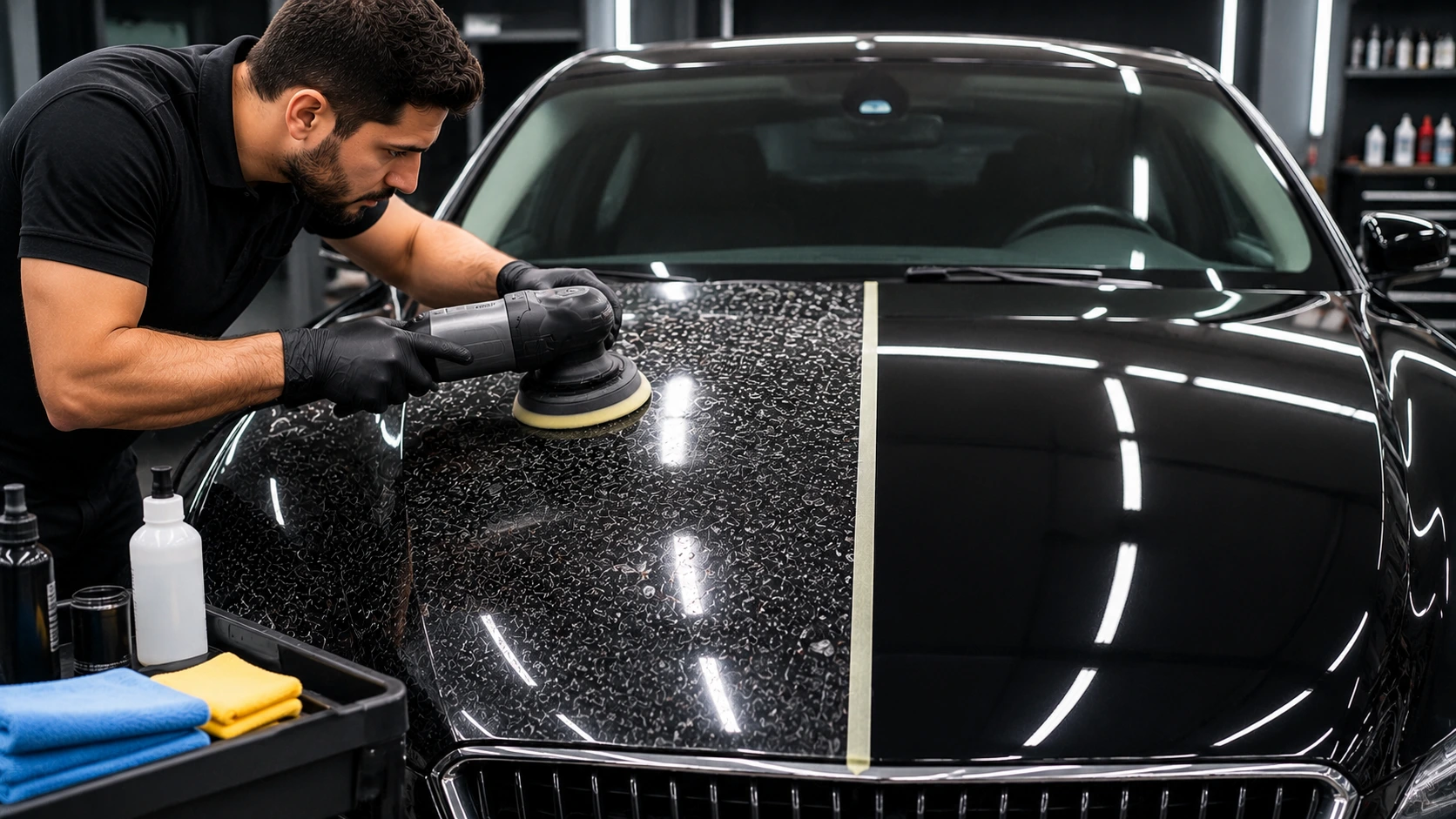
Where clay bar treatment alone does not fully remove the deposit — typically on spots that have been baked on for several weeks — a light machine polish with a mild cutting compound on a dual-action polisher removes the remaining deposit alongside a negligible amount of clear coat. This should be followed by a paint sealant or wax application to protect the freshly polished surface. For any exterior paint protection work needed alongside water spot treatment, our car painting team handles colour-matched paint correction at the same visit.
Type 3 — Etched Clear Coat: Professional Correction Required
Type 3 etching cannot be addressed with DIY products — the clear coat has been permanently altered and requires professional machine polishing.
What Professional Paint Correction Does
A professional paint correction uses machine polishing with progressively finer cutting compounds to remove the surrounding clear coat down to the level of the etched area — evening the surface and eliminating the visible depth discrepancy. This process requires experience with rotary or dual-action polishers to avoid heat damage to the thin remaining clear coat.
When Respray Is the Only Option
Where type 3 etching has penetrated through the clear coat into the base coat — visible as a colour change or metallic fleck disruption in the spot area — polishing cannot restore the surface. The affected panel requires repainting. This outcome results from mineral deposits that were left untreated for an extended period in Dubai’s UV and heat.
Products That Work vs Products That Damage Dubai Paint
Not all products marketed as water spot removers are safe for all paint types — and some accelerate clear coat damage if misapplied.
Safe Products for Dubai Clear Coat
Automotive-specific pH-neutral detailing sprays for type 1 fresh spots. Dilute white vinegar (1:3 with distilled water) for type 1. Automotive clay bar with dedicated clay lubricant for type 2. pH-balanced machine polish compounds for type 2–3. These products are safe when applied correctly and rinsed completely.
Products That Can Cause Damage
Neat (undiluted) white vinegar applied without dilution can damage clear coat if left to dwell. Household glass cleaners containing ammonia damage car paint clear coat and should never be used on painted surfaces. Abrasive household cleaners or scouring pads cause scratching that is more visible than the water spots they were intended to remove. Wheel acid cleaners applied to paint are paint-damaging alkaline or acid products not formulated for clear coat. For any breakdown while sourcing treatment for paint damage, our roadside assistance covers Al Quoz and nearby Dubai areas.
What Never to Do When Trying to Remove Water Spots
These interventions cause more damage than the water spots themselves — and are the most common mistakes that produce a panel requiring professional correction.
Never Dry-Wipe a Spotted Surface
Wiping a dry spotted surface with a cloth — even a microfibre — causes the mineral particles in the dried deposit to act as micro-abrasives, dragging across the clear coat and producing fine scratches. Always wet the surface before any wiping contact.
Never Wash in Direct Dubai Sun
Washing a vehicle in direct sun accelerates water evaporation — turning the washing process itself into a water spot generator. Soap and rinse water evaporate before they can be cleared, leaving mineral and detergent deposits across the entire vehicle. Wash in shade or early morning when the paint surface is cool.
Never Use a Rotary Polisher Without Experience
A rotary polisher on clear coat without experience generates heat patches that permanently damage or cut through the clear coat. The result requires repainting. For type 3 etching, professional machine polishing at a qualified workshop is always the correct choice over attempting it with rented equipment without experience. Our car service packages include a paint condition assessment at every major service — identifying developing spot damage before it progresses to type 3.
How We Treat Water Spots at Rapid Rev Garage
Every water spot treatment begins with type assessment — the treatment plan is determined by the spot type, not by a standard default process.
Spot Type Assessment First — Always
Every water spot treatment at Rapid Rev Garage begins with the fingertip test and visual assessment to identify the spot type. This determines the treatment plan before any product is selected.
Treatment Matched to Type
Type 1: acid neutralisation rinse and dry. Type 2: clay bar treatment followed by light machine polish where needed. Type 3: professional paint correction with progressively finer compounds, followed by paint sealant application.
Post-Treatment Protection
Every water spot treatment is completed with a protective layer — wax, paint sealant, or ceramic coating — applied to the treated area. A clean, bare clear coat surface without protection is immediately vulnerable to fresh water spot formation. The protection layer provides the barrier that prevents the next water contact from starting the spot cycle again.
What Happens If Water Spots Are Left Without Treatment
In Dubai’s UV and heat conditions, the type progression from 1 to 3 happens faster than most drivers expect.
Type 1 Becomes Type 2 Within Days
A fresh type 1 deposit left on a Dubai car in direct summer sun progresses to a bonded type 2 deposit within one to three days. The treatment required changes from a two-minute acid rinse to a clay bar treatment that takes 30–60 minutes. Time is the single most important factor in water spot management.
Type 2 Becomes Type 3 Within Weeks
A bonded type 2 deposit that is left for weeks in Dubai’s UV begins chemically etching into the clear coat — progressing to type 3 damage that requires professional machine polishing. The DIY-accessible problem becomes a professional-only repair within a relatively short time in Dubai’s conditions. Our mobile car mechanic covers Al Quoz and nearby Dubai areas for on-site paint condition assessment before a workshop visit.
How Long the Treatment Takes
Treatment time depends on the confirmed spot type — type 1 is resolved in minutes, type 3 professional correction takes several hours.
Type 1 Treatment
15–30 minutes including rinse, spot treatment, and post-treatment wax application.
Type 2 Treatment
60–120 minutes for clay bar treatment and light machine polish on affected panels.
Type 3 Professional Correction
Two to six hours depending on the number of panels affected and the depth of etching requiring correction.
What the Treatment Costs in Dubai
Cost depends on the spot type and whether professional correction is required.
DIY Materials
Dilute vinegar and distilled water: under AED 20. Automotive water spot remover product: AED 50–150. Clay bar kit: AED 80–250.
Professional Treatment
Type 2 clay and light polish per panel: AED 200–500 per panel. Type 3 professional paint correction per panel: AED 400–1,000 per panel. Full vehicle paint correction including sealant: AED 1,500–5,000 depending on vehicle size and correction depth required. A written quote is provided after spot type assessment.
Preventing Water Spots in Dubai’s Conditions
Two habits prevent the majority of water spot formation in Dubai’s hard-water, high-UV environment.
Dry Immediately After Any Water Contact
The only guaranteed prevention for water spots in Dubai is removing water from the paint surface before it can evaporate and leave its mineral content behind. Keeping a clean microfibre cloth in the car for immediate drying after rain, sprinkler contact, or a bird dropping rinse is the single most effective habit.
Ceramic Coating or Quality Paint Sealant
A ceramic coating or high-quality paint sealant creates a hydrophobic surface that causes water to bead and roll off rather than sit in a droplet. This dramatically reduces the mineral contact time and prevents the majority of type 1 deposits from forming. A hydrophobic surface is the most effective structural prevention for water spots in Dubai. Our garage near me location in Al Quoz serves drivers from Business Bay, Jumeirah, Barsha, Satwa, Downtown, and the Sheikh Zayed Road corridor.
Why Rapid Rev Garage?
To remove water spots from car paint correctly in Dubai requires identifying the type before selecting the treatment. Type 1, type 2, and type 3 spots are at different stages of the damage progression — and each requires a different product, technique, and time commitment. Applying a cutting compound to a type 1 spot removes clear coat unnecessarily. Applying a rinse-and-dry to a type 3 spot achieves nothing. We assess the type first, match the treatment to the type, and protect the surface after — this is how to remove water spots from car paint correctly in Dubai.
FAQ — Remove Water Spots From Car Paint
These are the questions most frequently asked about water spot removal at our Al Quoz workshop.
Can I use WD-40 to remove water spots from car paint?
WD-40 is sometimes suggested as a water spot remedy — it can temporarily reduce the visibility of type 1 deposits by filling in the surface irregularity with oil. It does not remove the mineral deposit or prevent it from etching further. It leaves an oily residue that attracts dust and must be washed off. Use a dedicated water spot remover instead.
How long do I have before a water spot permanently damages my paint in Dubai?
For type 1 to type 2 progression: one to three days in direct Dubai summer sun. For type 2 to type 3 progression: one to four weeks depending on UV exposure and water mineral content. Act on fresh water spots within 24 hours when possible.
Does rain cause water spots in Dubai?
Yes — Dubai's occasional rainfall can produce water spots, particularly because rain washes road dust and construction particulate onto the vehicle surface as it falls. A brief Dubai rain shower can deposit a film of concrete and mineral dust mixed with water that produces spots more aggressive than tap water alone.
Will car polish remove water spots?
Polish removes type 2 bonded deposits and partially corrects type 3 etching. It has no chemical effect on type 1 surface deposits — a rinse treatment is more appropriate and preserves more clear coat. The correct treatment depends on the spot type.
Is ceramic coating worth it in Dubai specifically to prevent water spots?
Yes — ceramic coating is one of the most relevant paint protection investments for Dubai specifically, because it directly addresses the most common paint damage mechanism in this market. A ceramic-coated surface sheds water rapidly, dramatically reducing mineral contact time and virtually eliminating type 1 deposits under normal conditions.
Conclusion
To remove water spots from car paint in Dubai, identify the type first: type 1 surface deposits respond to dilute acid rinse; type 2 bonded deposits require clay bar and light machine polish; type 3 etched clear coat requires professional paint correction. The type progression is time-sensitive in Dubai’s UV and heat — a type 1 spot becomes type 3 within weeks if left untreated. Rapid Rev Garage in Al Quoz assesses spot type before any treatment is selected, matches the correct product and technique to the confirmed type, and protects the surface after treatment to prevent immediate recurrence.
Rapid Rev Garage is in Al Quoz, serving drivers across nearby Dubai areas — Business Bay, Jumeirah, Downtown, Barsha, Satwa, and the Sheikh Zayed Road corridor. Book your appointment on WhatsApp or find us on Google Maps.
Rapid Rev Garage — Remove Water Spots From Car Paint | Al Quoz, Dubai